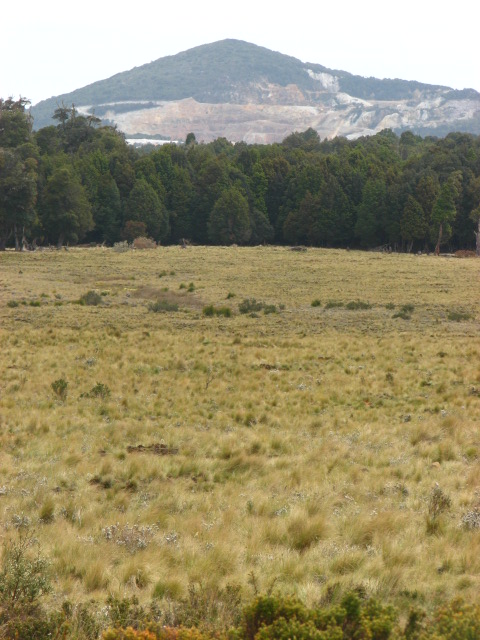
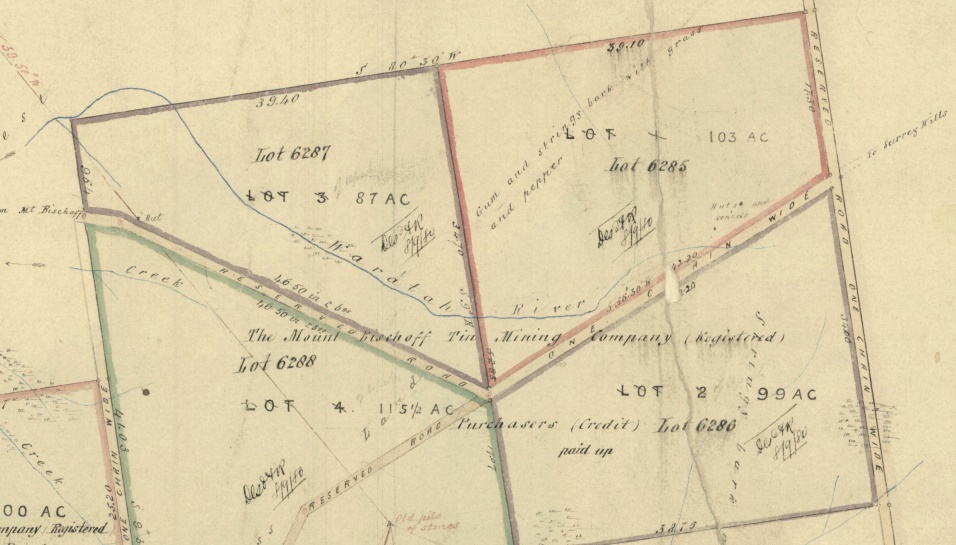
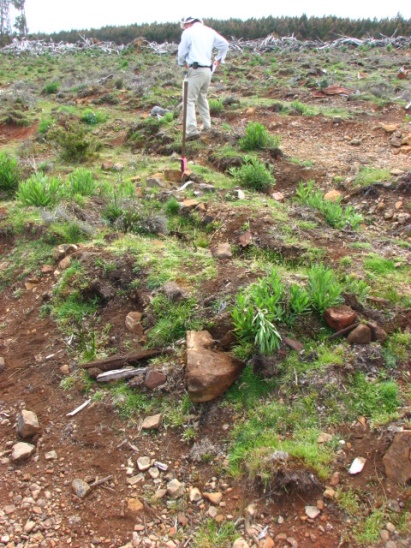
by Nic Haygarth | 18/04/20 | Tasmanian high country history
When it comes to mythology, James ‘Philosopher’ Smith (1827–97), discoverer of the phenomenal tin deposits of Mount Bischoff in north-western Tasmania, has copped the lot. He was a mad hatter who ripped off the real discoverer, didn’t know tin when he saw it, threw away a fortune in shares (didn’t collect a single Mount Bischoff Co dividend) and ended up having to be saved from himself with a government pension.[1] Some of this hot air is still in circulation today—hopefully giving no one Legionnaire’s disease.
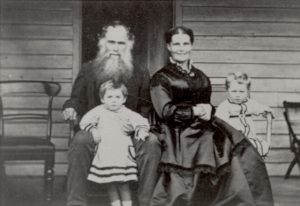
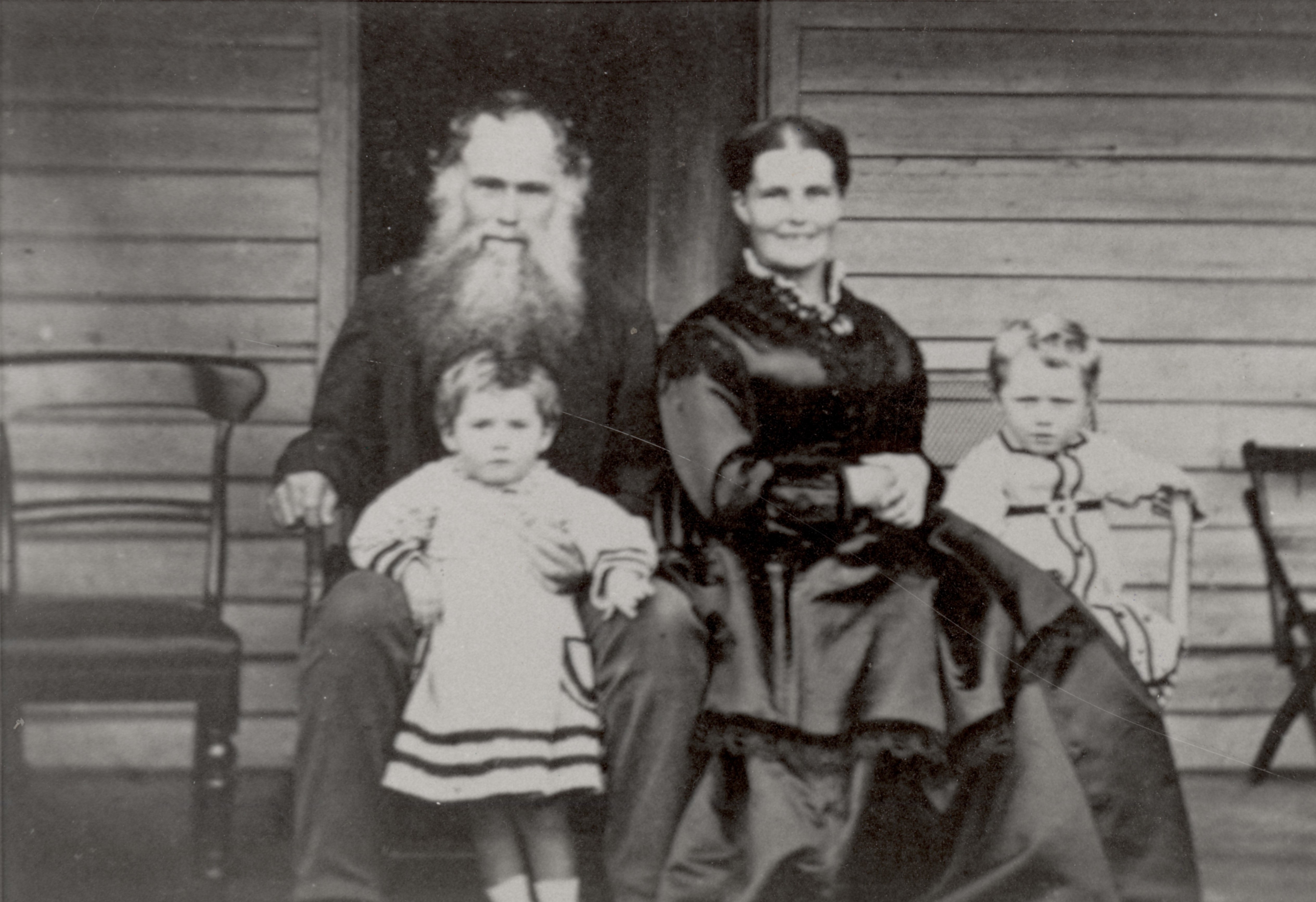
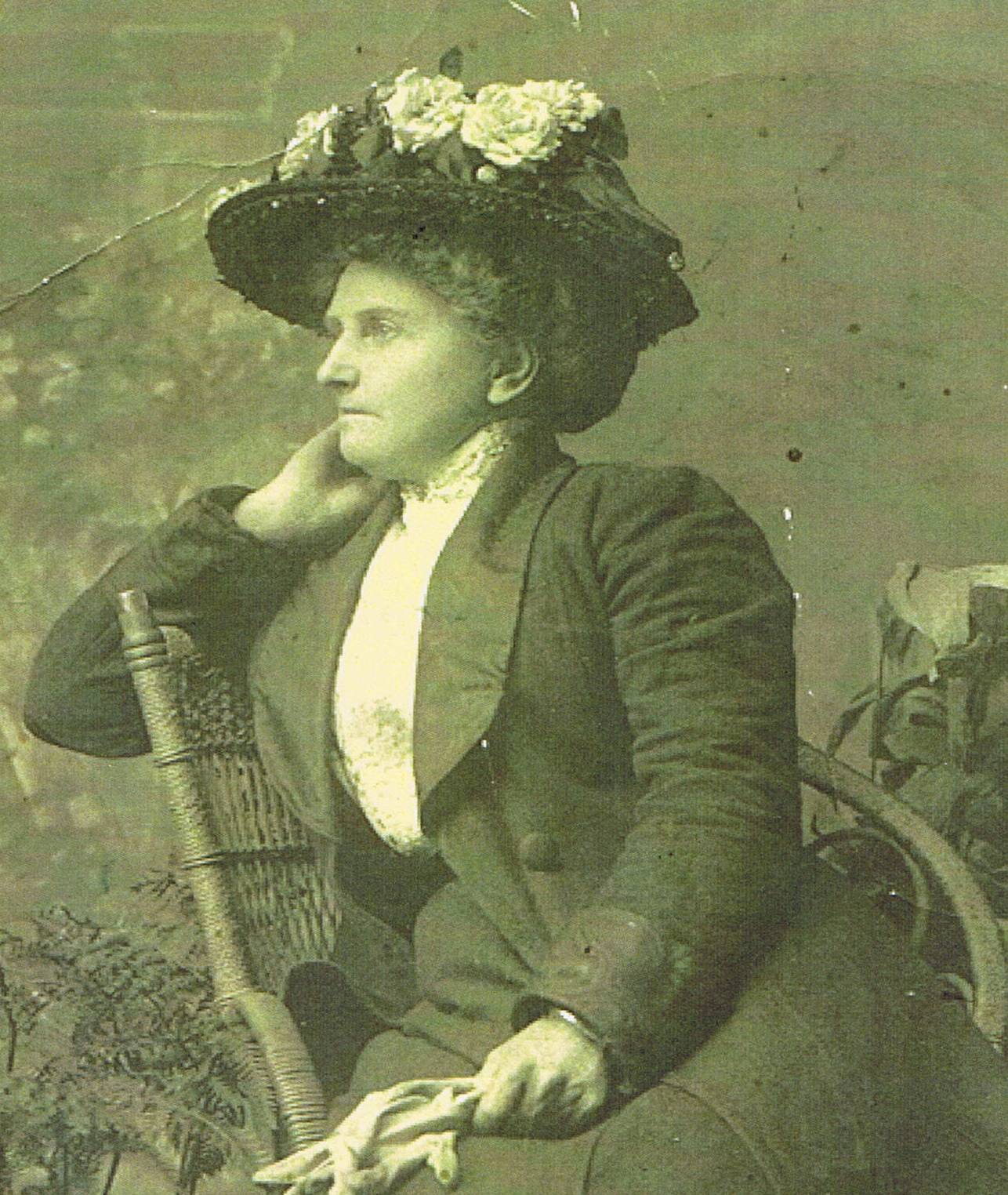
James ‘Philosopher’ Smith, wife Mary Jane and children Annie (left) and Leslie (right) at their near the Forth Bridge, 1877 or 1878. Peter Laurie Reid photo courtesy of the late Charles Smith.
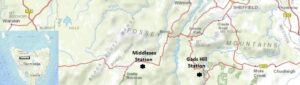
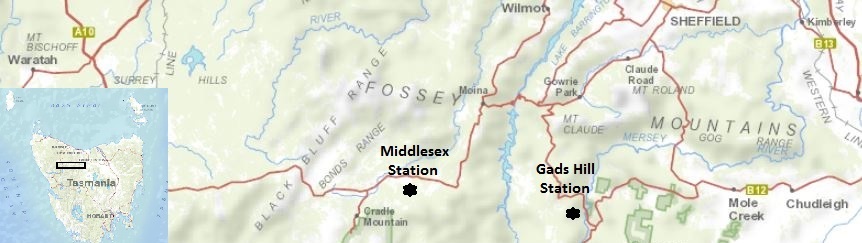
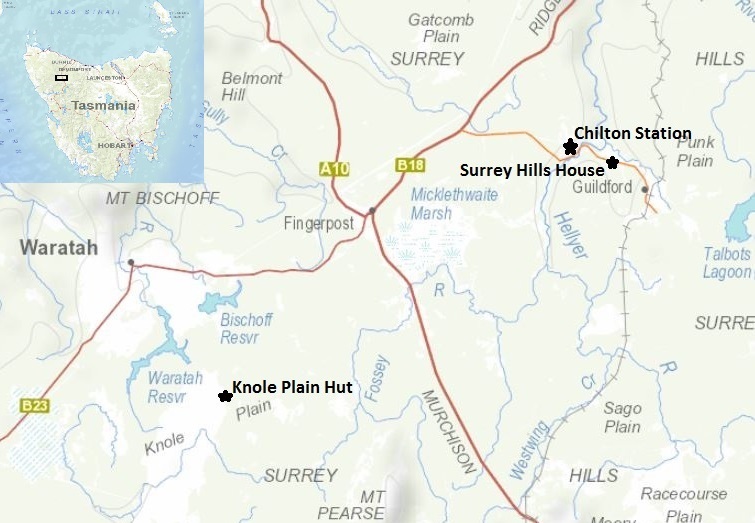
Base map courtesy of DPIPWE.
Unbeknownst to Fields’ Middlesex Plains stockman Jack Francis, he has also been mired in Smythology. My favourite version of how Jack Francis rescued—or might have rescued, given the chance—Philosopher Smith during his Mount Bischoff expedition is this published poem by E Slater:
‘How Mount Bischoff was found’
Philosopher Smith was full of go,
He tried lots of times to get through the snow,
With his swag on his back he was not very slow,
And he crawled through the bush when his tucker was low.
So he had to turn back, to Jack Francis he came,
To the stockriders’ hut on Middlesex Plains,
I was in the hut when the old man came in,
And gave him some whisky, I think it saved him.
He told us quite plain that the tin it was there,
So he never gave in, or did not despair,
He got some more tucker and went out again,
This time he found Bischoff (it was teeming with rain).[2]
Not content with having Francis save a teetotaller with a bottle of whisky, this bold author decided to mooch in on the tall tale and make himself the saviour. The poem continues, inexplicably, to describe Smith’s triumphant return from Bischoff to the Middlesex Hut after finding the tin and his exit right via Gads Hill and Chudleigh.
Why would Smith take that circuitous route home? At the time, he owned the property Westwood at Forth, but he was also renting land at Penguin while he was involved in opening up the Penguin Silver Mine.[3] At least one author has claimed that Smith’s definitive prospecting expedition was mounted from Penguin up the Pine Road he had had cut in 1868 to enable piners to exploit the forests at Pencil Pine Creek near Cradle Mountain.[4]
However, in his notes Smith made it clear that he travelled from Forth via Castra, the logical route from Westwood to the gold-bearing streams of the Black Bluff Range and the mineralised country around the Middlesex Plains. His main plan was to test the headwaters of the Arthur River for a gold matrix, in support of which he had had a stash of supplies packed out to the base of the Black Bluff Range.
And so, according to Tasmania’s late-nineteenth-century Book of Genesis, James Smith unearthed hope and prosperity in the form of tin at Mount Bischoff on 4 December 1871. What Smith’s notes tell us is that, after a week of work at Mount Bischoff, he ran out of food and—with apologies to those who have claimed he ate his dog[5]—retreated to the hut of Field’s Surrey Hills stockman-hunter Charlie Drury to beg a feed. Drury, not Francis, was the stockman Smith recalled meeting during his Mount Bischoff expedition.[6]
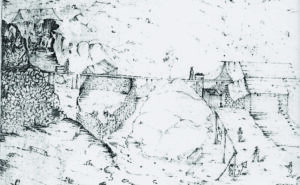
Action from the
Slaughteryard Gully Face of the Mount Bischoff Tin Mine, c1876, showing the yarding and slaughter of stock reflected in its name. Courtesy of the late Charles Smith.
Regardless of Jack Francis’s non-glorification in the discovery of Bischoff, the tin mine brought a benefit to the denizens of Middlesex Station. The advent of the town of Mount Bischoff (Waratah), from about 1873, brought them closer to civilisation. However, there was no Mount Bischoff Tramway until 1877, and in its early days the town had no resident doctor. This meant that when a kick from a horse broke Jack Francis’s thigh at Middlesex in 1875, the nearest medical help was the unqualified ‘Dr’ Edward Brooke Evans (EBE) Walker of Westbank, Leven River (West Ulverstone). The round trip from the coast to Middlesex Station via the VDL Co Track—about 240 km—must have taken several days each way. ‘I had a nice jaunt to Middlesex’, Walker reported,
‘JT Field wrote asking me to go there to see a poor fellow a stock rider who had broken his thigh eight weeks before offering me £10!! to go there … I had to break it as it was 4 inches [9 cm] too short … I wrote and told him [JT Field] that he ought to supplement his offer but have had no answer … ‘[7]
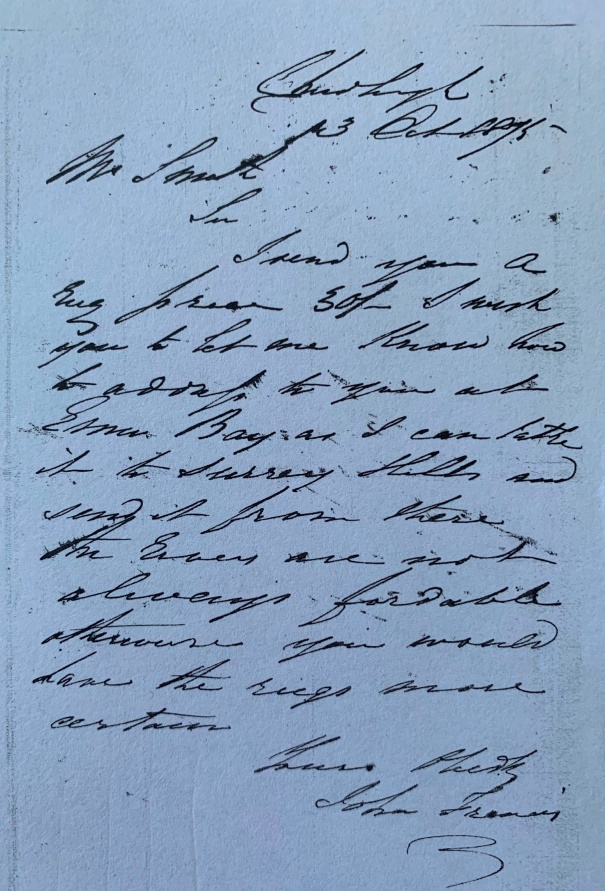
Despite the pain, Jack—and/or his wife Maria Francis—made good use of this ‘down’ time, assembling a 30-shilling possum skin rug. ‘The rivers are not always fordable otherwise you would have the rugs more certain’, Jack told a customer, Van Diemen’s Land Company (VDL Co) local agent James Norton Smith.[8] He could ride, but for years the thigh injury still prevented him from walking far. In 1881 he asked the VDL Co to give him free passage to Waratah on the company’s horse-drawn tramway, enabling him to ride there after hitching his horse at the Surrey Hills stop.[9]
The establishment of Waratah also raised the Francis family’s social profile. One-time recipients of Her Majesty’s pleasure (they were both ex-convicts) became vice-regal hosts. In January 1878 Jack, Maria and possibly young George Francis put up Lieutenant Governor Frederick Weld at Middlesex Station. Escorted by a young Deloraine Superintendent of Police, Dan Griffin, and guided by Thomas Field, the vice-regal party negotiated Gads Hill on its way to visit the new mining capital—Weld being the first governor since George Arthur to tackle the VDL Co Track.[10] So it was that Jack Francis scored his moment of glory without even tempting the temperate Philosopher.
[1] For Smith finding the Mount Bischoff tin in the hut of stockman Charles Drury (‘Dicey’), see ‘The story of Bischoff’, Advocate, 24 April 1923, p.4. For Smith failing to identify the tin when he saw it, see, for example, Ferd Kayser, ‘Mount Bischoff’, Proceedings of the Australasian Association for the Advancement of Science (ed. A Morton), vol.iv, Hobart, 1892, p.342. For Smith squandering a fortune and having to be saved by the Tasmanian Parliament see, for example, ‘Parliamentary notes’, Launceston Examiner, 21 October 1878, p.2. For Smith ‘not making a cent’ out of Mount Bischoff tin and not collecting a single dividend from the Mount Bischoff Tin Mining Co, see, for example, Carol Bacon, ‘Mount Bischoff’; in (ed. Alison Alexander), The companion to Tasmanian history, Centre for Tasmanian Historical Studies, University of Tasmania, Hobart, 2005, p.243.
[2] E Slater, ‘How Mount Bischoff was found’, Waratah Whispers, no.15, March 1982; reprinted there from ‘an old newspaper cutting’.
[3] Application to register the Penguin Silver Mines Company was gazetted on 23 August 1870. The assessment roll for the district of Port Sorell for 1870 lists Smith as the occupant of a hut on 47 acres at Penguin owned by Thomas Giblin of Hobart (Hobart Town Gazette, 22 February 1870, p.298).
[4] See ‘Penguin old and new: record of great development’, Weekly Courier, 17 December 1927, p.35.
[5] See, for example, ‘Nomad’, ’Correspondence: Philosopher Smith’, Circular Head Chronicle, 25 May 1927, p.3.
[6] James Smith notes, ‘Exploring’, NS234/1/14/3 (TAHO).
[7] EBE Walker to James Smith, 8 July 1875, NS234/3/1/4 (TAHO).
[8] Jack Francis to James Norton Smith, 13 October 1875, VDL22/1/5 (TAHO).
[9] Jack Francis to James Norton Smith, 11 April 1881, VDL22/1/9 (TAHO).
[10] ‘Vice-regal’, Tribune, 28 January 1878, p.2; ‘DDG’ (Dan Griffin), ‘Vice-royalty at Mole Creek’, Examiner, 15 March 1918, p.6.
by Nic Haygarth | 03/04/20 | Story of the thylacine, Tasmanian high country history
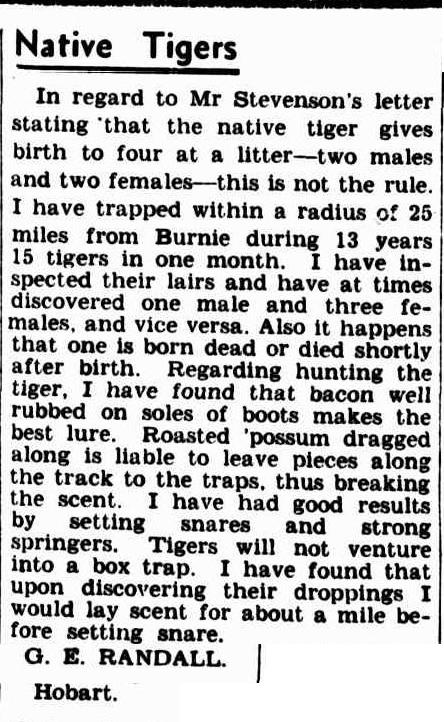
In 1945 one-time wrestler George Randall (1884–1963) recalled catching fifteen thylacines in the space of a month within 25 miles (40 km) of Burnie. He didn’t smother them in a bear hug. Randall reminisced that, upon finding tiger scats, he would lay a scent for half a mile from that point to his snares. The cologne no tiger could resist was actually the smell of bacon rubbed onto the soles of his boots.[1]
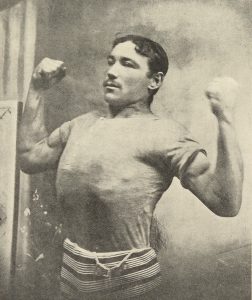
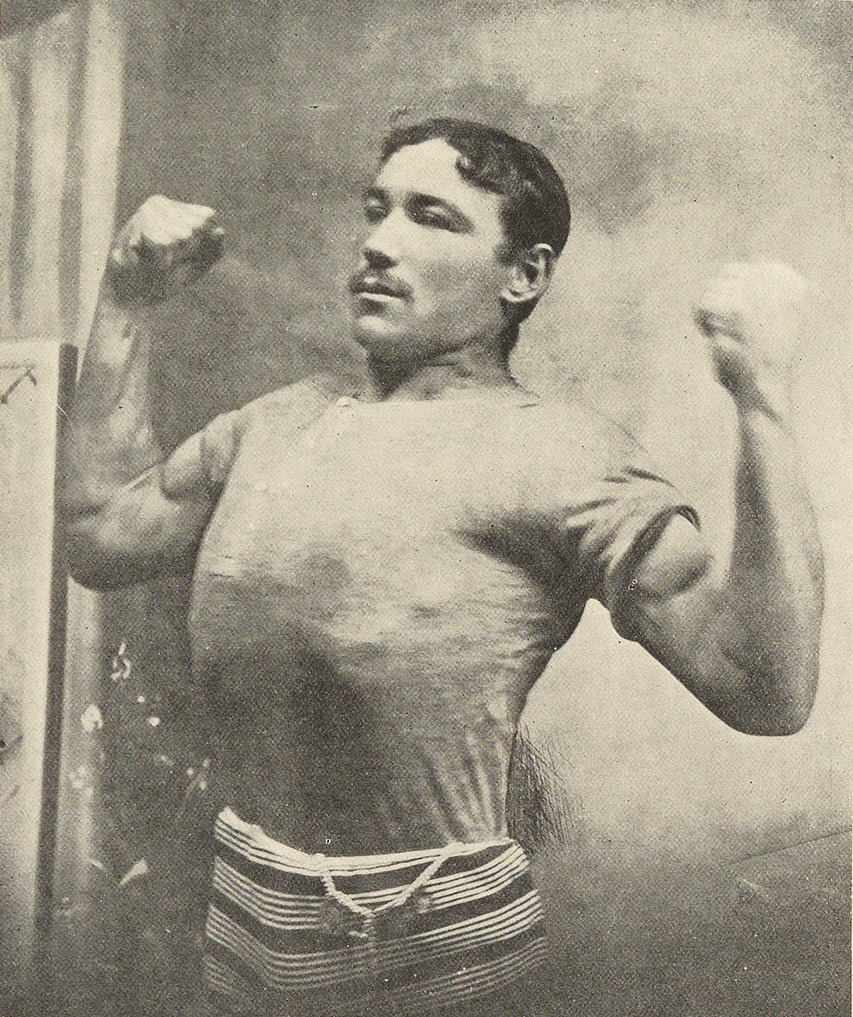
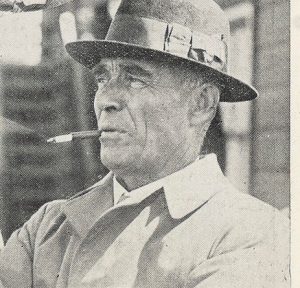
Champion wrestler George Randall, from the Weekly Courier, 18 February 1909, p.18.
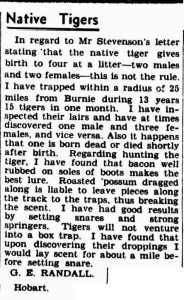
George Randall in the Mercury, 12 December 1945, p.3.
Fifteen tigers—a big boast indeed. I was suspicious of those numbers. Who was Randall, and if he was such an ace tiger killer why had he never claimed a government thylacine bounty? Government bounties of £1 for an adult tiger and 10 shillings for a juvenile were paid in the years 1888 to 1909, after all, plenty of time in which he could leave his mark. The production of a carcass at a police station was the basis for a bounty application.
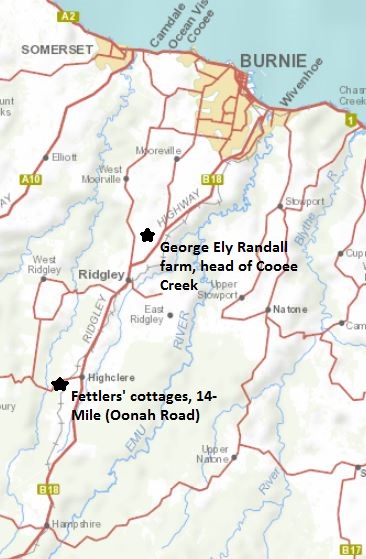
Randall was born at Burnie to George Ely Randall (1857–1907) and Emily Randall, née Charles (1871–1938).[2] By 1891 his father George Randall senior was a ganger maintaining the Emu Bay Railway (EBR) at Ridgley, south of Burnie. There were some tigers about, and it didn’t take much effort to find some Randalls killing one. In May 1892 Tom Whitton, who was aware of tigers coming about the gangers’ camp at night, set some snares and caught a large male. Two Randalls, George senior and his brother Charles, plus a fettler named Ted Powell, were at hand to help throttle the beast.
Wellington Times editor Harris added: ‘The tiger’s head was inspected by a large number of persons up to yesterday, many of whom remarked that they had never seen larger from a native animal; but yesterday the head had to be thrown away as it was manifesting signs of decay.’[3]
Thrown away?! So much for the £1 bounty. Perhaps the killers were too bloated on public admission fees to care about the bounty payment.
Another Randall killing came only two months later, when Powell and Charles Randall’s dogs flushed a tiger out of the bush at the 23-Mile on the EBR. Again the body was hauled into Burnie as a trophy.[4] Was a £1 government reward paid?
The government bounty records for the period May–July 1892 show the difficulty of reconciling newspaper reports with official records. There is no evidence of a bounty application having been made for the tiger killed on the EBR on 13 May 1892, but the one destroyed there in the week preceding 12 July 1892 is problematical. Was James Powell, who submitted a bounty application on 8 July, a relation of Ted Powell, the fettler involved in the two killings on the EBR? I could find no record of a James Powell working or residing in the Burnie area at that time, whereas two James Powells in pretty likely tiger-killing professions—manager of a highland grazing run, and bush farmer under the Great Western Tiers—were easily identified through digitised newspaper and genealogical records (see Table 1):
Table 1: Government thylacine bounty payments, May–July 1892, from Register of general accounts passed to the Treasury for payment, LSD247/1/1 (TAHO).
| Name |
Identification |
Application date |
Number |
| G Atkinson |
Probably farmer George Elisha Atkinson of Rosevears, West Tamar |
13 June 1892 |
2 adults[5] |
| A Berry |
Probably shepherd Alfred James Berry, Great Lake, Central Plateau |
21 July 1892 |
1 adult[6] |
| John Cahill |
Farmer/prospector, Stonehurst, Buckland, east coast |
8 July 1892 |
1 adult[7] |
| WF Calvert |
Wool-grower/orchardist William Frederick Crace Calvert, Gala, Cranbrook, east coast |
21 July 1892 |
4 adults[8] |
| J Clifford |
Probably bush farmer/hunter Joseph Clifford of Ansons Marsh, north-east |
12 May 1892 |
1 adult[9] |
| Harry Davis |
Mine manager, Ben Lomond, eastern interior |
31 May 1892 |
2 adults & 1 juvenile[10] |
| CT Ford |
Mixed farmer Charles Tasman Ford, Stanley, north-west coast |
21 July 1892 |
1 adult[11] |
| Thomas Freeman |
Shepherd at Benham, Avoca, northern Midlands |
12 May 1892 |
1 adult[12] |
| E Hawkins |
Shepherd William Edward Hawkins, Cranbrook, east coast |
9 July 1892 |
1 adult[13] |
| E Hawkins |
Shepherd William Edward Hawkins, Cranbrook, east coast |
21 July 1892 |
1 adult[14] |
| Thomas Kaye |
Labourer at Deddington, northern Midlands |
31 May 1892 |
1 adult[15] |
| John Marsh |
John Richard James Marsh of Dee Bridge, Derwent Valley |
27 June 1892 |
1 adult & 1 juvenile[16] |
| W Moore junior |
Bush farmer William Moore junior, Sprent, north-western interior |
13 June 1892 |
1 adult[17] |
| E Parker |
Probably grazier Erskine James Rainy Parker of Parknook south of Cressy, northern Midlands |
27 June 1892 |
2 adults[18] |
| James Powell |
Probably manager, Nags Head Estate, Lake Sorell, Central Plateau, or bush farmer, Blackwood Creek, northern Midlands |
8 July 1892 |
1 adult[19] |
| Charles Pyke |
Mail contractor, Spring Vale, Cranbrook, east coast |
27 June 1892 |
1 adult[20] |
| A Stannard |
Probably shepherd Alfred Thomas David Stannard, native of Mint Moor, Dee, Derwent Valley but thought to have been in the northern Midlands at this time |
21 July 1892 |
1 adult[21] |
| D Temple |
Shepherd David Temple senior, Rocky Marsh, Ouse, Derwent Valley |
21 July 1892 |
1 adult[22] |
| R Thornbury |
Farmer Roger Ernest Thornbury, Bicheno, east coast |
12 May 1892 |
1 adult[23] |
| H Towns |
Farmer Henry Towns, Auburn, near Oatlands, southern Midlands |
20 June 1892 |
1 adult[24] |
The two EBR slayings are not the only known tiger killings missing from the bounty payment record: two young men reportedly snared a live tiger near Waratah at the beginning of May 1892, but the detained animal accidentally hanged itself on its chain in a blacksmith’s shop; while on 22 July 1892 well-known prospector/sometime postman and seaman Axel Tengdahl shot a tiger that broke a springer snare on the Mount Housetop tinfield.[25] (Another July 1892 killing by ‘Bill the Sailor’ Casey at Boomers Bottom, Connorville, Great Western Tiers, was not rewarded until 5 August 1892, a lag of almost a month.[26]) The reasons for the Waratah and Housetop killings going unrewarded are not clear. While Tengdahl was in an inconvenient place to submit a tiger carcass to a police station, he was probably also snaring for cash as well as meat, so would have needed to leave the bush anyway in order to sell his skins to a registered buyer.
Anyway, back to Randall the tiger tamer. We know that young George Randall junior, eight years old in 1892, grew up with his elders hunting and chasing tigers. Then he went out on his own. He claimed that he trapped within a 40-km radius of Burnie for thirteen years, and that sometime during that period, in the space of a month, he killed fifteen tigers. It should be easy enough to figure out when this was. The ten-year-old would have been still living along the EBR with his family and presumably at school in 1894 when his mother was judged to be of unsound mind and committed to the New Norfolk Asylum.[27] In the years 1897–1901 (from the age of thirteen to seventeen) he was an apprentice blacksmith while living with his father at the 14-Mile (Oonah).[28] [29] He was still in the Burnie area in 1902 when he was cutting wood for James Smillie and driving a float for JW Smithies, but in 1903, as a nineteen-year-old, he was an insolvent fettler at Rouses Camp near Waratah.[30]
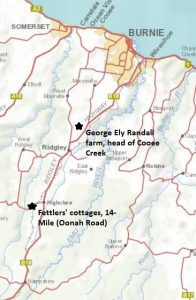
Emu Bay Railway south of Burnie, showing sites that George Randall may have hunted from. Base map courtesy of DPIPWE/
By 1907 Randall was a married man working at Dundas.[31] He did not return to the Burnie region after that, doing the rounds of Tasmania’s mining fields and rural districts for two decades with intermissions at Devonport, Hobart and Hokitika, the little mining port on the west coast of New Zealand’s South Island.[32] At Zeehan he was described as ‘the champion [wrestler] of Tasmania’, and he was noted not as a hunter but as a weightlifter and athlete.[33] More importantly, the blacksmith qualified as an engine driver and a winding engine driver, making him eminently employable in resource industries.[34] Randall finally settled at Hobart in 1929 at the age of 45.[35]
If we consider his Rouses Camp fettling a short aberration, the thirteen-year period in which Randall hunted around Burnie could have been approximately 1894 to 1906, that is, between the ages of ten and 22. The government bounty was available for the whole of this time, so why is there no record of George Randall’s prowess as a tiger tamer?
There are two possibilities. One is that Randall, a born showman, simply lied. The other possibility is that he killed or captured (he doesn’t say which) a lot of tigers but the evidence of same is hard to find.[36] There are few surviving records of the sale of live thylacines to zoos or animal dealers, or of bounty applications made through an intermediary like a hawker or shopkeeper. In some cases suspicion of acting as an intermediary even attaches to farmers—such as Charles Tasman (CT) Ford.
In later life Guildford’s Edward Brown assumed respectability as a breeder of race horses and hotelier. Stephen Spurling III photo from the Weekly Courier, 16 November 1922, p.28.
Randall may have been rewarded for fifteen thylacine carcasses through intermediaries such as shopkeepers, hawkers, skin buyers or some regular traveller to Burnie. Hunter/skin buyers such as Thomas Allen (15 adults and a juvenile, 1899–03)[40] and Edward Brown (7 adults, 1904–05)[41] operated in the Ridgley-Guildford area along the railway line, possibly accounting for some bounty payments for the likes of Randall, ‘Black Harry’ Williams, ‘Five-fingered Tom’ Jeffries and Bill Todd.
However, it does seem extraordinary that fifteen tiger captures or kills within the space of a month escaped public attention. We can assume that Randall never anticipated the scrutiny of his life that digitisation of records now allows us, let alone that someone who read his 1945 letter in the next century would try to dissect his life in order to verify his words. It is likely that Randall guessed that he had hunted in the Burnie region for thirteen years. Perhaps it was ten years, and perhaps his tigers took a lot longer to secure. Perhaps in a trunk in an attic somewhere is a mouldering trophy photo of the wrestler who wrangled tigers—dead or alive.
[1] GE Randall, ‘Native tigers’, Mercury, 12 December 1945, p.3.
[2] Born 1 July 1884, birth record no.1298/1884, registered at Emu Bay; died 14 July 1963, will no.44135, AD960/1/95, p.911 (TAHO), https://librariestas.ent.sirsidynix.net.au/client/en_AU/names/search/results?qu=george&qu=edward&qu=randall#, accessed 28 March 2020.
[3] ‘Capture of a native tiger’, Wellington Times and Agricultural and Mining Gazette, 12 May 1892, p.2.
[4] ‘A big tiger’, Wellington Times and Agricultural and Mining Gazette, 12 July 1892, p.2.
[5] Bounty no.147, 13 June 1892, LSD247/1/1 (TAHO).
[6] Bounty no.207, 21 July 1892, LSD247/1/1 (TAHO).
[7] Bounty no.190, 8 July 1892, LSD247/1/1 (TAHO).
[8] Bounty no.203, 21 July 1892, LSD247/1/1 (TAHO).
[9] Bounty no.118, 12 May 1892, LSD247/1/1 (TAHO).
[10] Bounty no.136, 31 May 1892, LSD247/1/1 (TAHO).
[11] Bounty no.204, 21 July 1892, LSD247/1/1 (TAHO).
[12] Bounty no.119, 12 May 1892; LSD247/1/1 (TAHO).
[13] Bounty no.188, 9 July 1892, LSD247/1/1 (TAHO).
[14] Bounty no.210, 21 July 1892, LSD247/1/1 (TAHO).
[15] Bounty no.135, 31 May 1892, LSD247/1/1 (TAHO).
[16] Bounty no.173, 27 June 1892, LSD247/1/1 (TAHO).
[17] Bounty no.148, 13 June 1892, LSD247/1/1 (TAHO).
[18] Bounty no.172, 27 June 1892, LSD247/1/1 (TAHO).
[19] Bounty no.189, 8 July 1892, LSD247/1/1 (TAHO).
[20] Bounty no.171, 27 June 1892, LSD247/1/1 (TAHO).
[21] Bounty no.206, 21 July 1892, LSD247/1/1 (TAHO).
[22] Bounty no.208, 21 July 1892, LSD247/1/1 (TAHO).
[23] Bounty no.117, 12 May 1892, LSD247/1/1 (TAHO).
[24] Bounty no.151, 20 June 1892, LSD247/1/1 (TAHO).
[25] ‘Waratah notes’, Wellington Times and Agricultural and Mining Gazette, 10 May 1892, p.3; ‘Housetop notes’, Wellington Times and Agricultural and Mining Gazette, 28 July 1892, p.2.
[26] ‘Longford notes’, Launceston Examiner, 14 July 1892, p.2; bounty no.236, 5 August 1892, LSD247/1/1 (TAHO).
[27] ‘Burnie: Police Court’, Daily Telegraph, 7 February 1894, p.1.
[28] ‘Wanted’, North Western Advocate and the Emu Bay Times, 11 July 1901, p.3.
[29] ‘For sale’, North Western Advocate and the Emu Bay Times, 31 January 1902, p.3.
[30] ‘Arson: case at Burnie’, North Western Advocate and the Emu Bay Times, 20 March 1902, p.3; ‘New insolvent’, Examiner, 29 April 1903, p.4.
[31] He married Ethel May Jones on 22 May 1907 at North Hobart (‘Silver wedding’, Mercury, 23 May 1932, p.1). Dundas: ‘To-night at the Gaiety’, Zeehan and Dundas Herald, 7 September 1907, p.3.
[32] Zeehan: Editorial, Zeehan and Dundas Herald, 31 August 1908, p.2; ‘Macquarie district’, Police Gazette Tasmania, vol.48, no.2595, 16 April 1909, p.81; Commonwealth Electoral Roll, Division of Darwin, Subdivision of Zeehan, 1914, p.2. Devonport: Commonwealth Electoral Roll, Division of Wilmot, Subdivision of Devonport, 1914, p.36. Waratah: ‘Waratah’, North Western Advocate and the Emu Bay Times, 17 October 1918, p.2; Commonwealth Electoral Roll, Division of Darwin, Subdivision of Waratah, 1919, p.14. Hobart: Commonwealth Electoral Roll, Division of Denison, Subdivision of Hobart East, 1922, p.30. Mathinna: ‘Personal’, Daily Telegraph, 30 September 1924, p.5. Cygnet: ‘Shooting at electric lines’, Mercury, 28 June 1926, p.4. Taranna: ‘Centralisation of school teaching’, Mercury, 12 May 1927, p.6. Hokitika: ‘Macquarie district’.
[33] Editorial, Zeehan and Dundas Herald, 31 August 1908, p.2; ‘Macquarie district’.
[34] Certificate of competency as second class engine drive, 1916, AA80/1/1, p.424, image 63 (TAHO), https://librariestas.ent.sirsidynix.net.au/client/en_AU/names/search/results?qu=george&qu=edward&qu=randall; Certificate of competency as mining engine driver, 1926, LID24/1/4, pp.109 and 109b (TAHO), https://librariestas.ent.sirsidynix.net.au/client/en_AU/names/search/results?qu=george&qu=edward&qu=randall#, accessed 28 March 2020.
[35] ‘Motor cycle registrations’, Police Gazette Tasmania, vol.68, no.3629, 8 February 1929, p.33.
[36] Randall mentioned using springers, the supple saplings used to ‘spring’ the snare, generally employed in footer snares, which caught the animal by the paw, not being designed to kill it. Many thylacines sent to zoos were captured in footer snares.
[37] Bounties no.365, 31 July 1891 (2 adults); no.204, 21 July 1892, LSD247/1/1; no.402, 9 January 1893; no.71, 27 April 1893 (2 adults); no.91, 5 May 1893; no.125, 19 June 1893; no.183, 24 July 1893, no.4, 23 January 1894 (2 adults); no.239, 22 September 1897 (3 adults, ‘August 2’); no.276, 4 November 1897 (2 adults, ’27 October’); no.379, 1 February 1898 (‘4 December’); no.191, 2 August 1898 (2 adults, ‘7 July’); no.158, 30 May 1899 (’26 May’); no.253, 30 August 1899 (3 adults, ’24 August’); no.254, 30 August 1899 (2 juveniles, ‘24 August’), LSD247/1/2 (TAHO).
[38] Bounties no.43, 27 February 1900 (3 adults, ’22 February’); no.250, 16 August 1900 (5 adults, ’26 July’); no.316, 3 October 1900 (4 adults, ’27 September’); no.398, 15 November 1900 (4 adults and 4 juveniles, ’28 October’); no.79, 13 March 1901 (2 adults, ’28 February’); no.340, 31 July 1901 (7 adults, ’25 July’); no.393, 28 August 1901 (6 adults, ‘2/3 August’); no.448, 3 October 1901 (’26 September’); no.509, 5 November 1901 (’24 October 1901’); no.218, 7 May 1903 (2 adults, ’24 April’); no.724, 17 November 1903 (4 adults); no.581, 21 June 1906, LSD247/1/2 (TAHO).
[39] Woolnorth farm journals, VDL277/1/1–33 (TAHO). The Woolnorth figure for 1900–06 excludes one adult and one juvenile killed by Ernest Warde and for which he claimed the government bounty payment himself (bounty no.190, 20 October 1904, LSD247/1/2 [TAHO]).
[40] Bounty no.374, 12 January 1899 (3 adults, ‘3 December’); no.401, 15 November 1900 (3 adults, ’15 June’); no.482, 21 January 1901 (3 adults, ’17 December’); no.22, 4 February 1901 (3 adults, ‘4 January’); no.985, 25 July 1902 (‘July’); no.1057, 27 August 1902 (’15 August’); no.1091, 17 September 1902 (‘4 September 1902’); no.462, 6 August 1903, (1 juvenile, ’24 July’), LSD247/1/ 2 (TAHO). See ‘Burnie’, North Western Advocate and the Emu Bay Times, 15 December 1900, p.2.
[41] Bounty no.233, 16 June 1904 (5 adults); no.125, 28 September 1905 (2 adults, ’31 August and 8 September’), LSD247/1/2 (TAHO).
by Nic Haygarth | 15/03/20 | Tasmanian high country history
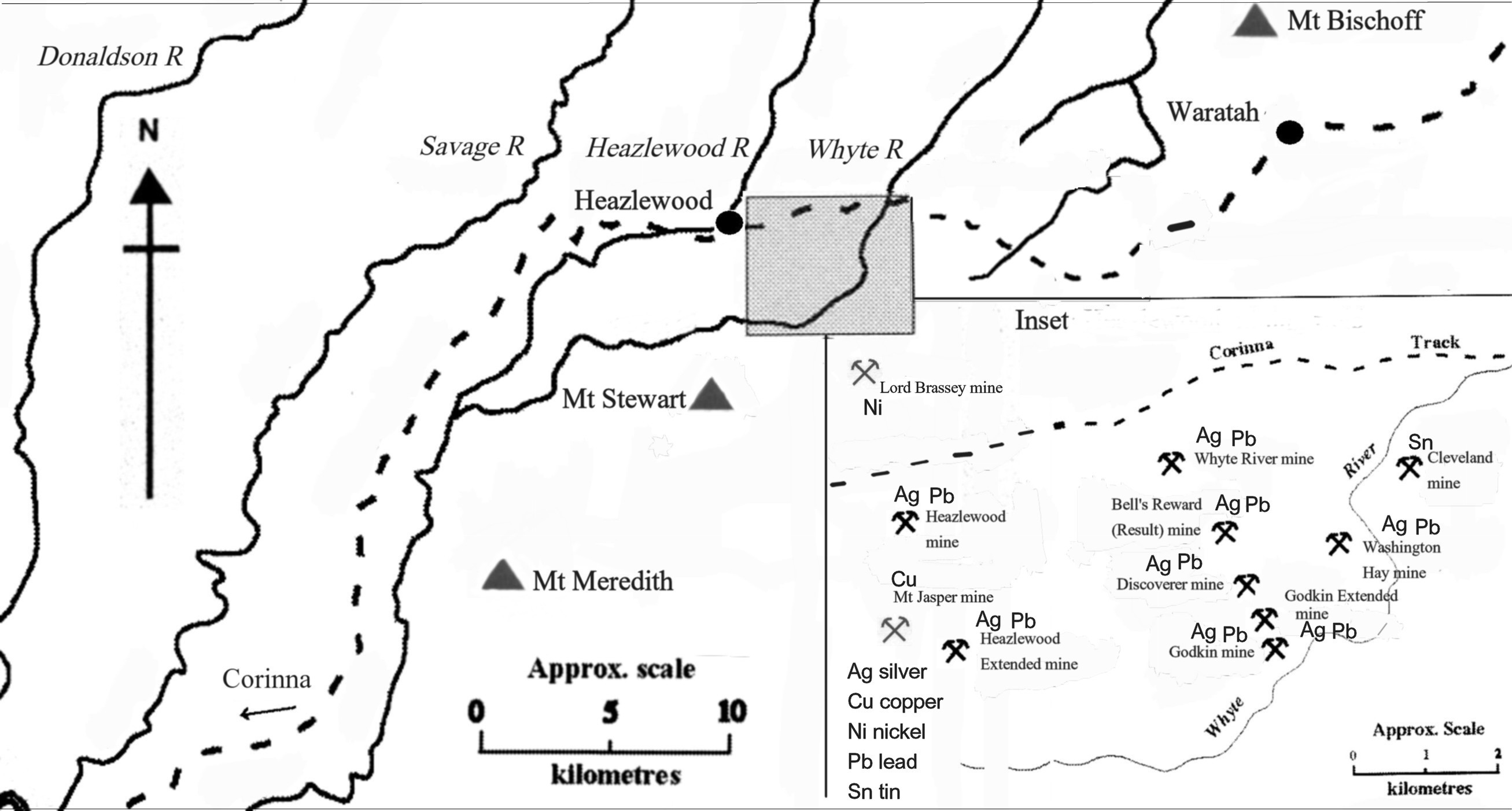
In 1891 the Godkin Silver Mining Company (GSM Co) spent about £7000 building a horse-drawn tramway to service its mine before the value of the property was even established. Its mine manager, Arthur Richard (AR) Browne, was more interested in installing machinery at the property 13 miles (21 km) south-west of Waratah. He wanted the Godkin to not only control the mining field’s transport but to be its custom smelter.[i] The GSM Co’s early half yearly reports are a litany of grand installation plans fed by Browne’s delusional ore values: £10,000 worth of ore were said to be on the claim in September 1890; £70,000-£80,000 worth in March 1891.[ii]
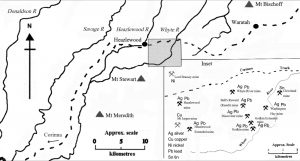
The mines on the 13-Mile silver field west of Waratah, Tasmania. The site of the village of Heazlewood on this map is the original site on the Heazlewood River. The village was later re-established further east. Base map drawn by the late Glyn Roberts.
However, the September 1891 report, tabled when Browne was on sick leave, painted a sobering picture of the mine. Only 27 tons of silver and lead ore from the southern section had been sold, for a profit of £218—not much of a return on the £7000 tramway.[iii] Directors were nervous.[iv] Notably, no banquet was called to celebrate completion of the second, 4-km-long stage of the Godkin Tramway to the Arthur River, which was tipped to occur in October 1891. No announcement of the achievement was ever made. Since the tramway never reached Waratah, it is safe to say that none of the construction costs were defrayed by hauling freight for other mining companies.
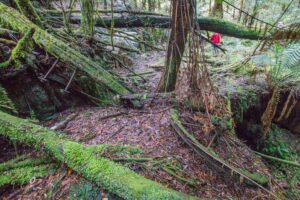
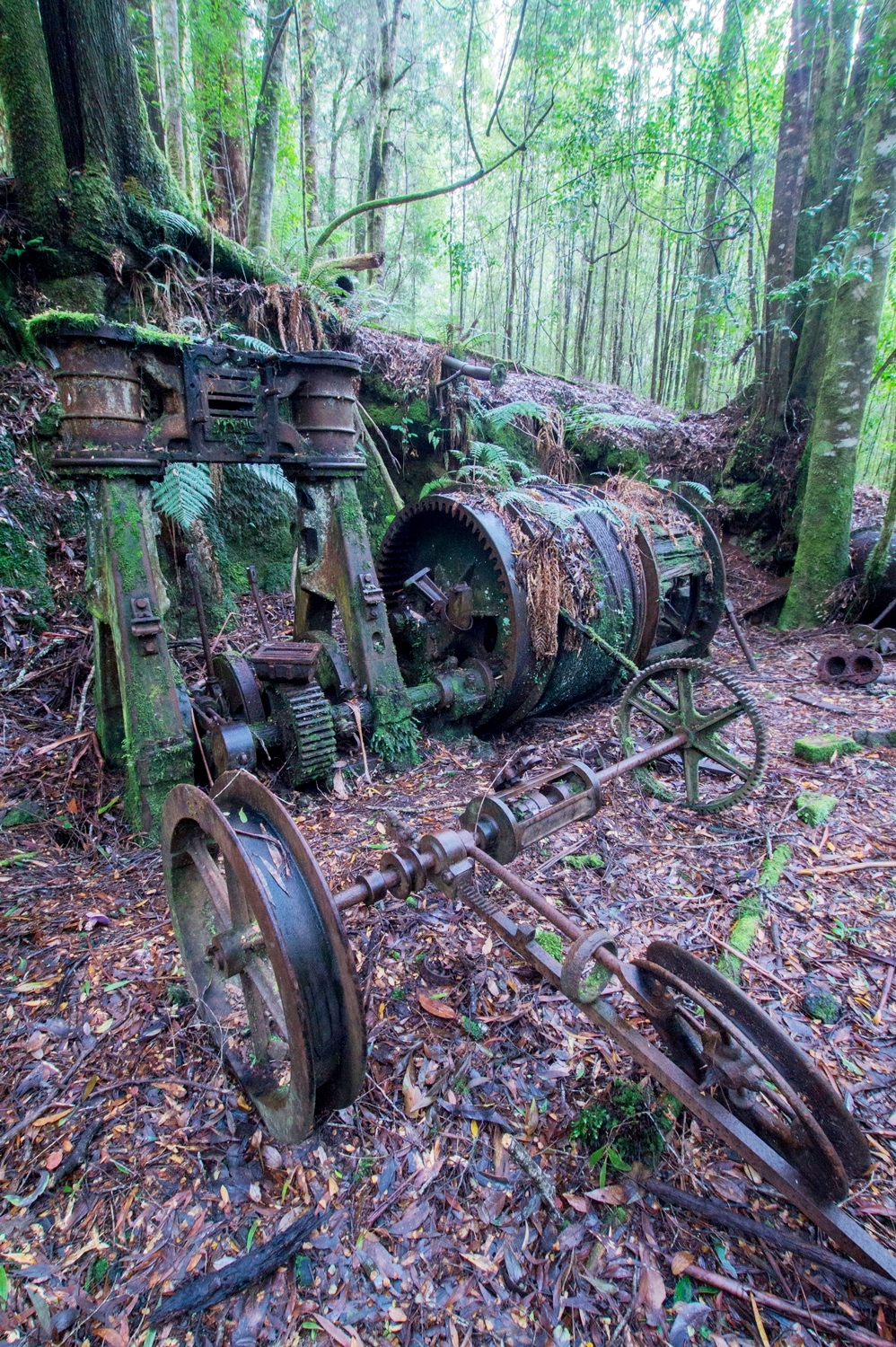
Remains of the headframe and flywheel at the South Godkin Shaft. Nic Haygarth photo.
Browne never returned to the Godkin, reportedly resigning in protest at directorial preference for tramway construction. His preference remained not proving the mine, but smelter building.[v] His last hurrah, delivered vicariously by Chairman of Directors TC Smart at the February 1892 half yearly meeting, was to compare the Godkin with Broken Hill mines and to continue to press for a smelter. Smart kept up the rhetoric, declaring in September 1892 that no Broken Hill mine had produced such rich ore at such a shallow level.[vi] When Browne returned to Tasmania in January 1893, it was as the Burnie agent for the Queensland Smelting Company, which envisaged buying ores from the new Tasmanian silver fields at the 13-Mile and Zeehan.[vii] Browne must have died an optimist in 1900 when, at the age of only 34, after stints at mines in Western Australia and British Columbia, he succumbed to asphyxia at the London home of his father, Lord Richard Browne.[viii]

The North Godkin Shaft today: pumps and windlass. Worthington pumps and a collapsed horse whim also help tell the story of the mine’s development and de-evolution. Nic Haygarth photo.
Despite securing another Broken Hill mining manager, Nathaniel Hawke, the GSM Co was already doomed.[ix] It had spent about £26,000 for a return of less than £300 when in 1892 government geologist Alexander Montgomery reported that it was no closer to success than when it started, having no payable ore on hand and needing to conduct deep sinking to prove its claim.
Montgomery also offered a cheaper alternative to deep sinking, but it was one which could never be definitive: driving a 1200-metre-long drainage tunnel from the Whyte River through both southern and northern leases to meet the engine shaft in the northern lease. While still working the upper, oxidised zone, this would test the entire property at a deeper level as well as drain it. The estimated cost of £2500–£3000 was well beyond the means of the GSM Co during tough economic times, and it succumbed to creditors in May 1894.[x] The surveyed township reserve of Stafford near the South Godkin site was never needed.
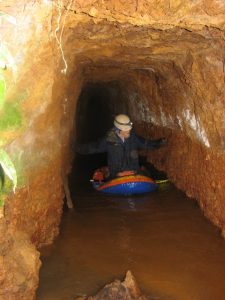
Paul Darby brown water rafting in Godkin Adit no.5. Nic Haygarth photo.
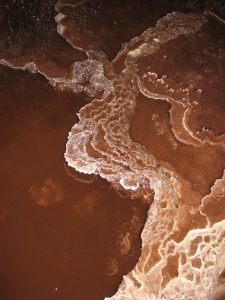
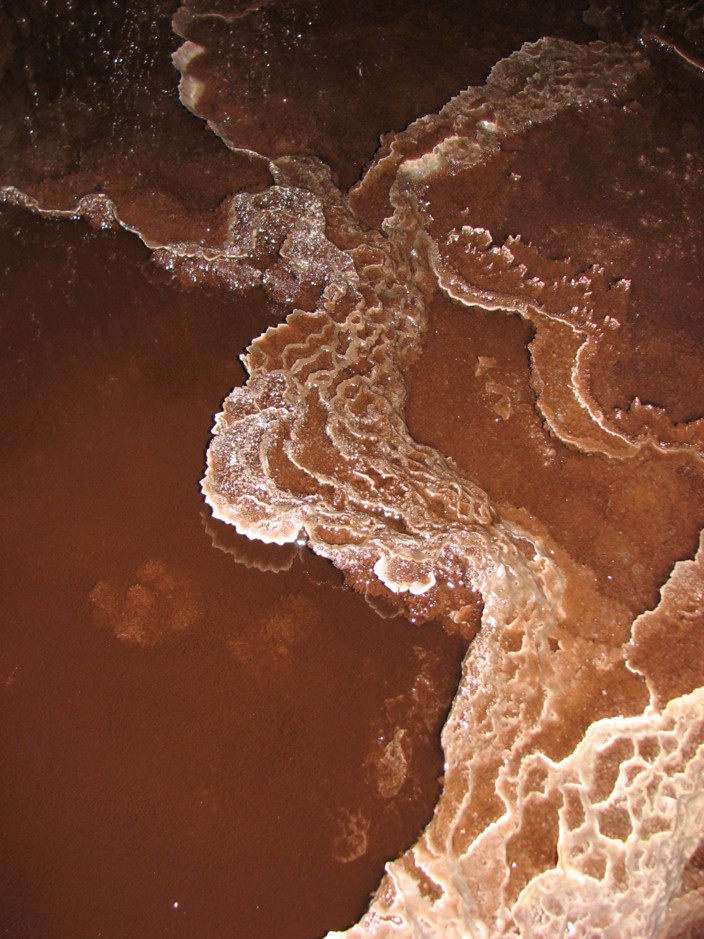
Gour pools in the Washington Mine Main Adit. A mixture of limestone and other minerals gives the 13-Mile mine workings rich calcite formations. Nic Haygarth.
The 13-Mile field today
The subsequent history of the 13-Mile mines is a typical one of de-evolution, both financial and technological. In the case of the Godkin, under-capitalised companies forced to revert to basic technology sought to exploit a lode that a heavily capitalised company had failed to even prove. The Victorian Magnet Company, which in 1912 completed the 1200-metre-long drainage tunnel, worked the North Godkin shaft using not a steam engine but a horse whim for motive power.[xi] By 1923 this company still used the Godkin Tramway to access the mine from the Corinna Road at Whyte River, but had converted it into a sledge track, the wooden rails having been torn up decades before in order to help build the nearby Whyte River Hotel.[xii] None of the 13-Mile mines was tested at depth until Electrolytic Zinc drilled the North Godkin site, Bell’s Reward, Discoverer and Godkin Extended in 1949—and the South Godkin Mine site remains undrilled to this day.[xiii] The likely presence of zinc in the Godkin’s pre-1917 finger dumps (that is, mullock that pre-dates the separation of zinc in Tasmania by the electrolytic process) and the possible presence of tin threaten to disturb what can now be seen as a fine historical mining interpretation site.
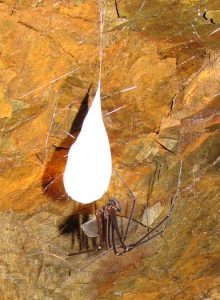
Hickmania troglodytes, Tasmanian cave spider with egg sac, Washington Hay Lower Adit. Nic Haygarth photo.
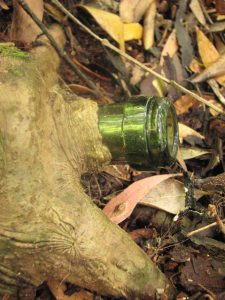
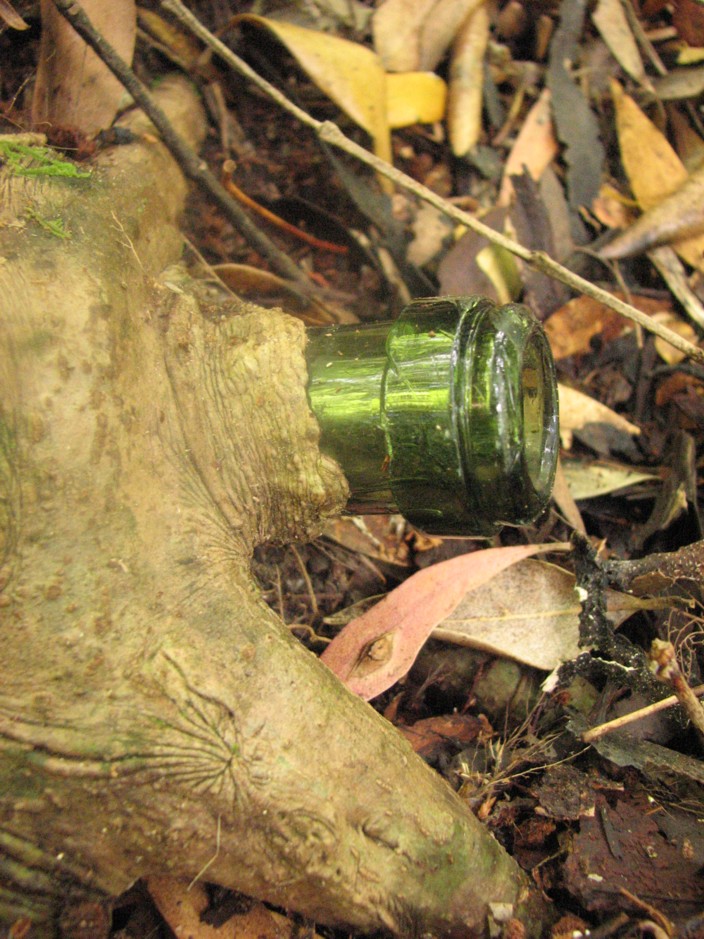
Well-rooted bottle, Godkin Mine. The tree root has grown around this discarded bottle over the course of nearly 130 years. Nic Haygarth photo.
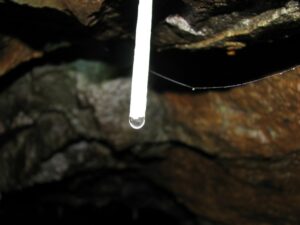
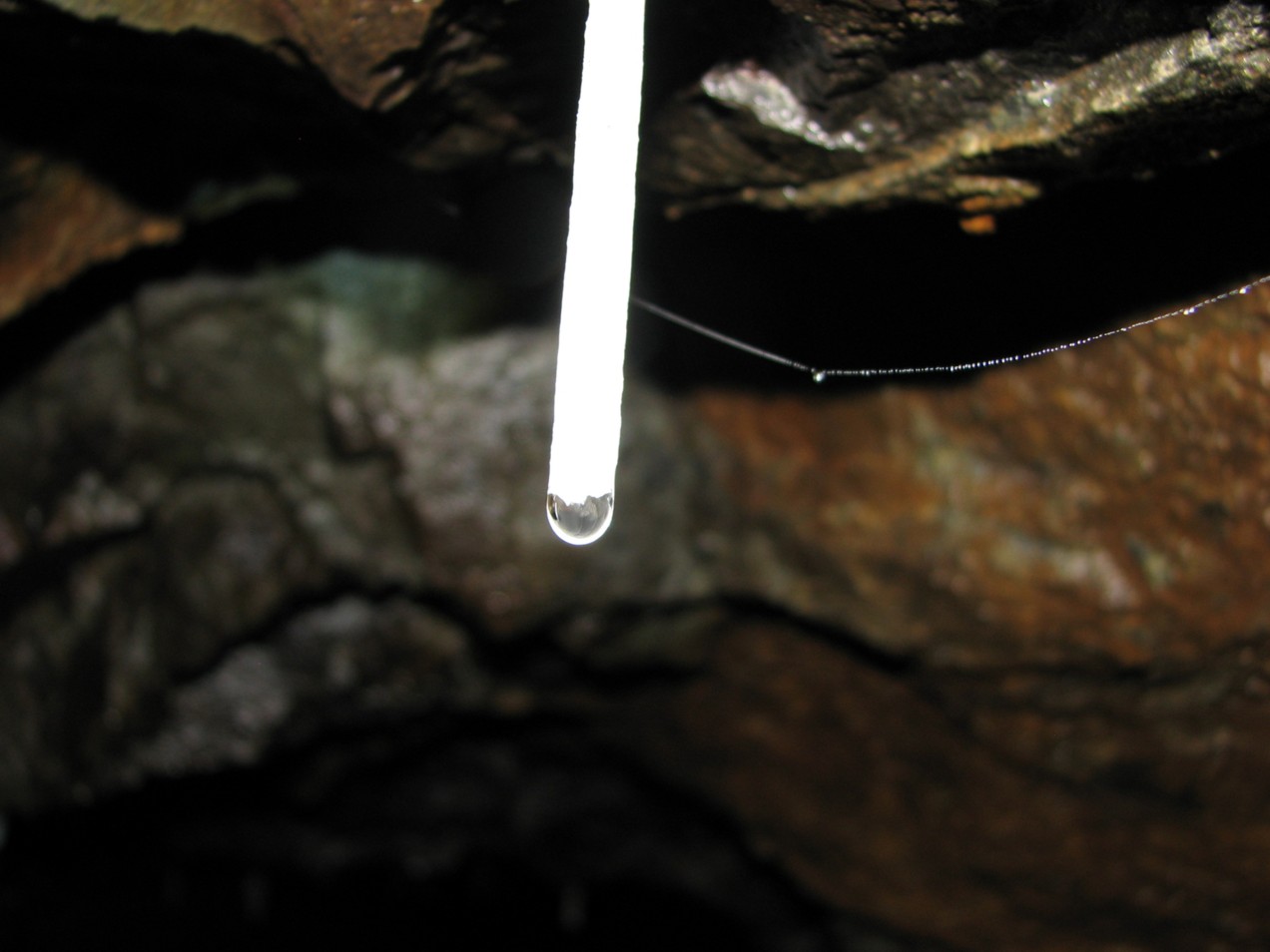
End of a calcite straw in one of the Godkin adits. Nic Haygarth photo.
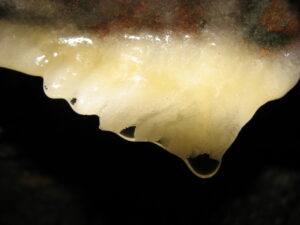
Calcite shawl in one of the Godkin adits. Nic Haygarth photo.
Aside from pilfering by visitors, the 13-Mile field has remained largely undisturbed for almost a century. With so many artifacts still in place and with more than 50 adits, shafts and other workings, this is one Tasmania’s most impressive mining heritage sites. The expenditure demonstrated by the Godkin and Godkin Extended Tramways (1889–92), Cornish boiler (1891), blacksmith’s shop, ship’s tank, steam pumps, windlass, flywheel and head frame tell the tale of a fanatical response to the Broken Hill silver boom of 1888, while the horse whim at the North Godkin shaft recalls the technological reversal of later years. Similarly, the main tramway, with its in places corduroyed formation, bridge ruins, discarded iron wheels, axles, sledge artifacts and branch tramways to other mines, demonstrates not only the GSM Co’s efforts to capitalise on the mining field’s transport needs, but the de-evolution of the Godkin.[xiv]
[i] ‘Meeting of the company’, Mercury, 8 January 1891, p.3.
[ii] ‘Meeting: Godkin SM Co’, Mercury, 26 September 1890, p.3; ‘Godkin SM Co’, Mercury, 26 March 1891, p. 3.
[iii] The company would sell only seven more tons of ore, to Kennedy and Sons and the Clyde Works in Sydney, in 1892.
[iv] ‘Godkin Silver Mining Co’, Mercury, 29 September 1891, p.4.
[v] ‘The Godkin Mine’, Launceston Examiner, 5 November 1891, p.4.
[vi] ‘Meetings: Godkin SM Co’, Mercury, 1 October 1892, supplement, p.1.
[vii] GVS Dunn to JW Norton Smith, Van Diemen’s Land Company, 31 May and 10 June 1892, VDL22/1/23; Arthur R Browne to JW Norton Smith, Van Diemen’s Land Company, 24 January 1893, VDL 22/1/23 (TAHO).
[viii] ‘Queenstown notes’, Zeehan and Dundas Herald, 12 May 1900, p.4; ‘Sudden death of Lord Richard Browne’s son at Reigate’, Sussex Agricultural Express, 28 April 1900, p.10.
[ix] Little is known of Hawke’s performance, but his ability to defend himself with a gun prompted a conviction for assaulting the mine’s dismissed engineer in August 1892 (editorial, Zeehan and Dundas Herald, 12 August 1892, p.2).
[x] Alexander Montgomery, Report on the Godkin Silver Mine, Geological Surveyor’s Office, Launceston, 1892, p.3; advert, Launceston Examiner, 14 May 1894, p.2.
[xi] Secretary of Mines Annual report for 1912, 1913, p.37.
[xii] Nye, The silver-lead deposits of the Waratah district, p.118.
[xiii] DI Groves, The geology of the Heazlewood–Godkin area, Department of Mines, Hobart, 1966, pp.37–39; Allegiance Mining, EL 14/2001 Heazlewood Area, Tasmania: partial relinquishment report, 2002, p.20.
[xiv] See also Parry Kostoglou, An archaeological survey of the historic Godkin Silver Lead Mine, Archaeological Survey Report, 1999/03, Mineral Resources Tasmania, Hobart, 1999.
by Nic Haygarth | 15/03/20 | Tasmanian high country history
Tasmania has produced some disastrous mining ‘bubbles’. Stamper batteries and water wheels were rushed to the ‘Cornwall of the Antipodes’, the Mount Heemskirk tin field, in the early 1880s.[i] In the following decade the hydraulic gold craze crossed the Tasman Sea from Otago, while in 1910–12 the discovery of a so-called second Mount Lyell mine was celebrated in the Balfour copper boom. All of these were spectacular failures.
The ‘Broken Hill of Tasmania’ was another case of catastrophic piggybacking.[ii] It began in 1885 with prospector WR Bell returning to Tasmania from an exploratory tour of the Barrier Ranges silver field—later to become famous as the Broken Hill field—in western New South Wales. Bell put his Broken Hill experience to good use at home in the next five years, making a series of silver, galena and lead discoveries.[iii]
The mines on the 13-Mile silver field west of Waratah, Tasmania. The site of Heazlewood as marked on this map is the original site on the Heazlewood River. The village was later re-established on the 13-Mile field. Base map drawn by the late Glyn Roberts.
Among them was the Bell’s Reward mine on what became known as the 13-Mile silver lode, since it was 13 miles (about 21 km) west of Waratah, in Tasmania’s west coast mining province. However, it was the adjacent Godkin Mine that grabbed the headlines—and shareholders’ wallets—when in 1888 the Broken Hill silver boom reverberated across Tasmania. Never was there a better example of needless infrastructure spending before a mine was proven, or of the blinding effect of ‘mining fever’, than the Godkin.
Broken Hill invigorates the Tasmanian silver mines
In June 1887 Bell and his friend and business partner James ‘Philosopher’ Smith were granted 20-acre reward leases at what became known as the Bell’s Reward and Discoverer Mines respectively.[iv] Axes rang in the forest and cross-cut saws echoed in sawpits as a new mining village known as Heazlewood was established. Myrtle timber served for mining props, rails, building timber and firewood. Within a few years, five mine managers, two carpenters, a sawyer, a constable, a baker, a bank manager, three other storekeepers, a cricket team, hoteliers Joe and Emma Jupp and a branch of the Amalgamated Miners’ Association all called Heazlewood home.[v]
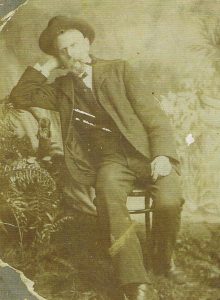
Insatiable prospector and innkeeper Josiah Jupp of the Heazlewood Hotel. Courtesy of Debra Talbot.
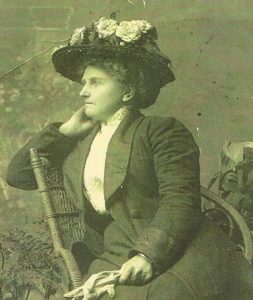
Mistress of the Heazlewood Hotel, Emma Jupp, equalling her husband in studio presentation. Courtesy of Debra Talbot.
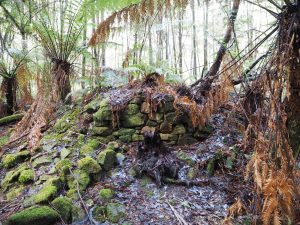
Probable remains of the Heazlewood Hotel in 2016. Paul Darby photo.
Other prospectors arrived on the 13-Mile, including 23-year-old New Norfolk prospector Norman Godkin, representing the Dunrobin Prospecting Association.[vi] A touring phrenologist, Professor Klang, claimed to have divined Godkin’s suitability to a mining career from reading the bumps on his head, vocational advice which his customer adopted.[vii] Working south from the Bell’s Reward, Godkin found a gossan outcrop close to the northern side of a small tributary flowing into the Whyte River. The Godkin Mine was born.
Since Broken Hill was the model for development at the 13-Mile, the services of a Broken Hill manager were deemed essential. The Bell’s Reward syndicate rejected Lane, manager of the Block 14 Company mine at Broken Hill, after he demanded a salary of £2000 per year, plumping instead for Edgar L Rosman, former mine manager for the Broken Hill Proprietary itself.[viii] The pedigree of Arthur Richard (AR) Browne, the Godkin Silver Mining Company’s (GSM Co’s) Broken Hill man, was even more impressive. The English-born nephew of the Marquis of Sligo, he was educated at the Freiberg School of Mines, Saxony.[ix] Significantly, neither of these men had experience of Tasmanian geology, geography, climate, terrain or transport infrastructure.
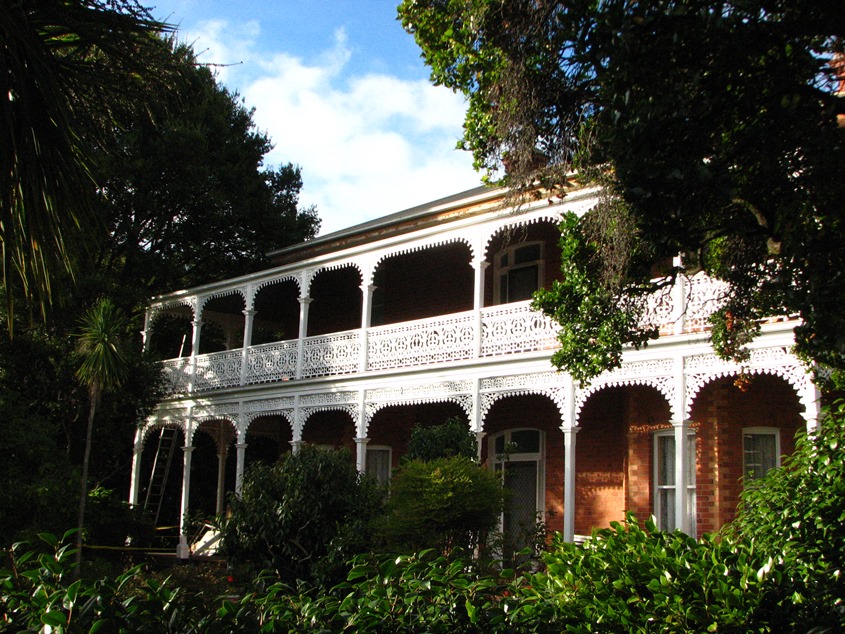
In 1891, only months before a severe economic downturn, Bell and Smith floated the Bell’s Reward and Discoverer mines, pocketing £3000 each from their sale.[x] The shareholders of the Bell’s Reward Silver Mining Co, an under-capitalised, privately subscribed Melbourne company, grew dispirited in 1893 after two years of fruitless work when water burst into a crosscut, flooding the main shaft.[xi] By then the true meaning of the Bell’s Reward was apparent on the hill above Burnie, where Bell had used his share of the proceeds to raise Glen Osborne, still one of the city’s finest homes. This remains the second most impressive product of the 13-Mile field, albeit physically distant from the mines themselves.
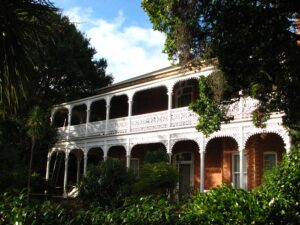
Glen Osborne, WR Bell’s home on the hill at Burnie. Nic Haygarth photo.
Tramway to nowhere
The most impressive product of the 13-Mile field was the Godkin Tramway. Having raised much more money than any of the neighbouring mines, the GSM Co was able to exercise its delusions of grandeur. During winter the dray track between Waratah and the 13-Mile mines was a sea of mud. Possibly with Broken Hill’s Silverton Tramway in mind, the GSM Co took matters into its own hands. The well-known Huon timber tramway builder known as John Hay no. 2 (junior) was engaged to deliver the mine from isolation. He surveyed and built the 3-foot-6-inch gauge horse-drawn wooden-railed Godkin Tramway at a cost of about £7000, the wide gauge having been chosen to connect the line with the Van Diemen’s Land Company railway from Waratah to the port of Burnie.[xii] The Godwin Tramway Act (1891) empowered the company to charge neighbouring companies for freight on the line, potentially placing it in a position to dominate the mining field.
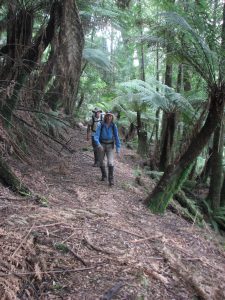
The Godkin Tramway formation today. Nic Haygarth photo.
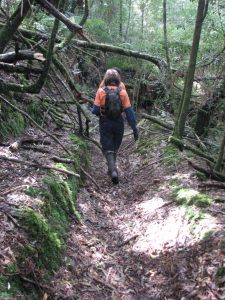
Godkin Extended Tramway formation between the South and North Shafts of the Godkin Mine. Nic Haygarth photo.
Early bush tramways were constructed of whatever timber was available locally. Hay would have been familiar with the process of clearing and levelling the route, splitting myrtle sleepers, sawing and morticing the wooden rails and securing the line with gauge sticks. He set up a sawmill to cut the rails. The tramway rested on cross logs, on which were placed stringers, then four-inch slabs across those. The wooden rails were fixed on top of the slabs. Trestles were necessary in several places, but no ballast was used. Steel rails were placed on some of the curves on the line.[xiii]
The Godkin Tramway must have rivaled the famous Zigzag Railway in the Blue Mountains of New South Wales for switchback bends. At one point passengers could see two other sections of tramway and the Whyte River stretched out beneath them. The views were spectacular: ‘Here and there magnificent gullies and ravines, precipices of 200 ft or 300 ft on one side or the other that made one’s blood run cold to anticipate an overthrow’.[xiv] Yet it was said that the line enabled one horse to draw two tons of freight and/or passengers, with four trips possible in a day.[xv]
The mine remained unproven, but excitement mounted as some Godkin silver was smelted into a pendant for the governor, Sir Robert Hamilton.[xvi] Tramway builder Hay was a ‘strict total abstainer’, but soon he also became intoxicated—by silver. While constructing the tramway he struck his own silver lode near the Whyte River, floated a company, installed a concentrating plant alongside the tramway and set it up as the custom crusher for the district.[xvii]
In mid-February 1891 Minister of Lands and Works, Alfred Pillinger, opened the 4.8-km-long first stage of the Godkin Tramway to the bridge over the Whyte River.[xviii] Now the mine could be tested. The 200 tons of Godkin ore reported to be ready for export could be sent out.[xix] Pumping and winding machinery could be brought to the Godkin, enabling sinking to prove whether the mine lived down. Tenders were called for the supply and erection of 40-ton and 80-ton water jacket smelting furnaces at the mine and for the construction of a police station at ‘Godkin’s and Heazlewood’.[xx] The arrival of machinery in July 1891 also warranted a celebratory banquet in Waratah and, more ambitiously, a christening ceremony on site on the mine’s southern section.[xxi] Mine manager Browne guaranteed one of his invited guests ‘a regular little spree for the men & the visitors’.[xxii]
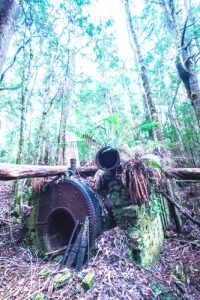
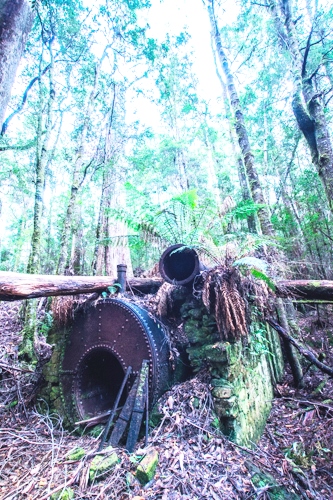
The bricked-in Austral Otis Godkin boiler, which has been on the field since 1891 and was once investigated as a possible thylacine lair. Nic Haygarth photo.
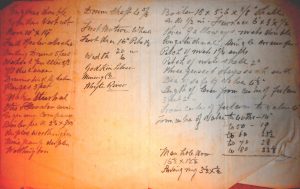
The boiler was officially inspected only once, in 1891. From AC705/1/1, 1885–1898 (TAHO).
Getting to the spree was a challenge. A party of guests, including Miss Seagrave, Browne’s future bride, left Waratah by coach and horseback for the start of the tramway. The coach broke down on the Magnet Range, forcing its passengers to wade through knee-deep mud for about a kilometre to the rails. At the mine, the Melbourne-based Austral Otis Elevator and Engineering Company boiler was inspected, after which Miss Inge and Miss Seagrave set the machinery in motion for the first time.[xxiii]
[i] The phrase ‘Cornwall of the Antipodes’ was credited to John Addis, manager of the Prince George Mine on the Mount Heemskirk tin field, in 1881 (‘Mount Heemskirk’, Mercury, 7 December 1881, p.3).
[ii] ‘A Bushman’, ‘The Whyte River Silver Field’, Mercury, 27 February 1890, p.3, described the field as being ‘in the opinion of many … destined to be the Broken Hill of Tasmania’.
[iii] For Bell, see Nic Haygarth, ‘Richness and prosperity: the life of WR Bell, Tasmanian mineral prospector’, Papers and Proceedings of the Tasmanian Historical Research Association, vol.57, no.3, December 2010, pp.203–35.
[iv] PB Nye, The silver-lead deposits of the Waratah district, Geological Survey Bulletin no.33, Department of Mines, Hobart, 1923, p.109.
[v] For Smith being elected vice-president of the Heazlewood Cricket Club, see JE Lyle to James Smith, October 1888, no.485; and 15 October 1888, no.500; NS234/3/16 (Tasmanian Archive and Heritage Office, Hobart [hereafter TAHO]).
[vi] ‘In Chambers’, Mercury, 7 November 1888, supplement p.1.
[vii] Editorial, Zeehan and Dundas Herald, 19 November 1890, p.2.
[viii] WR Bell to James Smith, 3 March and 4 March 1891, NS234/3/19 (TAHO).
[ix] ‘Mining news’, Daily Telegraph, 7 June 1889, p.3; ‘Queenstown notes’, Zeehan and Dundas Herald, 12 May 1900, p.4.
[x] Agreements dated 3 February 1891 and 15 June 1891, NS234/3/19 (TAHO).
[xi] J Harcourt Smith, ‘Report on the mineral district between Corinna and Waratah 28 July 1897’, Secretary of Mines Annual Report 1997, Parliamentary Paper 44/1897, pp. i–xix.
[xii] ‘Meetings: Godkin’s SM’, Mercury, 29 March 1890, supplement, p.1; Henry Penn Smith, Godkin Silver Mining Company, to JW Norton Smith, Van Diemen’s Land Company, 23 February 1891, VDL22//21 (TAHO).
[xiii] Arthur R Browne to JW Norton Smith, Van Diemen’s Land Company, 27 September and 4 October 1891, VDL22/1/21 (TAHO).
[xiv] ‘Whyte River silver field’, Launceston Examiner, 22 July 1891, supplement p.2.
[xv] ‘The Godkin Tramway: opening ceremony’, Wellington Times, 18 February 1891, p.3.
[xvi] ‘Personal’, Daily Telegraph, 1 October 1920, p.8.
[xvii] ‘Mining’, Mercury, 30 January 1891, p.3; ‘Obituary’, Examiner, 16 May 1902, p.7.
[xviii] ‘The Godkin Tramway: opening ceremony’.
[xix] ‘Waratah notes’, Wellington Times, 27 May 1891, p.3.
[xx] Adverts, Daily Telegraph, 10 June 1891, p.1 and 22 August 1891, p.7.
[xxi] ‘Starting the Godkin machinery’, Mercury, 20 July 1891, p.3.
[xxii] Arthur R Browne to JW Norton Smith, Van Diemen’s Land Company, 12 July 1891, VDL22/1/21 (TAHO).
[xxiii] ‘Starting the Godkin machinery’. Details of the boiler inspection can be found in AC705/1/1, 1885–1898 (TAHO).
by Nic Haygarth | 06/03/20 | Tasmanian high country history
DYI dentistry would make for intriguing reality TV (Channel Seven’s new blockbuster The chair anyone?) but in the nineteenth-century Tasmanian backwoods it was an everyday reality. Many people were far removed from medical services, and if you owned forceps you were licensed to operate. Middlesex Plains stockman Jack Francis (c1828–1912) was a model of self-sufficiency—hunter, stock rider, tanner, bootmaker, rug maker, leather worker, blacksmith, tool maker and dentist. Whether he aspired to more advanced surgery is unknown, but his prowess with the pincers must have made for some tense moments around the family dinner table.
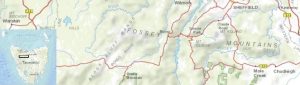
From Chudleigh to Waratah, including the Field brothers’ stations of Middlesex Plains and Gads Hill. Map courtesy of DPIPWE.
Given that 40,000 years of Aboriginal custodianship are unrepresented on official charts of the area, it shouldn’t be surprising that Francis’s comparatively miniscule 40-year familiarity with this former Van Diemen’s Land Company (VDL Co) highland run is not recorded on its landmarks. Unlike his notable successor, Dave Courtney (recalled by Courtney Hill), the short, stocky Francis cut no memorable figure. He had no moustaches he could tie behind his back or thick beard to hide his face. Nor was he a ‘man of mystery’, as much as some might have preferred him to be. Francis’s convictism was unpalatable in some quarters even after his death. One newspaper editor omitted the words ‘though a prisoner for some trifling offence’ from his obituary.[1] Highland journalist Dan Griffin was less mealy-mouthed but confused Jack Francis the stockman with Jack Francis the builder and failed assassin.[2] Both men were transported from England to Van Diemen’s Land, the latter for taking pot shots at Queen Victoria, but Jack Francis the stockman was the most benign and pathetic of transportees, being a boy convicted of stealing a barometer.[3] These beginnings make his nickname ‘Jack the Shepherd’, recalling the notorious Irish outlaw, even more ironic.[4]
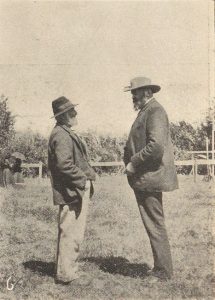
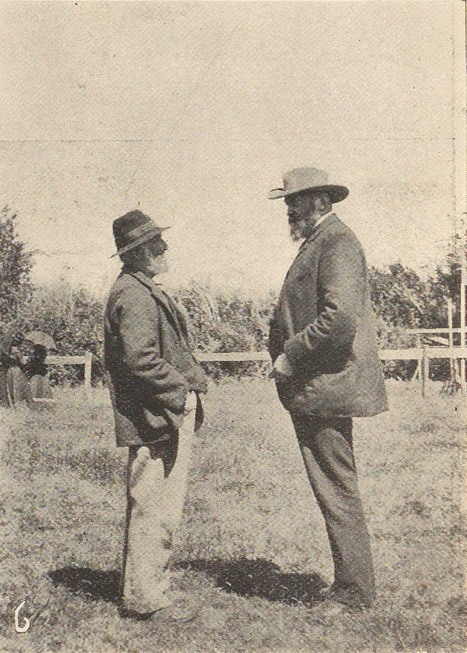
Jack Francis and Dan Griffin at the Chudleigh Races, from the Weekly Courier, 23 January 1904, p.23.
A native of County Armagh, Northern Ireland, Francis was apparently apprenticed as a ‘rough shoemaker’ when he faced court in Lancaster, Lancashire, England.[5] He probably had no idea how those skills would serve him in future years. Measuring all of 167 cm, he must have had a basic education. He could write, but with apparent difficulty, clearly preferring to dictate letters rather than write them himself.[6] Transported for seven years on the Egyptian in 1838, the boy convict served Launceston bootmaker Amos Langmaid before being assigned to rural masters James Grant at Tullochgorum near Fingal and Theodore Bartley at Kerry Lodge near Breadalbane.[7]
By now Francis was getting his leather in the field as well as at the end of an awl. After securing a certificate of freedom in 1845, he was a shepherd at Bentley near Chudleigh before securing his first posting to the highlands.[8] If childhood transportation to the antipodes hadn’t shaken his being to the core, his life now got a mite more adventurous. Because of Legislative Council parsimony, there were few public road bridges in northern Tasmania before 1865, but the VDL Co Track by which the highlands grazing runs were accessed from Chudleigh had dangerous fords much later than that. Negotiating the track for the first time, Francis and his two companions found the Mersey River almost impassable. Jim Garrett took the other two men’s clothes across on horseback, but with such difficulty that he could not return for the men, who of course had no chance of wading the torrent. They therefore had to spend the night without warm clothes or bedding, and were without food until late the next day when crossing became possible.[9]
This was probably in 1851 when grazier William Kimberley became the first victim of a beautiful mirage called the Vale of Belvoir. In that year Kimberley leased 1000 acres of this snowy glacial valley as a summer sheep run, posting Francis as their protector.[10] Barometer boy apparently had more of an issue with ‘wolves’ than with the highland weather. Thylacines—but more likely wild dogs—were said to have decimated Kimberley’s flock, although the survivors thrived, some being too fat to travel.[11]
Perhaps tubby sheep were Francis’s passport to the overseer’s position at Fields’ Middlesex Plains Station. This was a lonely, isolated job, with only the annual muster party and the occasional prospector like James ‘Philosopher’ Smith or surveyor like Charles Gould to interrupt proceedings. However, a routine of maintaining fences, preventing liver fluke in sheep, rescuing stock from bogs and patch-burning the runs left plenty of time for the hunter-stockman’s real occupation, snaring and hunting—primarily for the fur industry, secondarily for meat.
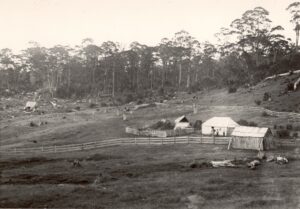
Middlesex Station, 1905, photo by RE Smith, courtesy of the late Charles Smith.
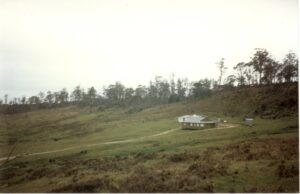
Same view of Middlesex Station in 1993, 88 years on. Nic Haygarth photo.
The stock-in-trade of the highland stockman was the brush-possum-skin rug. The cold highland climate necessitated thick furs, and Francis, with his expertise in leatherworking, was well placed to take advantage of the demand for this specifically Tasmanian product.[12] Possum-skin carriage rugs and stock-whips he sold to VDL Co agent James Norton Smith fetched £2 and 16 shillings each respectively.[13] This was useful money, given that a stockman or shepherd’s annual wage was in the range of only £20–£30, supplemented by rations (flour, sugar, tea, tobacco, perhaps potatoes and some meat) delivered to a depot on Ration Tree Creek at the foot of Gads Hill, the milk he could wring from a cow, a few skilling sheep and an abundance of wallaby and wombat meat. He would have grown a few hardy vegetables, guarding them against frost and snow.
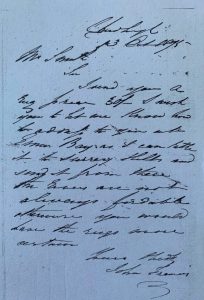
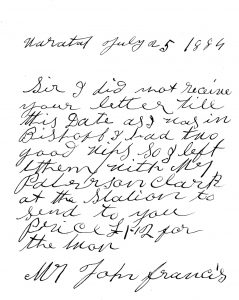
Jack Francis letters to the VDL Co’s James Norton Smith in 1875 and 1884 respectively, showing the difference between Maria’s fluent hand (above) and Jack’s laboured one (below).
From VDL22/1/9 and VDL22/1/12 (TAHO) respectively.
Not every woman would have fancied the lifestyle, but plenty of Jack’s contemporaries were accustomed to hardship. Jack Francis married 29-year-old house maid and factory worker Maria Bagwell (c1830–83) at Deloraine in 1860, subordinating his Roman Catholicism to her Protestantism.[14] She had been transported for seven years for stealing barley meal in Somerset in 1849. Perhaps she needed the nourishment, measuring only 166 cm as a nineteen-year-old. Her prison record is littered with the phrase ‘existing sentence of hard labour extended’. In 1852 she had been ‘delivered of’—deprived of?—an ‘illegitimate child’ at the Female House of Correction.[15] What happened to this unnamed girl from an unnamed father? Just as elusive is George Francis (?–1924), the child apparently born to Jack and Maria Francis during their time at Middlesex.[16]
The house maid seems to have taken to station life. In 1865 Maria Francis escorted surveyors James Calder and James Dooley from Middlesex Station to Chudleigh. To their ‘amazement’, their guide sat astride her horse like a man
‘and thus rode the whole way … with an amount of unconcern that surprised us not a little; and as if determined that we should not lose sight of this extraordinary feat of horsewomanship, she rode in front of us almost the whole distance, smoking a dirty little black pipe from one end of the journey to the other’.[17]
The couple’s son George Francis had arrived by 1871, when a child was mentioned by a visitor to Middlesex. Now Jack Francis revealed himself to be not just a skilled shoemaker and possum-skin rug maker but an expert tanner, clothing himself and his family in leather. They lived
‘in a clean and comfortable hut. A very few minutes sufficed for Mrs Francis to give us a cup of good tea, with abundance of milk, toast, and bread and butter, and when bedtime came she provided us with flealess bed-clothes, an unusual luxury in the bush….’
Jack Francis was ‘a very handy fellow … adept at shoeing a horse or drawing a tooth, having himself made a first-rate pair of forceps with which to perform this last-named operation …’ [18]
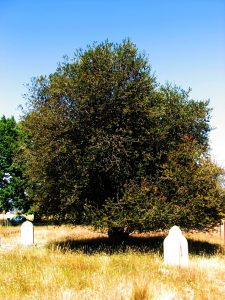
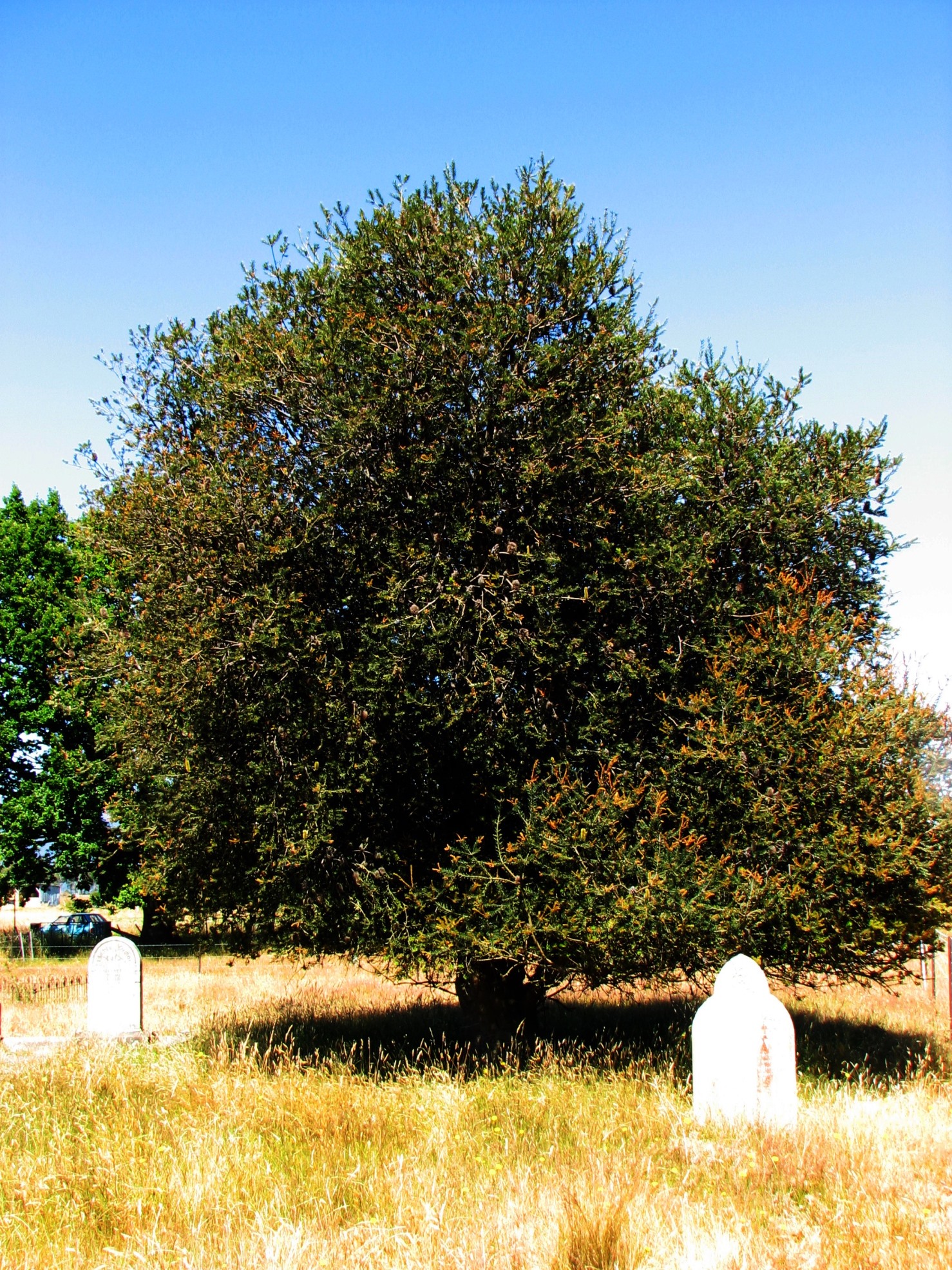
Final resting place for Jack and Maria Francis, Old Chudleigh Cemetery. Nic Haygarth photo.
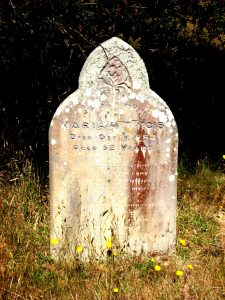
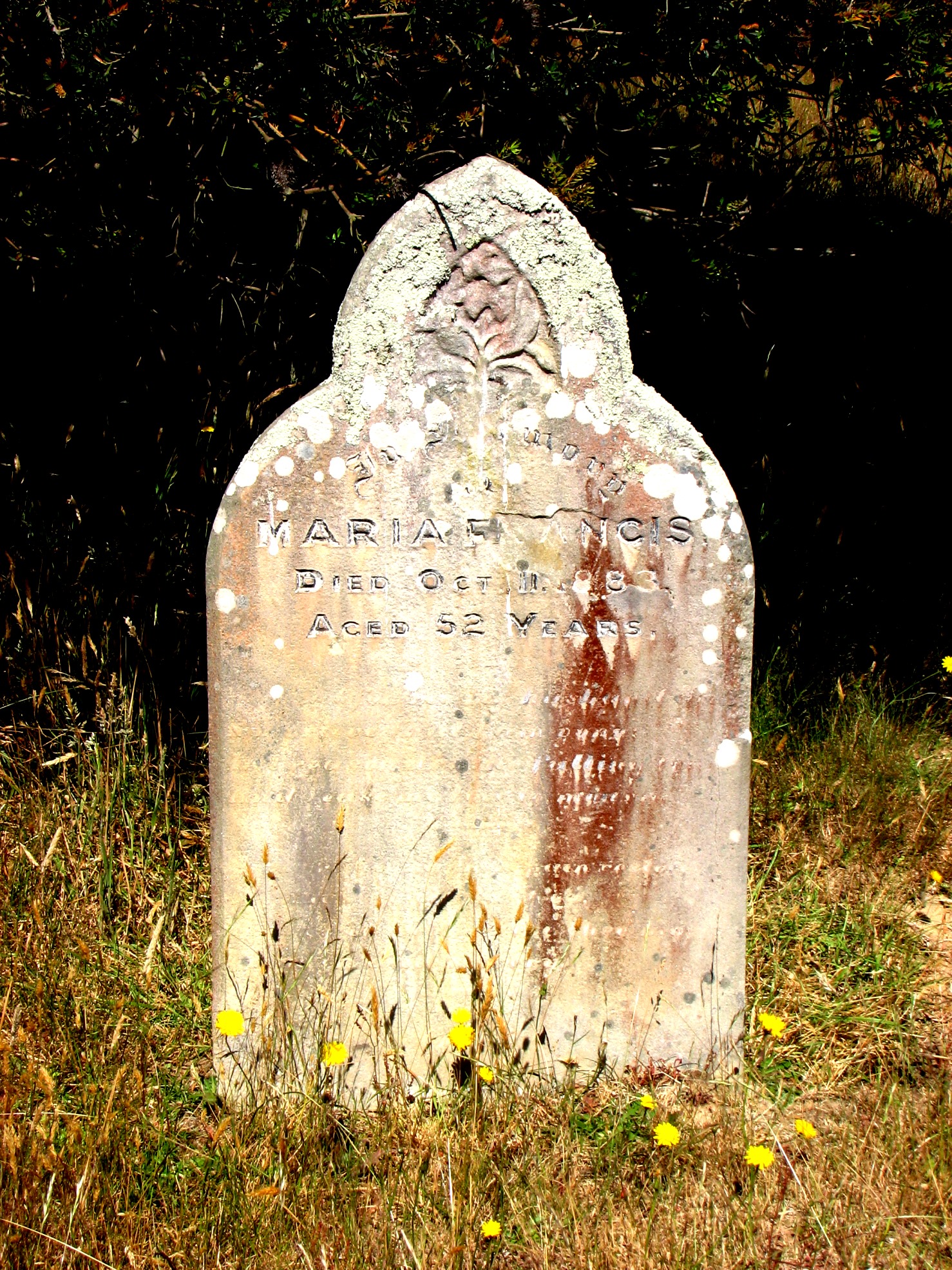
Headstone of Maria Francis, Old Chudleigh Cemetery. Nic Haygarth photo.
Today not even a headstone in the Old Chudleigh Cemetery records this go-getter’s existence. Around Middlesex Station the ‘old’ European names are forgotten: Misery (now Courtney Hill), the Sirdar (after Horatio Herbert Kitchener of the South African War), Pilot, Sutelmans Park, Vinegar Hill, Twin Creeks. Who named them all and why? No journalist interviewed the old station hands. Yet while the Francises left their mark only in written history, digitisation of archival records is enriching our knowledge of displaced people like them, who lived remarkable lives in remote places.
[1] ‘A veteran drover’, Examiner, 7 March 1912, p.4.
[2] ‘DDG’ (Dan Griffin), ‘Vice-royalty at Mole Creek’, Examiner, 15 March 1918, p.6.
[3] See conduct record for John Francis, transported on the Egyptian for seven years in 1839, CON31/1/12, image 175 (TAHO), https://stors.tas.gov.au/CON31-1-12$init=CON31-1-12p175, accessed 16 February 2020.
[4] For the nickname see, for example, ‘River Don’, Weekly Examiner, 4 October 1873, p.11; ‘A veteran drover’, Examiner, 7 March 1912, p.4.
[5] Francis’s obituarist in, for example, ‘A veteran drover’, Examiner, 7 March 1912, p.4, claimed that he was born at Woodburn, Buckinghamshire, 5 February 1828. Francis’s convict records make him a native of County Armagh.
[6] Indent for John Francis, CON14/1/48, images 25 and 26 (TAHO), https://librariestas.ent.sirsidynix.net.au/client/en_AU/tas/search/detailnonmodal/ent:$002f$002fARCHIVES_DIGITISED$002f0$002fARCHIVES_DIG_DIX:CON14-1-48/one, accessed 16 February 2020. Compare, for example, his letter to James Norton Smith, 11 April 1881, VDL22/1/9 (TAHO), written by his wife Maria Francis, with his letter to James Norton Smith, 25 July 1884, VDL22/1/12 (TAHO), written in his own hand after Maria’s death.
[7] Conduct record, as above.
[8] ‘A veteran drover’, Examiner, 7 March 1912, p.4.
[9] ‘A veteran drover’, Examiner, 7 March 1912, p.4.
[10] ‘Crown lands’, Courier, 5 February 1851, p.2; ‘Surveyor-General’s Office’, Courier, 3 December 1851, p.2; ‘The Tramp’ (Dan Griffin), ‘In the Vale of Belvoir’, Mercury, 15 February 1897, p.3.
[11] ‘The Tramp’ (Dan Griffin), ‘In the Vale of Belvoir’, Mercury, 15 February 1897, p.3.
[12] HW Wheelright, Bush wanderings of a naturalist, Oxford University Press, 1976 (originally published 1861), p.44.
[13] Jack Francis to James Norton Smith, 10 October 1873, NS22/1/4; and 25 July 1884, VDL22/1/12 (TAHO).
[14] Married 24 December 1860, marriage record no.657/1860, at St Mark’s (Anglican) Church, Deloraine, RGD37/1/19 (TAHO), https://librariestas.ent.sirsidynix.net.au/client/en_AU/names/search/results?qu=john&qu=francis&qf=NI_INDEX%09Record+type%09Marriages%09Marriages&qf=NI_NAME_FACET%09Name%09Francis%2C+John%09Francis%2C+John, accessed 15 February 2020. On his marriage certificate, Jack underestimated his age as 28 years.
[15] See conduct record for Maria Bagwell, transported on the St Vincent, CON41/1/25, image 16 (TAHO), https://stors.tas.gov.au/CON41-1-25$init=CON41-1-25p16, accessed 15 February 2020. See also birth record for Maria Bagwell’s unnamed illegitimate female child, born 7 September 1852, birth record no.1780/1852, registered at Hobart, RGD33/1/4 (TAHO), https://librariestas.ent.sirsidynix.net.au/client/en_AU/names/search/results?qu=NI_NAME%3D%22Bagwell,%20Maria%22#, accessed 15 February 2020.
[16] George Francis died 12 January 1924, will no.14589, administered 7 March 1924, AD960/1/48, p.189 (TAHO), https://librariestas.ent.sirsidynix.net.au/client/en_AU/names/search/results?qu=george&qu=francis&qf=NI_INDEX%09Record+type%09Marriages%09Marriages+%7C%7C+Deaths%09Deaths+%7C%7C+Wills%09Wills&qf=PUBDATE%09Year%091906-1976%091906-1976, accessed 16 February 2020.
[17] James Erskine Calder, ‘Notes of a journey’, Tasmanian Times, 18 May 1867, p.4.
[18] Anonymous, Rough notes of journeys made in the years 1868, ’69, ’70, ’71, ’72 and ’73 in Syria, down the Tigris … and Australasia, Trubner & Co, London, 1875, pp.263–64.
by Nic Haygarth | 05/03/20 | Tasmanian high country history
The palm of being Waratah’s first alcoholic probably belonged to its first resident doctor, John Waldo Pring, a Crimean War veteran who drank himself to death in the years 1876–79.[1] One of his lowest moments came in March 1876 when he escorted a disguised detective to a sly grog shop for a snort.[2] Another who upset early Waratah’s temperance wagon was former Sussex labourer Charlie Drury (c1819–76), who traded native animal hides for rum. For decades before Waratah was born Drury lived a twilight existence remote from civilisation, with often only his dogs, his drink and the spirit world for companions. He even went out on a bender, leaving a legacy of decimated wildlife, delusional folklore and fire-managed grasslands to the hunters and graziers who followed him.
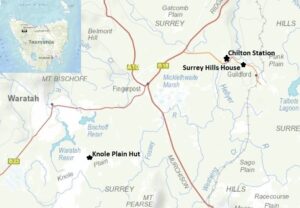
Mount Bischoff, Waratah, Knole Plain and the Surrey Hills. Map courtesy of DPIPWE.
Transported at 20 on a fifteen-year sentence for larceny, the 178-cm tall Drury was no mal-nourished urchin.[3] James ‘Philosopher’ Smith rather generously called him ‘a sturdy type of an Englishman’.[4] Drury could read—books and newspapers were delivered to him in the back country—although no letters survive to testify to his fluency with the pen.[5] Arriving in Van Diemen’s Land in July 1839, he went straight into the assigned service of British pastoral enterprise the Van Diemen’s Land Company (the VDL Co) at the Surrey Hills, working with hutkeeper Edward Garrett and stockkeeper Richard Lennard (c1811–94).[6] The area between the Hellyer River and Knole Plain would be his home for most of his remaining life. His early services to the VDL Co were valued at only £15 per year (when he was stationed at Emu Bay 1845–46) but rose to £30, a typical stockman’s wage of the time, in the years 1850–52.[7] Hunting would have brought in much more than that.
Drury would have been thrown out of his official work when the VDL Co shut down all operations in 1852. He attended the Victorian gold rushes in February of that year, but would have returned to his old haunts after northern graziers the Field brothers (William, John, Thomas and Charles) rented the Surrey Hills in 1853, living chiefly off the proceeds of his unfettered hunting.[8] Of course he also had the gold ‘bug’, finding a little gold at Cattley Plain under the Black Bluff Range in 1857 or 1858.[9]
The old lag was joined at the Surrey Hills by fellow ex-convict Martin Garrett (aka Garrett Martin, c1806–88), who had racked up an impressive record of robbery in Dublin, bushranging in New South Wales and probation served at Port Arthur. Not bad for a dairyman![10] Both men took to hunting, with a little prospecting on the side.[11] Like other highland hunter-stockmen such as Jack Francis of Middlesex Plains, Drury had a little cottage industry going, his specialty being the whittling of celery-top-pine walking sticks manufactured on commission.[12] It would be surprising if he didn’t also make and sell possum-skin rugs, which could fetch £2 each. The two men lived in a surprisingly sumptuous eight-room house with a blacksmith’s shop, stable, out-houses and cattle yards about two kilometres east of the Hellyer River.[13] The cottage was designed for the VDL Co by none other than onetime colonial architect John Lee Archer—something of a comedown from his work on Parliament House and the treasured Ross Bridge.[14]
Drury’s twilight zone
Decades of isolation in the boondocks of failed VDL Co settlements may have taken their toll on Drury. Even well after the tribal Aboriginal people had been driven out of the north-west, the ‘ghosts’ of their clashes with the VDL Co and the isolation played havoc with him. The company’s old Chilton homestead up above the Hellyer River was said to be haunted by the spirits of murdered Aboriginals. Drury reputedly enjoyed being lulled to sleep there by ghostly ‘music’, until one night a more lively manifestation left him crouched in the fireplace with his gun drawn.[15]
Drury sold skins to his former VDL Co workmate and ex-convict Richard Lennard, who was now keeper of the Ship Inn at Burnie. Lennard would regularly bring a horse and dray up to Drury containing grog and rations, returning to Burnie with the skins. On one occasion when Lennard was arriving at Surrey Hills, Drury came out to meet him, calling out, ‘I know what you are going to tell me—Jack Flowers is dead.’ This referred to the ex-convict known as ‘Forky Jack’, a previous workmate, who had died recently. Lennard knew that Drury had had no contact with the outside world during that time, so how could he possibly know of Flowers’ death? ‘He passed over here’, Drury told him, calling ‘Charlie [distant], Charlie [loud], Charlie [distant]’—on his way to hell.[16] James ‘Philosopher’ Smith got the same story from Drury, who had heard Flowers calling him ‘in the most hasty manner possible while very quickly passing through the air’. The hallucination, if that is what it was, apparently occurred at about the time of Flowers’ death.[17]
Drury had other supernatural experiences/hallucinations and beliefs. One day he was out hunting not far from home when it came on dark. He sat down under a tree for a nap, intending to hunt badgers (wombats) when the moon rose. He was awoken by a clap on the shoulder and the words, ‘Charlie! Didn’t you say you were going to start out after the badgers as soon as the moon was up? Here it is more than three hands high’. The speaker, Drury told his friend William Lennard, wore a sleeved waistcoat and an English top hat. Drury gathered his dogs, including Long Jim, who his new friend pointed out to him a little way off, and as he did so the apparition ‘backed away through a swamp and faded out’.[18]
On another occasion Drury and William Lennard were camped at an isolated place called Sutelmans Park somewhere near Bonds Plain (east of the Vale of Belvoir). Come morning Drury declined to leave camp, having been warned by the banshee (a female Irish spirit who heralds death) during the night that some misfortune would befall him if he did so. Lennard persuaded Drury to disregard the warning, and they went out hunting with Drury’s favourite dog Turk. Later that morning they found the dog dead. ‘There you are’, Drury remarked, ‘what did I tell you?’ Drury then tried to bring the dog back to life by ‘wailing’ over it. Lennard recalled laughing at him for being so foolish, whereupon Drury ‘levelled his gun at him and threatened to blow his head off’. Realising the precariousness of his position, Lennard quickly came to his senses.[19]
In the early 1870s Drury’s unusual ways made it into an international travel book. When an 1871 party visited the Surrey Hills, Drury fed them cold beef, and the visitors got to try those famous possum-skin rugs, which, as was customary, were alive with fleas. While his guests battled these, Drury went badger hunting by the light of the moon with about a dozen kangaroo-dogs, bringing home three skins and one entire animal—presumably for breakfast. As he explained at the dining table, ‘the morning after I have been out badger-hunting at night I always eat two pounds of meat for breakfast, to make up for the waste created by want of sleep’. Drury also recalled his pack of ferocious hunting dogs falling in with a ‘flock’ of seven ‘hyenas’, four thylacines being killed at a time when, unfortunately for him, there was no government thylacine bounty.[20]
Drury and the Bischoff tin
Through the 1850s and 1860s the VDL Co was tantalised by reports of gold discoveries on or near its land. The company’s local agent, James Norton Smith, appears to have placed some faith in Drury as a potential gold discoverer, following his claim to have found gold at the Cattley Plain, and as late as 1872 offered him prospecting tools and discussed a reward for discovery of payable gold.[21]
Prospector James ‘Philosopher’ Smith got to know Drury, calling at his cottage in December 1871 when short of food after discovering one of the world’s greatest tin lodes at Mount Bischoff. Drury had seen Smith pass by on his way to Bischoff, and now expressed surprise that he was able to stay out in the bush so long. He also told Smith that he had no food—a statement that no doubt sent a shock wave through the enervated prospector. However, relief was at hand:
‘He [Drury] replied that what he meant was that he had no beef but had kangaroo, bread and tea. He hurriedly invited me into the house and commenced to prepare a meal with the utmost celerity. He slung a camp oven containing fat and then seized a chopper with one hand and a leg of kangaroo with the other and in a few minutes he had some of the meat frying while he also attended to the tea kettle.’[22]
Smith would have found accounts of this visit written long after his death harder to swallow. In 1908 and 1923 claims were made that Smith found the Mount Bischoff tin in Drury’s hut. ‘There’s a mountain of it just outside there’, Drury apparently told Philosopher, sending him a few metres to the summit of the mountain.[23] Why anyone who had been at Waratah in its early days, when Mount Bischoff was accessed via a tunnel through the horizontal scrub, would suggest the existence of a stockman’s hut in such a position it is hard to imagine.
Drury was the stuff of which disenfranchised prospectors are made, the bumpkin shepherd who stumbles upon a fortune. The strongest argument against the Drury discovery story—apart from his stock of hallucinations—is Smith’s unblemished reputation for integrity. The closest that Drury is likely to have got to the Bischoff scrub is the very edge, where the wallabies snoozed before making their way to the grassy plains at night to feed.
Protective of his father’s reputation and achievements, Garn Smith interviewed Jesse Wiseman and William Lennard, both of whom had hunted with Drury in the early 1870s. Both said that Drury never claimed to have found the Mount Bischoff tin.[24] Wiseman recalled Drury saying, ‘Just fancy us hunting about here all these times and not knowing anything about [the Mount Bischoff tin]‘.[25]
Yet other Drury acquaintances told a different story. An anonymous source claimed that ‘old Charlie Drury made no secret about telling travellers in those days that he directed Mr James Smith to where the tin was, he having a few specimens of this strange metal in his hut, which he showed to “Philosopher” Smith, who continued the quest …’[26]
Grazier John Bailey Williams was another to vouch for Drury, telling Lou Atkinson ‘I ought to have found Bischoff as Drury told me of the mineral, but I paid no attention to him. I had heard so many wild stories of this sort’.[27] Williams had encountered Drury while trying to run sheep in the open grasslands at Knole Plain in 1864–65.[28] His application to lease 6500 acres of Crown land there foundered, with many sheep reportedly starving to death.[29] Well might he have wished for a tinstone saviour!
However, it seems that wild stories were Drury’s stock in trade. It wouldn’t be at all surprising if the old sot had mineral samples in his hut—but it would be a great shock if they were cassiterite specimens.[30]
Opportunity knocks
The Mount Bischoff Tin Mine and its new trade route with Emu Bay brought financial opportunity to previously remote hunter-stockmen. Fields’ Hampshire Hills overseer Harry Shaw wanted to set up an ‘eating house’ along the road. [31] Garrett must have had similar commerce in mind when he tried to buy land at the Hampshire Hills.[32] He later drove the VDL Co Tram between Emu Bay and Bischoff and worked as a blacksmith at the Wheal Bischoff Co Mine.[33] Drury became a commercial operator. He and his mate John Edmunds established a base on the hunting ground of Knole Plain, leaving Garrett to hunt the Surrey Hills. Their hut stood right along the track to the mountain, on grasslands that the Mount Bischoff Tin Mining Company wanted to keep for feed for the bullock and horse teams carting between Waratah and the port at Emu Bay. They were professional hunters paying a £1 annual licence and returning up to £70 per season for shooting 600 to 1000 wallabies as well as the brush possums which formed their possum-skin rugs—at least that was told they told a visiting reporter.[34] The suggestion that such men obeyed government regulations is ludicrous. Additional money was to be had packing supplies for mining companies, as well as supplying Waratah with wallaby meat and some of the grog that they received from Emu Bay.[35] Feeding 20 kangaroo dogs alone would necessitate constant hunting.
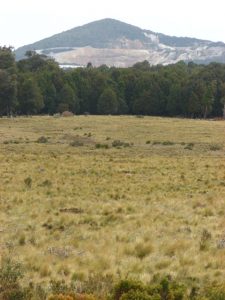
Mount Bischoff from Knole Plain, 2009. Nic Haygarth photo.
The new trade route through to Emu Bay also gave hunters like Drury and Garrett better access to skin buyers—although their attempt to sell the skins of Drury’s beloved badger seems to have foundered. [36] While Garrett and Drury were out hunting, their charges—the Field brothers’ notoriously wandering cattle—wandered onto Waratah dinner plates, much to their owners’ disgust. In 1874 Thomas Field called for police intervention.
So did the Mount Bischoff Company when the first pub opened in town.[37] Drury’s unofficial pub never closed. One man was discharged from Walker and Beecraft’s tin claim for getting drunk there.[38] Drury himself was likely to get ‘on the spree’ at any time, making him an unreliable employee.[39] There was a celebrated incident in which Drury got hammered on a keg of rum and accidentally burned down his and Edmunds’ hut, destroying not only his own skins and stores but supplies belonging to prospectors Orr and Lempriere and surveyor Charles Sprent. The only thing salvaged was the keg, to which the hunter was said to have clung ‘with the affection of a miser’.[40]
Drink eventually killed Drury in his hut at Knole Plain. James Smith learned that:
‘His end was a melancholy one. He had been drinking somewhat heavily when two Christian men from Waratah went to see him at his hut … While talking to his new friends he lay down on his bed and seemed to doze but when after a time one of them tried to rouse him it was found that he was dead.’[41]
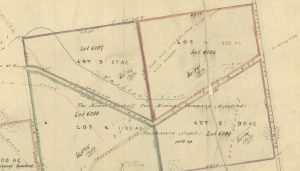
Detail from Charles Sprent’s January 1874 map, ‘Plan of agricultural sections on Knole Plain, County of Russell’, showing ‘hut and kennels’ (upper right, just above the road reserve. AF396/1/806 (TAHO).
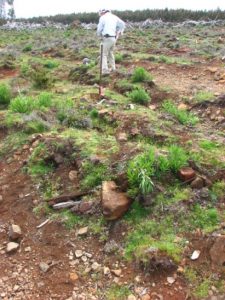
Potential rubble from Drury’s hut protruding from the furrows of a future plantation on Knole Plain in 2009. Presumably Drury remains buried here, although the eucalypt that marked the spot is long gone. Nic Haygarth photo.
Finding Drury
Drury is said to have been buried beneath a eucalypt near his hut on Knole Plain.[42] Did anything remain there of either his hut or his grave? Examining an old map of Knole Plain more than a decade ago, Burnie surveyor and historian Brian Rollins found the notation ‘hut and kennels’. Brian was interested to find a James Sprent survey cairn that was marked on the same map. We resolved to combine our interests and, under the stewardship of Robert Onfray from Gunns, we made a trip to the Knole Plain area. We found ploughed remains of a long-fallen building which suggested Drury’s hut or some later version of it. No weathered cross tilted over the detritus. No bleached bones poked out of the furrows of the plantation coup. Perhaps Charlie Drury is six feet under the tussock grass, raising a toast with his insubstantial friends, his beloved dogs crashing through some underworld after twilit kangaroo, badger and tiger.
[1] ‘Mount Bischoff’, Devon Herald, 27 September 1879, p.2; he died of natural causes, 19 September 1879, inquest SC195/1/60/8154 (Tasmanian Archive and Heritage Office, afterwards TAHO), https://stors.tas.gov.au/SC195-1-60-8154, accessed 29 February 2020.
[2] ‘Sly grog selling at Mount Bischoff, Cornwall Chronicle, 27 March 1876, p.3.
[3] Drury was transported on the Marquis of Hastings. See his conduct record, CON31/1/12, image 31 (TAHO), https://stors.tas.gov.au/CON31-1-12$init=CON31-1-12p31, accessed 1 March 2020, also Description list, CON18/1/16, p.200 (TAHO), https://librariestas.ent.sirsidynix.net.au/client/en_AU/names/search/results?qu=charles&qu=drury#, accessed 23 February 2020.
[4] James Smith notes, ‘Exploring’, NS234/14/1/ 3 (TAHO).
[5] Cavanagh (?) to James Smith, 24 January 1875, no.38, NS234/3/1/4 (TAHO).
[6] VDL61/1/2 (TAHO). For Lennard see conduct record, CON31/1/27, image 179 (TAHO), https://stors.tas.gov.au/CON31-1-27$init=CON31-1-27p179, accessed 1 March 2020.
[7] VDL133/1/1 (TAHO).
[8] From Launceston to Melbourne on the City of Melbourne, 3 February 1852, POL220/1/1, p.558 (TAHO), https://librariestas.ent.sirsidynix.net.au/client/en_AU/names/search/results?qu=charles&qu=drury#, accessed 23 February 2020. Drury’s sentence expired in March 1853, leaving him free to choose his employer (‘Convict Department’, Launceston Examiner, 19 March 1853, p.6).
[9] See WR Bell, ‘Report on the hydraulic gold workings at Lower Mayday Plain …’, 14 May 1896, EBR13/1/2 (TAHO). In June 1858 a prospector W MacNab testing the Hampshire and Surrey Hills for gold complained that a mining cradle he expected to use had been removed for use by a stockkeeper from the Surrey Hills Station. See W MacNab to James Gibson, VDL Co agent, 9 June 1858, VDL22/1/2 (TAHO).
[10] See his conduct record, CON39/1/2, p.334 (TAHO), https://librariestas.ent.sirsidynix.net.au/client/en_AU/all/search/results?qu=Martin&qu=garrett, accessed 23 February 2020. After a stint in the New Town Invalid Depot (admitted 24 November 1886 to 17 December 1886, POL709/1/21, p.207) Garrett died of ‘dropsy’ (oedema, fluid retention) in Launceston in 1888 when he was said to be 82 years old (2 December 1888, death record no.391/1888, registered in Launceston, RGD35/1/57 [TAHO]).
[11] Garrett may have discovered the barytes deposit at the Two Hummocks near Fields’ Thompsons Park Station (James Smith to Ritchie and Parker, 10 July 1875, no.327, VDL22/1/4 [TAHO]).
[12] Richard Hilder, ‘The good old days’, Advocate, 5 January 1925, p.4; Charles Drury to James Norton Smith, 24 July 1872, VDL22/1/4 (TAHO).
[13] ‘Country news’, Tasmanian, 30 August 1873, p.5; G Priestley, ‘Search for Mr D Landale’, Weekly Examiner, 11 October 1873, p.19.
[14] Agreement between the VDL Co and builder George Fann, 4 March 1851, VDL19/1/1 (TAHO). Fann was paid £150 for the job on 19 April 1852 (VDL133/1/1, p.153 [TAHO]). Archer sent two designs for a stockkeeper’s hut to James Gibson on 17 February 1851, although unfortunately the designs cannot be found on file (VDL34/1/1, Personal letters received by James Gibson [TAHO]). See also the 1842 census record for Richard Lennard, who was then living at the VDL Co’s old Chilton homestead. He was one of ten men from the ages of 21 to 45 resident there at the time, only one of whom arrived in the colony free, while another qualified under ‘other free persons’. Two who were in ‘government employment, six in ‘private assignment’. Two were ‘mechanics or artificers’, two were ‘shepherds or others in the care of sheep’, five were ‘gardeners, stockmen or persons employed in agriculture’ and one was a ‘domestic servant’ (CEN1/1/8, Circular Head, p.63 [TAHO], https://librariestas.ent.sirsidynix.net.au/client/en_AU/all/search/results?qu=richard&qu=lennard, accessed 1 March 2020).
[15] William Lennard, quote by RS Sanderson, ‘Discovery of Tin at Mount Bischoff’, RS Sanderson to Arch Meston, May 1923?, M53/3/6 (Meston Papers, University of Tasmania Archives, Hobart).
[16] William Lennard, quoted by RS Sanderson, ‘Discovery of Tin at Mount Bischoff’.
[17] James Smith notes, ‘Exploring’, NS234/14/1/ 3 (TAHO).
[18] William Lennard, quoted by RS Sanderson, ‘Discovery of Tin at Mount Bischoff’.
[19] William Lennard, quoted by RS Sanderson, ‘Discovery of Tin at Mount Bischoff’.
[20] Anonymous, Rough notes of journeys made in the years 1868, ’69, ’70, ’71, ’72 and ’73 in Syria, down the Tigris … and Australasia, Trubner & Co, London, 1875, pp.263–64.
[21] James Norton Smith to VDL Co Court of Directors, Outward Despatch 38, 15 May 1872, p.482, VDL1/1/6; James Norton Smith to Charles Drury, 12 June 1872, p.493, VDL7/1/1 (TAHO).
[22] James Smith notes, ‘Exploring’, NS234/14/1/ 3 (TAHO).
[23] ‘Patsey’ Robinson, quoted in ‘The oldest inhabitants’, Zeehan and Dundas Herald, 24 April 1908, p.2.
[24] GH Smith, ‘The true story of Bischoff’, Advocate, 1 May 1923, p.6.
[25] Jesse Wiseman quoted by RS Sanderson, ‘Discovery of tin at Mount Bischoff’.
[26] ‘1866’, ‘Discovery of tin at Mount Bischoff’, Advocate, 30 April 1923, p.6.
[27] John Bailey Williams, quoted by RS Sanderson, Discovery of Tin at Mount Bischoff’.
[28] John Bailey Williams to Charles H Smith, Du Croz & Co, 25 January 1865; and to VDL Co agent Charles Nichols, 11 April 1865, VDL22/1/3 (TAHO).
[29] Thomas Barrett to R Symmons, 2 March 1867, VDL22/1/3 (TAHO).
[30][30] Thomas Broad claimed to have seen tin specimens in Drury’s hut—but did Broad have enough expertise in mineralogy to make that call? See Thomas Broad, ‘Mt Bischoff’s early days’, Advocate, 3 May 1923, p.2.
[31] James Smith to Ferd Kayser, 15 January 1876, NS234/2/1/2 (TAHO).
[32] James Smith to Martin Garrett, 30 June 1875, no.310, NS234/2/1/2 (TAHO).
[33] Hugh Lynch to James Norton Smith, 23 April 1877, VDL22/1/5; Daniel Shine to James Norton Smith, 27 October 1879, VDL22/1/7 (TAHO).
[34] ‘Country news’, Tasmanian, 30 August 1873, p.5.
[35] For packing, see WR Bell to James Smith, 20 July 1875, no.335; and Joseph Harman to James Smith, 11 October 1875, no.450, NS234/3/1/4 (TAHO).
[36] AM Walker to James Smith, 11 February 1873, no.115, NS234/3/1/2 (TAHO).
[37] Minutes of directors’ meetings, Mount Bischoff Tin Mining Company, 7 September 1875, NS911/1/1 (TAHO).
[38] Mary Jane Love to James Smith, 12 October 1873, no.290/291, NS234/3/1/2 (TAHO).
[39] William Ritchie to James Smith, 9 March 1874, NS234/3/1/3 (TAHO).
[40] ‘Trip to Mount Bischoff’, Mercury, 18 December 1873, p.3.
[41] James Smith notes, ‘Exploring’, NS234/14/1/ 3 (TAHO). Drury died 3 March 1876, death record no.151/1876, registered at Emu Bay, RGD35/1/45 (TAHO), https://librariestas.ent.sirsidynix.net.au/client/en_AU/names/search/results?qu=charles&qu=drury#, accessed 23 February 2020. Cause of death was given as ‘excessive drinking’.
[42] ‘An Old Hand’, ‘The O’Malley and the Labor Movement in Tasmania’, Zeehan and Dundas Herald, 28 May 1908, p.2.