
If William Long was alive today he’d be 210. Or maybe 206. One-hundred-and-fifty of those years have been spent on the Mount Bischoff Tin Mine, which is hard yakka by anyone’s standards. He was there while the mighty Brown Face was whittled away to line food cans and make solder, bronze and pewter. The underground firings shook his bones. Then everything went quiet but for a bandicoot or two. He was probably still lying in state when Bluestone/Metals X dug a big hole in 2008 to supplement their Renison crushings. Now he’s possibly a native revegetation consultant (NRC), pushing up tea-trees rather than daisies on a parched surface.
Who was this William Long who died at Bischoff in 1876? He may have been one of five convicts of that name. There is insufficient information to make a call. Convict number five was transported to Van Diemen’s Land for seven years for falling asleep at his sentry post at the York Barracks. A bit harsh, surely. Whichever convict (or none) he might have been, 52-year-labourer William Long married 39-year-old schoolteacher Mary Ann Wilson by Congregational rites at her home at Forth in 1872.[1] Mary Ann was assistant teacher at the Forth Public School and was probably living in the teacher’s quarters of the school at 97 William Street.[2] In 1875 William and Mary Ann Long bought Lot 23 at what is now 684 Forth Road and commissioned or built the cottage there today.[3]
Money was tight for the Longs but the tin mines at Mount Bischoff brought opportunity. William Long packed out ‘heads’ (nuggets of tin) for the Mount Bischoff Co at a time when the mine was very remote, with bullock and horse teams providing most of the transport. There was no tramway to Waratah, just a boggy track from Emu Bay.
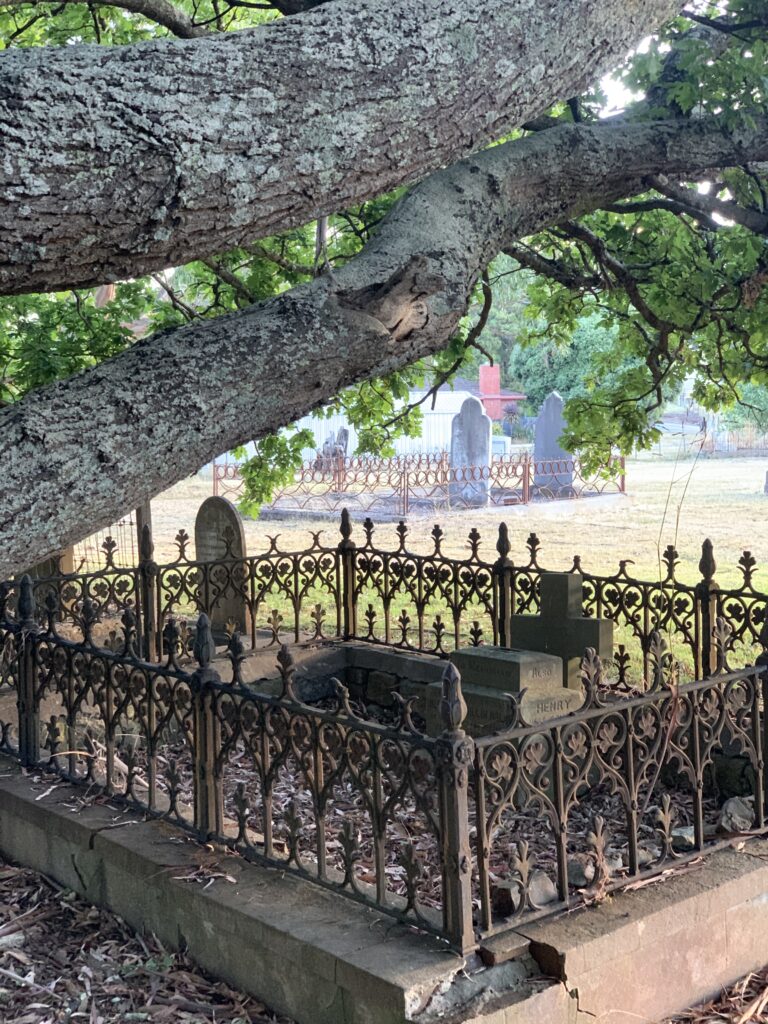
Bischoff was no place to get sick. There was no resident doctor. In 1874 a Mount Bischoff mining manager named William Kappler received medical attention too late to save him from pneumonia at the age of only 29.[4] In lieu of a cemetery a grave was dug for him on the eastern side of Waratah Falls—but it was never filled.[5] William Henry paid for the removal of Kappler’s corpse and he now lies in an unmarked grave at the Don Congregational Cemetery.[6]
William Long had no posthumous benefactor. The Longs appear to have been practising dietary self-denial to save money.[7] William’s official cause of death was ‘general debility’[8] but Mount Bischoff Co Mine Manager Ferd Kayser seemed to blame malnutrition. At a time when Kayser was under fire for his mining methods and harsh treatment of bullock drivers, he felt keenly the wrath of Mary Ann Long, who apparently blamed him for her husband’s demise. ‘All I can say is that everything [was] done, what was in our power under the circumstances both before as well as after his death’, Kayser told ‘Philosopher’ Smith. ‘All he wanted was nutriment and so far as our stores at hand [could] do him any good he was supplied. The greatest fault was that he was fairly neglected by himself and it appears nothing could save him …’[9]
Forgotten for 45 years
Bill’s demise didn’t make the newspapers for 45 years. Why? Newspaper reports from remote places relied on local correspondents. The Launceston Examiner’s Waratah correspondent in January 1876 was Mount Bischoff Co Assistant Mine Manager Charles Hall.[10] Perhaps he was too busy helping his boss berate the ore carters and finesse the half-yearly mining report to worry about a Waratah column. No newspaper ran a report from Waratah during the month of January 1876. William Long was not discussed at Mount Bischoff Co directors’ meetings nor mentioned in the half-yearly report tabled that month. Money and careers were at stake. Labourers were of no consequence.
Long’s celebrity began in 1921 and was short-lived. In that year the Advocate’s travelling correspondent stated that Long was buried on the mountain, ‘close to the camp, the grave being marked [in 1921] by a gum-tree planted near the spot’.[11] This suggested that Bischoff miners of the time knew of the grave. The camp on the mountain mentioned by the reporter would have been the gathering of huts near the Slaughteryard Gully Face.
To fence or not to fence
Then came some old-time reminiscences of the mine. In December 1921 Charles Thompson revisited his old stamping ground. Forty-five years on the former miner recalled Long packing out ‘heads’ from the mining face to the ore washing facilities at the Waratah Falls. The packer was buried
near to the huts on top of Mount Bischoff. At a later time it was discovered that the ground chosen for his burial was in rich tin bearing country. The ground all round [sic] the spot has been worked out, but the grave of Bill Long has been left undisturbed. Its white fence and solitary small gum tree is a landmark.
The site was within a ‘stone’s throw’ of the Brown Face.[12]
Only Thompson mentioned the white fence. How long did it stand? Perhaps it was gone by 1927 when former ore carter Richard Hilder ‘turned his steps’ from the Brown Face to pay his respects at ‘the resting place of an early miner whose body lay securely enfolded beneath the gnarled roots of a sickly looking stringybark tree’.[13]
Finding the solitary stringybark
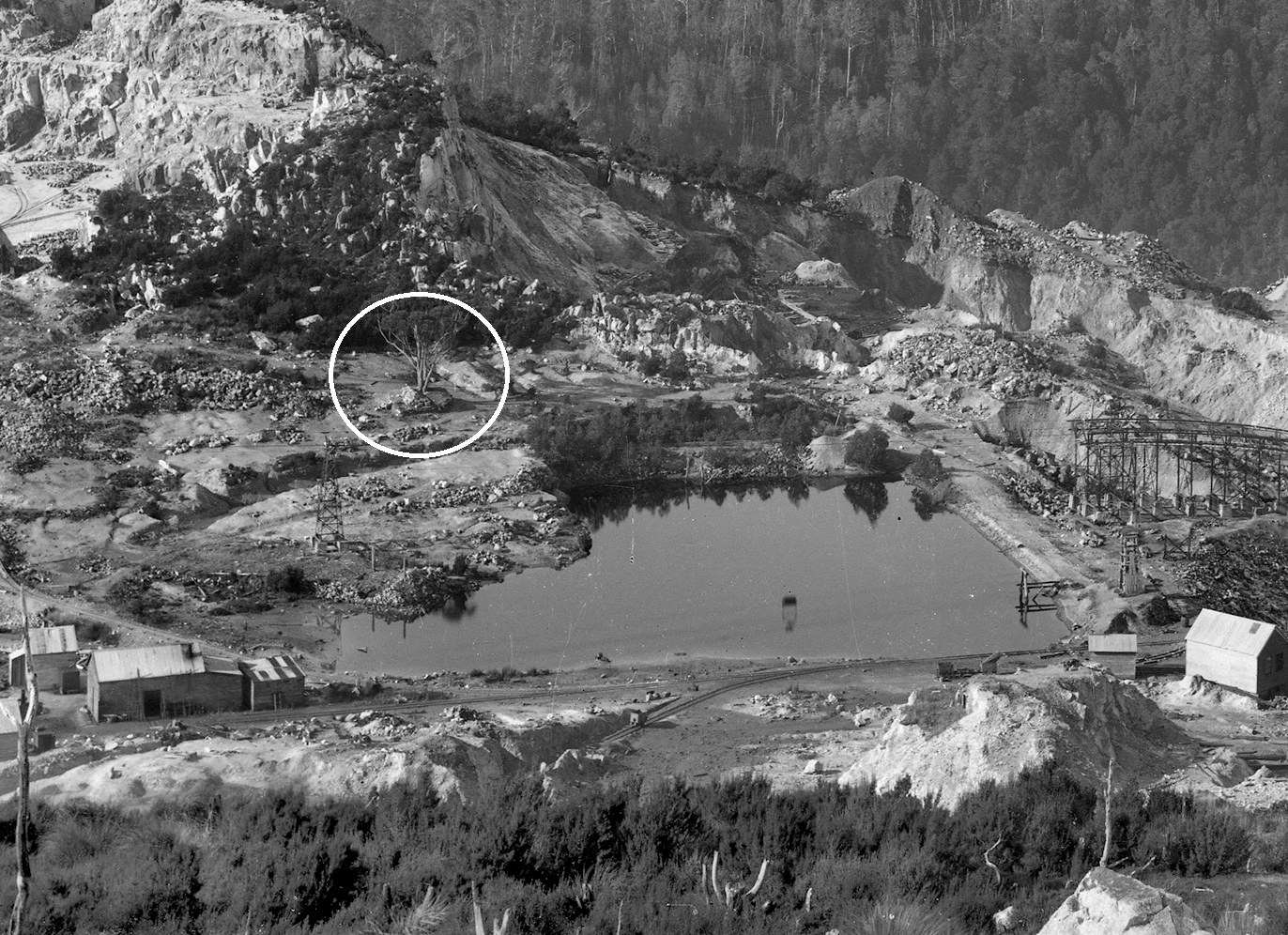
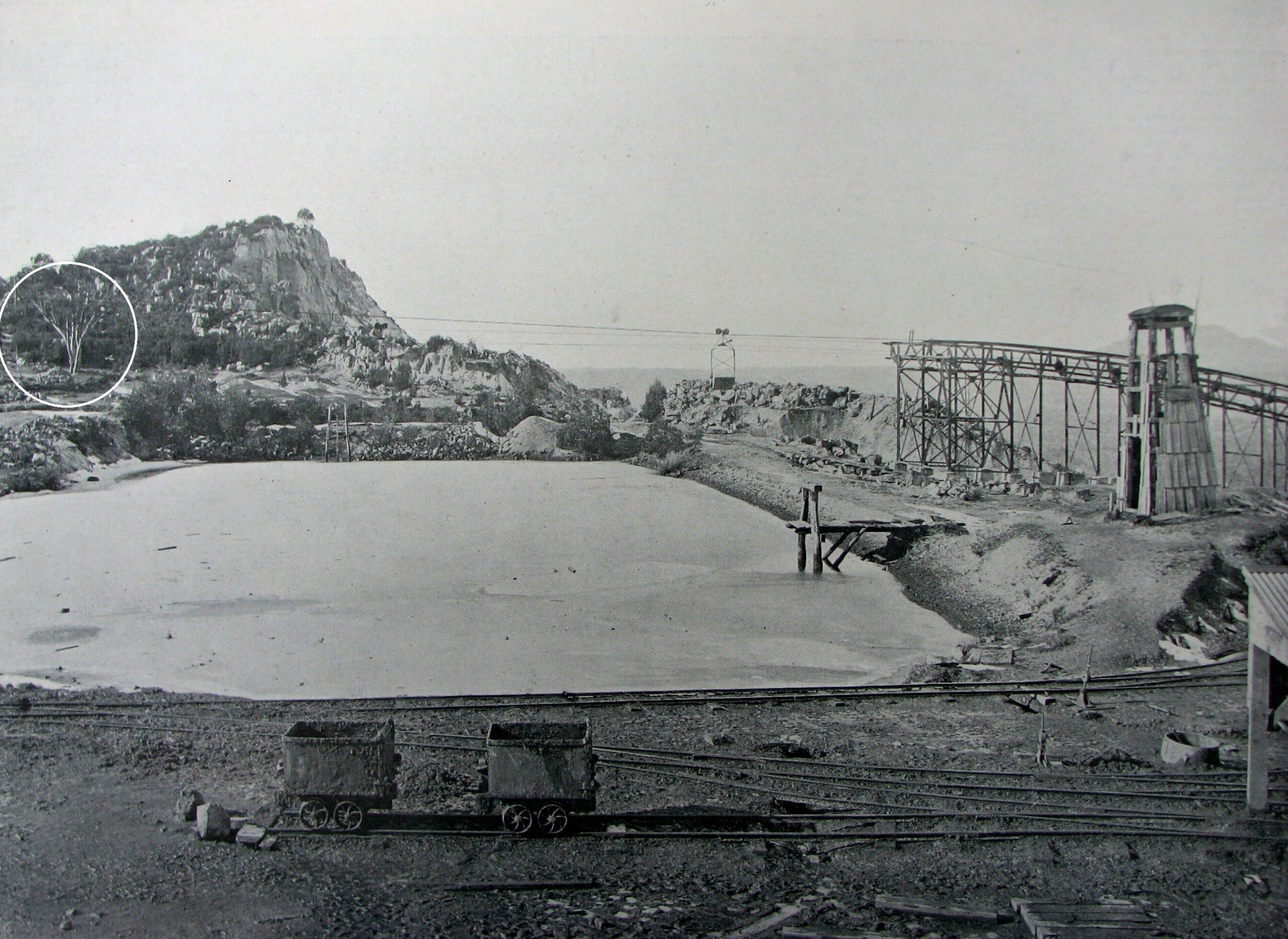
That solitary stringybark near the huts and the Brown Face should have stood out. Jackie Robinson, Waratah’s resident photographer, must have captured every green filament on the mountain with his roving lens. Working for the Mount Bischoff Co, Robinson recorded all aspects of the Bischoff operation and lease. But I couldn’t find a Robinson photo of a grave on Mount Bischoff.
Was it in his photos anyway? Jackie took several photos of the Bellhouse Dam region above the Bischoff loading bays in the period c1910–50. It’s hard to date some of them, the only milestone being the 1914 advent of the aerial tramway that carried ore across the mountain from the North Valley workings. Although it was abandoned in 1920 when fire destroyed the northern section of line the pylons were never removed.
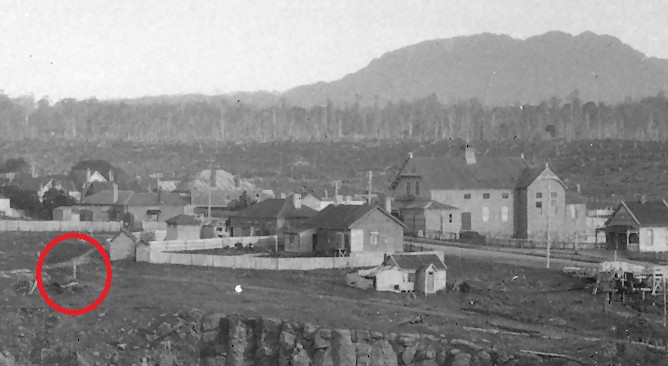
But one tree has a conspicuous presence in Robinson’s photos. A pre-aerial tramway shot of the area covered in snow shows a small tree a few metres to the north-east of the Bellhouse Dam. The tree was there again in a 1914 photo. The clincher for me was another photo which not only showed the tree but a mound of stones beside it. No white fence, but a distinctly squared area with a mound of stones upon it.
Long’s present whereabouts
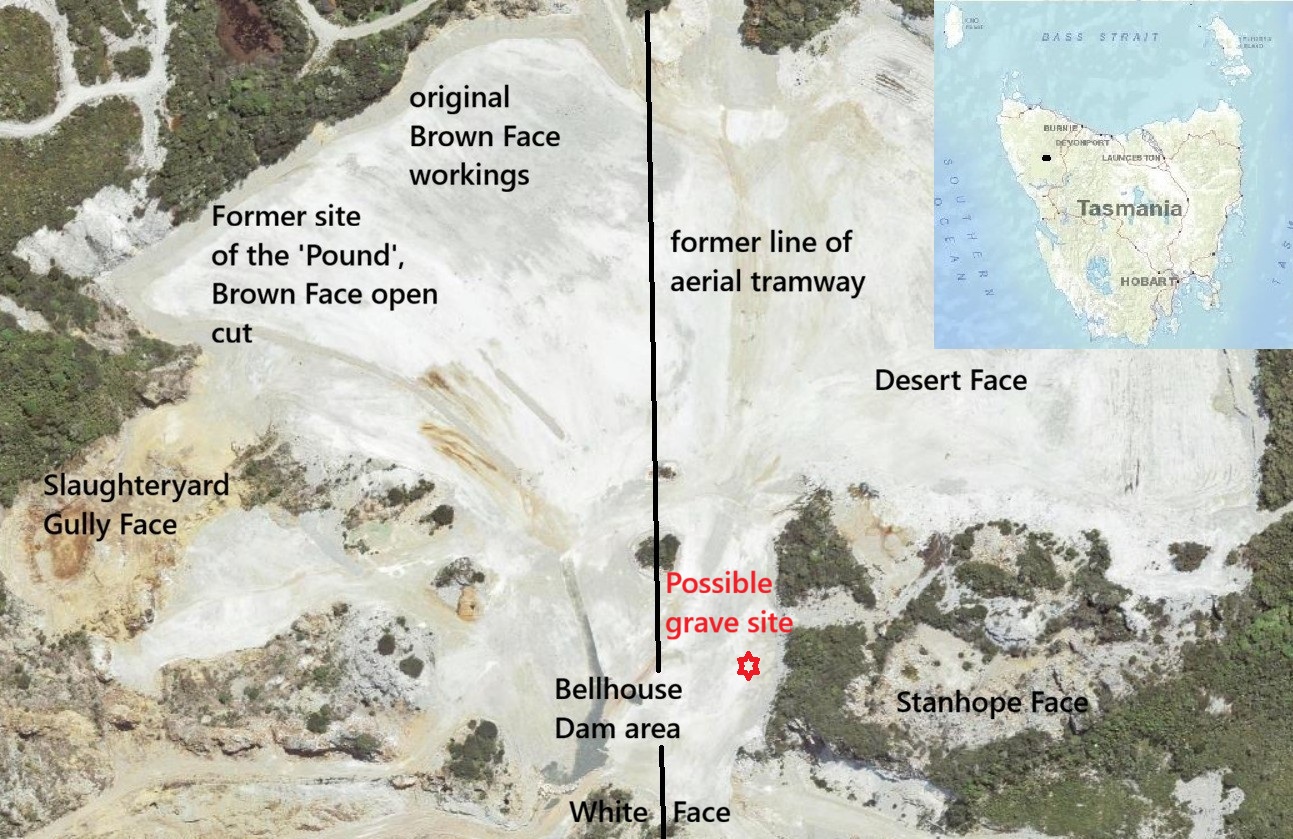
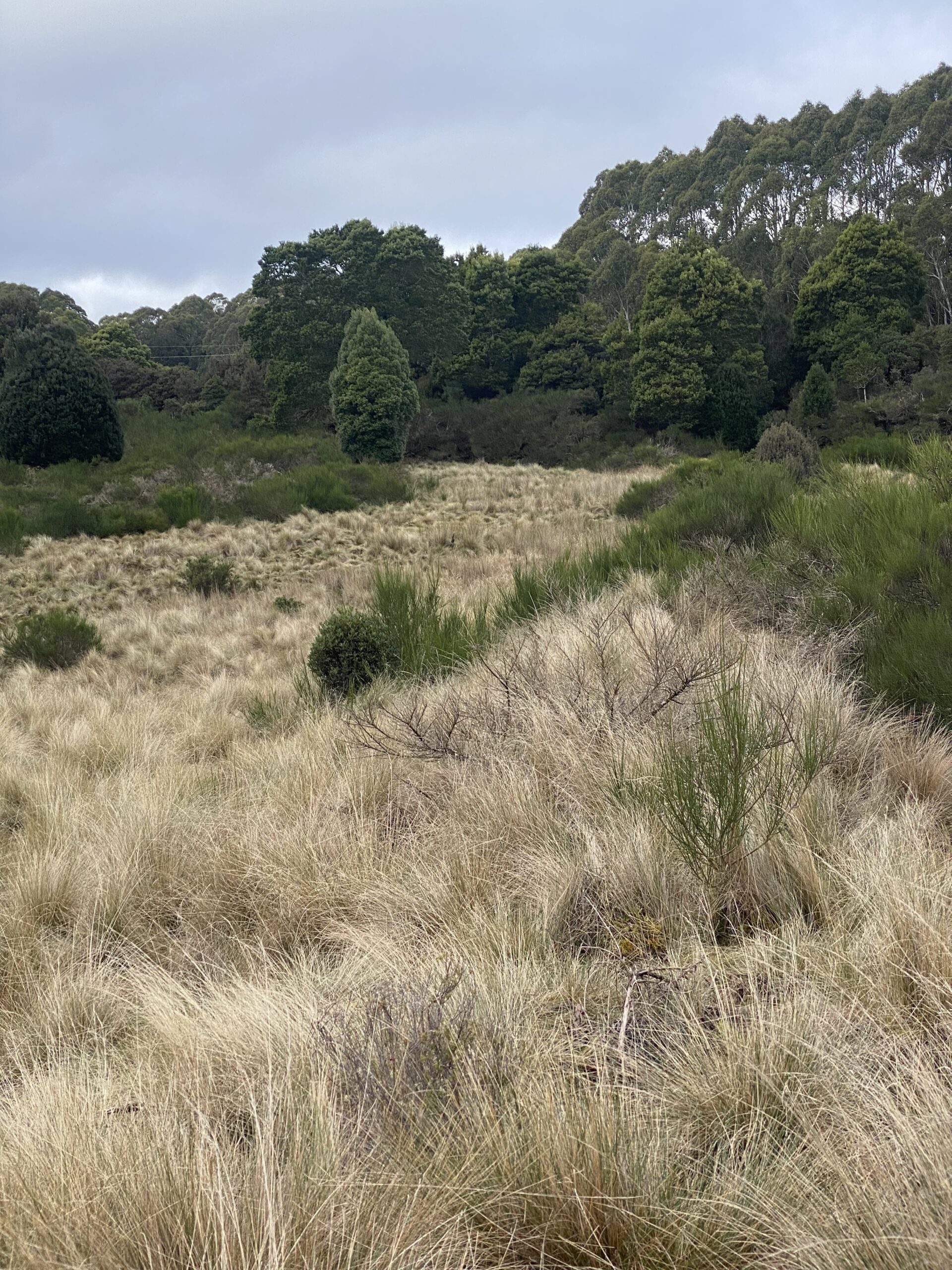
The Bellhouse Dam area had a hair-cut long before Bluestone cropped the surface further. The dam is long gone, but two small patches of vegetation in the same general area drew my attention. The more southerly patch contains two mounds of earth and stone, one about 2m long, the other about 3m. Nice! Unfortunately, the two vegetation clumps also contain the fallen pylons of the old aerial tramway, which is why they were saved from ‘rehabilitation’. Based on evidence in the old photos, the ‘grave’ had to be 20 to 30m further to the south-east.
That area is a flat, feature-less mining thoroughfare speckled with small tea-trees. It looks as if William Long’s stringybark tree and grave marker were bulldozed away decades ago during mining operations. He is possibly still there beneath the surface, but the ground is hard and compacted, certainly not amenable to the burial pick and shovel. May he rest in peace one day, when Bischoff’s wealth is finally exhausted and all the ore trucks are rusting in their own industrial graves.
Other early deaths at Mount Bischoff/Waratah
The Waratah Public Cemetery was not established until 1879.
- On 5 July 1875 64-year-old labourer Edward Hargraves died at Waratah of ‘decay of nature’, although it seems no inquest was conducted.[14] Old Bischoffite Charles Thompson claimed he was buried behind the Waratah Police Station.[15]
- On 22 April 1876 59-year-old storekeeper Henry Walker was crushed to death by iron after being thrown off the Mount Bischoff Co Tramway while it crossed a gully.[16] His brother Alfred Walker blamed the Mount Bischoff Co for Henry’s death since, he believed, it blocked the road deliberately with a fallen tree to monopolise the traffic between Rouses Camp and Bischoff.[17] Henry Walker was buried with family at the Congregational Cemetery, Forth.
- On 10 April 1877 60-year-old labourer John Guest died of ‘organic disease of the heart and dysentery’ in a bakery at Waratah.[18] His body was kept in situ for nearly a week, awaiting the coroner from Emu Bay, who never came, after which time he was buried.[19] His final resting place is unknown. Hopefully the bakery regained its custom.
[1] Married 11 May 1872, marriage record no.546/1872, registered at Port Sorell, RGD37/1/31 (TA), https://librariestas.ent.sirsidynix.net.au/client/en_AU/names/search/results?qu=william&qu=long&qf=NI_INDEX%09Record+type%09Marriages%09Marriages&qf=PUBDATE%09Year%091860-1877%091860-1877&isd=true, accessed 5 April 2026.
[2] The couple certainly lived at the teacher’s quarters in 1873 (‘Board of Education’, Weekly Examiner, 15 February 1873, p.7).
[3] Conveyance 6/578, 6 January 1875. The purchase price of £40 suggests no cottage then existed.
[4] Died 21 November 1874, death record no.166/1874, registered at Emu Bay, RGD35/1/43 (TA), https://librariestas.ent.sirsidynix.net.au/client/en_AU/names/search/detailnonmodal/ent:$002f$002fNAME_INDEXES$002f0$002fNAME_INDEXES:1159898/one?qu=kappler&qf=NI_INDEX%09Record+type%09Deaths%09Deaths, accessed 28 March 2021. See also ‘Death at Mount Bischoff’, Tasmanian, 5 December 1874, p.9.
[5] Unless you believe Charles Thompson, who claimed that Edward Hargreaves was buried there. See ‘Early days of Waratah: pioneer’s reminiscences’, Advocate, 13 December 1921, p.6.
[6] Richard Hilder, ‘That empty grave at Waratah: story of remarkable incident of 1873’, Advocate, 25 July 1927, p.8. Now that the Weindorfers have cleared out of the Don Congregational Cemetery perhaps Kappler could have their redundant headstone.
[7] James ‘Philosopher’ Smith to Ferd Kayser, 5 February 1876, NS234/2/1/3 (TA).
[8] Died 7 January 1876, death record no.140, registered at Emu Bay, RGD35/1/45 (TA), https://librariestas.ent.sirsidynix.net.au/client/en_AU/names/search/results?qu=william&qu=long&qf=NI_INDEX%09Record+type%09Deaths%09Deaths, accessed 4 April 2026. William Long’s death certificate gave his age as 60, whereas the age given on his marriage certificate suggests that he would have been 56 years old at most.
[9] Ferd Kayser to James ‘Philosopher’ Smith, 18 January 1876, NS234/3/1/5 (TA).
[10] Hall gave up the anonymous correspondent role in June 1876 when he feared he would be ‘outed’ by Kayser, who was unimpressed with the correspondent’s criticism of his work. See Charles Hall to James ‘Philosopher’ Smith, 24 June 1876, no.194, NS234/3/1/5 (TA).
[11] ‘Our Special Reporter’, ‘Waratah mining fields: early days and future prospects’, Advocate, 6 July 1921, p.4.
[12] ‘Early days of Waratah: pioneer’s reminiscences’.
[13] Richard Hilder, ‘That empty grave at Waratah’.
[14] Death record no.218/1875, registered at Emu Bay, RGD35/1/44 (TA), https://librariestas.ent.sirsidynix.net.au/client/en_AU/names/search/results?qu=edward&qu=hargraves, accessed 12 April 2026.
[15] ‘Early days of Waratah: pioneer’s reminiscences’.
[16] Death record no.159/1876, registered at Emu Bay, RGD35/1/45 (TA), https://librariestas.ent.sirsidynix.net.au/client/en_AU/names/search/results?qu=henry&qu=walker&qf=NI_INDEX%09Record+type%09Deaths%09Deaths&qf=PUBDATE%09Year%091873-1884%091873-1884, accessed 12 April 2026. See also ‘Accident at Mount Bischoff’, Launceston Examiner, 27 April 1876, p.3.
[17] William Ritchie to James Smith, 24 July 1876, no.213, NS234/3/1/5 (TA).
[18] Death record no.147/1876, registered at Emu Bay, RGD35/1/46 (TA), https://librariestas.ent.sirsidynix.net.au/client/en_AU/names/search/results?qu=john&qu=guest, accessed 12 April 2026.
[19] E Richall Richardson, ‘A tour in the north’, Tribune, 23 April 1877, p.2.