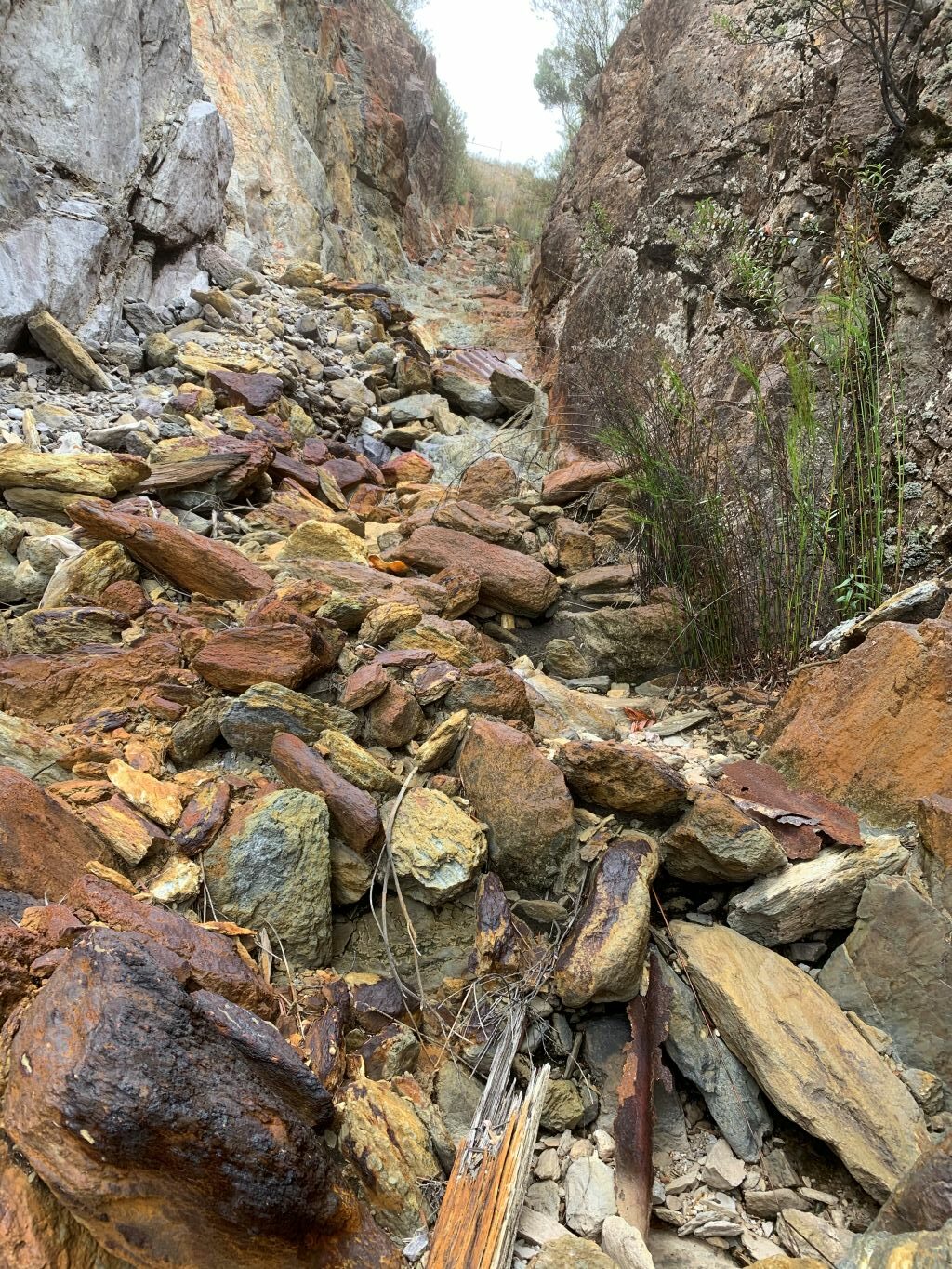
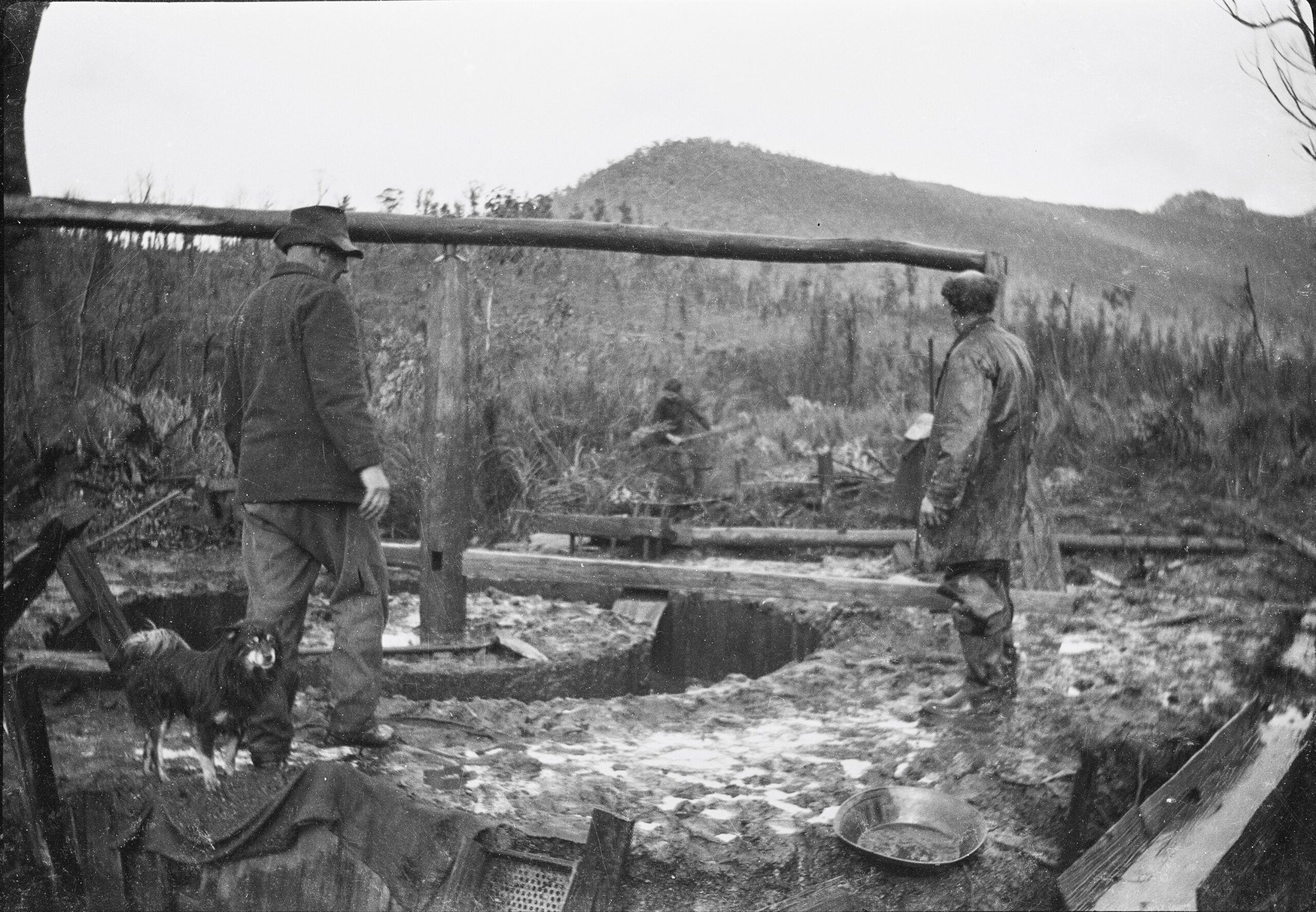
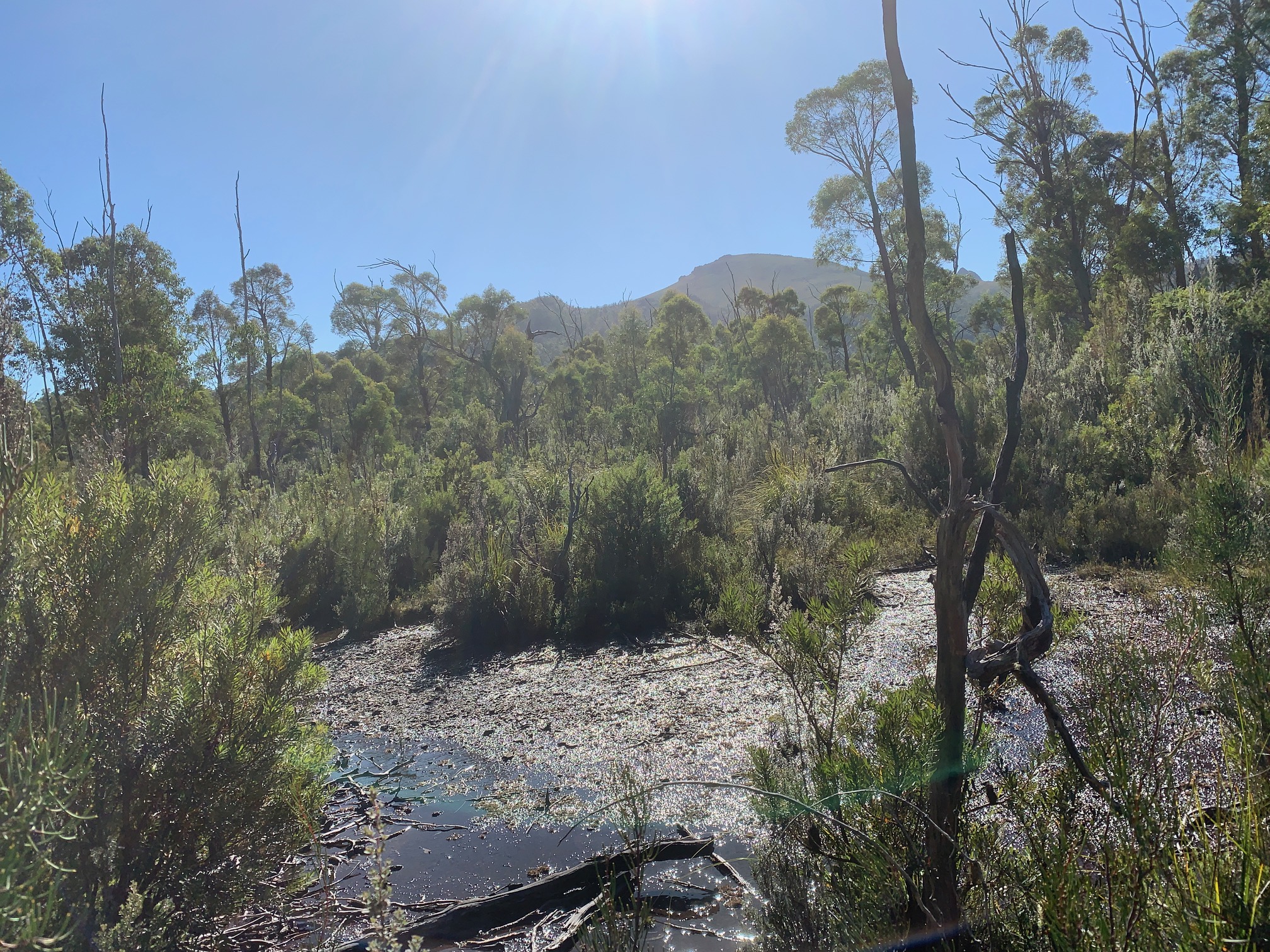
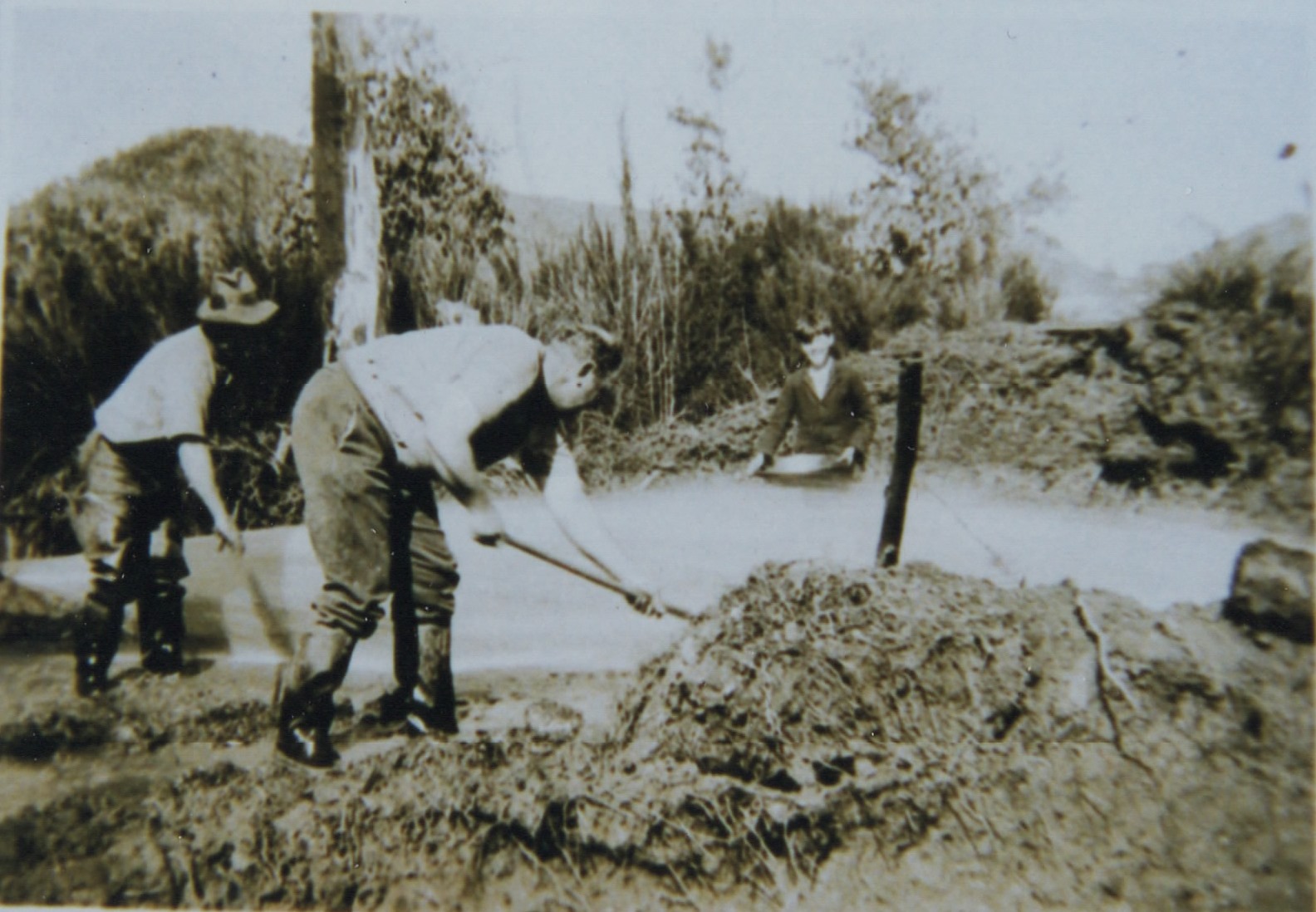
If William Long was alive today he’d be 210. Or maybe 206. One-hundred-and-fifty of those years have been spent on the Mount Bischoff Tin Mine, which is hard yakka by anyone’s standards. He was there while the mighty Brown Face was whittled away to line food cans and make solder, bronze and pewter. The underground firings shook his bones. Then everything went quiet but for a bandicoot or two. He was probably still lying in state when Bluestone/Metals X dug a big hole in 2008 to supplement their Renison crushings. Now he’s possibly a native revegetation consultant (NRC), pushing up tea-trees rather than daisies on a parched surface.
Who was this William Long who died at Bischoff in 1876? He may have been one of five convicts of that name. There is insufficient information to make a call. Convict number five was transported to Van Diemen’s Land for seven years for falling asleep at his sentry post at the York Barracks. A bit harsh, surely. Whichever convict (or none) he might have been, 52-year-labourer William Long married 39-year-old schoolteacher Mary Ann Wilson by Congregational rites at her home at Forth in 1872.[1] Mary Ann was assistant teacher at the Forth Public School and was probably living in the teacher’s quarters of the school at 97 William Street.[2] In 1875 William and Mary Ann Long bought Lot 23 at what is now 684 Forth Road and commissioned or built the cottage there today.[3]
Money was tight for the Longs but the tin mines at Mount Bischoff brought opportunity. William Long packed out ‘heads’ (nuggets of tin) for the Mount Bischoff Co at a time when the mine was very remote, with bullock and horse teams providing most of the transport. There was no tramway to Waratah, just a boggy track from Emu Bay.
Bischoff was no place to get sick. There was no resident doctor. In 1874 a Mount Bischoff mining manager named William Kappler received medical attention too late to save him from pneumonia at the age of only 29.[4] In lieu of a cemetery a grave was dug for him on the eastern side of Waratah Falls—but it was never filled.[5] William Henry paid for the removal of Kappler’s corpse and he now lies in an unmarked grave at the Don Congregational Cemetery.[6]
William Long had no posthumous benefactor. The Longs appear to have been practising dietary self-denial to save money.[7] William’s official cause of death was ‘general debility’[8] but Mount Bischoff Co Mine Manager Ferd Kayser seemed to blame malnutrition. At a time when Kayser was under fire for his mining methods and harsh treatment of bullock drivers, he felt keenly the wrath of Mary Ann Long, who apparently blamed him for her husband’s demise. ‘All I can say is that everything [was] done, what was in our power under the circumstances both before as well as after his death’, Kayser told ‘Philosopher’ Smith. ‘All he wanted was nutriment and so far as our stores at hand [could] do him any good he was supplied. The greatest fault was that he was fairly neglected by himself and it appears nothing could save him …’[9]
Forgotten for 45 years
Bill’s demise didn’t make the newspapers for 45 years. Why? Newspaper reports from remote places relied on local correspondents. The Launceston Examiner’s Waratah correspondent in January 1876 was Mount Bischoff Co Assistant Mine Manager Charles Hall.[10] Perhaps he was too busy helping his boss berate the ore carters and finesse the half-yearly mining report to worry about a Waratah column. No newspaper ran a report from Waratah during the month of January 1876. William Long was not discussed at Mount Bischoff Co directors’ meetings nor mentioned in the half-yearly report tabled that month. Money and careers were at stake. Labourers were of no consequence.
Long’s celebrity began in 1921 and was short-lived. In that year the Advocate’s travelling correspondent stated that Long was buried on the mountain, ‘close to the camp, the grave being marked [in 1921] by a gum-tree planted near the spot’.[11] This suggested that Bischoff miners of the time knew of the grave. The camp on the mountain mentioned by the reporter would have been the gathering of huts near the Slaughteryard Gully Face.
To fence or not to fence
Then came some old-time reminiscences of the mine. In December 1921 Charles Thompson revisited his old stamping ground. Forty-five years on the former miner recalled Long packing out ‘heads’ from the mining face to the ore washing facilities at the Waratah Falls. The packer was buried
near to the huts on top of Mount Bischoff. At a later time it was discovered that the ground chosen for his burial was in rich tin bearing country. The ground all round [sic] the spot has been worked out, but the grave of Bill Long has been left undisturbed. Its white fence and solitary small gum tree is a landmark.
The site was within a ‘stone’s throw’ of the Brown Face.[12]
Only Thompson mentioned the white fence. How long did it stand? Perhaps it was gone by 1927 when former ore carter Richard Hilder ‘turned his steps’ from the Brown Face to pay his respects at ‘the resting place of an early miner whose body lay securely enfolded beneath the gnarled roots of a sickly looking stringybark tree’.[13]
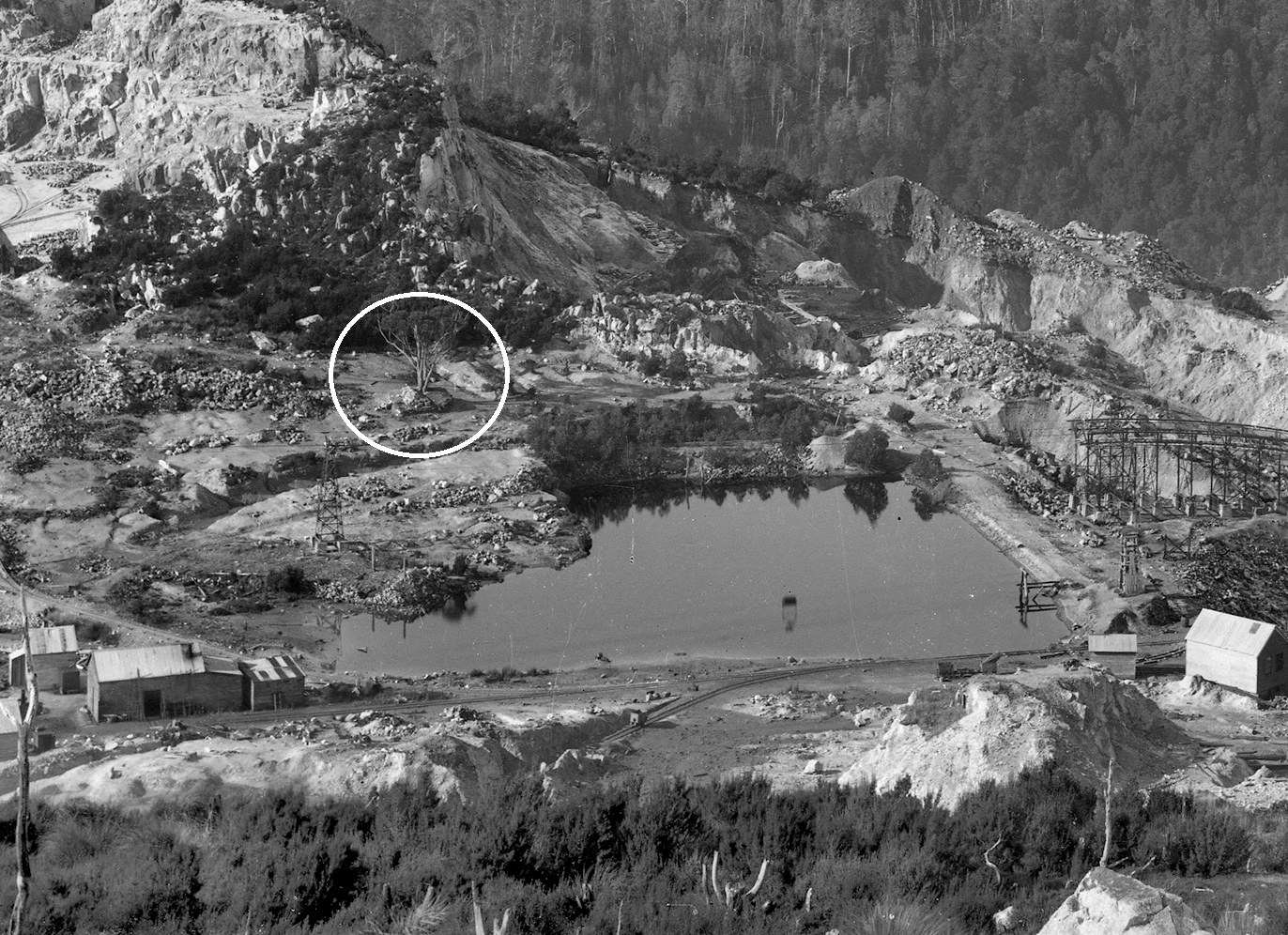
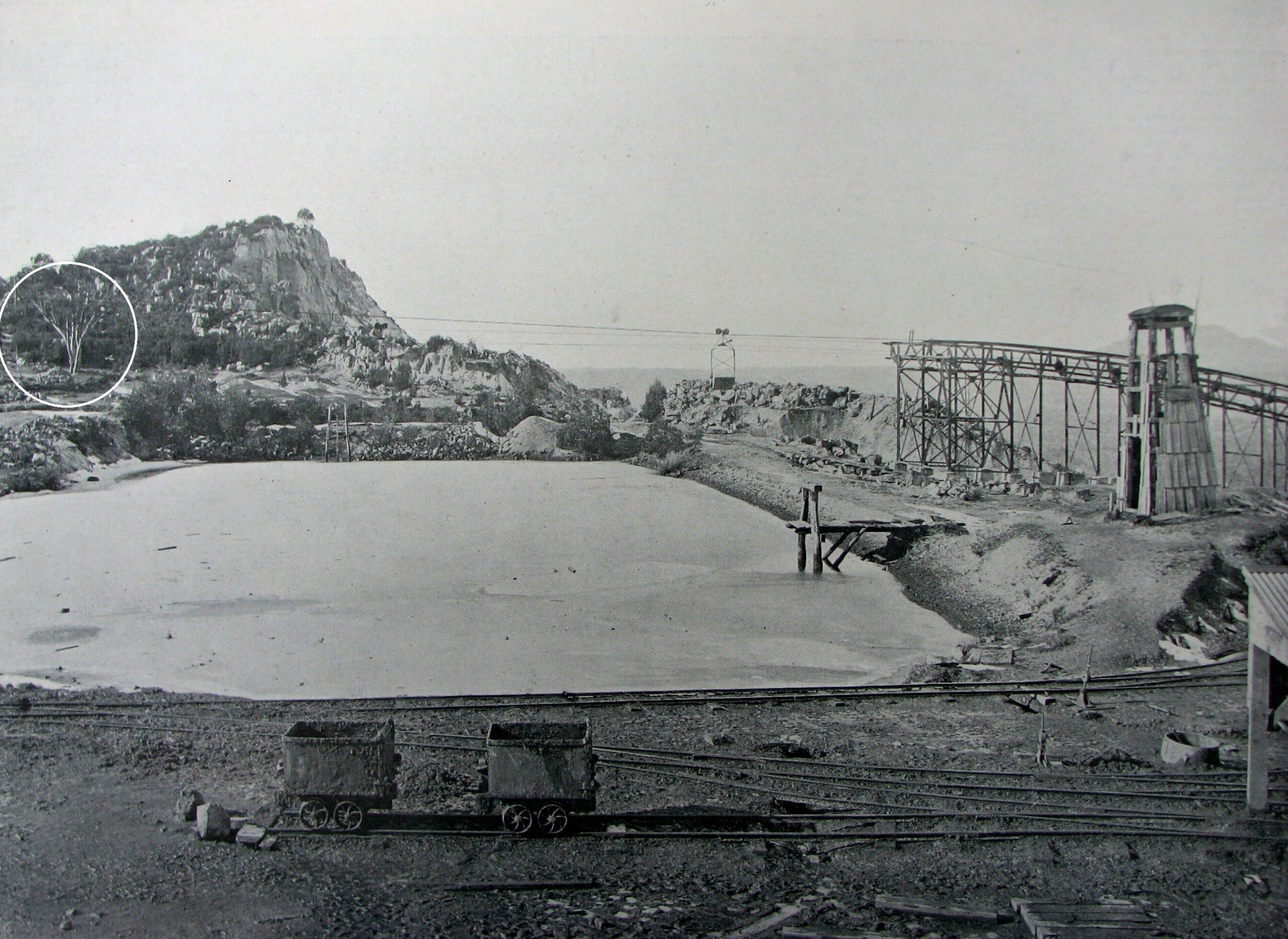
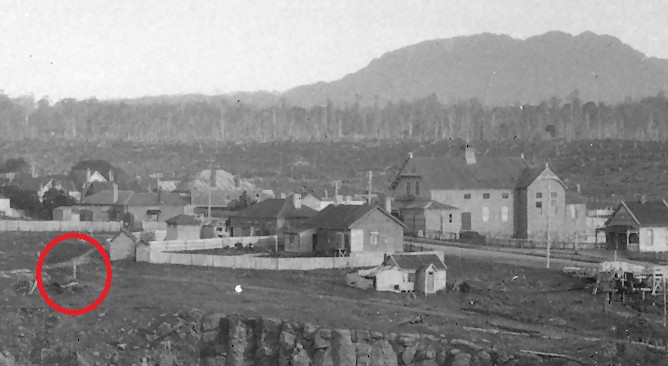
Two JH Robinson images showing the conspicuous tree. The top one is 1998_P_1569.02 (QVMAG). The bottom photo is from the Weekly Courier, 30 July 1914, p.17.
Finding the solitary stringybark
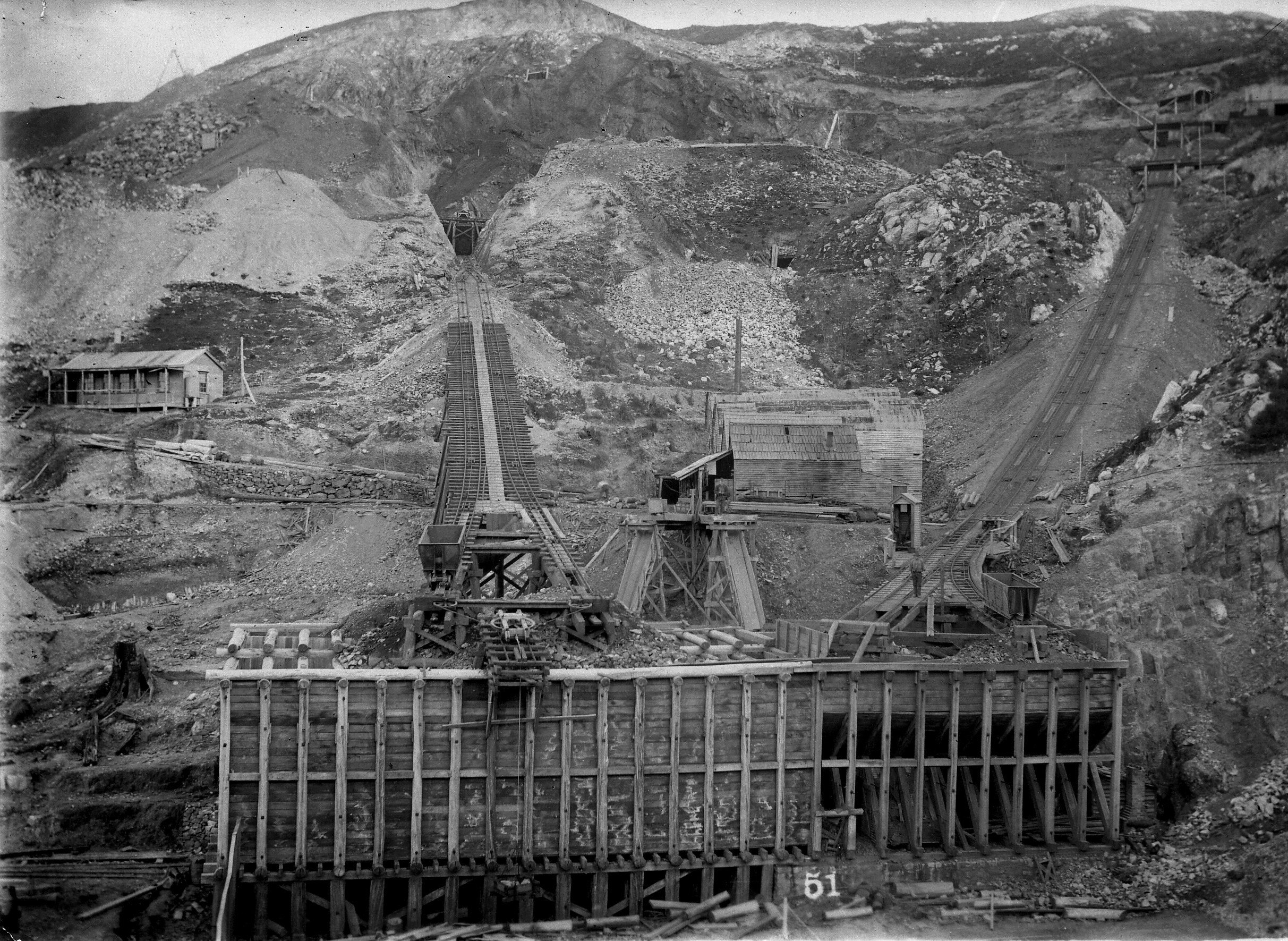
That solitary stringybark near the huts and the Brown Face should have stood out. Jackie Robinson, Waratah’s resident photographer, must have captured every green filament on the mountain with his roving lens. Working for the Mount Bischoff Co, Robinson recorded all aspects of the Bischoff operation and lease. But I couldn’t find a Robinson photo of a grave on Mount Bischoff.
Was it in his photos anyway? Jackie took several photos of the Bellhouse Dam region above the Bischoff loading bays in the period c1910–50. It’s hard to date some of them, the only milestone being the 1914 advent of the aerial tramway that carried ore across the mountain from the North Valley workings. Although it was abandoned in 1920 when fire destroyed the northern section of line the pylons were never removed.
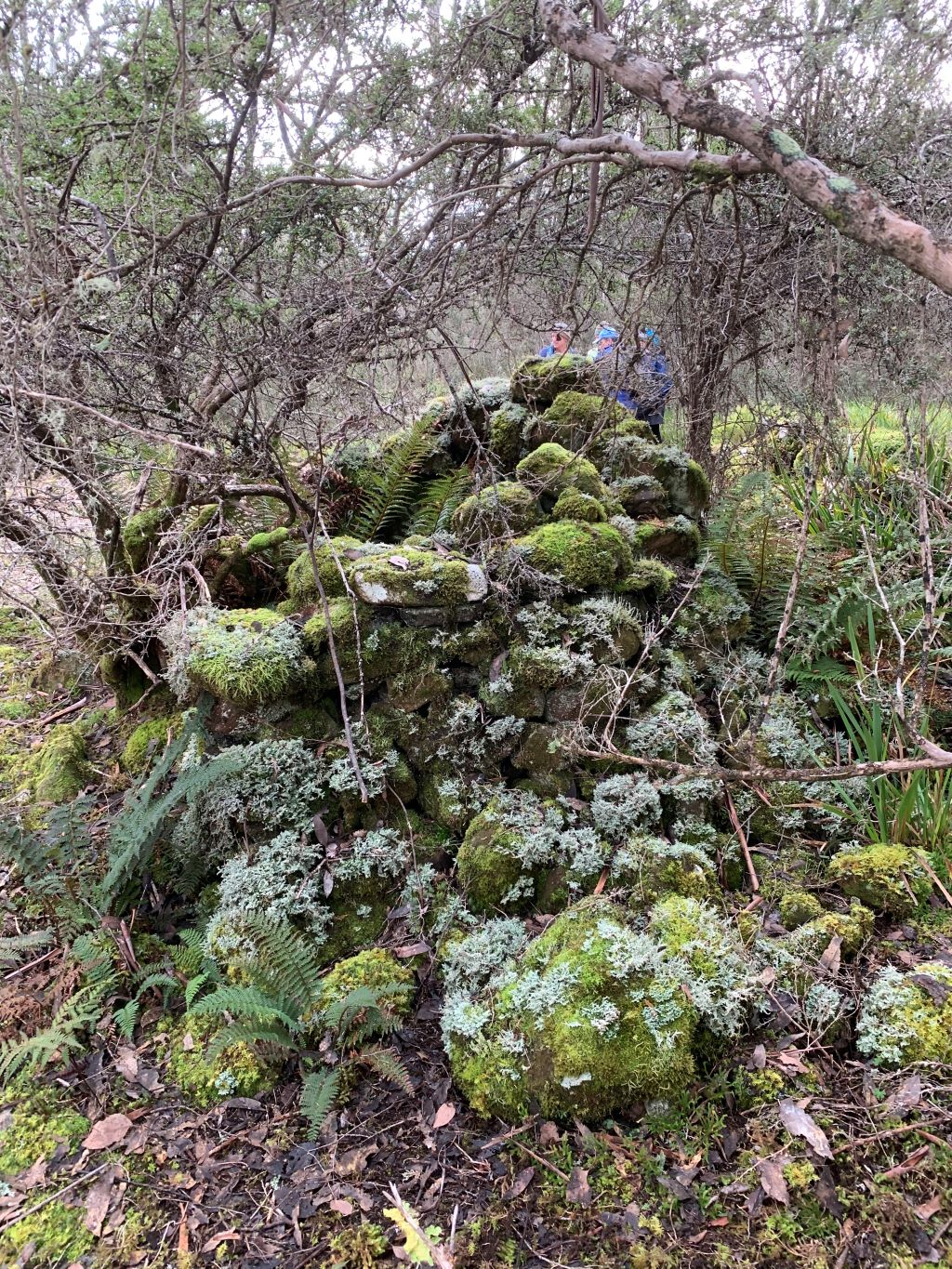
But one tree has a conspicuous presence in Robinson’s photos. A pre-aerial tramway shot of the area covered in snow shows a small tree a few metres to the north-east of the Bellhouse Dam. The tree was there again in a 1914 photo. The clincher for me was another photo which not only showed the tree but a mound of stones beside it. No white fence, but a distinctly squared area with a mound of stones upon it.
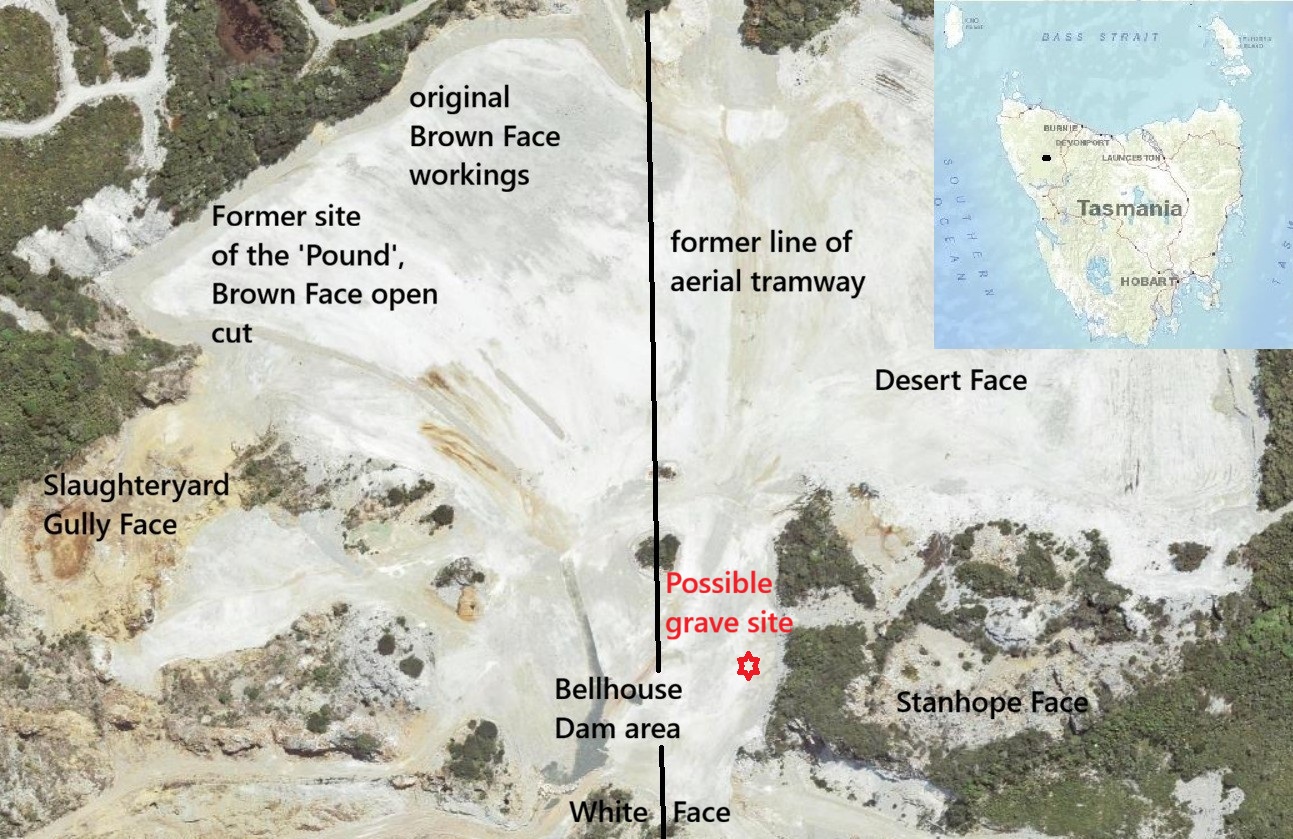
Mount Bischoff, showing the site of the possible grave. TOPOGRPAHIC BASEMAP FROM THELIST, STATE OF TASMANIA
Long’s present whereabouts
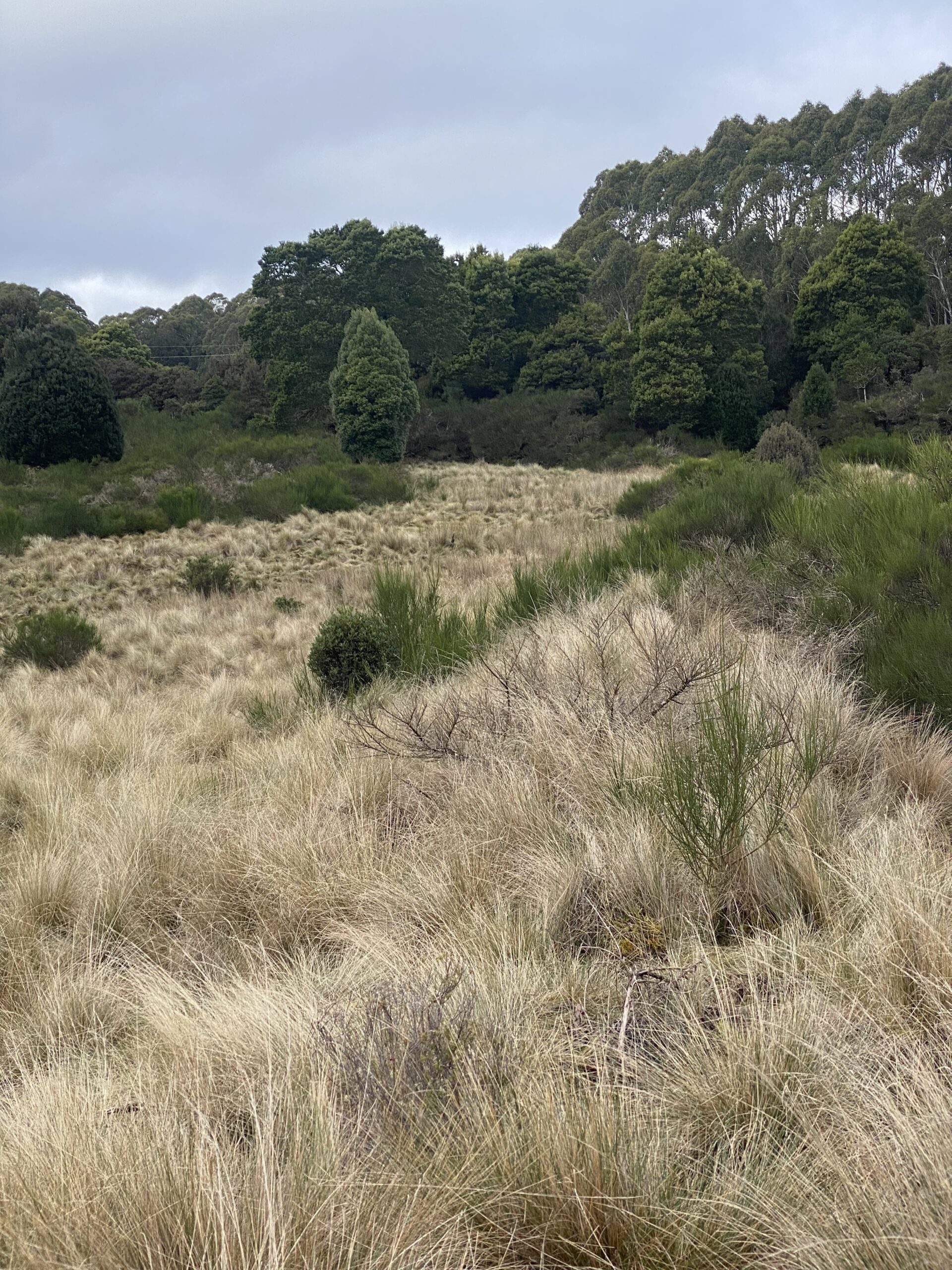
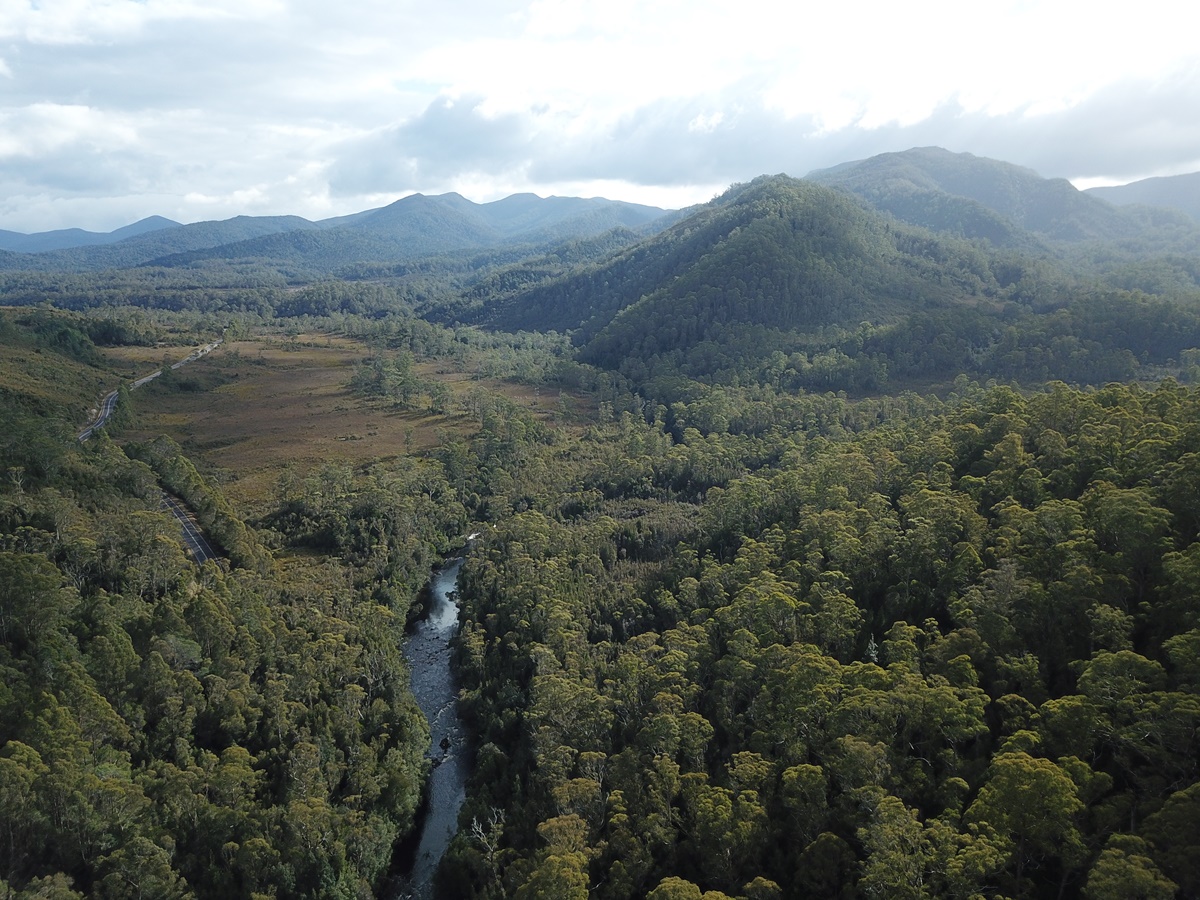
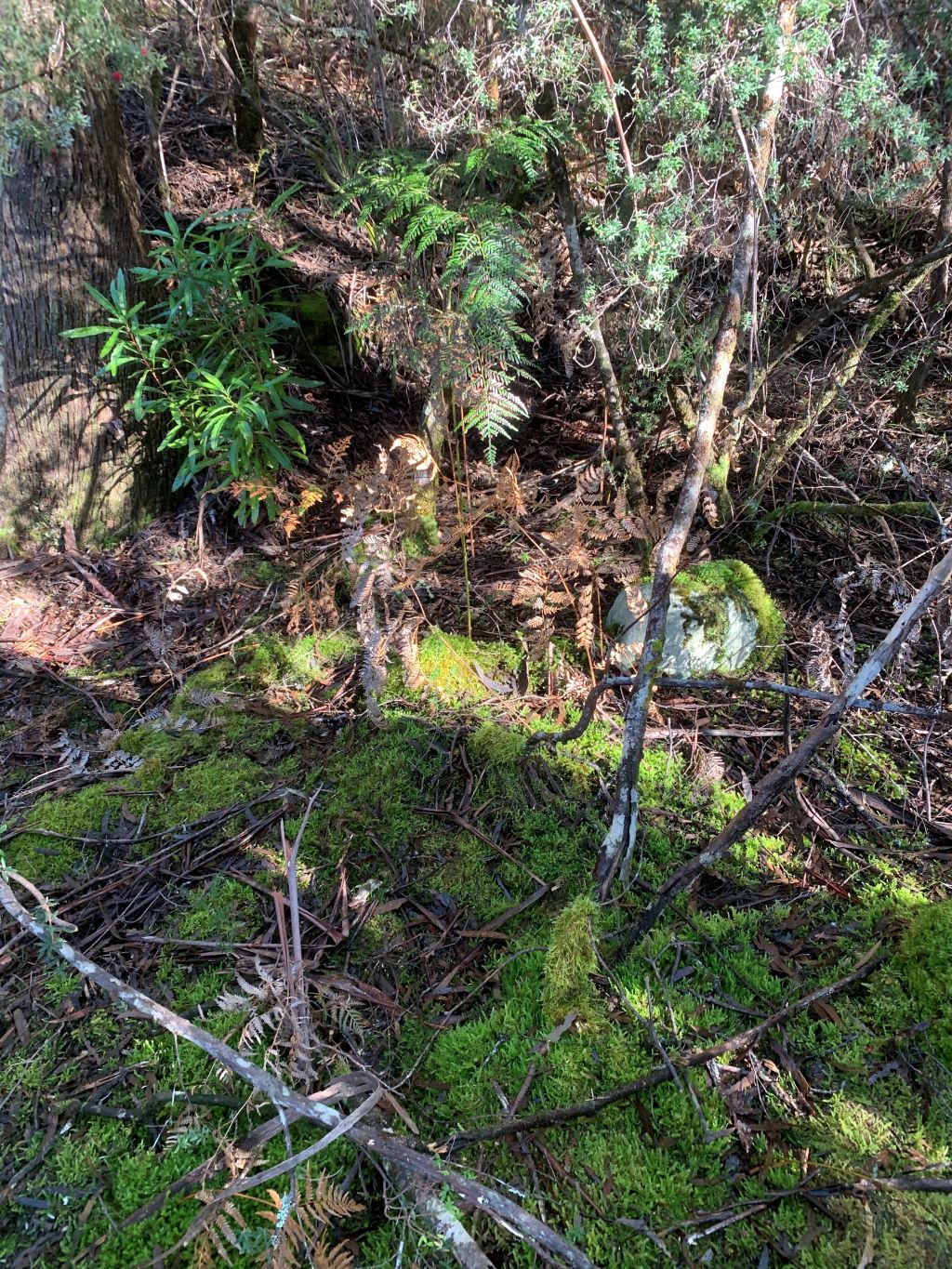
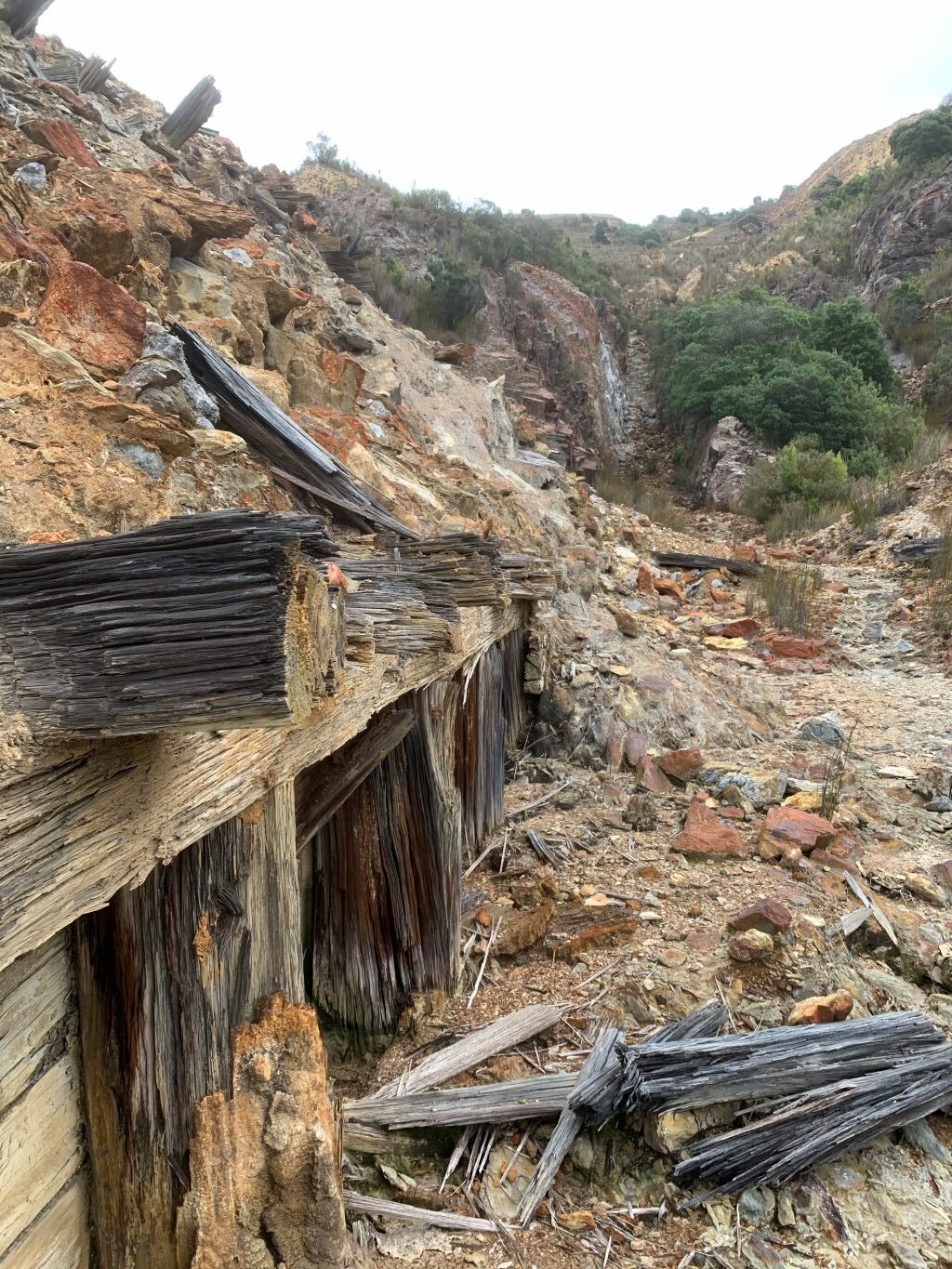
The Bellhouse Dam area had a hair-cut long before Bluestone cropped the surface further. The dam is long gone, but two small patches of vegetation in the same general area drew my attention. The more southerly patch contains two mounds of earth and stone, one about 2m long, the other about 3m. Nice! Unfortunately, the two vegetation clumps also contain the fallen pylons of the old aerial tramway, which is why they were saved from ‘rehabilitation’. Based on evidence in the old photos, the ‘grave’ had to be 20 to 30m further to the south-east.
That area is a flat, feature-less mining thoroughfare speckled with small tea-trees. It looks as if William Long’s stringybark tree and grave marker were bulldozed away decades ago during mining operations. He is possibly still there beneath the surface, but the ground is hard and compacted, certainly not amenable to the burial pick and shovel. May he rest in peace one day, when Bischoff’s wealth is finally exhausted and all the ore trucks are rusting in their own industrial graves.
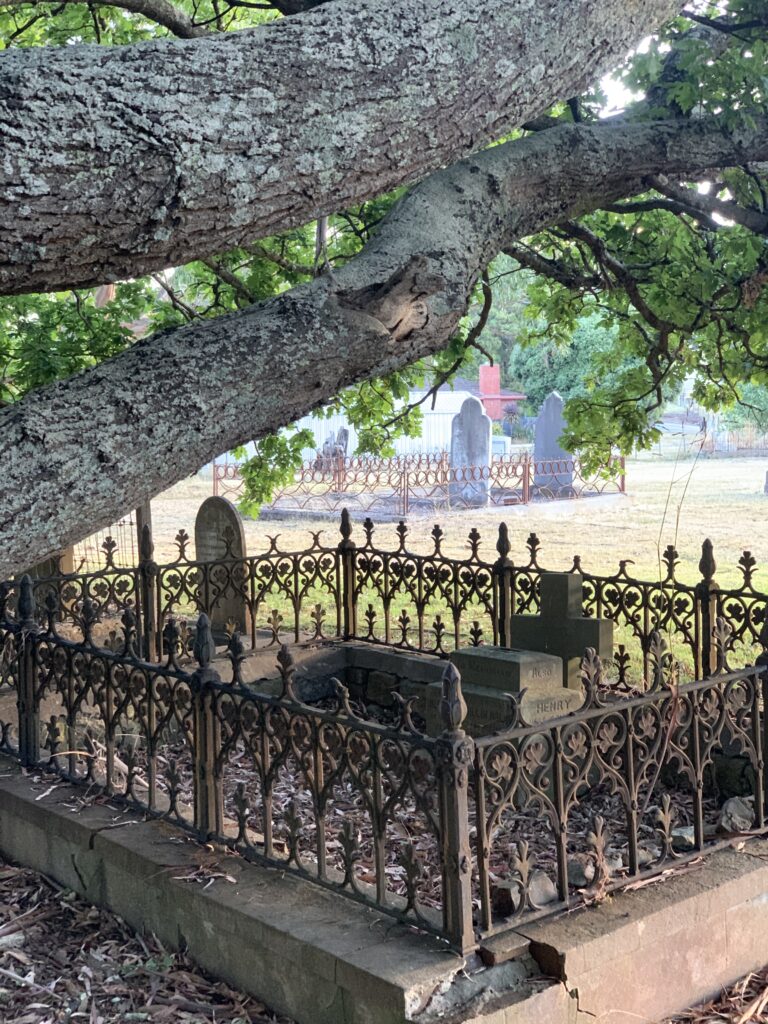
Henry Walker’s grave in the Forth Congregational Cemetery and the place where he died, the gully where the Bischoff Co Tram crossed Stone Dam Creek near Waratah.
What’s this post behind the Police Station in an old JH Robinson photo? The remains of a cross?
Other early deaths at Mount Bischoff/Waratah
The Waratah Public Cemetery was not established until 1879.
On 5 July 1875 64-year-old labourer Edward Hargraves died at Waratah of ‘decay of nature’, although it seems no inquest was conducted.[14] Old Bischoffite Charles Thompson claimed he was buried behind the Waratah Police Station.[15]
On 22 April 1876 59-year-old storekeeper Henry Walker was crushed to death by iron after being thrown off the Mount Bischoff Co Tramway while it crossed a gully.[16] His brother Alfred Walker blamed the Mount Bischoff Co for Henry’s death since, he believed, it blocked the road deliberately with a fallen tree to monopolise the traffic between Rouses Camp and Bischoff.[17] Henry Walker was buried with family at the Congregational Cemetery, Forth.
On 10 April 1877 60-year-old labourer John Guest died of ‘organic disease of the heart and dysentery’ in a bakery at Waratah.[18] His body was kept in situ for nearly a week, awaiting the coroner from Emu Bay, who never came, after which time he was buried.[19] His final resting place is unknown. Hopefully the bakery regained its custom.
[5] Unless you believe Charles Thompson, who claimed that Edward Hargreaves was buried there. See ‘Early days of Waratah: pioneer’s reminiscences’, Advocate, 13 December 1921, p.6.
[6] Richard Hilder, ‘That empty grave at Waratah: story of remarkable incident of 1873’, Advocate, 25 July 1927, p.8. Now that the Weindorfers have cleared out of the Don Congregational Cemetery perhaps Kappler could have their redundant headstone.
[7] James ‘Philosopher’ Smith to Ferd Kayser, 5 February 1876, NS234/2/1/3 (TA).
[9] Ferd Kayser to James ‘Philosopher’ Smith, 18 January 1876, NS234/3/1/5 (TA).
[10] Hall gave up the anonymous correspondent role in June 1876 when he feared he would be ‘outed’ by Kayser, who was unimpressed with the correspondent’s criticism of his work. See Charles Hall to James ‘Philosopher’ Smith, 24 June 1876, no.194, NS234/3/1/5 (TA).
[11] ‘Our Special Reporter’, ‘Waratah mining fields: early days and future prospects’, Advocate, 6 July 1921, p.4.
[12] ‘Early days of Waratah: pioneer’s reminiscences’.
[13] Richard Hilder, ‘That empty grave at Waratah’.
In the centre of Tasmania is an entertainment zone where the rules of decency are blurred. He-men brandishing ski poles, their bare nipples lasering the path to the Narcissus jetty, bleeding kids wondering if leeches are protected by UNESCO, beautiful, unwashed young couples smelling like a long-drop and swarms of flies experiencing the disappointment of tofu all help pickle the romance of the Overland Track between Dove Lake and Lake St Clair.
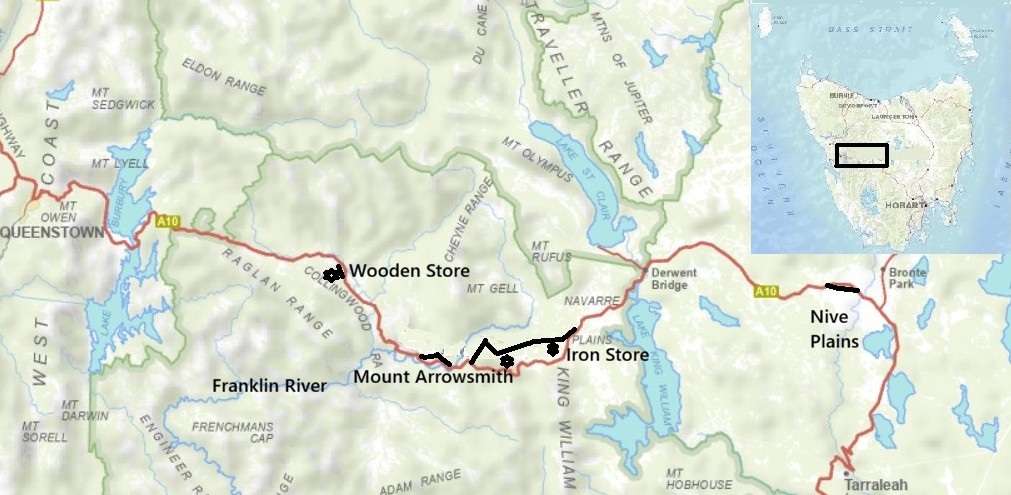
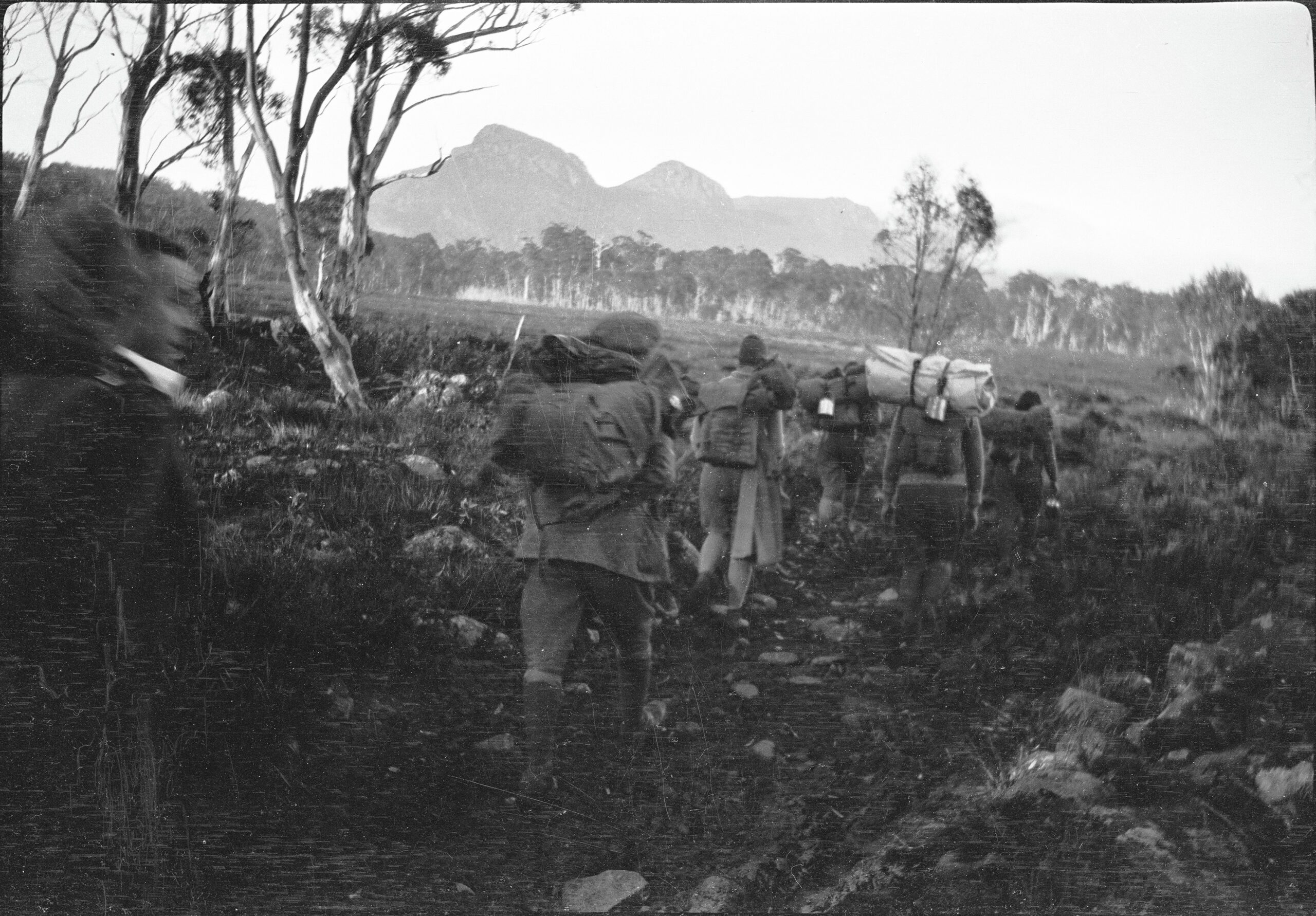
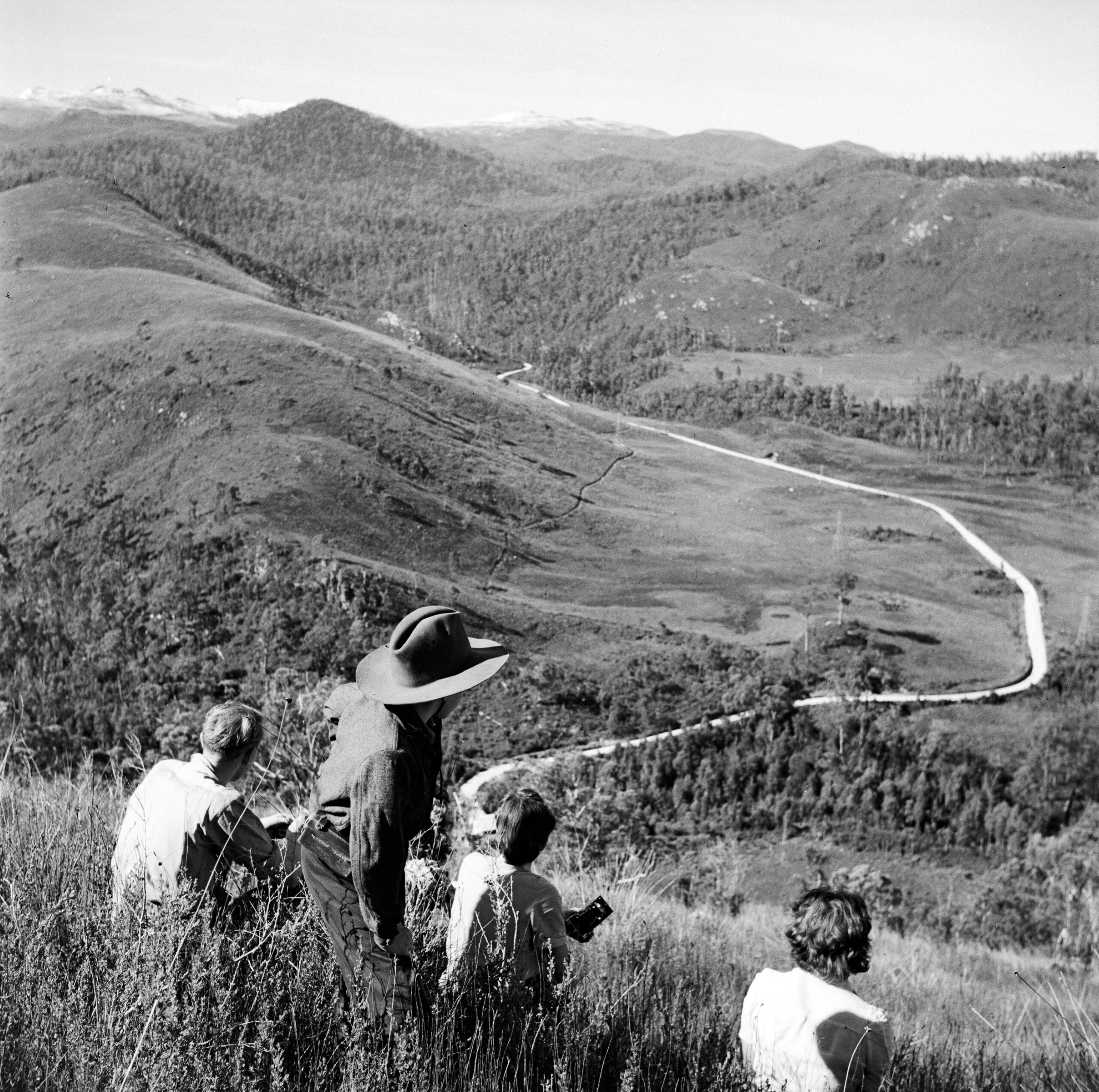
What about the original Overland Track? How did that compare as a mountainous hikeathon? Ye olde Trip Advisor is silent on that one. Snaking a path between the Nive River district and Mount Lyell, this Overland Track was Hobart’s nineteenth-century conduit to mining riches. The Linda Track, as it was otherwise known, bore a hint of James Calder’s 1840s trackwork but its heart was late-Victorian. Its comforts were too. No boardwalks, no signage, no tent platforms, no rangers, no chai-latte-tendering, guided private expeditionary services. Only a few bridges over major streams but plenty of opportunities to die of exposure. The history of the Linda Track is spiced with the same arguments about public safety as that of the present Overland Track—but at least it had Tom Moore as a guardian.
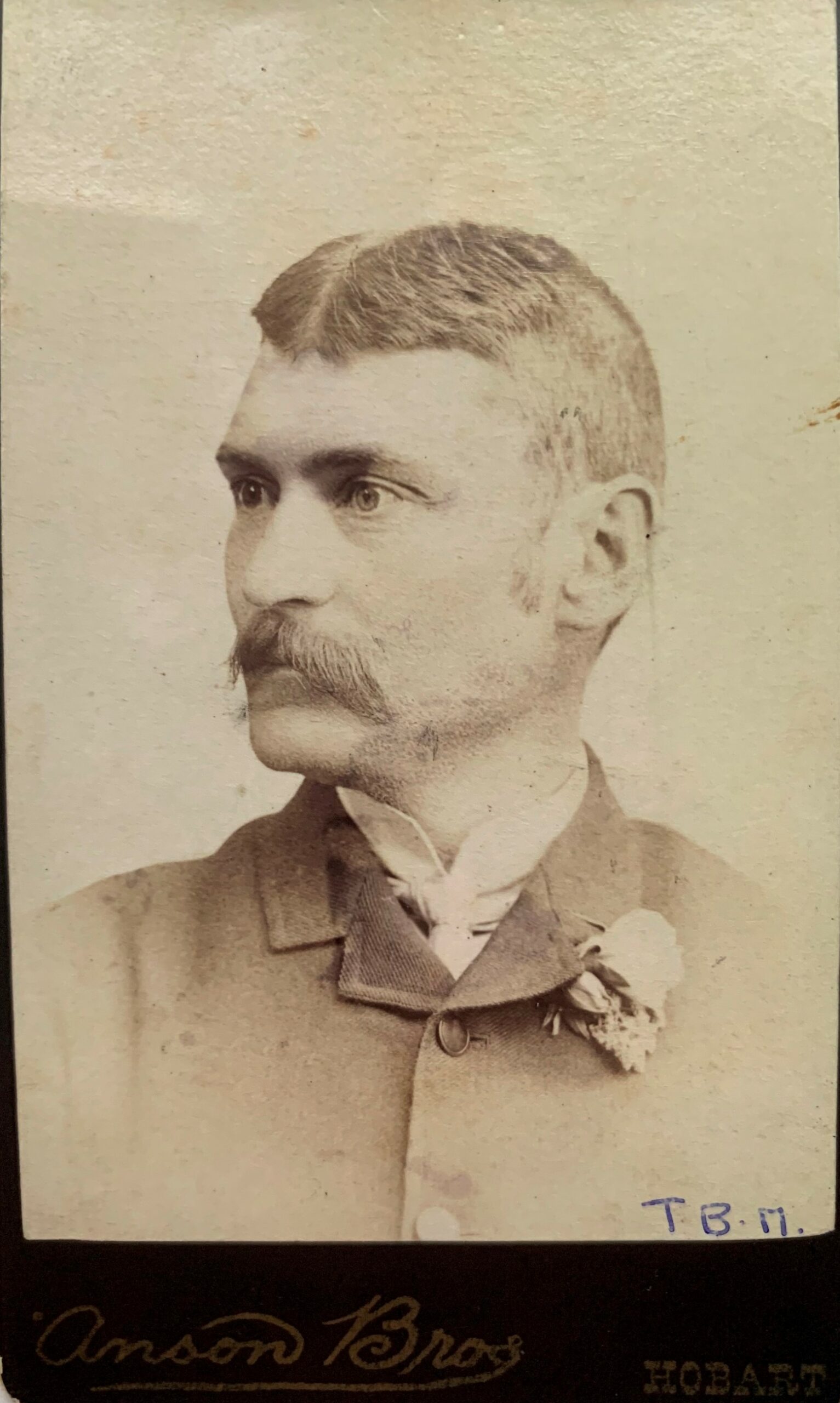
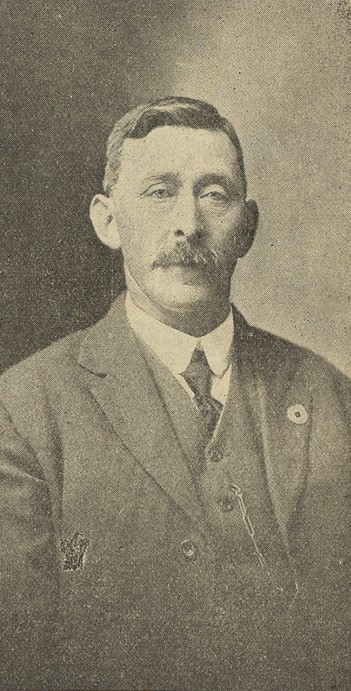
Tom Moore in middle age. Anson Brothers photo courtesy of Margaret Elliston.
Tom Moore and the Mount Lyell Iron Blow
Anyone who has been a prisoner of their own tent will wonder at the curiosity, the ambition and the dedication of Thomas Bather Moore (1850–1919, aka Tom Moore or TB Moore). Each night in the bush, after retiring rain-sodden from the mud and a feed of echidna or wallaby, by candlelight in his tent Moore kept his immaculate diary, sometimes adding lines of philosophical verse, botanical notes or observations of comets and earth tremors. Moore’s solitary exploration work, endurance and scientific interests made him a legendary figure on Tasmania’s West Coast.
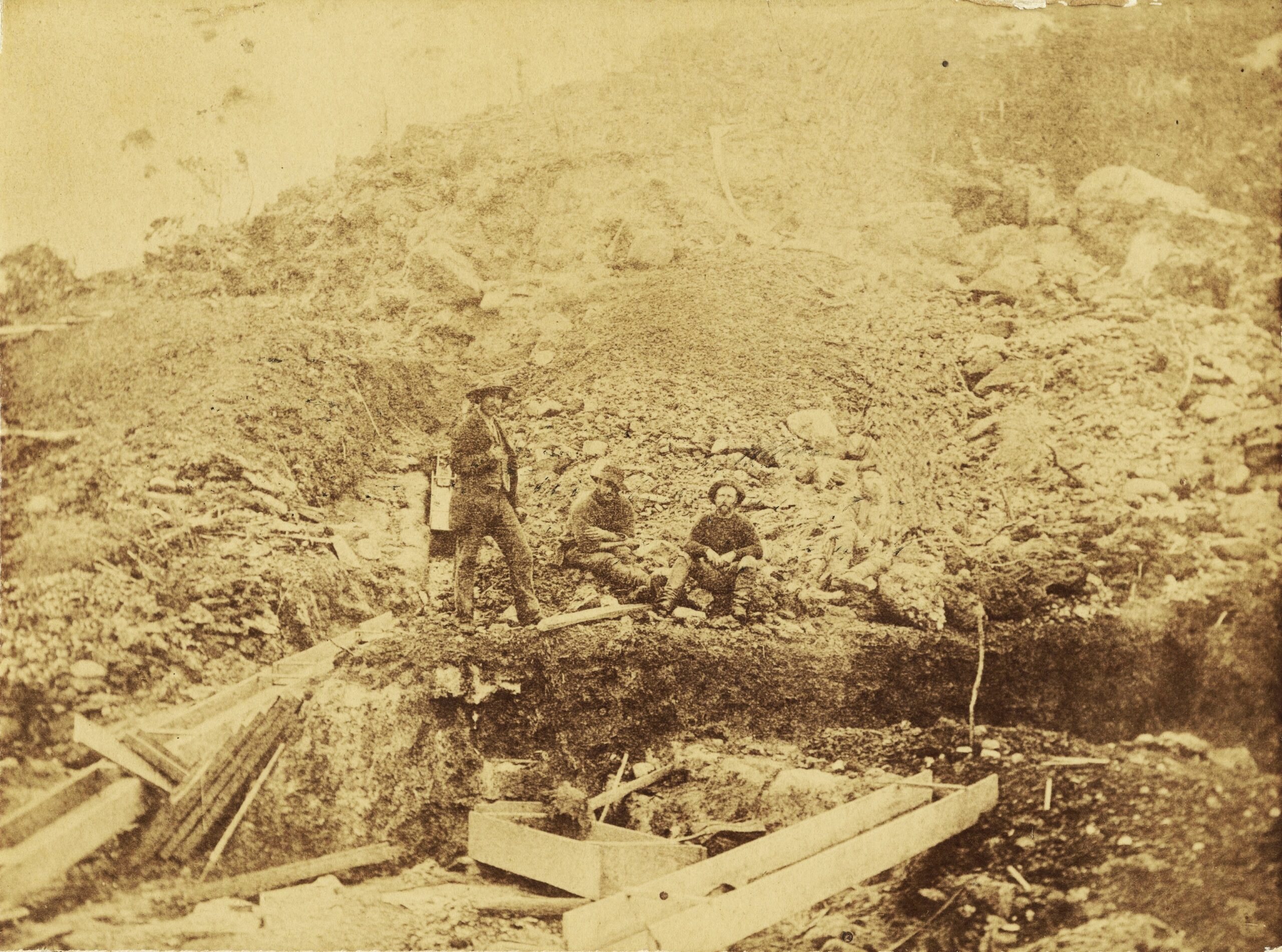
His chance to be known as a successful mineral prospector went begging—and this is really where the story of the Linda Track begins. In February 1883 Moore and a party of three including his brother Jim (JLA) Moore searched for an access route from Lake St Clair through to the West Coast. Near Mount Arrowsmith they established a supply depot. During the trip Moore named many features which are seen along the present-day Lyell Highway.[1] Entering the Linda Valley, Moore’s party climbed into the divide between Mounts Owen and Lyell, and while traversing what is now Philosophers Ridge discovered copper and iron pyrites. They also noticed the dark-coloured formation of boulders later known as the Iron Blow. According to Moore, another prospector and track-cutter, Tom Currie, found gold at or near the Iron Blow before being forced to withdraw from the field by illness.[2]
The Mount Lyell Iron Blow in 1884, presumably showing the three original lessees and one other. The fourth figure at right is almost ghostly. From NS3245/1/243 (TA).
Moore’s party was in no hurry to examine the Iron Blow. The appearance on the scene of ‘new chum’ prospectors, the brothers William and Michael McDonough, plus Steve Karlson, did not worry the Moores either, since they believed they only wanted to prospect the creeks for alluvial gold.
When Moore next visited the Iron Blow site, he was surprised to discover that the McDonoughs and Karlson had pegged a 50-acre prospecting area around the Iron Blow. Moore later conceded that underestimating the ‘new chums’ had cost him the chance to peg one of Tasmania’s greatest mineral treasures.[3] However, had Moore pegged the Iron Blow, it is possible that he would have fared no better than the prospectors who did. Their shares were surrendered for want of money, service providers and sharp investors being the beneficiaries of their plight.
Moore’s only consolation from his Iron Blow blunder was obtaining track-cutting work that served the discovery. The goldfield attracted a lot of attention in Hobart. In November 1885 he applied for the position of superintending overseer in the construction of the proposed track from the Marlborough property on the Nive Plains via the Collingwood Valley to the King River goldfield. Engineer of Roads William Duffy recommended Moore’s appointment because his knowledge of the country would be valuable in determining the route and securing the best line.[4] Moore accepted a salary of £4 per week, his duty being to mark a track in advance of the work gangs.[5] He showed the value of his experience immediately upon arrival at the Clarence River when he suggested a better way to supply the men and larger work gangs. He recommended setting up a store and employing a storekeeper. Pack-horses which conveyed supplies, Moore contended, could also be used in the haulage of logs and timber.[6]
The 1915 iteration of the Iron Store complex of buildings. From the Tasmanian Mail, 21 January 1915, p.18.One of the gargantuan chimney butts at the Iron Store site today. Nic Haygarth photo.
Building the Iron Store
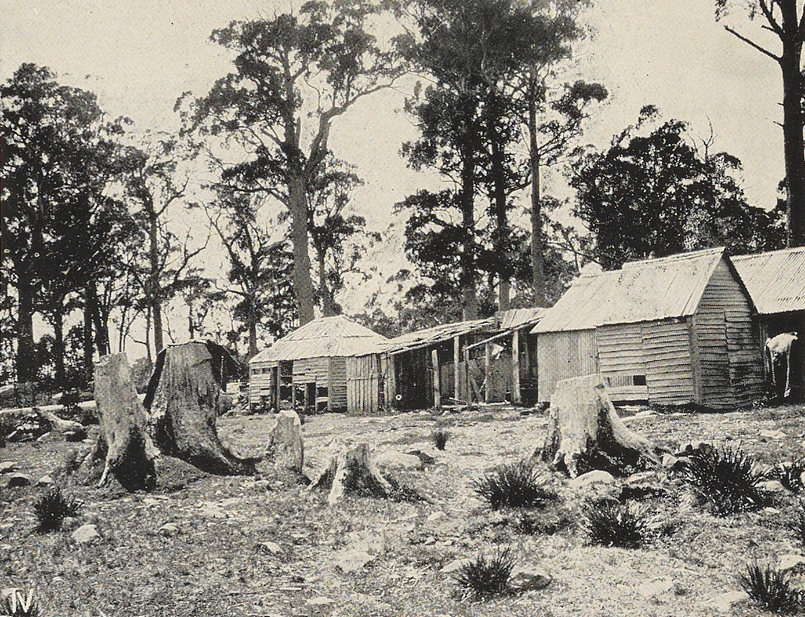
In his track work Moore chose to follow the general line of his 1883 route to Mount Lyell, settling on a route over Mount Arrowsmith.[7] He decided to erect the so-called Iron Store at King William Creek, on the site of his 1883 supply depot, the materials being packed in from Hobart. George Bray was appointed storekeeper. No additional hut was built simply for shelter at this time, although before the season closed Moore’s fellow overseer George Walch erected a slab stable to accommodate four horses.[8] Moore resented sharing command with Walch, whose management style frustrated him. He sought to undercut the other man by suggesting efficiencies and better methods of bridge building.[9]
Meanwhile, the track builders worked nine hours per day instead of the prescribed eight through the autumn, with the understanding that they were paid for days when the weather made it impossible to work. Moore proved a difficult man to control from head office. When ordered to stop work in April 1886, he refused, claiming that there was at least a further month of good weather ahead. Engineer of Roads William Duffy complained that ‘It will be impossible to work with a gentleman who refuses to obey such simple and necessary routine orders’.[10]
The Collingwood River Valley looking west, with Pigeon House Hill in the background at right, and Redan Hill, site of the first Wooden Store, in the foreground at left. Shane Pinner photo.Platform of the original Wooden Store today, beside the Linda Track at Redan Hill. Nic Haygarth photo.
Building the Wooden Store
Duffy got over it. The Lands Department needed Moore’s knowledge and drive. Moore requested the construction of another stores depot and shelter hut in the Collingwood Valley which would ‘eventually be useful as a halfway shelter hut’.[11] This hut was among the future needs he listed in his diary:
Stable at the Collingwood River 24 long 9 ft wide
6 ft being 12 front high & four stalls & chaff house 4 ft wide
(Palings 280 6 ft 200 5 ft) (4.6 wide)’
Huts required
From store depot [Iron Store]
Timber can be obtained without much difficulty.
West bank of Franklin R. 7 or 8 miles
West bank of Collingwood R 15 to 16 —
The Bubbs Victoria Pass 25 or 26 —
Huts to be built of six feet palings
18 feet long 10 feet wide 6 feet high
rafters 7 feet long, partition for sleeping 8 wide
with 4 feet chimney (store room 10 x 10 wide)
with door lock & key 2 ft sq window in gable with hinges & fastenings
While Moore’s plans for huts at the Franklin River and Bubbs Hill were shelved, the so-called Wooden Store and stable were built on the edge of the Linda Track at Redan Hill, overlooking the Collingwood River. These buildings lasted only a dozen years, gradually being destroyed by travellers, with the bunks pulled out, the door ripped off its hinges, the window broken and the timber chimney attacked with an axe.[13]
The Mount Lyell Iron Blow, battery, loading ramp and haulage, 1890s. James Huntley Clarke collection, NS6313/1/67 (TA).Loading facility and haulage at the Iron Blow today. Nic Haygarth photos.
Gold at Mount Lyell
In the winter of 1886 reports of fabulous gold assays circulated from the Mount Lyell Iron Blow. Inspector of Mines Gustav Thureau compared the Iron Blow to the famous gold deposits of Mount Morgan in Queensland, predicting a bonanza of ‘practically inexhaustible’ gold at Mount Lyell.[14]
The Iron Store showed its value as a shelter when excited investors despatched mining ‘experts’ to inspect Mount Lyell. In February 1887 Iron Storekeeper Bray took pity on one of them, Theophilus Jones, the itinerant, poverty-stricken journalist who was wending his way back to Hobart after being abandoned by the newspaper that sent him out. Jones reported gratefully that
Mr Bray, with that fine feeling, often displayed by those used to fatigue towards another on the march, insisted on my being seated to gain all the rest possible, whilst he went to the stream for a billy of water to make the ever refreshing tea, and when the infusion was ready helped us bountifully to his stores of tinned meat, etc.[15]
The Mount Lyell Gold Mining Company was registered in Launceston in 1888, echoing the momentous establishment of the Mount Bischoff Tin Mining Company there fifteen years earlier.[16] Unfortunately, Mount Lyell also had a much more complex ore body than Mount Bischoff, and was more isolated requiring more capital investment than the Launceston company could raise.
Alfred Taylor, from the Tasmanian Mail, 11 December 1919, p.20.
The trail runner for the telegraph line
The present Overland Track measures 65 km from Dove Lake to Narcissus, with four intervening huts. The original Overland Track was 98 km from Nive Plains to Mount Lyell with initially just two huts. 1890s telegraph lineman Alfred Taylor would challenge modern ultra athletes skipping from Cradle to St Clair in a day. Broken culverts and fallen trees forbade horse travel along the Linda Track in the early years. Thus Taylor often hotfooted 138 km in three days from the Clarence River to Strahan. The ravenous tiger cats at the Iron Store may have prompted Taylor to sprint 58 km on the first day to avoid it by reaching the Wooden Store. A swig from the brandy flask would help him sleep through the cold (in winter) and the mosquitoes (in summer). Next stop was the Queen River Hotel, 45 km further on, where a jug of beer awaited him. Strahan, the end of the journey, was another 35 km beyond that. If a steamer was in port, Taylor would take the 6.5-day voyage to Hobart, otherwise retrace his steps to his home at Dee River.
The telegraph line from the Iron Store to Strahan, connecting Hobart to the western seaboard, was the work of brothers John, James and David Pearce in 1891–92. Taylor supervised their contract work and then continued as lineman. He described a daily menu of bully beef, bacon, wombat and honey stolen from hives in the myrtle forest; and a daily routine of being soaked to the skin and camped knee-deep in mud among swarming tiger cats. Leeches didn’t seem to bother him.[17]
Taylor the human snow plough
The annual Cradle Mountain Run now pushes marathoners the full 80 km from Cradle to the southern end of Lake St Clair. How would they have fared on the Linda Track without duckboards, thermals and satellite phones in the great snows of 1894 and 1900? Taylor turned yeti in these conditions. On Mount Arrowsmith he ploughed through snow drifts up to 5 m deep. Sometimes 60 cm or more of snow were frozen hard on the top of each tree used as a telegraph pole. Bashing the base of the tree to unfreeze it, he would sometimes receive the bulk of the snow down the front of his shirt, giving him a counterweight to the icicles hanging from his nose and moustache.[18]
Taylor got no help from fellow travellers. By 1896 the only way to keep the rain out of the Wooden Store was to stuff clothes in the open window hole.[19] Two years later ‘the old barn with chimney and door down and windows out’ was replaced by a new iron ‘Wooden’ Store, stable and cattle yard built much closer to the Collingwood River.[20] However, the location proved just as boggy as the old one, with mud several feet thick being reported after the ground was churned up by horse traffic.[21] The mosquitoes there were reportedly ‘intolerable’.[22]
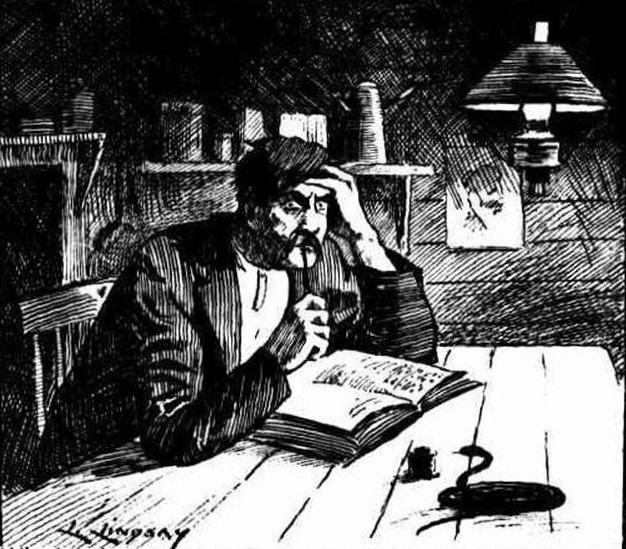
Garland bewitched by the serpent at the Iron Store From Free Lance, 14 May 1896, p.14.Sydney Page, Weekly Courier, 29 April 1920, p.23.
Sydney Page’s coach service
In 1896 a writer calling himself Arthur Conway penned a screed about a storekeeper losing his sanity ‘in the house of the ungodly’, a tin hut on the Linda Track known as the Iron Store. In the solitude, with only the tigers and devils for company, Hugh Garland succumbed to the snake.[23]
The serpent might have been trampled by the hooves of the coach service in the following year.[24] The Mount Lyell Copper Mine was then the subject of Australia’s last national mining boom of the nineteenth century.[25] Foot traffic on the improved track increased to the extent that Sydney Page, son of the late stage-coach entrepreneur Samuel Page, tried a coach and horse service between the rail head at Macquarie Plains near Glenora and Gormanston, the miners’ town for the Iron Blow. The stage-coach section had stopovers at the Jenkins residence, Dee River, and the Lake St Clair Accommodation House, before travellers reached the coach terminus of the Iron Store. On day four they set off on horseback across Mount Arrowsmith, overnighting at the Wooden Store beyond the Collingwood River.[26]
The service didn’t last long, because while Page’s nags were kicking over the gibbers northern interests were waging a ‘railway war’ to send a line westward. In 1899 the Emu Bay Railway Company laid rails into Zeehan, completing a connection with Mount Lyell. The Linda Track remained Hobart’s overland route to the west until in the late 1920s—about the time Ron Smith conceived the idea of the present Overland Track—the Lyell Highway obliterated much of it. Further tales of the original Overland Track will follow.
[1] These included Artist Hill, in keeping with nearby Painters Plain, and Junction Peak, at the junction of the Franklin and Collingwood Rivers. In the Collingwood River Valley Moore named several features (Redan Hill, Raglan Range, Scarlett Hill, plus the Inkerman, Balaclava and Cardigan Rivers) to complement Charles Gould’s Crimean War reference of the Alma River. Further west he christened Nelson River after his godson Nelson Brent, the Princess River in keeping with the King and Queen Rivers and Thureau Hills after Inspector of Mines Gustav Thureau (TB Moore diary, 1974–87 compilation, ZM5618 [TMAG]).
[2] TB Moore diary, 1974–87 compilation, ZM5618 (TMAG); TB Moore, ‘In the early days of Mount Lyell: the first discovery of gold on the Mount’, Mount Lyell Standard and Strahan Gazette, 5 December 1896, p.4; TB Moore, ‘Discovery of Mount Lyell Mine’, Zeehan and Dundas Herald, 12 May 1919, p.1.
[4] William Duffy, notes written on the back of Moore’s application, PWD18/1/966 (TA).
[5] TB Moore to the Minister of Lands, 3 December 1885, PWD18/1/966 (TA).
[6] TB Moore to the Minister of Lands, 21 January 1886, PWD18/1/966 (TA).
[7] TB Moore diary, 1874–87 compilation, ZM5618 (TMAG).
[8] Overseer George Walch to the Director of Public Works, 1 May 1886, PWD18/1/966 (TA).
[9] TB Moore diary entry, 15 March 1886, ZM5620 (TMAG); Moore to Minister of Lands, 26 March 1886.
[10] William Duffy, Engineer of Roads, memo for Overseer George Walch, 28 April 1886; William Duffy, Engineer of Roads, memo dated 19 May 1886, PWD18/1/966 (TA).
[11] TB Moore to William Duffy, Engineer of Roads, from Iron Store, 3 March 1886, PWD18/1/966 (TA).
Ernie Bond (1891–1962) was more than a highland farmer: he was a facilitator, one of those figures who introduced Tasmanians to the bush. John Watt (JW) Beattie, Stephen Spurling III, Fred Smithies, Ray McClinton and Herb (HJ) King did it with photos and lantern lectures. Gustav Weindorfer, Paddy Hartnett, Bert ‘Fergy’ Fergusson and Ernie Bond played the facilitator role by establishing themselves in the highlands and inviting people to join them. They were ‘bush magicians’ whose personal charm brooked no argument.
Bond’s journey from Hobart businessman to highland guru was a strange one. It probably began with his need to address a drinking problem. It is also possible that his decisions to mine and then farm in the bush were a rejection of expectations that he would follow in his father’s footsteps as a business tycoon. There is something humbling about a failed produce merchant who sets out to ‘get his hands dirty’ by learning how to actually grow produce, just as, perhaps, he saw becoming a miner as a rebuke to his father, the razor-sharp mining investor who probably never once plunged his dish into the wash dirt.
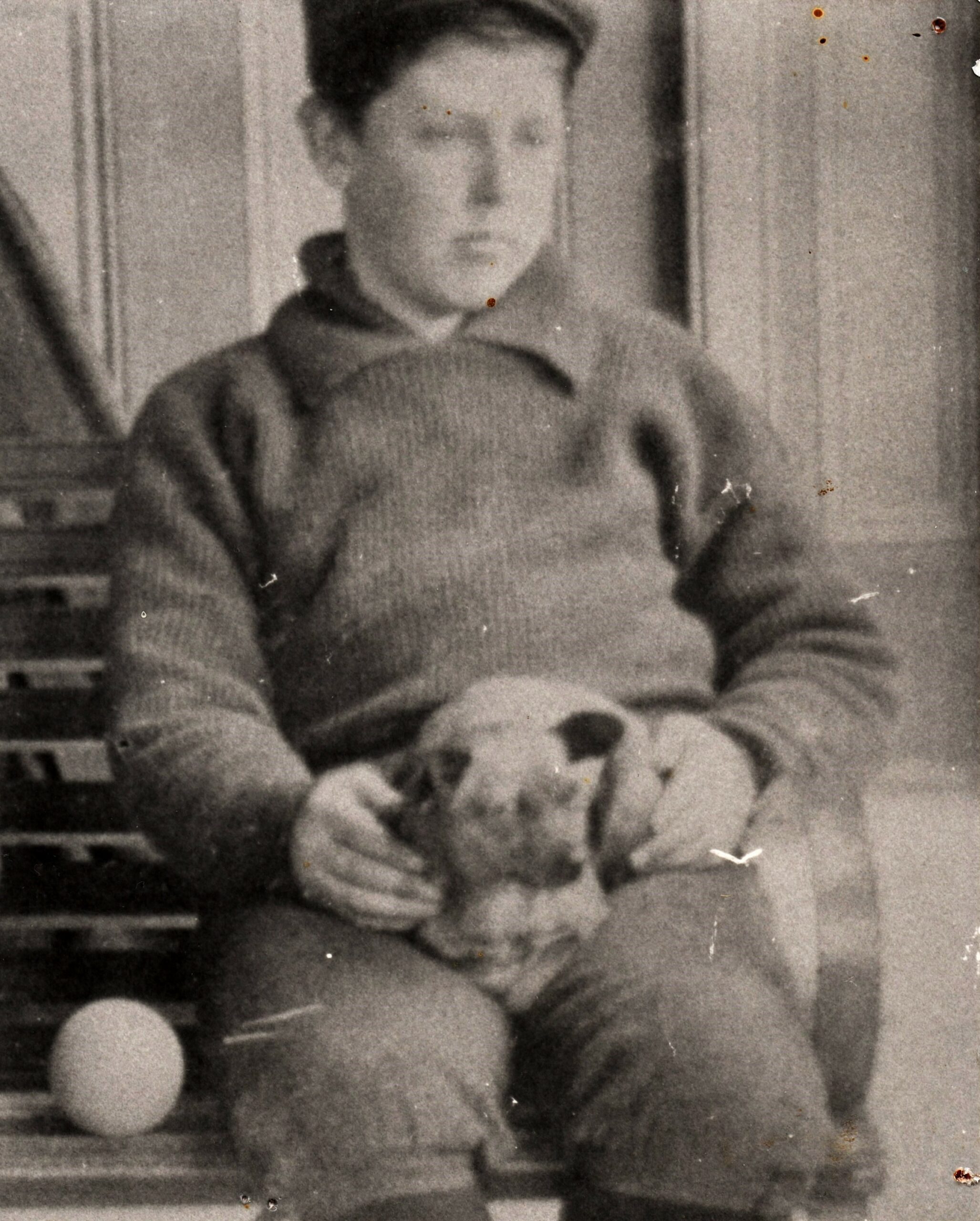
Ernie Bond as a boy. Courtesy of Roger Nutting.
Early life
Hobart-born, Ernie Bond was the youngest of four sons of well-to-do, self-made businessman and parliamentarian Frank Bond (c1856–1931), and Sarah Bond, née Cowburn (c1863–1934).[i] Frank Bond was enterprising in the manner of many children of ex-convicts. He became probably Tasmania’s leading mining investor, eventually buying one of the state’s major silver producers, the North Mount Farrell Mine, where he employed about 130 men.[ii] He is said to have been so astute financially that he even profited from the collapse of the Bank of Van Diemen’s Land in 1891 by buying scrip at a low price, then doubling his money when it declared a dividend.[iii]
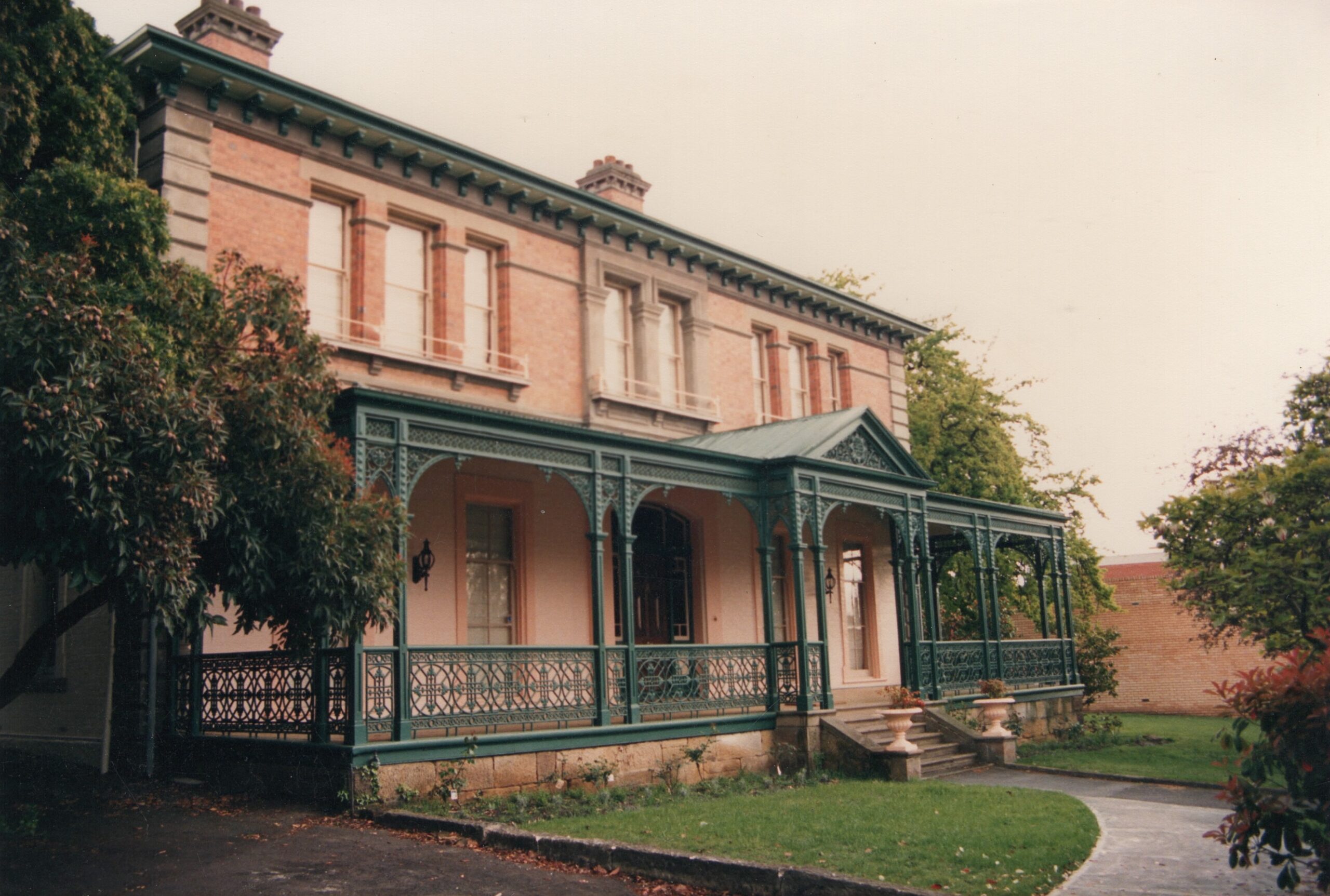
Gattonside, formerly 41 Montpelier Road, now 51-53 Sandy Bay Road, Battery Point, built for the Scott family in 1885, initially rented by Frank Bond and then owned by him 1899-1904. Roger Nutting photo.
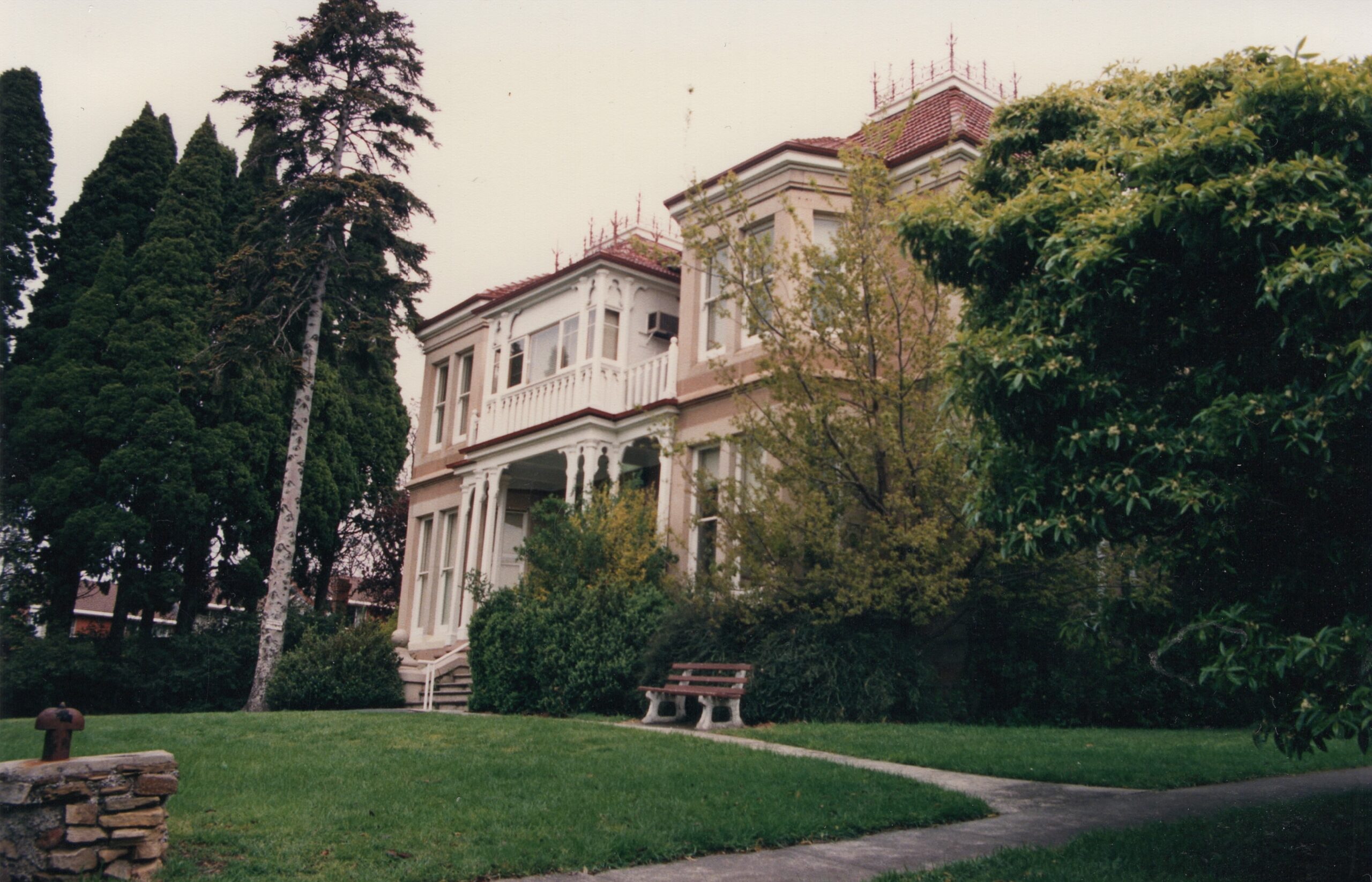
Ernie Bond grew up at an imposing ‘gentleman’s residence’, Claremont House, Claremont; and at Gattonside, Battery Point, where the family moved c1897; while his adolescence and early adulthood were lived at Mimosa, in Elizabeth Street/New Town Road, North Hobart from 1905. Like his older brothers, George (1883–1934), Basil (1885–1932) and Percy (1888–1929), Ernie attended Buckland’s School, a boarding and day school for boys opened by former Hutchins School assistant master WH Buckland at the Barracks, Hobart.[iv] In 1905, the year that Buckland’s school amalgamated with Hutchins, Ernie achieved one pass in the Junior Public Examination which determined eligibility for the state public service.[v] He instead took a clerical job at AG Webster and Sons, produce merchants, which meant that, like his brothers, he was trained in his father’s line of business.[vi]
In October 1916 he fronted City Hall as one of 70 or 80 men between the ages of 21 and 35 with surnames beginning with A or B to enrol that day for World War One service.[vii] There was no military conscription as such, but young unmarried men were compelled to contribute to the war effort. There was also enormous public pressure to participate and, as the son of a public figure, Bond’s absence would have been noted. Perhaps he failed his medical, as he did not serve in the armed forces, and what part he subsequently took in the war effort is unknown. His brother George, who left Hobart with the original 26th Battalion in May 1915 and was awarded the Military Cross, was the only one of the Bond brothers to reach the battlefront.[viii]
Through the South Hobart Progress Association Bond became involved in local politics, supporting the political journalist Leopold Broinowski’s unsuccessful 1922 National Party candidature for the House of Representatives seat of Denison.[ix] Broinowski advocated ‘Tasmania first’, adopting the familiar theme of state rights in the federal sphere.[x] Accordingly, Norman Laird summed up his friend Ernie Bond’s political beliefs as ‘Victorian in period’.[xi]
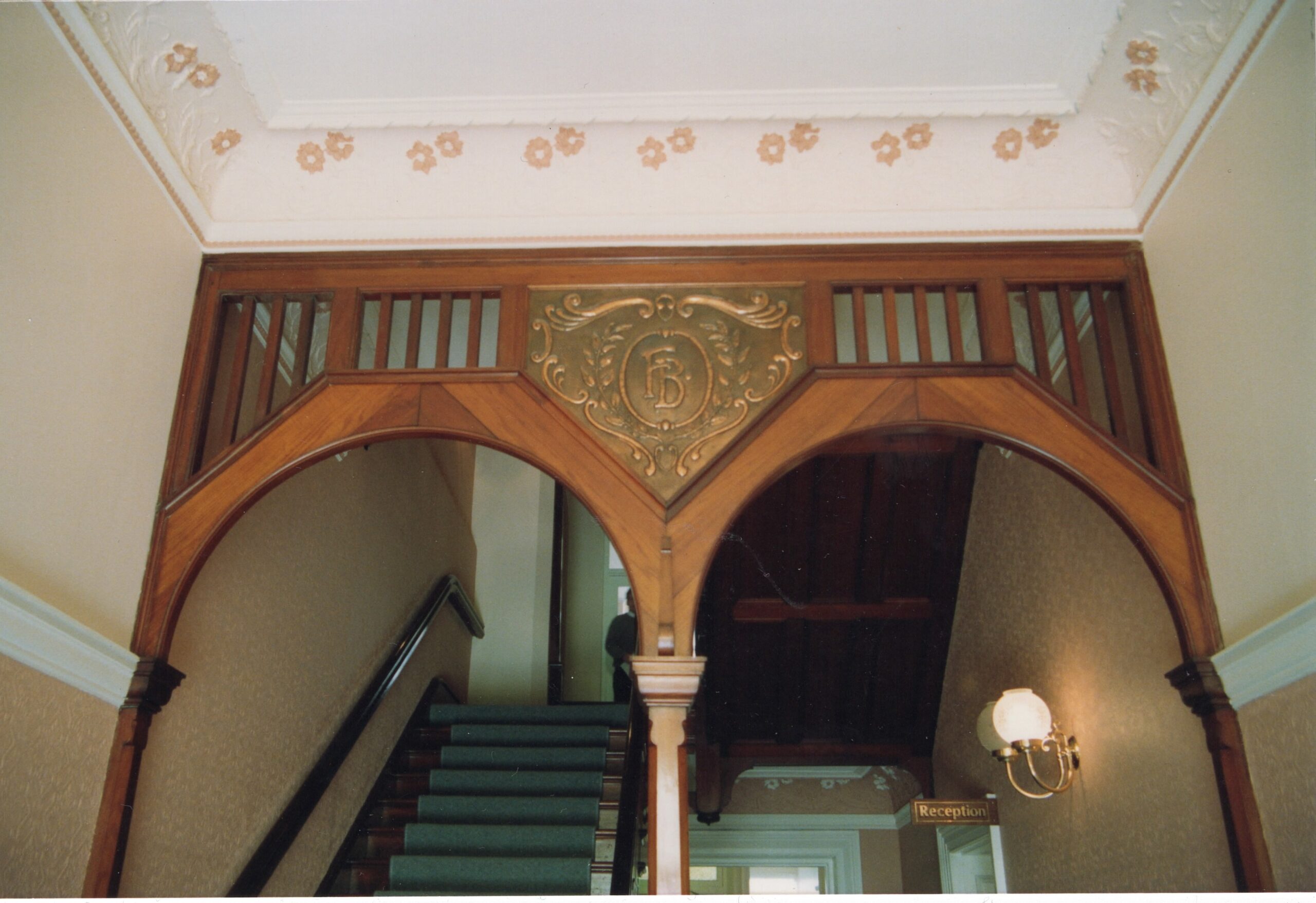
Mimosa, 446 Elizabeth St, North Hobart, which Frank Bond bought from Dr Henry Benjafield in 1905. Roger Nutting photo.A hall screen inside the house features Frank Bond’s initials. Roger Nutting photo.
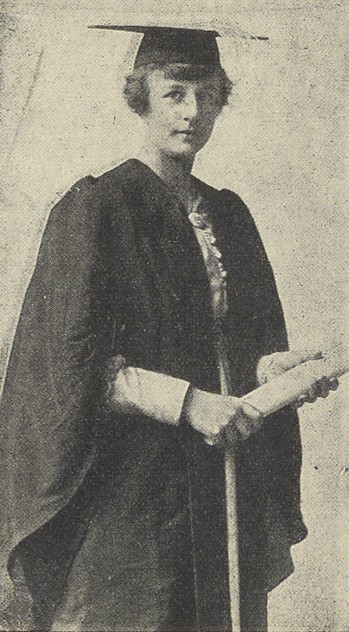
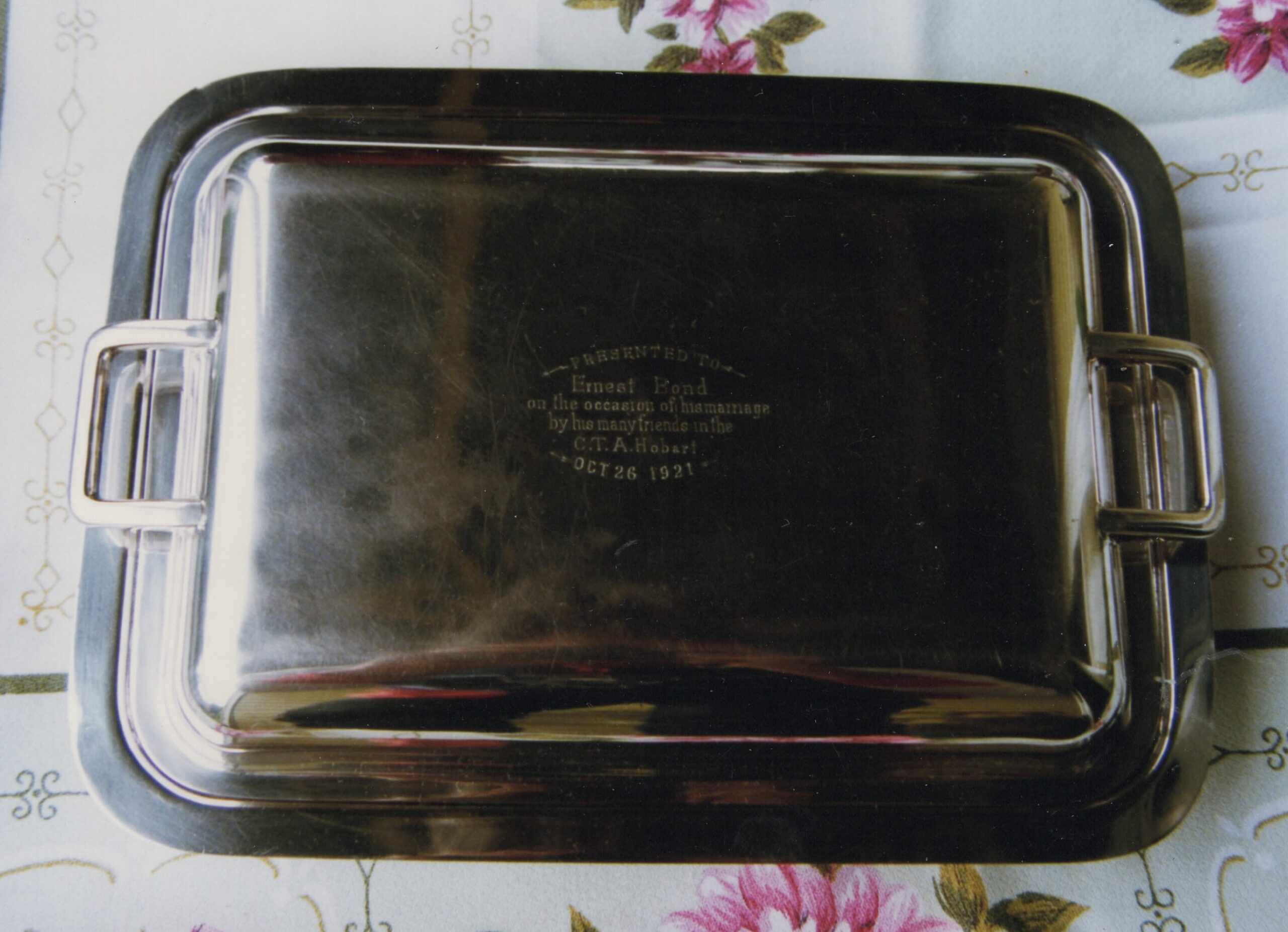
In 1921, 29-year-old Bond took possession of a house in Ferndene Avenue, South Hobart, and married seventeen-year-old Birdie Louisa Gatehouse.[xii] Like him, she came from a well-to-do family with an enterprising convict forebear. The newlyweds had a son, Ernest Edward Bond (Ernie junior), born 18 November 1922.[xiii]
Bond’s future wife Birdie Gatehouse receiving her Diploma of Associate for Pianoforte in December 1919. From the Tasmanian Mail, 6 May 1920, p.20.A domestic wedding gift engraved by its presenters, Bond’s friends in the Commercial Travellers Association. Roger Nutting photo.
Bond at Adamsfield 1927–34
Bond would have been aware of Tasmania’s osmiridium mining industry. In the years 1918–26, before cheaper substitutes were found for it, Tasmania had a virtual world monopoly on ‘point metal’ (granular) osmiridium used to tip the nibs of fountain pens. Osmiridium won favour because of its durability. Having travelled only a short distance from its host rock, serpentine, the best metal was coarse or ‘shotty’, perfectly sized to be glued onto a nib in a New York, London or Berlin fountain pen factory. In October 1919 osmiridium reached £42 per oz., making it far more attractive to prospectors than gold.[xiv] The alluvial osmiridium of the north-western fields was worked out by the mid-1920s, but the Adams River (Adamsfield) osmiridium rush about 120 km west of Hobart in the spring of 1925 was a sensation, with several prospecting partnerships initially returning about £1000 per month.[xv] Even though many diggers only made a subsistence wage at Adamsfield, the rush was seen as something of a godsend, because Tasmania’s mining industry, like its agricultural sector, was in dire straits.
Born in comfortable circumstances, well educated, Ernie Bond was far removed from many of the osmiridium diggers, who were from poor rural farming families. At the time of the Adamsfield rush, he was a married father wielding the hammer as an independent produce merchant and auctioneer in greater Hobart and the Tasman Peninsula.[xvi] Yet for all his enterprise the business went belly up, with his own father bailing him out to the tune of £2500.[xvii] Not yet 36 years of age, Bond announced his retirement from business—which is a dignified way of withdrawing to rethink one’s options.[xviii] He had taken many steps down the path of emulating his father as public leader, businessman and politician, but all he had to show for it was public humiliation.
Perhaps his marriage was not rosy either, because in September 1927 he left wife Birdie and young son Ernie junior and went bush.[xix] ‘Mid-life crises’ were a luxury at the time, especially for a family man. It seems likely that Bond was just another of the many people—men, women and children—who trudged 42 km through mud and rain from the railway terminus at Fitzgerald to seek sustenance at Adamsfield when the osmiridium price made a temporary recovery after the market had been glutted during the initial rush. With the easily-won alluvial osmiridium now almost gone, the era of the reef miner, the hydraulic company and the investor was dawning. Bond must have invested a considerable amount of his scarce capital in buying the old ten-acre Stacey and Kingston reward claim from Turvey and Robinson in August 1928.[xx] It was worked by a horse-drawn puddling machine which separated the ‘point metal’ from ‘pug’ (clay).
Ernie Bond, left, with the puddling machine at Adamsfield. Jack Thwaites photo, NS3195/1/1515, Tasmanian Archives.Ernie Bond puddler site in April 2023. Nic Haygarth photo.
Did Bond know anything about mining? Given his father’s leanings, he probably knew something about mining investment, but when it came to the nuts and bolts of it he would have been a ‘new chum’. Acting as an osmiridium buyer at Adamsfield would not have helped him much, given the low demand. The price dipped dramatically to below £9 per oz. during 1932.[xxi] ‘The diggers are desperate and starving at Adamsfield’, the old digger JS Fenton told Phil Kelly MHA in May 1934. ‘The storekeepers with there [sic] cunning can get all the metal for food alone …’ Only the government, Fenton believed, could save the miners from the colluding forces of shopkeepers and precious metal dealers who oppressed them.[xxii]
Bond’s new career on the osmiridium fields was fast evaporating, but he wasn’t destitute. When his mother died in October 1934, Bond had lost all his siblings and both his parents in the space of five years, severing some of his ties to Hobart. However, in her will Sarah Bond provided £250 for educating Ernie junior while he attended the private Hutchins School, to be expended at a maximum of £30 per year. Bond was to receive half the balance of that £250 if any remained when his son left school, plus half her trust fund.[xxiii] He owned some shares, and he received rent from his former marital home after his wife and child vacated it.[xxiv] Additional relief came Bond’s way in 1935 when he won a court battle against an alleged £2500 debt to his father’s estate, that is, the money he believed his father gave him to bail him out his business failure.[xxv]
Bond hydraulic sluicing at Adamsfield, with J Beaton, left, and Billy McCafferty, background right. From the Ernie Bond collection, courtesy of Roger Nutting.
It is clear that Bond wanted to stay in the bush. While squelching in the mud and snow as an Adamsfield digger, he would have noticed the more lucrative support services operating around him. The Quinn brothers were not miners. Hop, berry and dairy farmers, they supplemented their incomes by hunting in winter, so they knew the back country and supply routes well and were already equipped with a team of horses. Merv and Jim Quinn packed supplies to the osmiridium field and operated a store, first at the Florentine River, then at Adamsfield itself.[xxvi] However, the Quinns were less enterprising than the sly-grog merchants, Ralph Langdon and Elias Churchill, who both earned enough money on the mining field to advance to keeping legitimate, licensed premises in Hobart.[xxvii]
Perhaps Bond was also stung into action by mining field prices. One miner bought £3 worth of potatoes and onions at Fitzgerald, which cost him £28 by the time they were delivered to Adamsfield, 42 km away.[xxviii] What if he could farm closer to the osmiridium fields, undercutting all competitors? Bond’s new regime of earning a living by market gardening, plus hunting in winter, along with a little prospecting, would be a variation on the models of the bushman adopted by people like William Aylett and Paddy Hartnett and that of the Quinn brothers.[xxix] He had found a way to retain the bush lifestyle that he apparently loved. All he needed was a venue.
[ii] ‘North Mt Farrell’, Mercury, 10 April 1931, p.6; ‘Obituary’, Mercury, 16 December 1931, p.7.
[iii] Joe Cowburn; interviewed by David Bannear, 27 August 1990, in What’s the land for?: people’s experience of Tasmania’s Central Plateau Region, Central Plateau Oral History Project, Hobart, 1991, vol. 3, p.1.
[iv] ‘Scholastic’, Tasmanian News, 28 September 1893, p.2.
[v] ‘Buckland’s School’, Mercury, 1 April 1903, p.7; ‘Separate subjects list’, Mercury, 1 January 1906, p.7. For the amalgamation of schools, see Margaret Mason-Cox, Character unbound: a history of the Hutchins School, the Hutchins School, Hobart, 2013, p.22.
[vi] ‘Criminal Court’, Mercury, 28 October 1916, p.10. In 1916, at the age of 25, Bond’s position was auctioneer’s clerk (‘Police Courts’, Mercury, 7 October 1916, p.4).
[vii] ‘Proclamation Day’, Daily Post, 4 October 1916, p.5.
[viii] ‘Personal’, Mercury, 20 September 1916, p.3.
[ix] ‘Macquarie St tram’, World, 4 November 1922, p.7; ‘Denison” Mr Broinowski’s candidature’, Mercury, 13 December 1922, p.7.
[xi] Norman Laird, ‘Thylacine reports—Queen Victoria Museum—Launceston: Ernie Bond …’, NS463/1/1 (Tasmanian Archives, afterwards TA).
[xii] Conveyance 15/4889 from Robert M Ross, 21 September 1921; Bond mortgaged the property to Marion Nicolson, 16/171, on 10 February 1923 and later to Perpetual Trustees, 16/2902, 16 September 1923 (NRET); ‘Family notices’, Mercury, 30 December 1921, p.1. They married 26 October 1921. Her parents were Cecil Leonard and Elsie Harriet Gatehouse. Birdie Gatehouse was born 31 January 1904 (‘Births’, Mercury, 4 February 1904, p.1).
[xiii] ‘Family notices’, Mercury, 20 November 1922, p.1.
[xiv] Secretary of Mines (Tasmania), Annual Report, 1919, p.36. For the Tasmanian osmiridium industry generally, see Nic Haygarth, On the ossie.
[xv] ‘Register of osmiridium buyers’ returns of purchases, September 1922–October 1925’, MIN150/1/1 (TA).
[xvi] ‘New produce business’, Huon Times, 27 July 1923, p.2; conveyance 16/1651, 11 June 1923 (NRET).
[xvii] ‘Kingborough Show’, Mercury, 22 April 1924, p.2; ’Nubeena sale’, Mercury, 3 March 1926, p.10; ‘Gift or Loan?’, Mercury, 11 December 1934, p.5.
[xviii] ‘Auctioneers’ notices’, Mercury, 22 April 1927, p.10; Bond recalled the tenth anniversary of his arrival in Adamsfield in his diary entry 10 September 1937, NS1331/1/1 (TA).
[xix] The Electoral Roll for the seat of Denison, Subdivision of Hobart South for 1928, p.5, lists Birdie Louisa Marshall Bond and Ernest Bond living at 2 Ferndene Avenue, South Hobart.
[xx] ‘Mining’, Mercury, 27 August 1928, p.4; PB Nye, The osmiridium deposits of the Adamsfield district, Geological Survey Bulletin, no.39, Department of Mines, Hobart, 1929, p.42.
[xxi] Ernie Bond offered diggers £8 5 shillings per oz in November 1932, in which year the average price paid in Tasmania was £11 5 shillings 6 pence. In 1933 the average price was £8 8 shillings 4 pence. See ‘Osmiridium slight rise in price’, Mercury, 2 November 1932, p.4.
[xxii] JS Fenton to Phil Kelly MHA, 22 May 1934, MIN2/1/585–87 (TA).
[xxiv] Electoral Roll for the seat of Denison, Subdivision of Hobart South for 1937, p.6; Ernest Bond diary, 15 January 1937, NS1331/1/1 (TA). Whether Ernie Bond was making maintenance payments to his wife Birdie Bond is unknown.
[xxv] See, for example, ‘Son’s claim upheld’, Examiner, 14 December 1934, p.9.
[xxvi] See Nic Haygarth, On the ossie, pp.131 and 143.
[xxvii] ‘Sly-grog’ in this case does not refer to the illegal distillation of spirits, but to the illegal sale of bottled alcohol from unlicensed premises. There was no licensed public house at Adamsfield.
[xxviii] Percy O Lennon, ‘The Adams River osmiridium field and the surrounding country’, Illustrated Tasmanian Mail, Christmas number, 1 December 1926, p.105.
[xxix] For Aylett and Hartnett see Simon Cubit and Nic Haygarth, Mountain men: stories from the Tasmanian high country, Forty South Publishing, Hobart, 2015. Bond continued to make occasional prospecting trips to the Boyes River (see, for example, ‘Adamsfield’, Mercury, 29 December 1932, p.3) and in 1941 prospected the old Reward Claim at Adamsfield without success (Ernest Bond diary, 10 July 1941, NS1331/1/5 [TA]).