by Nic Haygarth | 17/06/23 | Tasmanian high country history, Tasmanian nature tourism history
While walking the Overland Track between Cradle Mountain and Lake St Clair in 1931, pedestrian extraordinaire ET Emmett found some words scribbled on a pine rafter inside the old mine workers’ hut at Pelion Plain.[1] The scribble authors, Emmett wrote, were ‘members of Mr Jocelyne’s [sic] South African party’, who had recorded details of their seven days’ stay in the area:
‘Scalps taken: Mt Oakleigh, Mr Ossa, Lake Ayr, Mt Thetis, Forth Gorge, Toad Rocks, Pelion East’.[2]
The Joscelyne in question was probably Horace Joscelyne (1878–1965), a Launceston-born grocer’s assistant who visited Cradle Mountain in 1922.[3] But who were the South Africans? Perhaps Horace and his wife Addie showed Tasmania to some South African visitors. Emmett’s 1931 Overland Track party was guided by temporary park ranger Bert Nichols, but the Joscelyne tour was probably from the time of Nichols’ predecessor as highland tour guide, Paddy Hartnett.
The Fred Smithies papers in the Tasmanian Archives[4] contain what is probably a semi-fictional account of the Joscelyne trip with Hartnett. Most of the same ‘scalps’—Mounts Oakleigh, Ossa and Thetis, Lake Eyre [sic] and ‘Pelion’s giant toad’—in the fictional account were ‘taken’ in similar order as outlined on the Pelion hut rafter. Although the story has a more linear structure than ‘A dip into the Waldheim mailbag’ (see earlier blog), it refers to the earlier story and appears to have the same anonymous author. As outlined in the previous blog, the author of the Waldheim mailbag story is likely to be one of Vera May Scott, Lydia Morrison or Addie (Harriet Mary) Joscelyne. It is unknown whether any of these women was a member of Horace Joscelyne’s ‘South African’ party. The candidates for authorship line up like this:
Vera May Scott (1886–1962)[5] was born at Battersea, London. At the 1901 British census she was a 15-year-old living in London with her 47-year-old piano tuner father Henry Sidney Scott and 37-year-old Brisbane-born mother May Scott.[6] No record of the family’s migration was found, but in 1922 Vera May Scott was an unmarried typist living at 28 Delamere Crescent, Trevallyn with her parents and sister Eleanor Scott.[7] Scott lived next door to the Joscelynes and had a strong connection to the family. In 1945 she thanked Horace Joscelyne for ‘unfailing kindness’ during her mother’s long illness.[8] Rupert William Joscelyne Hart, whom Scott recognised in her will, was the son of Horace Joscelyne’s sister Violet Mary Joscelyne.[9]
Lydia Morrison (1886–1971)[10] appears to have emigrated from England as a small child in 1891, along with her two-year-old brother and her parents, 28-year-old Lydia Morrison senior and 35-year-old farmer William Morrison.[11] In 1922 Lydia lived with her parents, her sister Dorothy Mary Morrison and brother William Morrison junior, at 211 St John Street, Launceston.[12] Forty-six years later in 1968 Lydia was still listed as an unmarried clerk—at 82 years of age—and living with her bookbinder sister at 6 Union Street, Launceston.[13]
Harriet (‘Addie’) Joscelyne née Cumings (c1872–1946) emigrated from England with her sister as a teenaged nursemaid in 1888. Her parents, Ebenezer and Caroline Cumings, had preceded her and were already Launceston residents.[14] Addie’s older sister Minnie gave her occupation in the passenger list as schoolteacher, and until her marriage in 1893 she operated the Trevallyn Preparatory School.[15] At this point Addie Cumings took over from her, continuing the school until at least 1897.[16] This suggests that she was at least reasonably well educated. Addie Cumings married Horace Samuel Joscelyne at Launceston in 1903. They had no children.[17]
When did the trip take place?
Details in the semi-fictional account allow us to arrive at a possible time for the trip on which it was based. It was undertaken when the waratahs were in flower, which makes it in the period October to December. The ‘mistress of the more pretentious hut’ mentioned in the text was Elizabeth Gregson of Gisborne’s Hut/the Mount Pelion Mines Hut. She was living alone, which puts the trip in a two-month window between the death of her partner John Gregson on 11 June 1926 and her admission to the New Town Charitable Infirmary on 5 August 1926.[18] This suggests a winter tour, a very unlikely scenario not only because of the weather conditions but because at this time Hartnett would almost certainly have been hunting out beyond Adamsfield. Clearly also this does not tally with the late spring/early summer appearance of waratah blooms! The fictional account contains a credible return visit to Gisborne’s Hut when Elizabeth was found to be ‘in most wretched and squalid sickness’, a ‘poor frail old form’ eliciting ‘a deep pity for all lonely bush women, and especially all sick ones’. This does suggest the type of situation in which the elderly widow would have been forced to enter the charitable institution. The writer has taken the liberty of moving Elizabeth Gregson’s last days of freedom into the late spring, a much more likely time for the Pelion excursion.
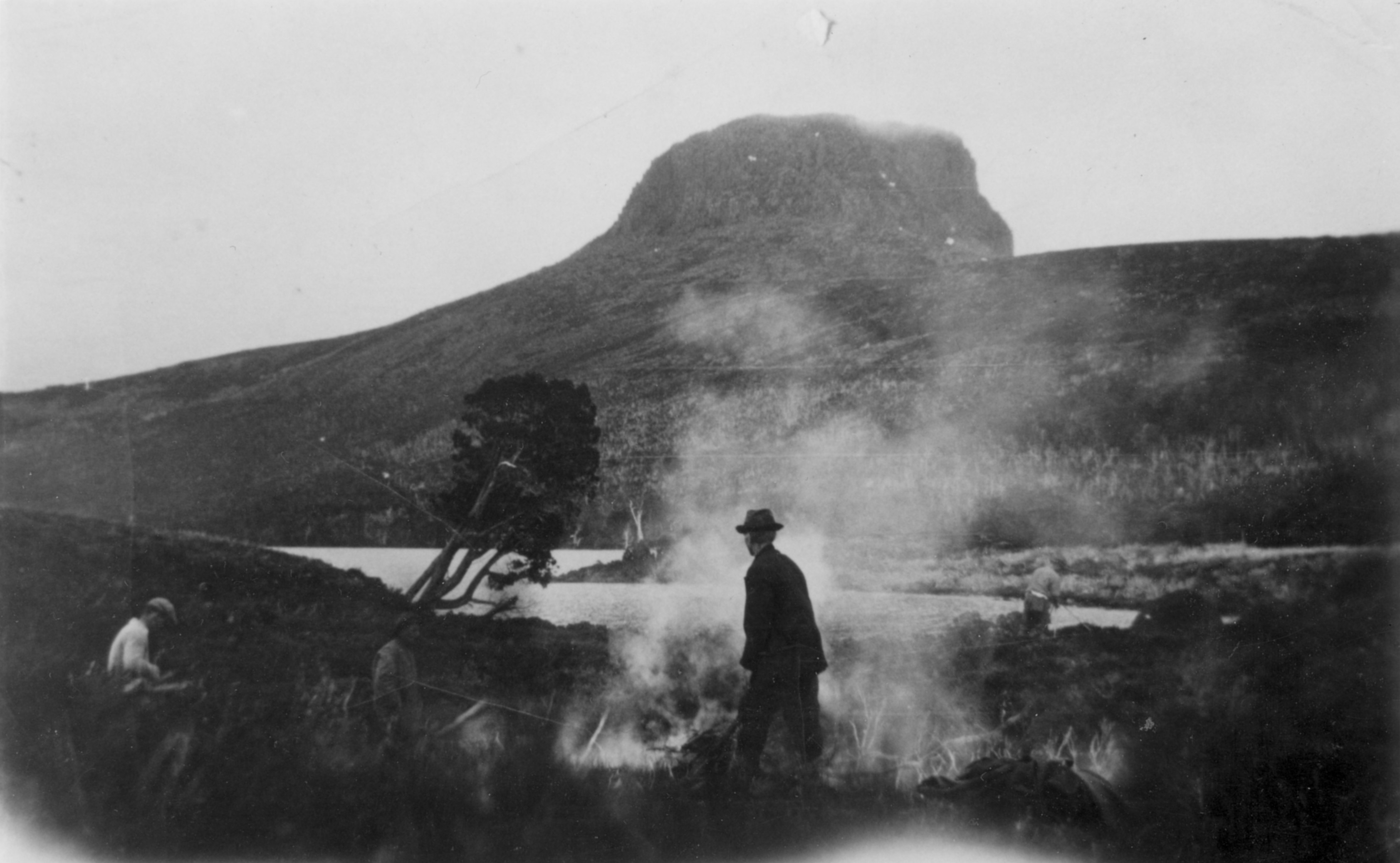
Paddy Hartnett burning off at Lake Will, with Barn Bluff in the distance.
Photo courtesy of the late Nell Williams.
What about the Waldheim component of the trip? A tantalising photo exists of Paddy Hartnett burning off grass at Lake Will, just off the logical route from Commonwealth Creek to Waldheim along the line of present Overland Track. The author of the semi-fictional Hartnett tour may well have climbed the Razorback on one of Hartnett’s real expeditions— yet in his diaries Gustav Weindorfer never mentioned a Hartnett party arriving at Waldheim from Commonwealth Creek via the Razorback Track.[19]
Leaving aside the matter of whether Hartnett ever brought a party to Waldheim via Razorback, there is evidence in the fictional account to suggest that the author either did in fact make a second trip to Waldheim or was very well informed about changes to that establishment. In her fictional account she mentioned seeing white pegs while rounding the western side of Cradle Mountain. These were possibly placed there by Weindorfer in April 1922 when he was engaged to mark or cut a pack-track from Waldheim to the Barn Bluff mines.[20] The writer mentioned a new woodshed and a ‘tent room’ at Waldheim. These were built 1923–24.[21] Weindorfer’s dog Flock was still alive at the time of the fictional visit—she died on 4 January 1927. Weindorfer was absent from Waldheim from 2 July to 13 November 1926, so he could not have met the timeline suggested by Elizabeth Gregson’s widowhood and removal from Gisborne’s Hut.[22] Puzzlingly, Weindorfer’s diaries contain no reference to Vera Scott, Lydia Morrison or the Joscelynes putting in another appearance at Waldheim after 1922. However, the Joscelynes were friends of Weindorfer whom he visited in Launceston in 1923 and 1926, and it is possible that the anonymous author (particularly if it was Vera Scott, who lived next door to the Joscelynes) was included in these visits and used these to update her knowledge of Waldheim.[23]
Most of ‘A dip into the Waldheim mailbag’ was written in character by Claudia Crane, who married at the story’s end. This time it appears to be her cousin Mona Moore’s turn, although the only names used in the later account are ‘Paddy’ and ‘Percy Lane’. Not even ‘Mine Host’ of Waldheim is actually named. Percy reappears at the end of the epistle to rescue the hospitalised Mona, who has been recalling her trip with Hartnett in the great outdoors as an antidote to the walls of the institution. Since writing a letter for the Waldheim mailbag, Mona has developed a staccato-style of writing with a fondness for the exclamation mark, as if to emphasise her girlish high spirits..
The account
My dear memory Pictures; How I have loved them and lingered over them in these long weeks of imprisonment! How often as I lay here the hospital walls have faded away and great trees have tossed their heads far above me. Once again I and my trusty comrades have tramped ankle-deep in the fragrant lemon thyme [sic], or scrambled happily among the giant boulders on the top of the world. Those long yet all too short days of happy comrade-ship; [sic] the unexpected meeting with our old friend Percy — the glad gathering up of the threads of old time friendship — the intimate talks on every subject under the sun — How I have lived it all over and smiled and sighed over my pictures! Just this once I am going to allow myself to glance at them all again, and then to work!
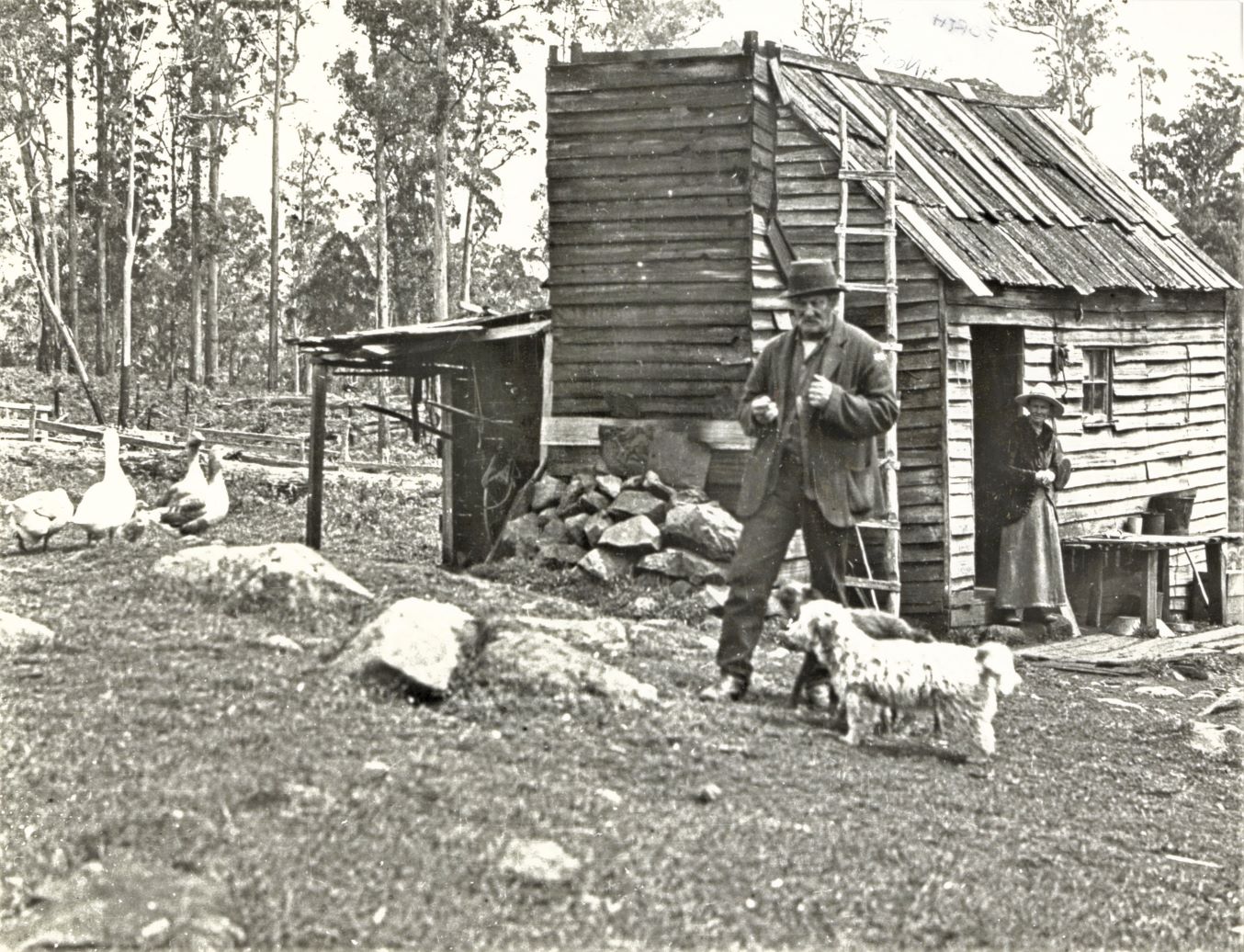
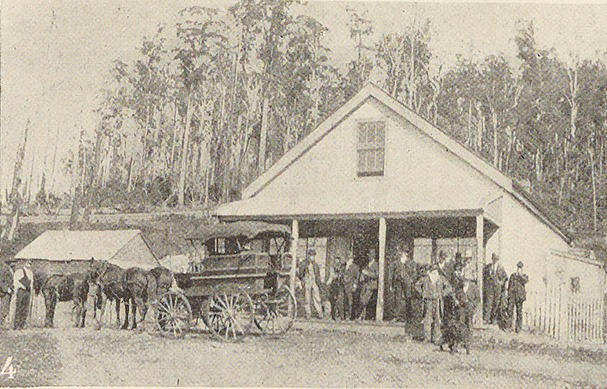
John and Elizabeth Gregson at Gisborne’s Hut in 1921. Fred Smithies photo, NS573/4/4/55 (TA).
A rolling green slope, hemmed in on all sides by great trees and roofed by the spacious sky. A streamlet purling past two little grey huts sleeping in the drowsy sunshine of a peaceful Sabbath afternoon.[24] A queer ramshackle vehicle toils up the slope and the peace is broken by a little party of Townies. The mistress of the more pretentious hut is a little wiry, shrivelled figure sharp of voice, but ready of smile and disposed to be friendly.[25] She soon has the feminine portion of the party ensconced on her doorstep listening to the finest entertainment she can offer — her gramophone. The entertainment is shared with dogs of all shapes and sizes, but alike in one respect, they are all the proud owners of a coat of thickly matted hair and buzzies. Troops of kittens tumble round but at the slightest movement in their direction they disappear under the house with the unanimity of well-trained soldiers.
As evening approaches the upper hut buzzes with life —the Townies are busily engaged settling in for the night. The wooden chimney proves to be well furnished with holes which admit the evening breezes, the said breezes being frolicsome blow clouds of smoke into the eyes of two busily making toast on forked sticks. The little breezes laugh to see a handkerchief cautiously removed to allow of lightning inspection of the toast and then as quickly replaced over aching streaming eyes. There were no regrets when that fire was allowed to die out.
Early morning sweet and fresh! Goodbye! Cavalcade sets forth led by the laden pack horses. Most inexperienced horse-women jogging gently along the beautiful winding path, filled with the deep quiet content of anticipation. The Forth gleams far below — now hiding — now shyly showing its beauty — the glint of the sun bringing out the warm tints of the mineral charged stones paving the clear stream. Presently the horse-women are footwomen by turns with a lame horse limping pain-fully [sic] behind. The pack horses far ahead — hot sunshine streaming down — Footsteps lagging a little.
****
Cool running water — Great trees offering its [sic] services as bridge — at long last the sight of a fire crackling away in the centre of the road! Pack horses minus their loads! Billy boiling! Glorious sense of restfulness pervading every inch of tired limbs stretched out on the cool grassy road. Tea! Lots of it, deliciously hot and wet! A chop, minus salt! A little bag of potatoes doing duty as a table! Our cutlery, a stick and occasional use of a penknife. But no more delightful meal was ever served. More delicious rest on the gently sloping road-side, [sic] now the useful bag of potatoes acting as a pillow. Hands clasped under head (but removed at intervals for vicious swoops at the myriads of droning blowflies floating round.) Eyes gazing dreamily into the smiling blue sky, or lazily following the movements of a tiny fluffy bird hopping and chirping in the feathery grey-green of the young wattles.
****
On once more through beautiful fens and foliage over a narrowing track, the Forth, friendly as ever, still keeping us company. At length, a steep track zigzagging up the hillside, the towers of Mt Oakleigh keeping guard above.[26]
Horseback becoming dangerous, we stiffly dismount and, seated on the rocks of the pathway, gaze with huge respect at the great towers above little thinking that before many hours have passed we will be enthroned thereon, peeping over the edge at our present lowly seat.
Through the Valley of Eden, across the flower-decked plains and, bathed in the lovely evening lights, we have our first glimpse of the circle of guardian mountains which ere long have become such familiar friends.
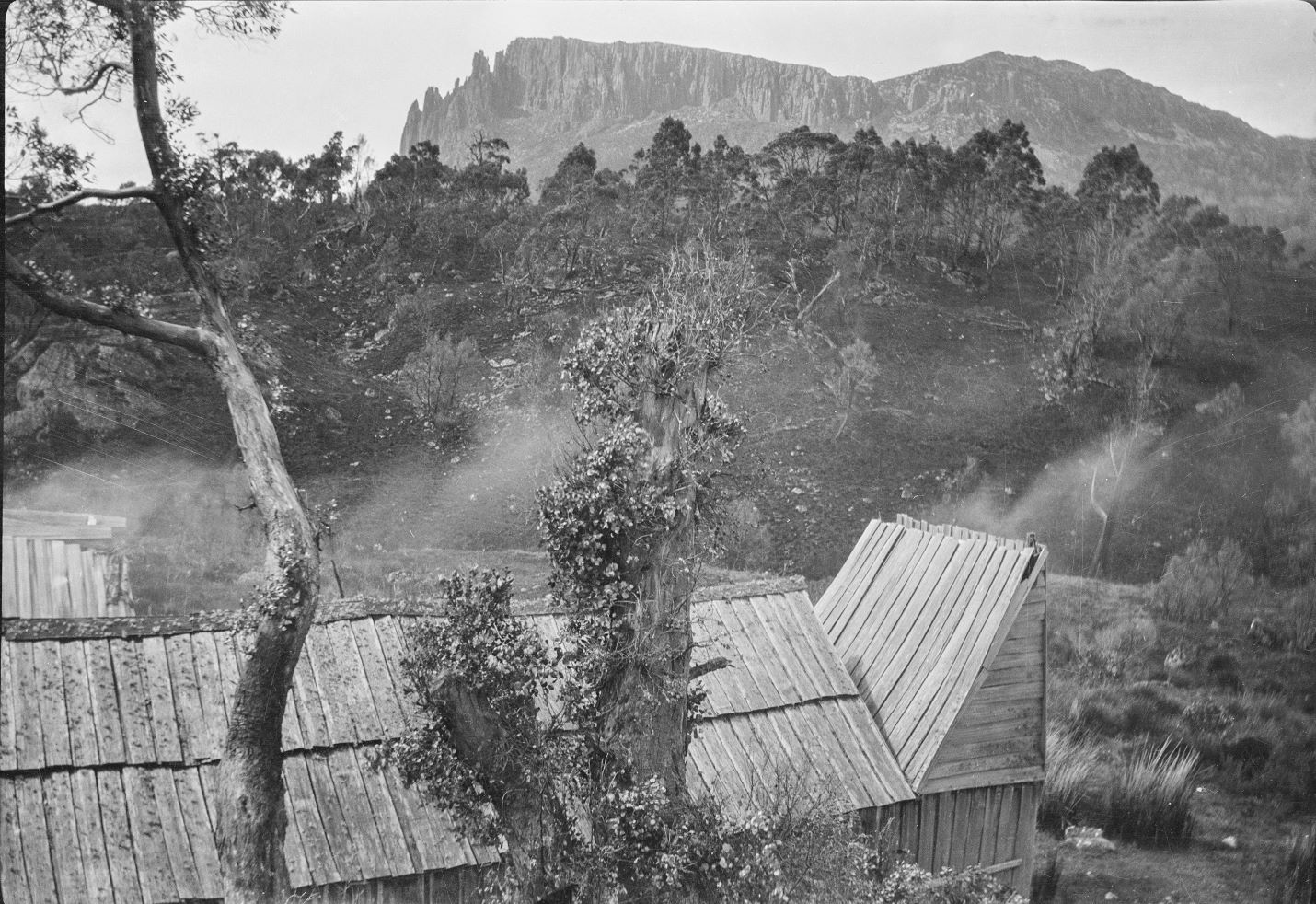
Pelion Huts in 1931, looking north, with Mount Oakleigh as a backdrop. Jack Thwaites photo, NS3195/2/1588 (TA).
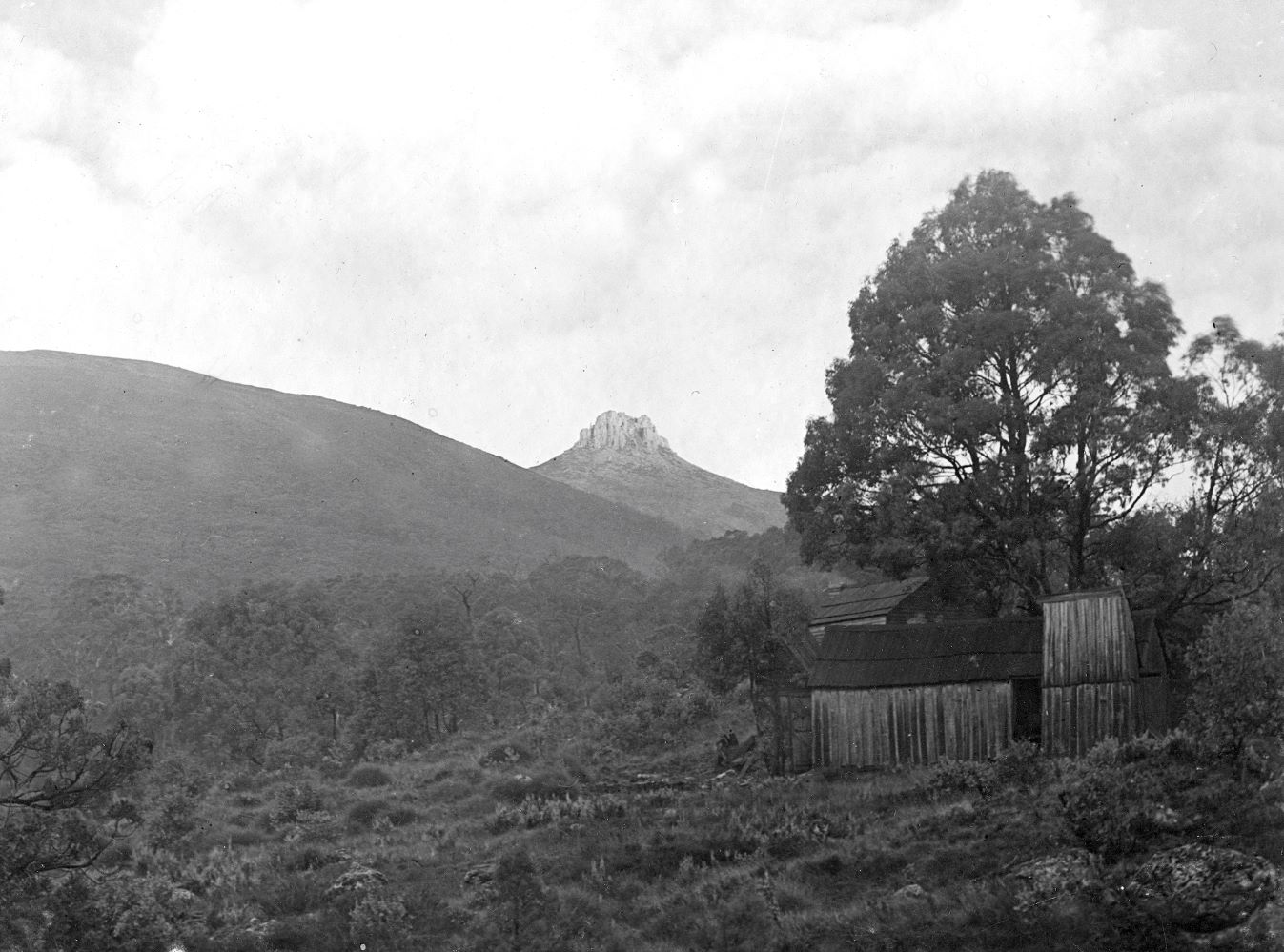
Pelion Huts looking south towards the Sugarloaf and Mount Pelion East, 1920. HJ King photo courtesy of the late Daisy Glennie.
Over the quaintest little bridge, walking on one log and clinging to another — and we are at Pelion Hut — our best loved home! In the next few days what expectant eyes it saw open on the light of a new day! What happy adventures fared forth from its portals and what tired, contented wayfarers returned at eventide!
At first we are a little put to it for lack of utensils, but as the days glide by we are the proud owners of a fine array of jam and fruit tins, which obligingly do duty as jelly molds, saucepans and all manner of things. The boxes in which our groceries were packed are just as obliging, three of them doing duty as table and the remainder as chairs.
Each morning as soon as breakfast is disposed of all are busy as bees preparing for the day’s adventure. On the table appears sundry little screws of paper containing salt, milk, powder, and tea etc; a tin of sugar, a mug of butter; the billy is packed with cups and the whole is soon transferred to the pack on Paddy’s back and off we start on the day’s tramp, cheered by the willing service of our old friend ‘billy’ and his busy little cousin ‘fizz’. When darkness falls, tired, sometimes wet, but happy, our hut sees us once more.
How bright and warm it grows under the combined efforts of huge fire, bicycle lamp, and candles stuck on tin lids. In a very few minutes the billy is boiling, the table fished from under the bunk and put together and the cloth laid (that cloth latterly of serviceable khaki relieved by small irregular splashes of white.)
Our centre piece is a paper serviette and a beautiful bouquet of Waratah [sic], ferny fronds, and graceful foliage, glorifies an empty jam tin given the necessary height of dignity by a pedestal of two tins of fruit. Our sugar basin is strangely like a mustard tin, the salt cellar strongly resembles the lid of that same tin, and they keep company with a most motley array of china, aluminium and enamel ware but we have a real teapot and a net milk jug cover, so what would you?
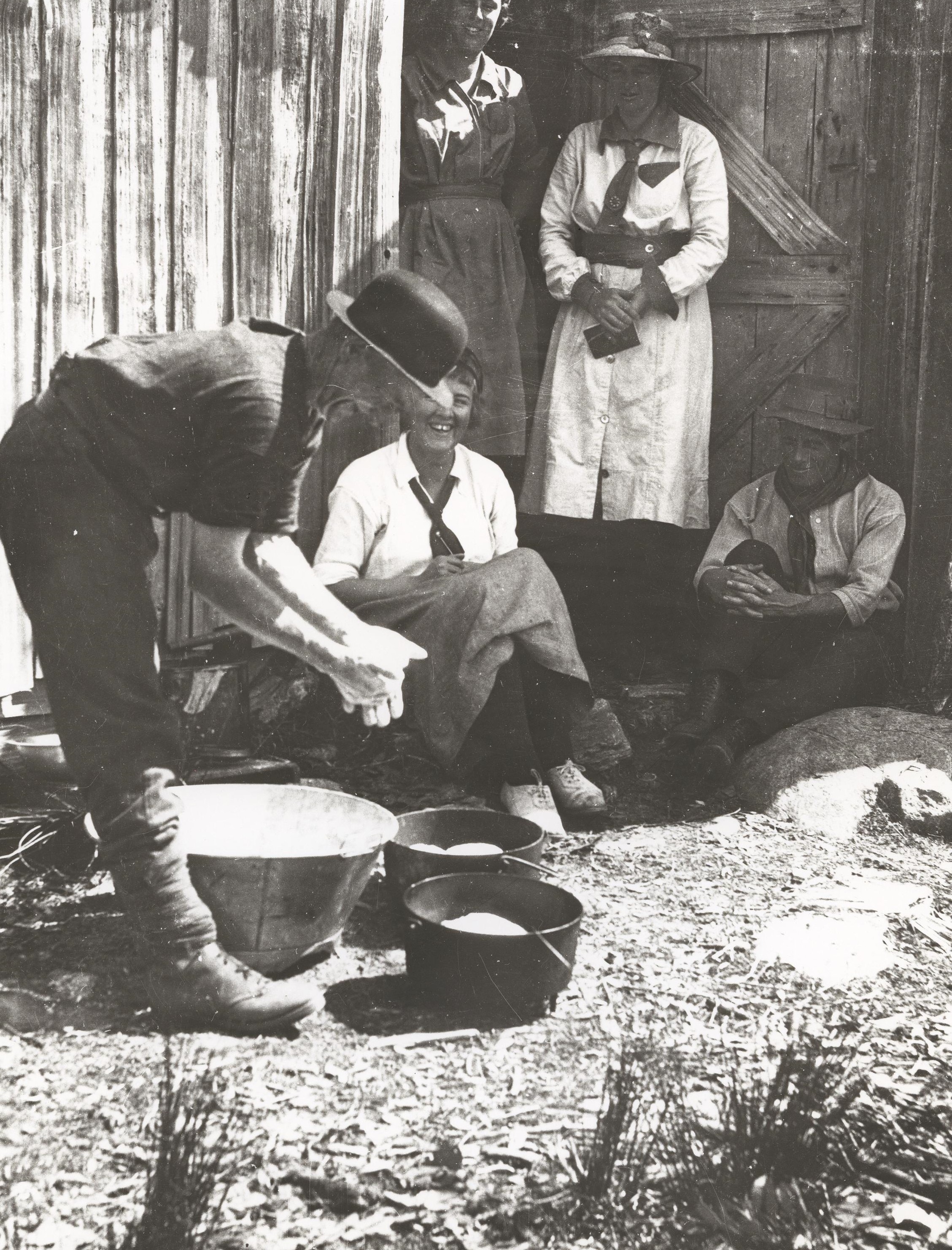
Hartnett (foreground) making damper, Pelion Huts, 1921, with (left to right) Florence Perrin (?), Edith McClinton (background in doorway), Ida Smithies (?) and George Perrin. Fred Smithies photo, NS573/4/4/1/36 (TA).
With what content we sit down to the well earned meal and when the first keen edge of appetite has worn off, push our box seats back so that the bunk supports serve as back rests, and talk and nibble nuts and raisins. Then the table is cleared, dishes washed, occasionally Paddy makes bread or we are visited by a tourist couple from a neighbouring hut, then our boxes are arranged in a cosy circle around the big rugged stone fireplace and a pleasant medley of poems, songs, and chat follows. Sometimes by the combined efforts of the whole party the whole of a song is remembered but usually one or two verses more or less mixed suffice! Even our childhood hymns have their places.
Then appears at the feet of each a cup of steaming coffee. Paddy lifts off the camp oven, ashes are scraped off, the lid is lifted, a chorus of approving voices greets the perfectly baked bread; very soon after that we are in dreamland.
****
Struggling slowly and with many a rest over the flowery plains and up lower slopes of the first mountain Oakleigh — Pushing through shady leafy tangles of vegetation richly illumined by brilliant touches of Waratah in full bloom — On the summit at last gazing our fill from one vantage point — Then being led to another and another until happy hours slip by unnoticed — The leisurely return over the plain in the wanning [sic] light — The magic of the long dreaming rest on the shores of the lakelet faithful mirror of the pearly sunset tints of the sky — Backward glances of Oakleigh now deliciously purple — Until at last the voices of the prudent are heard urging haste and most reluctantly we rise and wend our way homeward.
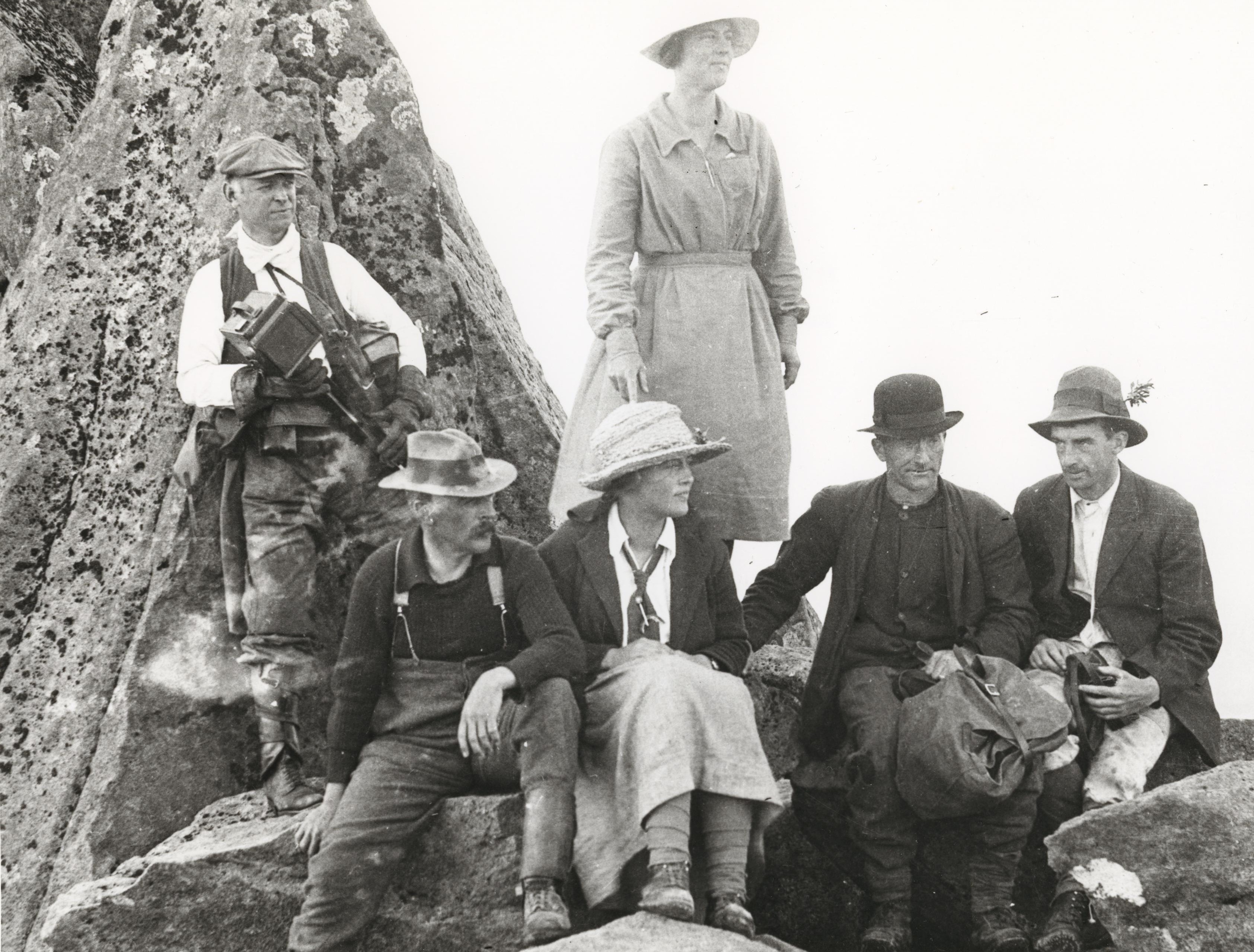
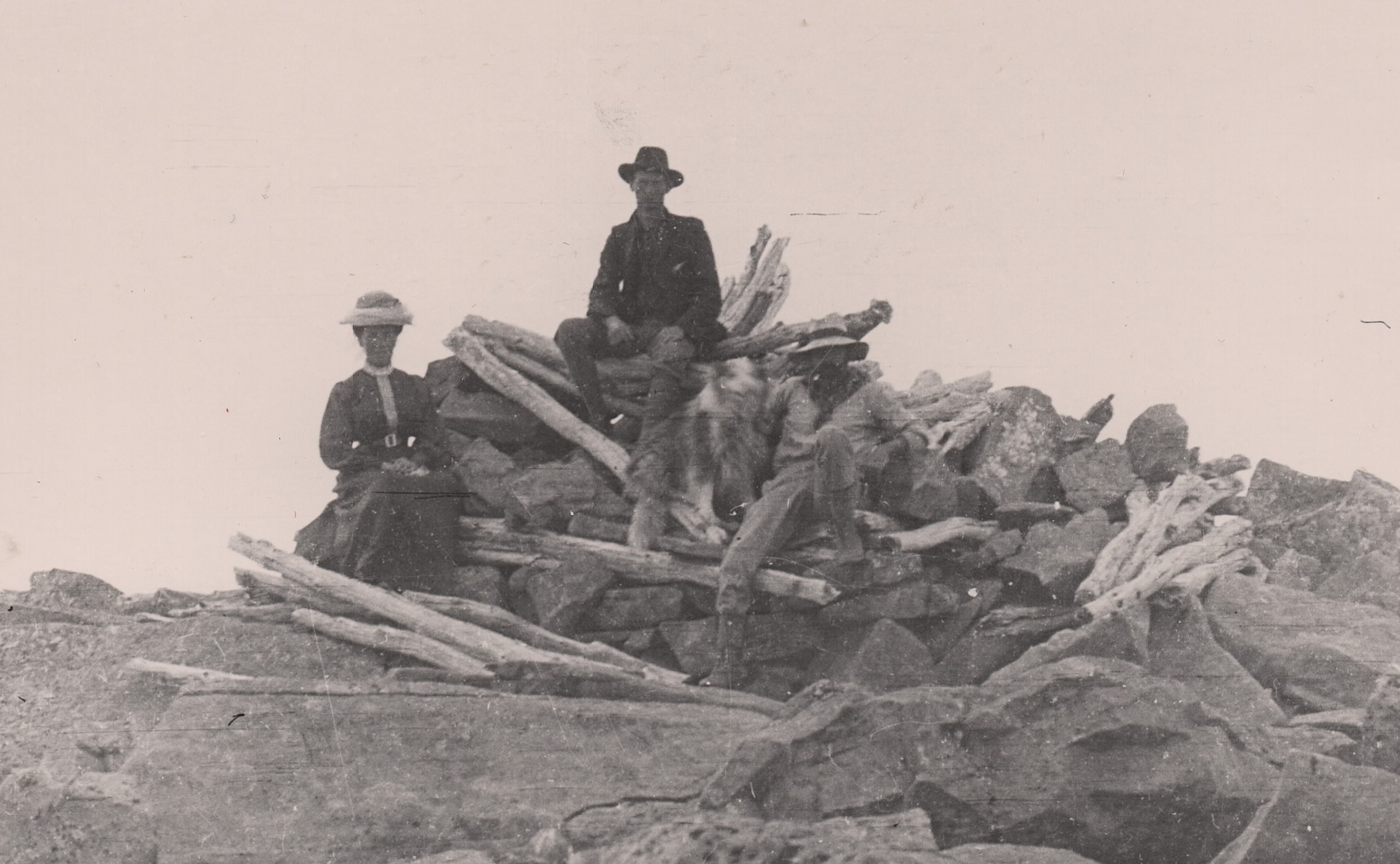
Paddy Hartnett (second from right) with a party on top of Mount Pelion West, 1921: (left to right) Ray McClinton, Frank Heyward, Florence Perrin, Edith McClinton and George Perrin. Fred Smithies photo courtesy of the late Nell Williams.
The swift rush of our descent from Ossa — The excitement of the rapid slides over the smooth snow heightened by the knowledge of great rocks and chasms and unknown depths below — Lowering ourselves cautiously down sheer drops with the friendly aid of the tough pineapple grass.
****
The rush up Thetis striving to race the driving mists to the summit — The biting wind which cuts into us whenever we come into the open — The grand piles of rock which we crawled or scrambled — The moments when we gazed helplessly at some huge heap and turned over for help that was never lacking — Places where the whole party hoisted us up or lowered us down some height — or where we walked up a ladder of human hands and shoulders. The foot reached at last in driving rain — We hastily prepared tea, cold and wet we sat down in one spot and carefully refrained from moving an inch from that partially dried and warm spot.
****
Lake Eyre [sic: Ayr] beautiful in the sunlight in its setting noble parklands. Paddy with an eye to next day’s dinner, leading gun in hand we followed in tip toe — picturesque glimpses of shy wild cattle — Tea interrupted by sudden rain — scuttle for shelter — two girls— lying flat one above the other squeezed beneath a fallen tree trunk — cosy intimate chat, eyes the while noting the lake dipling [sic, rippling?] and colour freshening on tree trunks and foliage under the rain — Contented, tramps round the lake and homeward single file in the gentle rain.
****
A leisurely stroll though plains thickly sprinkled with great daisies — where the plain ends, huge bushes of their smaller sisters greet us.
On we go up long easy slopes of springy green turf beautified by groups of large white orchids. Up here the Forth is young and frolicsome and dances gaily over little falls, turning and turning between beautiful pines that give it quite an alpine touch.
But we have a thought for tomorrow’s dinner despite the beauty surrounding us and keep a wary eye on the joyous flocks of jays noisily chattering overhead[27] — Girls still as mice! Vicious snap of Paddy’s gun! Quick downward fall of mute little body! Reckless plunge of men into the undergrowth! Triumphant return with one more trophy, and so on.
****
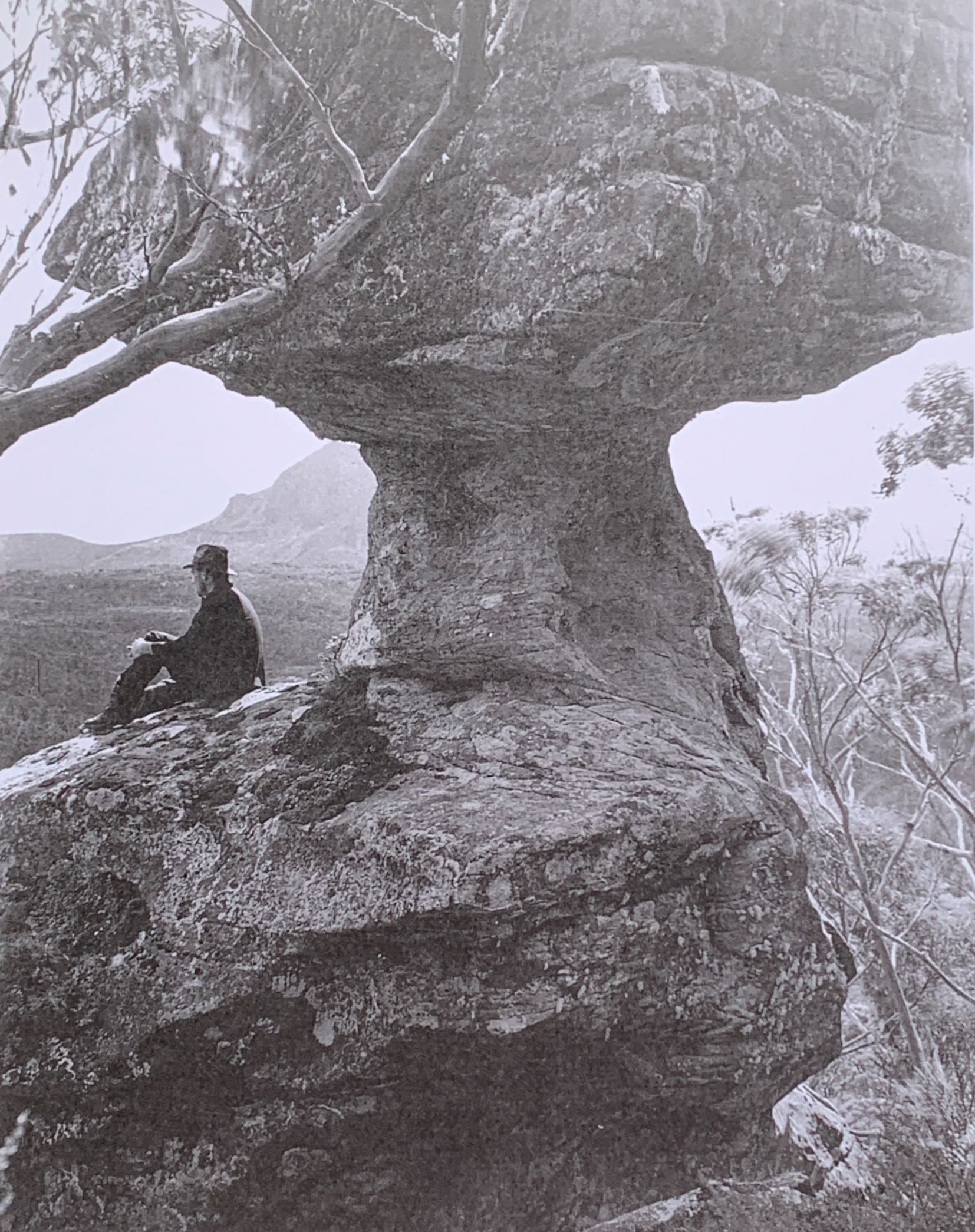
Toad Rock under Mount Pelion East. HJ King photo courtesy of the late Daisy Glennie.
Soon we are gazing on Pelions [sic] giant toad standing on his pedestal on guard, gazing across the tree tops over the hills and far away.[28] We cast wistful glances at Pelion so tantalisingly close, playing hide and seek with the mists; but time and the weather are against us, and we leave him unconquered.
****
One more pleasant picture that day holds — one suggesting Canadian backwoods. A lichen enamelled forest of giant Myrtles [sic] and King Billies, little streamlets making music through tis ferns and mosses — Hidden securely in its heart most picturesque Crusoe huts.[29]
****
Great fire! Billy boiling! Firelight flickering on weary party soon utterly content! Vacuum filled! Thirst quenched! As giants refreshed we rapidly make for home sweet home in the fading light.
****
Our sunshiny day off! A tap awakens us, the door opens, the sunlight streams in! Enter Paddy! Fire alight! Billy boiling! In a trice we are slowly sipping fragrant coffee and nipping biscuits, our eyes feasting on our one picture — a panel of Mount Oakleigh framed in the open doorway. Exit Paddy! Back we lie in luxurious idleness while light-hearted chatter and snatches of song are tossed back and forth through the pine wall.[30]
Leisurely toilet! Leisurely breakfast! Most leisurely household duties! Contented heaping of all culinary responsibilities on capable manly shoulders. Leisurely stroll down to the Forth,[31] very young and pretty between its steep banks. Soon in that secluded spot appears a softly rounded mermaid, splashing joyously in the crystal stream — smiling face and soft brown eyes radiating sheer joy in life. All too soon, alas, she has disappeared, and two commonplace mortals climed [sic] the bank to bask in the sunshine, exchanging low-voiced confidences until a much-uplifted voice summoned them to a wholly unearned, but much appreciated meal.
****
Reluctant farewell to our Pelion Hut, steps retraced with many a backwood [sic] glance! Eyes a fortnight older lingering on remembered scenes. Wolfram! Cautious feet exploring the damp dark mine tunnel![32] Dinner and brief rest at the miners’ huts. On! Over the Forth! Through luxurient foliages! [sic] Through black oozy mud, cautiously skirting the edges of the track at first in the vain endeavour to escape it — then plunging recklessly through it feeling it coldly oozing through the laceholes [sic] of our boots and squelching between our toes!
****
On up the razor back![33] Heats jumping! Breath coming quickly! Loose stones slipping beneath our feet. Ever slower and more slowly in the gathering dark until the pack horses have long disappeared in the gloom above. At long last Paddy and the horses (minus their loads) reappear and the day ends with a mysterious ride in inky darkness. We hear our horses splashing through the water but we cannot see it — we feel branches of trees brushing us as we pass, but these also we cannot see. Perched up on the sky line, we feel like Rebecca on her camel going to meet her lord. All we can see is a black sky far above, pierced by little steel stars. The cool evening air is soft on our faces, and we feel the exquisite luxury of transport on feet other than our own tired ones. Our journey ended, the new hut provokes a smile.[34] The fireplace end is missing and provided easy exit — also access to all and sundry. The floor is thickly strewn from end to end with dry brush etc, but Paddy’s broom of twigs soon sets that to rights. Willing hands have soon unpacked necessaries and gathered our fragrant leafy mattress after a hasty meal on a table which is a most ancient and feeble shell of grey paling which the slightest touch sends askew. An attempt to introduce an extra support shook it so alarmingly that the attempt was abandoned with a fervent prayer that it might outlast our need.
****
Paddy’s voice calling us next morning provoked most dismal groans, but soon we were busily engaged in making preparations for our visit to Cradle of happy memory. Trustfully we leave all but absolute necessities to the mercy of the ‘possum and their friends, and are on the tramp once more.
****
Seated above the wonderful wide sweep of a great cirque, two girls are having shooting lessons, a lovely spray of Blandfordia beside them surveying the performance with wondering eyes.
****
A line of wayfarers pushing rather wearily up seemingly endless slopes thickly clad in a ghostly pale grey thicket of leafless stunted bushes, extraordinarily tough and wiry, its pale skeleton fingers clutching spitefully at our garments as we press through it.
****
A grassy hillside thickly spotted with spikes of pretty pinkish flowers — fly-catchers. Paddy holds a flower in one sunburnt hand — a tiny piece of dry grass in the other. A group of figures kneel round him on the grass, eyes fixed on the flower. Its centre is touched! Down comes the fairy hammer! Little starts! Little exclamations! Peals of laughter! More hammers fall! More starts! More exclamations! More laughter! And so on ad lib.
****
The precious gun and our food are securely hidden in the bushes. Then onward round the white pegs at the base of Cradle, eyes eagerly searching for familiar landmarks. Once round Cradle we allow ourselves one long backward glance at Barn Bluff, softened and beautiful in the deep purple shades of evening, and then on we push. A glad cry announces the first sight of old Waldheim nestling among its pines. We descend the hill a little too far to the left and find ourselves in thick scrub, but on we rush, pushing through clinging branches, jumping, scrambling, anyhow, for we must reach Waldheim before dark actually falls.
Across the plain we break into a quick run — up the hill, round to the kitchen door — the familiar bark of Flock announces us — open comes the door, and we have the hearty surprised greeting of Mine Host.[35] We just have time to note a huge new woodshed facing the kitchen door, when we are swallowed up in the light and warmth. In a very few moments we are round the old table, attending to the needs of the inner man, and making the acquaintance of the other visitors. Then into the cosy old fireplace, chatting and listening to records, old and new, and off to the tent room to long dreamless sleep, buried under piles of grey blankets.
****
Morning! Bright sunshine! Breakfast! Friendly talk! Farewells!
****
On the trail once more! Rest on lovely green fairy mounds starred with tiny daisies. Crater Lake — still — mysterious — deeply, darkly blue — Dove Lake — sparkling dancing in the glorious sunlight. As we climb, many a backward glance is cast at Waldheim nestling in its valley and farewell cooees reach us, softly floating across the distance. The last thing we see as we disappear over the top of Cradle is a friendly white signal waving, and then we set to work in earnest to reach our hidden food.
But the day is far spent when at length it is reached and a silent and empty party sit down to the long deferred meal. But very soon our good friend ‘Billy’ works his magic beneficently as ever, and we laugh once more.
We are seated on the ridge between Cradle and Barn Bluff— those stately old giants gazing serenely over our heads in the soft evening light. One whose face is crimson with sunburn, produces a battered tube of lanoline wrapped in worn brown paper having a goodly share of lanoline upon it. With this paper he proceeds to anoint his burning face. A girl, equally crimson of visage, rummaging among a tiny stock of treasures produces a jar of face cream. Apparently the jolting of the trip has caused the cream to spread itself outside the jar. With this she economically proceeds to anoint her face. Something strange about it invites hasty investigation and with utmost horror she finds she has carefully rubbed tooth-paste [sic] upon her cherished countenance. And those hoary old giants suffer not a wrinkle in their old faces to twitch during the unseemly and ridiculous mirth that follows.
****
Rapidly we push on, but all too soon black darkness is upon us. Closely, blindly we follow in Paddy’s footsteps slipping, stumbling, over bogs, tussocks, stones, seeing not an inch in front of us except where the gleam of water shines warningly. At length rest becoming imperative, we stretch wearing limbs on the cool earth, gazing into the starlit immensity above. Voices break the silence ‘Can you see the duck?’ — minute directions — mystified eyes vainly straining. ‘See the handle of the saucepan — now the sweep of its breast!’ Triumphant laughter! ‘Acres of duck!’ ‘A bonza duck.’ ‘Pooh! It’s a brimming old duck!’ Then mightily refreshed by the sight of that duck we resume our stumbling march! The top of the hill is reached and soon home sweet home with the fresh night blowing through it.
****
Refreshment! Our leafy couches — and Silence.
****
Breakfast in bed and one more lazy sunshiny day of roaming round our hut and the next day we depart! The pack horses have disappeared — absolute necessities are packed and the bulk of the luggage left behind for those most foolish horses on their return up the razor back. This time we have leisure and light to see the beauties bordering the steep track and at the hill’s foot come upon our truant horses returning in charge of the packman. Most gladly the packs are shed and left in the pathway to be picked up.
Through sun-flecked paths the giant bracken bending low and caressing us as we pass we reach the beautiful Forth once more and hot and tired we clamber down its bridge supports to lunch on the cool flat stones in the shade of giant leatherwoods, one mass of beautiful bloom. Here the river is broad and deep and we sit in luxurious coolness watching its smooth flow until the word to march on.
****
Our first hut once more — We now recognise it as a palace with its real glass window and movable table and bunks — wallaby patties made by Paddy — then a visit to our friendly old lady, this time in most wretched and squalid sickness. A nightdress of indescribable hue hangs on her thin form and she is covered by a few soiled and tattered rags; no single sweet or fresh thing to be seen — lack of every little refinement to lighten sickness. On the walls are the only things that might attract attention — every inch of them is covered with magazine cuttings and girls, dogs, horses, all manner of things stare at the poor frail old form. When we left the listless eyes were a little brighter, and in our hearts was a deep pity for all lonely bush women, and especially all sick ones.
****
By dinner time next day our driver and a visiting surveyor had joined us, and we all sat down to our last bush meal — bully beef and onions — with borrowed cutlery added to our already motley collection.
****
One evening the moon looked down and saw the dear little fluffy nurse and the new Doctor [sic] climbing the steps to the ‘Eagles Eyrie’. Now, those steps are steep and the little nurse is plump, so is it any wonder that presently they sat down upon a step instead of climbing it?
When the little nurse got back her breath the moon heard in regretful tones, ‘Our pretty patient leaves to-morrow’. ‘What in the world did you do to her to-day? She looked as if she had got hold of the Elixir of Life.’ [sic] ‘I guess she had’ said the girl softly, ‘And he must have had a dose himself too, judging by the look on his face when he left.’ ‘Well! He’s a lucky chap!’ said the man heartily, ‘Who is he?’ ‘P Lane was on his bag.’ ‘Jerusalem! It must be old Percy! Used to know him at school. His dad lost a lot of money in that Barn Bluff oil show. Met him to-day, and he told me he had struck it lucky — in more ways than one it seems, but he didn’t mention that.’
[1] That is, the old two-chimney Mount Pelion Mines hut that stood below Old Pelion Hut and fell down in 1948.
[2] ET Emmett, ‘Scenic reserve: memorable week’s tour: Cradle Mountain to Lake St Clair: Hobart party’s experience’, Mercury, 10 January 1931, p.2.
[3] See ‘A dip into the Waldheim mailbag’.
[4] NS573/1/1/11 (Tasmanian Archives, afterwards TA).
[5] Years are from headstone, Carr Villa Memorial Park, Launceston; plus 1901 British Census as below.
[6] British Census, 1901, Administrative County of London, Civil Parish of Heathorn, p.22 (accessed through Ancestry.com.au).
[7] Electoral roll, Division of Bass, Subdivision of West Launceston, 1922, p.48. See also will of Henry Sidney Scott, in which he made his daughter Vera May Scott his sole executrix and beneficiary, will no.18727, AD960/1/56 (TA).
[8] ‘Thanks’, Examiner, 23 October 1945, p.2.
[9] See will no.43508, AD960/1/94 (TA).
[10] Years are from headstone, Carr Villa Memorial Park, Launceston.
[11] Passenger list for the Orana, October 1891, Series BT27, British National Archives (accessed through Ancestry.com.au).
[12] Electoral roll, Division of Bass, Subdivision of Launceston Central, 1922, p.34.
[13] Electoral roll, Division of Bass, Subdivision of Launceston Central, 1968, p.16.
[14] Descriptive list of immigrants, ss Coptic, arriving in Hobart 27 July 1888,. CB7/12/1/12–13, p.40 (TA), https://librariestas.ent.sirsidynix.net.au/client/en_AU/names/search/results?s=harriet+cumings&searchTarget=library&qu=harriet&qu=cumings, accessed 10 June 2023.
[15] ‘Current topics’, Launceston Examiner, 13 May 1893, p.5.
[16] See, for example, ‘Education’, Launceston Examiner, 4 January 1893, p.2; ‘Educational’, Daily Telegraph, 21 January 1896, p.4; ‘Diamond jubilee’, Launceston Examiner, 15 June 1897, p.6.
[17] Married 21 January 1903, registration no.608/1903, at St Paul’s Church, Launceston (TA).
[18] John Gregson’s headstone details are recorded on the Lorinna Cemetery page, Kentish Museum Trust, All known burials in the Kentish Municipality, 2nd edn., 2007. Elizabeth Gregson’s patient admission record for the New Town Charitable Infirmary on 5 August 1926 is HSD274/1/1 (TA), https://librariestas.ent.sirsidynix.net.au/client/en_AU/tas/search/detailnonmodal/ent:$002f$002fARCHIVES_DIGITISED$002f0$002fARCHIVES_DIG_DIX:HSD274-1-1/one?qu=%22hsd274%2F1%2F1%22, accessed 13 October 2019. Her age was given as 73 years. She never left this institution. Her date of death is also recorded there on 11 June 1927, death record no.1656/1927 (Tasmanian Pioneers Index).
[19] In the Weindorfer diaries the only instance of a party arriving at Waldheim from Commonwealth Creek/Lake McRae is Fred and Ida Smithies on 18 April 1927. They went around the eastern side of Cradle via Lake Rodway, but returned to Commonwealth Creek/Lake McRae via the western side of Cradle on 20 April 1927.
[20] Gustav Weindorfer diary, April 1922, NS234/27/1/8 (TA).
[21] The new woodshed was completed 7 August 1923, the tent room was finished 2 December 1924, Gustav Weindorfer diary (Queen Victoria Museum and Art Gallery, afterwards QVMAG).
[22] Gustav Weindorfer diary (QVMAG).
[23] Gustav Weindorfer diary 9 May 1923 and 13 October 1926 (QVMAG).
[24] The author describes travelling south on Patons Road towards the Wolfram Mine on the upper Forth River. The two huts were Gisborne’s Hut, owned by Hobart schoolteacher, orchardist, journalist and political commentator Frederic (FAW) Gisborne, and a hut nearby which was built by Mount Pelion Mines. The Gregsons appear to have occupied the former until the mining hut became available in 1921.
[25] The woman described is Elizabeth Gregson. For the full story of John and Elizabeth Gregson, see Simon Cubit and Nic Haygarth, Historic Tasmanian mountain huts: through the photographer’s lens, Forty South Publishing, Hobart, 2015, pp.100–105.
[26] The author describes the Zigzag Track, the pack track between the Wolfram Mine and the Pelion huts.
[27] ‘Jays’ or ‘black jays’ are currawongs.
[28] Toad Rock, under Mount Pelion East.
[29] A reference to the Crusoe Hut in Cataract Gorge, Launceston, a rustic hut established on the main walkway in 1893 as a reference to Daniel Defoe’s 1719 novel Robinson Crusoe, about a castaway marooned on an island off the coast of Venezuela.
[30] The larger hut at Pelion Plain, the two-chimney workers’ hut, was built of eucalypt. ‘Pine wall’ confirms that the hut the author slept in was the mine manager’s hut, now known as Old Pelion Hut.
[31] That is, Douglas Creek.
[32] The main adit of the Wolfram Mine, aka the Mount Oakleigh Wolfram Mine. Wolfram (tungsten) had been needed for munitions during World War One but after the war ended the price of tungsten dropped and the mine was abandoned.
[33] The notoriously steep Razorback Track between the Forth River and the Barn Bluff Copper Mine.
[34] Probably one of the huts at the abandoned Barn Bluff Copper Mine at Commonwealth Creek.
[35] Gustav Weindorfer, proprietor of Waldheim Chalet 1912–32.
by Nic Haygarth | 17/06/23 | Tasmanian high country history, Tasmanian nature tourism history
Tired of Kindling Kindred? [1] Well, here’s the original Cradle Mountain gushfest. The papers of Launceston mountaineer Fred Smithies contain a fictional account of a visit to Gustav Weindorfer’s Cradle Valley tourist resort Waldheim a century ago.[2] The author of ‘A dip into the Waldheim mailbag’ used fictional letters written home from Waldheim by the visitors to describe the events of the fictional trip. The imaginary party consisted of John and Grace Moore, their daughter Mona Moore, their niece Claudia Crane—and a visiting boy named Percy Lane. The author, who had obviously stayed at Waldheim, gushed high-spirited prose to the rhythms of Bob Quaile’s wagonette ride from Wilmot to Waldheim via Daisy Dell, and continued the girlish banter with Weindorfer.
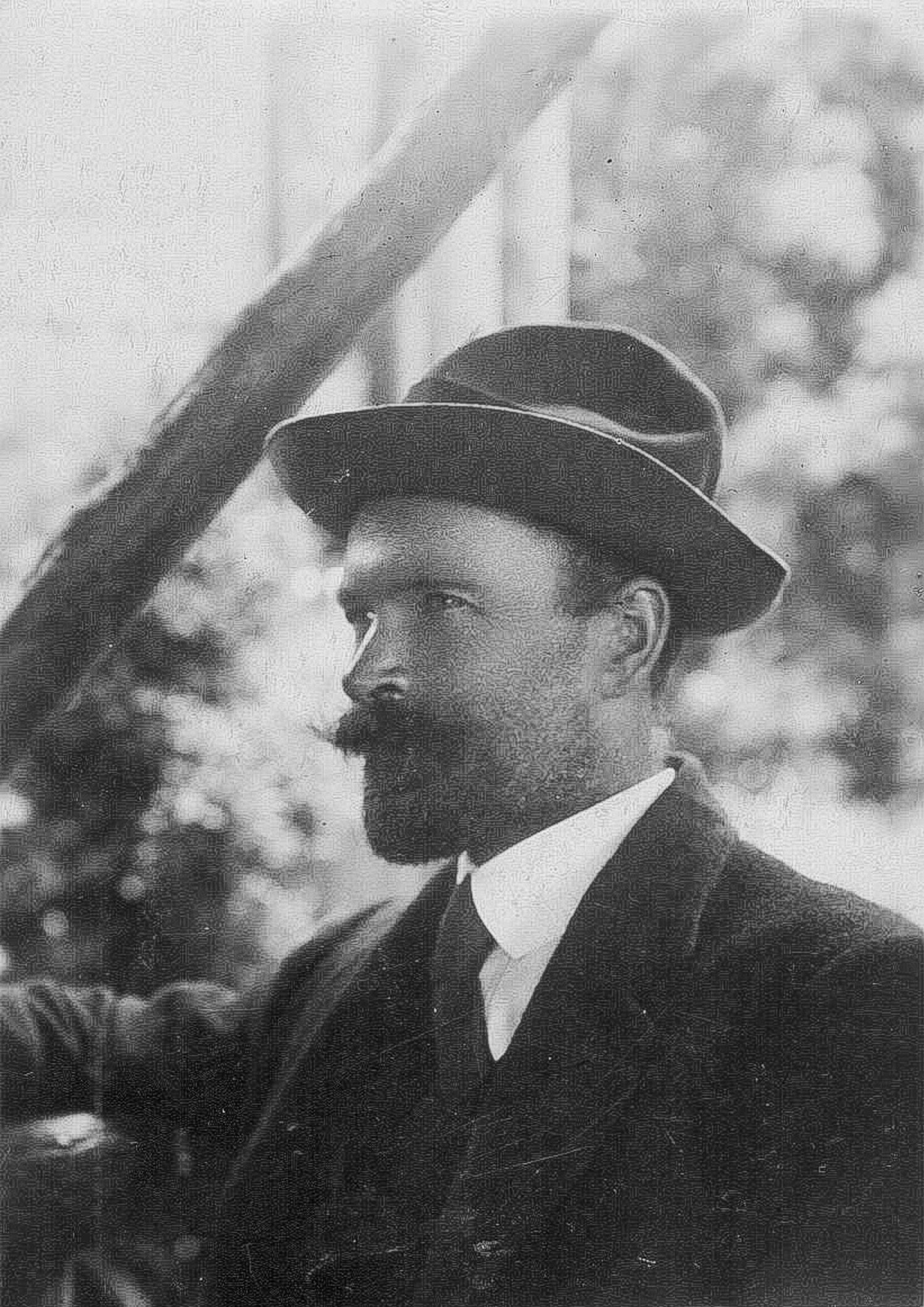
Gustav Weindorfer. Ron Smith photo.
Who was this accomplished author? Many women lost it over the cultured Carinthian immigrant ensconced in his mountain eyrie. In 1923, for example, Weindorfer was snowed in with the scary South African Maude Van der Riet, who later penned an epistle called ‘The Cradle Mountain: a climb to the peak: the world’s view’. The 49-year-old nurse and writer described Weindorfer as
tall and thin like a young cedar tree, with a moustache turned skywards the color [sic] Titian raved about in all his pictures. Mountain air complexion; eyes, what eyes! They flashed like fork lightning on pointed swords …[3]
However, it is likely that the mailbag author visited Waldheim earlier, in 1922. The clue is the name Percy Lane, which appears to be an amalgam of two surnames of real people with a Waldheim connection: men called Percy and Lane were working at the Tasman Oil Company’s Barn Bluff shale oil mine. In his diaries Weindorfer recorded Percy and Lane arriving at Waldheim from Barn Bluff on 21 March 1922 and returning to the oil show next day. A Launceston party by the name of Joscelyne was staying at Waldheim at that time, and their day-by-day activities mostly match those described in ‘A dip into the Waldheim mailbag’: arriving on Quaile’s wagonette, then visiting Hounslow Heath, Dove Lake/Mount Campbell and the Cradle Mountain summit.
The names of the Joscelyne party members are recorded in the Waldheim Visitors Book. A poem by Vera M Scott appears as an entry for the period 14–25 March 1922:
A party of five to Cradle Mount came
To visit ‘mine host’, Weindorfer by name
So charming they found him
As they clustered around him
That they marvelled no more at his fame.
They soon settled down to his motto & creed
That ‘nothing else matters’ and ‘of time there’s no need’.
They devoured his puddings with spring water mixed
But after two helpings they found themselves fixed,
And with coffee to follow they had a good feed.
One fine morning they thought up the Cradle they’d climb
Having nothing to do, and plenty of time
So they all started out
With mine host for a scout
The dogs, meanwhile, barking a chime.
The old Cradle frowned down on this frivolous crowd
And said ‘I know well how to deal with the proud.
I’ll teach them to cheek me,
And with lightness to treat me,
I’ll send them home all humbly bowed’.
So they started to climb, arrived at the top,
And the Cradle smiled softly, and said ‘I’ll soon stop
These impertinent mortals
From storming my portals’.
Sure enough they reached ‘Waldheim’ just ready to drop.
Now this party of five had vocations in town
And so, most reluctantly, had to come down
From that land near to Heaven
Of which fun is the leaven
And ‘Waldheim’ itself is the crown.
The visitors book entry bears four other signatures: Lydia Morrison, J [Julius] Norman Piper, HS [Horace Samuel] Joscelyne and his wife HM [Harriet Mary, known as ‘Addie’] Joscelyne née Cumings.[4] All these people were middle-aged but, as Maude Van der Riet had shown, when it came to Weindorfer age did not preclude gushing. Horace Joscelyne was a Trevallyn grocer’s assistant, while Addie managed their house at 26 Delamere Crescent, Trevallyn, Launceston.[5] They had no children. Piper was a soon-to-be-married jeweller in Bourke Street, Launceston.[6] Scott, the visitors book poet, Morrison and Addie Joscelyne seem the most likely candidates for authorship of ‘A dip into the Waldheim mailbag’. It is unknown whether any of them practised as a romance writer, but one of them certainly had the skills to do so.
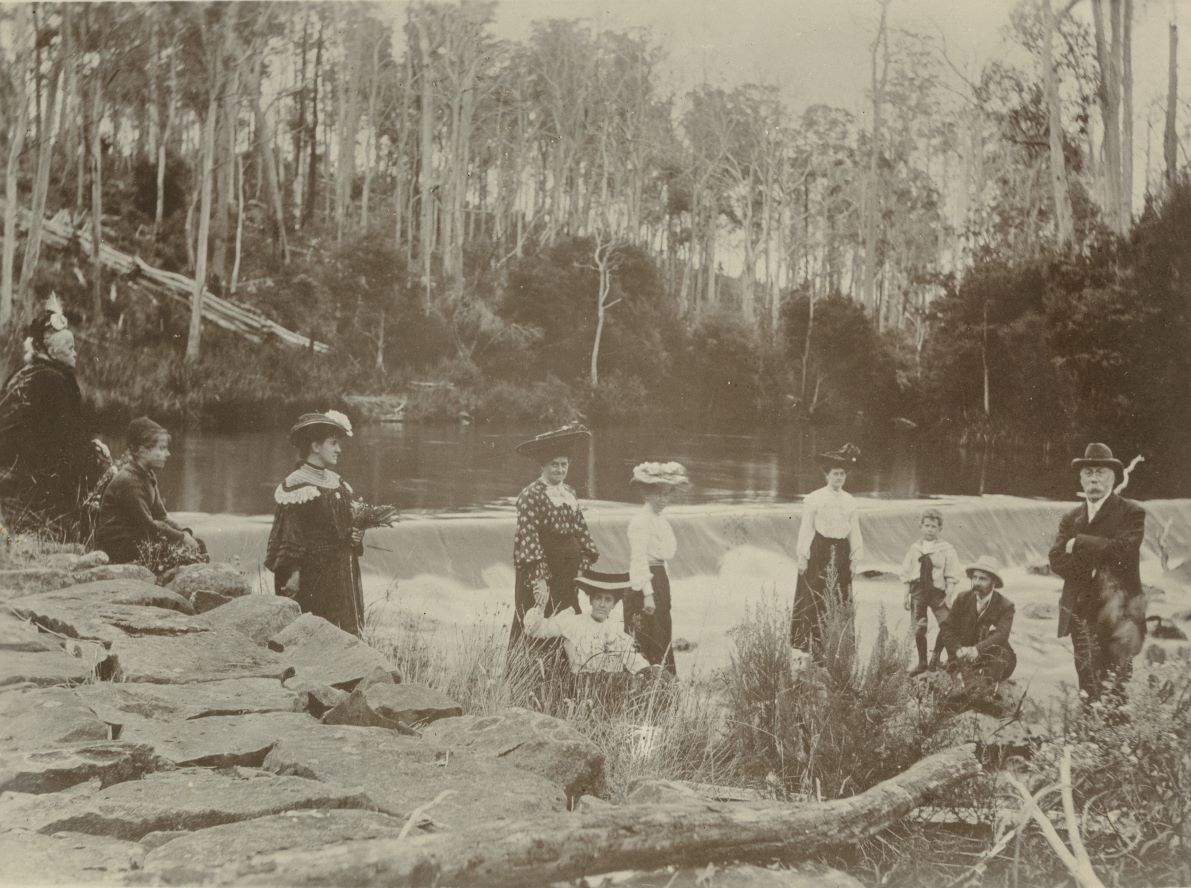
A picnic photo of Scotts and Cumings: (left to right) Caroline Cumings, AC Jowett, May Scott, Minnie Jowett née Cumings, Addie Joscelyne née Cumings, L Jowett, Wilfred Jowett, HWH Jowett and Henry Sidney Scott. Was Vera May Scott the photographer? LMSS754/1/28 (TA).
Vera May Scott (1886–1962)[7] was born at Battersea, London. At the 1901 British census she was a 15-year-old living in London with her 47-year-old piano tuner father Henry Sidney Scott and 37-year-old Brisbane-born mother May Scott.[8] No record of the family’s migration was found, but in 1922 Vera May Scott was an unmarried typist living at 28 Delamere Crescent, Trevallyn with her parents and sister Eleanor Scott.[9] Scott lived next door to the Joscelynes and had a strong connection to the family. In 1945 she thanked Horace Joscelyne for ‘unfailing kindness’ during her mother’s long illness.[10] Rupert William Joscelyne Hart, whom Scott recognised in her will, was the son of Horace Joscelyne’s sister Violet Mary Joscelyne.[11]
Lydia Morrison (1886–1971)[12] appears to have emigrated from England as a small child in 1891, along with her two-year-old brother and her parents, 28-year-old Lydia Morrison senior and 35-year-old farmer William Morrison.[13] In 1922 Lydia lived with her parents, her sister Dorothy Mary Morrison and brother William Morrison junior, at 211 St John Street, Launceston.[14] Forty-six years later in 1968 Lydia was still listed as an unmarried clerk—at 82 years of age—and living with her bookbinder sister at 6 Union Street, Launceston.[15]
Harriet (‘Addie’) Joscelyne née Cumings (c1872–1946) emigrated from England with her sister as a teenaged nursemaid in 1888. Her parents, Ebenezer and Caroline Cumings, had preceded her and were already Launceston residents.[16] Addie’s older sister Minnie gave her occupation in the passenger list as schoolteacher, and until her marriage in 1893 she operated the Trevallyn Preparatory School.[17] At this point Addie Cumings took over from her, continuing the school until at least 1897.[18] This suggests that she was at least reasonably well educated. Addie Cumings married Horace Samuel Joscelyne at Launceston in 1903.[19]
Tasmania’s great romance novelist of the time, Marie Bjelke Petersen, threatened to pen a Cradle Mountain tearjerker which never eventuated.[20] Given her habitual bible bashing, some may see that as a good thing, but a Bjelke Petersen blockbuster might have done wonders for Weindorfer’s business. It would be surprising if Bjelke Petersen hadn’t pencilled him in as a model for her male lead—like Robert Sticht in her Mount Lyell Mine saga Dusk (1921)—and Waldheim as her anonymous location. Like driver Vic Whyman in her Jewelled Nights (1923), Cradle Mountain coach driver Bob Quaile would surely have appeared under an alias in her new screed. Bjelke Petersen championed Tasmania’s great forests and mountain scenery, and as such may have looked askance at the ‘grass tree’ (Richea pandanifolia) bonfire in ‘A dip into the Waldheim mailbag’.
However, much of the latter text is straight out of the BP playbook. The unknown author’s heroine Claudia Crane even notes ‘I could not help thinking what rich material a novelist might find here’, before listing elements of the region’s romantic history. ‘Why go to other lands for the setting for tales of adventure, of love, and mystery?’ Why indeed? Cradle Mountain was a romance writer’s paradise waiting to be reimagined.
A DIP INTO THE WALDHEIM MAILBAG
From Claudia Crane to an invalid friend.
Wilmot
My dear Margaret,
I am on the eve of adventures strange and wonderful — bound for a lonely chalet in a mountain valley, 2000 feet above the sea level. How does that appeal to your romantic soul, oh! my friend? And, moreover, the said chalet is inhabited by a solitary man, who is cook, housemaid, washerwoman, waiter and guide rolled into one. Poor Aunt Grace is filled with the most dismal forebodings as to the dinners and beds we shall get, but to Mona (who has just turned sixteen) and myself, the prospect is most alluring — the uncertainty — the romance — of it all makes an irresistible appeal. (All the same we hope the dinners are good.)
On arriving we had a hearty welcome from Mr Quaile, a fine white haired, weather beaten old chap with a face like a rosy apple.[21] Mona christened him ‘Daddy’ on the spot and my heart warmed to him straight away as I caught the kindly, compassionate glance that just rested on my crooked shoulders. He led us on the verandah of a funny rather rambling little house and introduced us to the quaint, bright little hostess. When we trooped inside we found the place surprisingly roomy and comfy and we all approved of the cheery fire burning merrily in the open fireplace and straightaway fell in love with the inviting little white beds waiting for us. Now my inner woman having been well satisfied, I am writing this epistle in front of that same fire, with the lovliest [sic] pink lilies smiling down at me from the high mantel.
The little township seems to be a paradise for lilies. This afternoon as we were sitting on the grass in front of the house a lovely slip of a girl passed with a most beautiful cluster of the Golden Lily of Japan nestling in her arms peeping into her sweet oval face. I wonder who she is? She looked nearly as lovely as her lilies. We were favoured with many a kindly curious glance from the passers by [sic] and Mona was highly amused when one passing man called to us ‘You will find it cold up the mountains’.
Ah well that small white bed is calling me, so Good-night.
Yours,
Claudia (in search of adventure)
PS I find that the lovely girl is Daddy Q’s daughter.[22]
C.
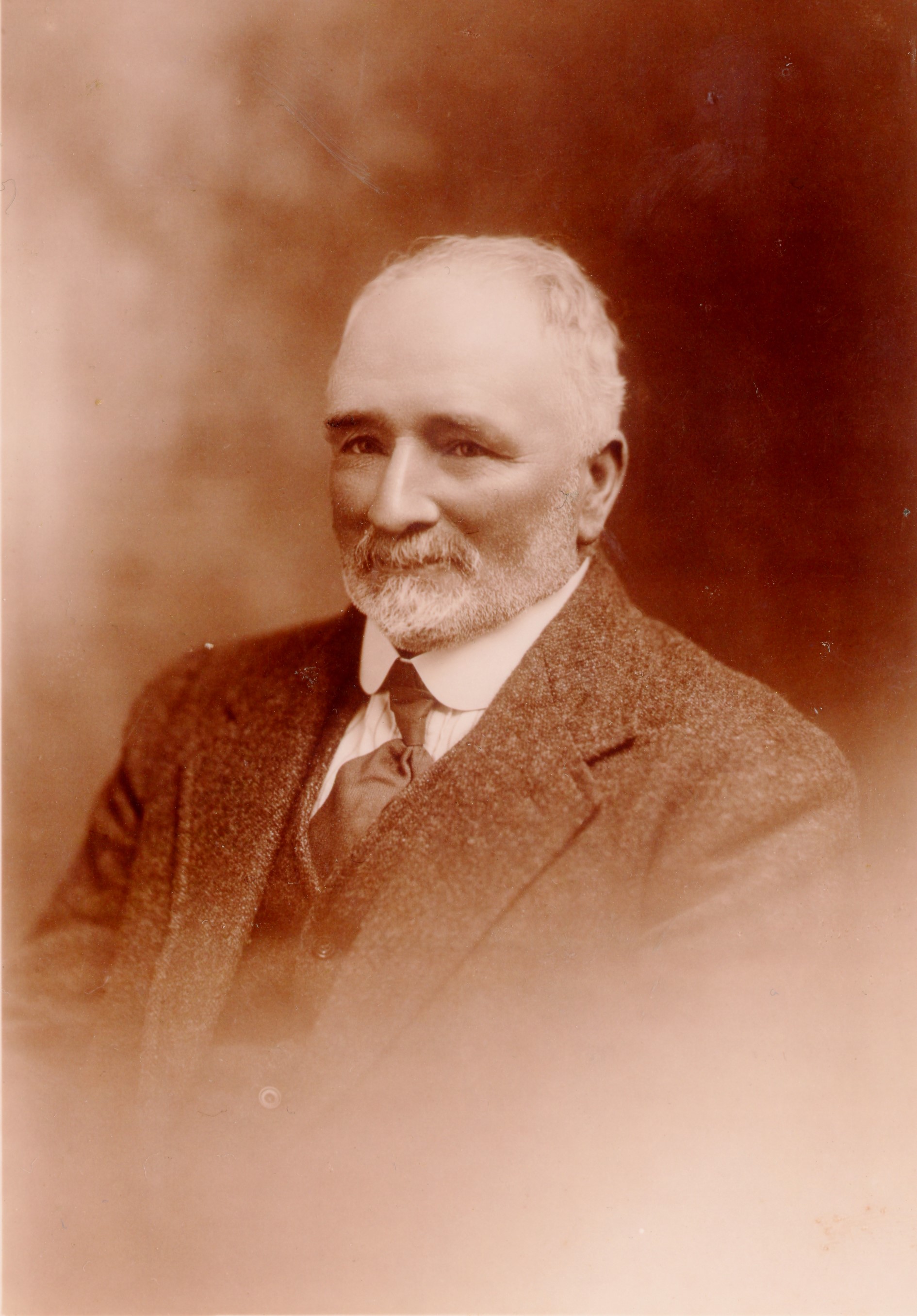
Bob Quaile. Photo courtesy of Leslie Quaile.
From Claudia to Margaret.
Dear Margaret,
We left the world behind at seven o’clock this morning, in the most glorious sunshine. Our vehicle was a weather beaten old warrior, and had evidently started life as a mailcoach [sic]. We were inclined to smile at it and our smiles broadened as our driver with a twinkle in his eyes, implored us to be careful of the upholstering, but before our journey ended we had a huge respect for our coach. We set off merrily along a very fine road, of which Daddy Q was very proud. He is evidently a man of many parts and equally at home as councillor, farmer, miner, road-maker, and moreover is no mean conversationalist.[23] He proved quite equal to carrying on several conversations at once, interspersed with various remarks to horses (sometimes with funny results, as for instance when the remark ‘Gee up, Commonwealth Bank’ nearly sent Mona into hysterics.) I had always had a vague idea that drivers of horses used fairly lurid language but, ‘Gee up! You lazy rubbish’! was about the most violent expression we heard — much to Mona’s disappointment. For the 1st time in my life, I found myself passing through mining country. We passed quite close to the ‘Shepherd and Murphy’, and Round Hill mines. Daddy Q also has a claim which he pointed out to us.[24] Further along the road we had quite a picturesque glimpse of a fine herd of wild cattle, grazing on a hillside. Great tracts of the country we passed through had been burnt, and I saw a variety of fence that was new to me —composed of simply of single huge trunks (mostly chared [sic]) laid end to end.
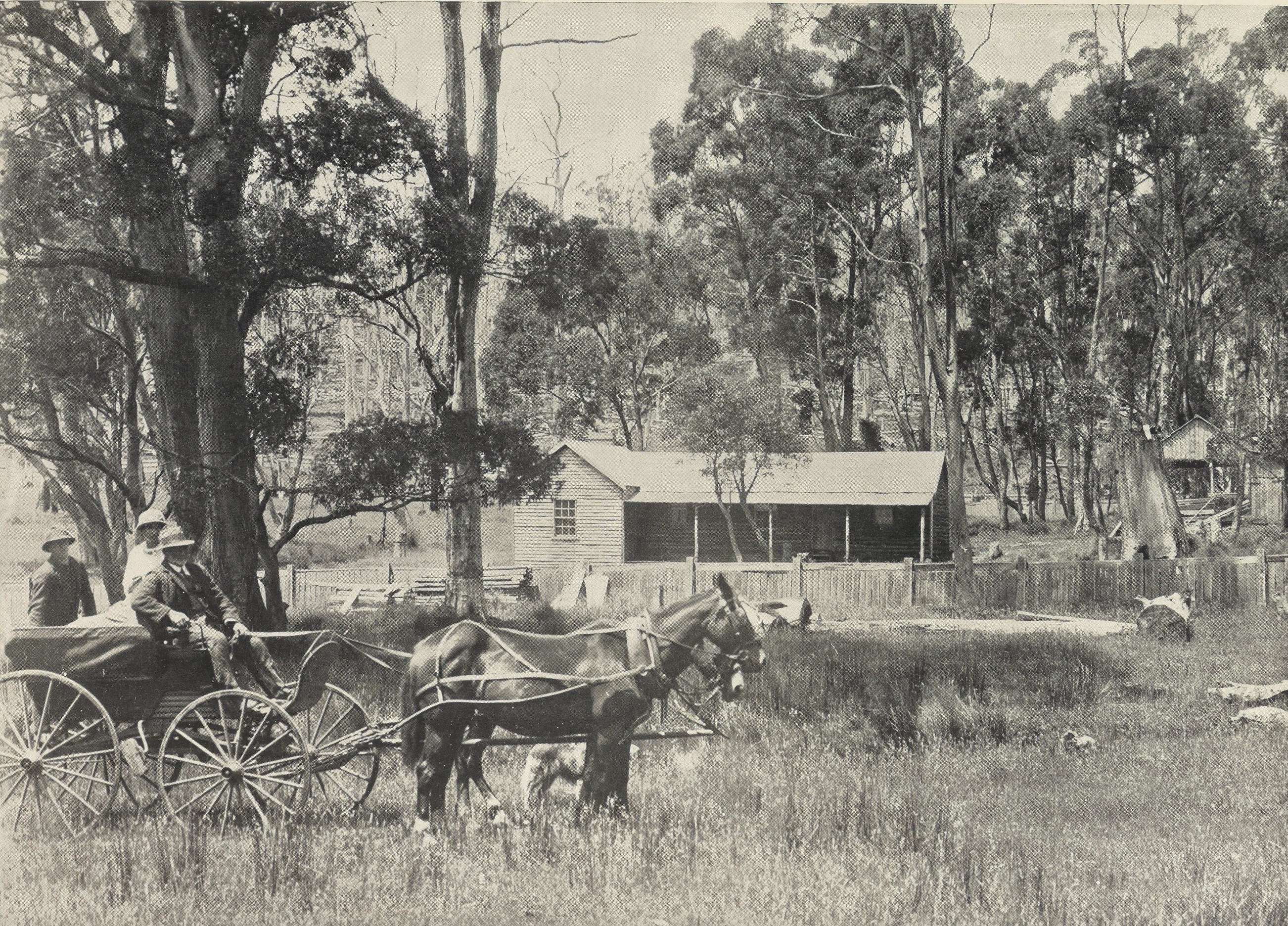
A posed photo of Bob Quaile with two tourists in his wagonette at Daisy Dell. Burrows photo from the Weekly Courier, 15 February 1923, p.21.
I liked the black and white effect. The quick eye of our driver distinguished some of his own cattle among others, and soon the truants were trotting along in front of us. By this time our fine road was left behind and we were passing along what we were assured was a ‘made road’, and nothing to what was in front of us.
We who were facing each other were bobbing and bowing to each other in a most absurd way. But it was a new experience to us and we rather enjoyed it, but nevertheless no-one grumbled when the horses were allowed to leave the ‘made road’ and take their way through paddocks to ‘Daisy Dell’, where quite our ideal dairy maid — fresh, comely and plump — served us with butter, cheese and cakes of the best. The horses were glad of the spell, as the road had been steadily ascending the whole way, and it was a pretty strenuous climb for them. We started once more, this time in a fine drizzling rain, which prevented our getting any of the early glimpses of the Cradle to which we had been looking forward.
Soon after we had passed Pencil Pine Creek and the Sawmill we came across a gang of men hard at work on the road, and there a halt was called, and our luggage had to be ‘packed’.[25] The girls decided to stroll on in the soft rain, and when the horses caught us up we could not help smiling at the poor pack horse — he looked for all the world like a camel with a huge hump. The decree went forth that we were to ride, to Mona’s huge delight and my inward dismay. But once mounted, I found it delightful to gaze round without troubling what my feet were doing.
The last three miles of our way lay along a lovely little green valley, much of it by the side of the Dove River. The 1st glimpses of our new home came rather unexpectedly, but a very pretty glimpse it was in spite of the rain. Soon we were at the porch and found ourselves welcomed, not by an old man, as we were expecting, but by a big dark-bearded man, in the prime of life.
We were soon lifted from the saddle and walked into the house on rather wobbly legs, to be greeted by a huge fire and a deep barking proceeding from under the couch. The barker proved to be ‘Flock’, a dignified and matronly old dog, who soon came out and made friends with us, together with her son, ‘Flick’ who is, according to his owner, ‘young and silly and spoiled by the ladies’. Our bedroom opens out of the living room and contains 4 bunks. Moss and lichen still clings to the small trees used as posts in the room, also to those supporting the bunks above our heads. The picture frames are of bark trimmed with lichen. The tassel on our blind is a dear little fir cone. The recess for our washstand (which I grieve to say looks uncommonly like a packing case, curtained,) is lighting by a tiny fascinating window made of three old negatives. The seats are merely lengths of tree trunk stood on end. The walls, of King Billy pine, are fine, each plank having a broad white streak running through it where the sap once ran. The rugs on our floor are badger skins, but the star room boasts a real carpet and a leopard skin, head and all.
I am too tired to write more to-night.
Yours,
Claudia.
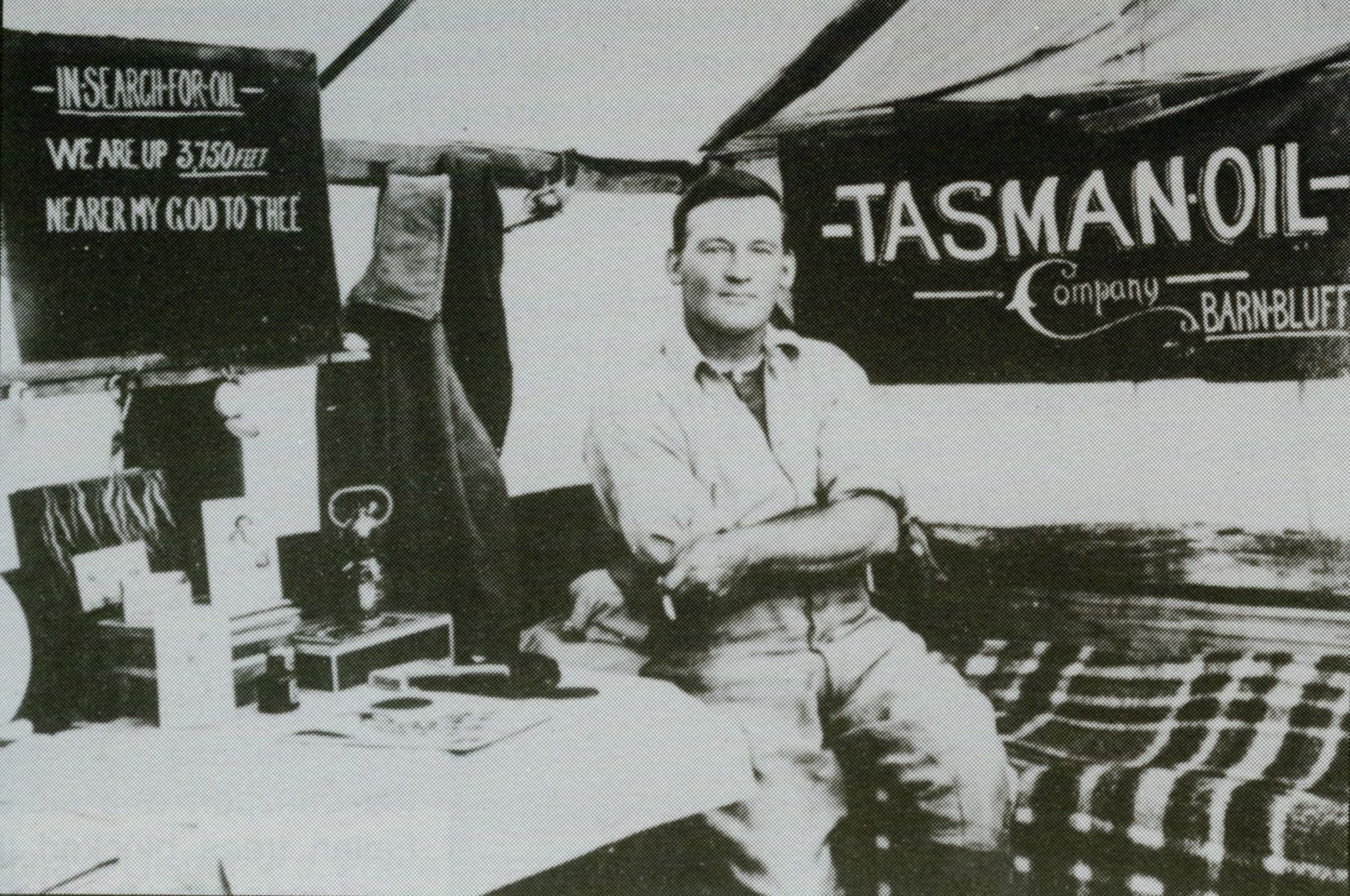
‘Nearer my God to thee’: AG Black, mine manager for the Tasman Oil Company at Barn Bluff, Christmas 1921, with his gun and family photos. Courtesy of the late Es Connell.
Mona to her girl friend [sic].
My Darling Marie,
Such a lovely thing has happened. A perfectly beautiful boy came here yesterday. He has most glorious brown eyes and a lovely big nose like Napoleon. His father and Dad used to be mates. His father is one of the directors in some mine here, and he worried his father till he let him come here to work, but now he is sick of it, and so Mum has asked him to come to town and stay for a holiday and it is such fun having him here, everyone else is pretty old except Claudia, she is a love, but she can’t tear round like I want to.[26] Percy had such a lark this morning. You know Mr W always brings us a cup of coffee before we get up. Well he knocked at the door and said ‘milk for the babies’ like he always does and I got on my elbow ready to take my cup (Claudia always get the tray — a bonza one made out of KB pine). When I looked up there was Percy grinning like a Cheshire cat and he had on the most beautiful silk pyjamas with purple stripes and a silk cord round the waist (Dad says he must be an awful fop to wear silk and he looked beautiful in them). I gave a most awful yell and nearly dropped the cup on the floor and Percy and I just squealed, it was so funny. We made such a row that everyone came trooping in to see the fun until Mum rapped on the wall and they all got for their lives.
Oh! I say Marie, did you know I had pretty ankles? Mr W served out leggings and putties to Mum and Claudia, but he wouldn’t give me any, because he said my ankles were the nicest he had seen for a long time and it was a pity to hide them. I thought perhaps he was stuffing, but he wasn’t because I asked Claudia, and she said it was quite true, she had often admired them. So that’s my first live compliment.
Mum is getting to be quite a sport up here — she doesn’t chip a bit. Every morning she goes out to the Kitchen for the Porridge jazz with the rest of us. We all streak out into the Kitchen like a lot of Oliver Twists and everyone grabs their own Porridge when Mr W puts it out and there is a procession back into the Dining-Room. But no-one ever asks for more, cos he gives us such big platefuls.
I do hate washing porridge pots at home, don’t you? But it is quite easy here the pot just gets stuck out on the roof until next morning and the Porridge comes off without any trouble. And he’s got quite a cute idea for washing windows, he just takes them right out and puts them in the Creek, and both sides are washed at once.
Mum doesn’t even mind getting her feet wet. You know coming out she wouldn’t even let me get out of the Trap to see the Pencil Pine Fall cos it was raining, and I might get my feet wet. But up here they are nearly always wet, and Mum thinks nothing of one foot slipping into a hole with water a foot deep in it. All the wet boots and stockings look so funny dangling round the fire place at night.
That Percy is pulling my hair so I’ll have to go and hammer him now so Ta-Ta, heaps of love.
Mona.
PS I hope you get that little note I sent by pigeon post. It was fun letting him go.
Mr John Moore to Percy’s father.
Dear Lane,
Suppose you will be somewhat surprised to note the address heading this letter — nearly as surprised as I was when your son rode in here. The lad had been sent over from the mine on an errand and was overjoyed to find our party. Truth to tell I think he is beginning to find the mine life a trifle monotonous and a short spell would [do] him no harm. Unless we hear from you to the contrary, therefore, it would give us great pleasure to keep him with us during our stay here and to take him home for a few weeks change. We would be glad if you would drop the manager a line and make this right for him. He and my little girl Mona have become great pals and are keeping all the old fogies alive with their harmless nonsense.
You should really take a spell and run over and see this place next summer. By that time the road will be right through and the accommodation even better than now, as our host has great plans for enlarging and improving the house and will probably have domestic help also.
At the present time he does the whole of the housework and cooking unaided, in addition to this work as guide, but expects the business will become far too large for that to continue possible [sic]. The wife was really rather worried about domestic arrangements, but our host soon proved he understood the important art of cooking a good dinner. On our first day we sat down to roast mutton, potatoes boiled in their skins and an excellent boiled ‘spring water’ pudding the flavouring of which aroused much curiosity among the ladies. As a matter of fact I found that ½ cup of rum was used and we have since had a similar concoction known as Barn Bluff pudding flavoured with port wine. Tip top coffee is the finishing touch to our meals. You will see that we are in no danger of starvation.
The house is unique, built almost entirely by our host. A picturesque porch opens into the dining room, 3 bed-rooms, the kitchen and wood shed open out of that, and one other bedroom out of the kitchen. There is an arrangement of curtains which can be drawn at will round the central part of the dining room to exclude draughts. Two long seats after the style of box couches run each side of the table and at the foot is an extremely solid arm chair cut from a tree trunk. The fire place is one of those huge affairs within which one can sit and is always garnished with a hug back log under which mine host can scarcely stagger. The kitchen is compact enough to be found on board ship and the owner can stand in the middle and reach almost anything he wants. By the way, we men, clad comfortably in pyjamas and slippers start most days in the kitchen with a good old yarn and smoke before the ladies are astir. You would enjoy those yarns. Most of the bedrooms are fitted with bunks, that occupied by my wife and self being the only one with ordinary beds. Our room also boasts a pretty little private balcony which the ladies have christened ‘The Juliet balcony.’ The tent room and the huts are some yards from the main buildings and are furnished with a couple of beds and a fire place with wood-shed attached, the hut having in addition a loft with an extra bed designed to accommodate mine host in times of pressure. The feature of the place however, is the bath room, a hut with its own small verandah standing on the brink of a creek a few yards from the house. Water is supplied from the creek by a most ingenious arrangement and may be heated in the copper which always stands on the huge fire place.
One thing I know will strongly attract you, there is a fine gramophone here, and a first class selection of records and we have enjoyed many a good concert as we sat round the fire after a long day’s tramp.
I should certainly like to come again next summer and possibly you can arrange to join our party then. However, we can discuss that at our next meeting.
Yours faithfully,
J Moore.
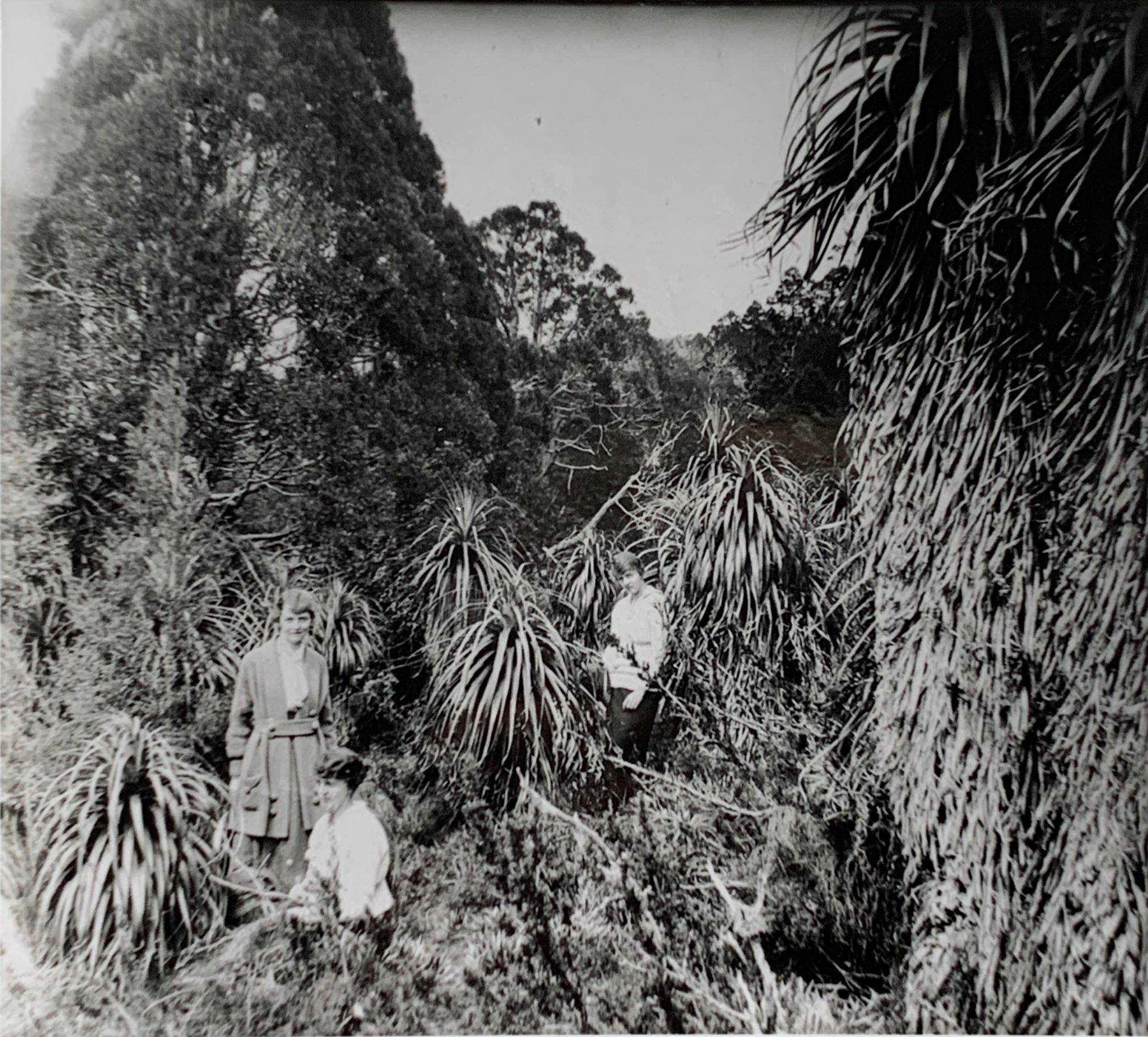
Richea pandanifolia in Cradle Valley. HJ King photo courtesy of the late Daisy Glennie.
From Claudia
My Dear Margaret,
I want to tell you of some of our walks. The first was in most glorious sunshine. We crossed the dear little creek that runs past the chalet and followed the steep moss-bordered path that winds up through the gulley [sic]. Here I made the acquaintance of the famous beech which is the only native tree that sheds its leaves.[27] Its slender graceful stem is beautiful and you have no idea how pretty, glimpses of the blue sky, looked through the canopy of little green leaves. I was quite sorry when we came up into the open but when we reached the top of Hampstead Heath we had a glorious view on all sides — the mountains in front and away back the way we had come to Middlesex.[28]
We went for the same walk again later but wandered further away over the hills and had a lovely picnic boiling the billy in the approved bush fashion. It was a delightful sight to see my rather stately Aunt Grace devouring a huge slice of bread and butter on which was spread a tinned herring and enjoying it too.
I think our lovliest {sic] picnic spot was a little pebbly speech on the shores of Dove Lake. The beauty of the spot and even the sight of Cradle frowning down upon us, failed to subdue the irrepressibles, who were madly engaged in getting as much of the beach as possible down each others’ backs. So to keep them quiet we set them to work getting our lunch. Our host had once been busy on that beach making a raft and the pair found too paddles roughly cut out of planks. These they seized and pressed into service as bread board and meat dish respectively. Mona soon had a nice little pile of bread and butter on one end of their respective paddles and solemnly marched round and served the waiting circle.
Soon we found ourselves climbing up the gently sloping sides of Mt Campbell. Half way up, we rested on a lovely fragrant couch of wild thyme[29] —So now I can say ‘I know a bank where the wild thyme grows’ because I do (Talking of resting, in this part of the world — if you want to rest where the ground is wet and it generally is wet, here we find you simply sit or lie on the strong stunted bushes growing about a foot above the ground and you have a seat fit for a Queen.)
As we pushed on up the mountain to our surprise we came across two or three snowdrifts. Of course each one was the signal for a scramble between the children (and I regret to say not wholly confined to them) but soon they came across an even more attractive diversion. Percy found a huge kerosene plant and promptly set fire to it.[30] It was really marvellous the way that green plant blazed and the intense heat it gave. Mona yearned to set fire to everyone she came across after that but her father wouldn’t hear of her spoiling the scenery in that fashion.
One morning we woke to find all the world white and the chalet a fairy place. We only got occasional glimpses of the Little Horn when her misty veil floated aside for a second, but those glimpses were beautiful indeed. Of course Mona and Percy were just spoiling for a snow fight and her father and I were dragged out to see fair play. At least that is what we intended, but we soon found ourselves involved in the battle and enjoying it mightily. The child’s delight in all was pretty to see, and so was the pride in her father’s eyes as they rested on the glowing face, alight with mischief and triumph as a well-armed snowball slipped down Percy’s neck. Our little Mona will be a very lovely woman some day. Ah me! What would it be to be sixteen and straight![31]
After peace had been declared we struck into the trees above the clear slope which had been the battlefield, and found a lovely little path winding among the trees towards the world. You have no idea how fascinating it is to stroll among the pretty floating flakes of snow. We felt quite injured when presently it turned to rain and sleet — it seemed commonplace. As we turned to retrace our steps Percy begged us to climb a tiny hill that lay between us and the ‘Dove’, directly facing Cradle. So up we climbed and there lay before us the Dove valley, Mount Campbell, the little foothills and Cradle, all one dazzling white vision of loveliness. I have only to shut my eyes and I can see it all once more. I wish you could, you would love it so.
Yours,
Claudia.
Dear Margaret,
It has been wet the whole day through. Mona was roaming restlessly round, poking her little nose into most things, when she came upon a printed notice on the roof ‘Special apartment for naughty girls’. Of course she immediately demanded the history thereof, and there was something very like a twinkle in the eyes of our host as he told the story of two unfortunate girls who had been imprisoned there. ‘And you too shall go up for you are the most naughty of them all’. There was a wild shriek from Mona, a frantic rush to the door, and then ensued such a scuffle as you never did see. When it was all over and Mona was safely in prison Mine host shook his head mournfully as he mopped his heated brow. ‘And she was the heaviest of them all.’ Then there was a shout of laughter for a shower of ancient Bulletins and Couriers came tumbling about his ears from the trap door above and Percy was promptly hoisted up to keep the rebel in order.
It was such evident cruelty to keep those two shut up that Uncle John proposed that we should take them for a walk, in spite of the rain. So off we set with one of the other visitors acting as guide to explore the valley in a new direction. First he led us into a most beautiful bit of virgin forest. Trees hundreds of years old towered above us.
Long ghostly locks of pale lichen hung from many of the smaller ones — I never saw such lovely moss and as I have seen here. Only once have we seen ferns in any of the glades, and those only of a common variety, but the mosses are exquisite. Presently we struck down into the opening and tramped briskly over the springy turf, the children wrangling away as usual.
Presently I made out that Percy was affirming his ability to make a big fire in the rain, and Mona was stoutly doubting.
We came to a little valley dotted with grass trees[32] and Percy stepped in front of a huge fellow, burrowed among the dried leaves around the trunk, set fire to them and waited. We watched breathlessly and soon saw a wicked little flame creeping up the trunk and in among the green leaves, and in a few moments great banners of flame were waving defiance to the rain. When we left, nothing remained of the beautiful green tree but a black smoking stump, and we were warned not to say anything about it on our return, as mine host doesn’t like the scenery spoilt. Neither do I, but all the same I am glad I saw it once.
One misty morning we started for the top of the Cradle. We had been looking forward to seeing the mountain lakes but the heavy mist hid everything. As we stood above what we were told was Crater Lake, occasionally we could see a thin silver line of foam, the mist would part for a second, allow us one weird glimpse of the lake then blot it out once more. By the time we had got within ¼ mile of the mountain’s foot the mist had turned to a fine thick rain, and the wind was icy, so a council of war was held and we decided to turn homeward by another route. In spite of the discomfort we enjoyed the experience — it was entirely new to us. It really was extremely funny to be tramping along in the fine rain and not worrying in the least, an inch of cold water swishing about in our boots, our faces perpetually washed but never dried, and drops of water hanging from brows, lashes, hair, chin — in fact anywhere they could cling. It is so strange to shut one’s eyes and fell the cold fringe of wet eyelashes. It was weird too, to look back and see mysterious indistinct figures, some armed with staves, looming in the distance. However we were soon safely home, into dry clothes, and grilling over the big home fire the chops we had expected to grill at the mountain’s foot.
Bed-time now so good-night.
Yours,
Claudia.
My Dear Margaret,
We had blackberry jam for tea, and it started us speaking of the occasional blackberry brambles we passed on our way here always beside a little stream, then someone said they had sprung up from seeds from blackberry jam used by prospectors camping there. Being in a dreamy mood I started picturing to myself the scenes round those camp fires — the rough hard faces lit up by the fitful flames, and from that I fell to musing over the glimpses we had had of lives so different from our own and the unexpected traces of history across which we had come. I could not help thinking what rich material a novelist might find here in the rough life of the mining settlements scattered among the hills — the lonelier camps away back in the mountains — the sawmill at Pencil Pine — the pioneer gang pushing their road into the mountains — the exciting rounding up of the magnificent wild cattle — the old life of the VDL Coy at Middlesex — the oldtime Governor [sic] who visited there — the convicts who toiled up the mountains laden with timber for the observation posts — the stalwart foreigner in his lonely chalet with its mysterious trap doors — the weather-beaten old man-councillor, — farmer, roadmaker [sic], miner, — his slender daughter with her sweet oval face and her hands full of golden lilies — or as we saw her later clad in rough trousers and boots for her work in the farm yard — her lover slipping along in the dusk to give her a helping hand. Why go to other lands for the setting for tales of adventure, of love, and mystery?
My dear! I have inflicted a screed on you. But we go home the day after to-morrow — that must be my excuse. Soon this freer and easy life — where ‘time is not [important] and nothing matters’, the porridge jazz, the wash up symphony, the picnics enlivened by the gambols [sic] of Flick and Flock, Mona and Percy, the fireside evenings of music and pleasant talk, the eagerly looked for coming of Mr Quaile with letters and papers, the meetings with visitors will be things of the past.
However often we come here in the future it will never be under quite the same conditions, and I am so glad we came before things are made too easy and ordinary for us.
Claudia.
MY DEAR MARGARET,
There is a touch of novelty about this letter. It is being written at the foot of Cradle — just as we started out I stuffed some paper and a pencil into my pocket in case I had a chance to write a line. We are just back from the summit and are resting before returning home. It has been a perfectly glorious scramble and I have enjoyed every minute of it. When we stood at the foot and looked up at the strange rugged pile I wondered if I could do it, but it turned out to be fairly easy. As we ascended our guide led us to the opposite side of the mountain and I felt a pang of disappointment as he began to go down, because I could see higher peaks above us. But it was only for a moment and then he began to ascend once more, passing over the lovliest [sic] little green velvety moss carpets. The view from the top is magnificent, we seemed to stand in a centre of ever widening circles of mountains. It was strange to stand on the cairn of tree trunks which we were told had been hauled and built up by convicts and think of the hard toiling hands that had placed them there, and to look at the wonderful view and think of the bitter, unhappy eyes that have gazed upon it before ours.
The scramble down gave us plenty of exercise and our hands were quite as useful as our feet; at the foot, one after the other down we went on hands and knees to drink from a tiny stream flowing from the hillside, and never was water sweeter. Mona seems pretty tired — don’t know what she will be like when we get home — she and Percy have been in such wild spirits that they have covered six times as much ground as anyone else. You know there is a lake on the way named after a Launceston lady,[33] and Mona was much taken by it and has been looking for something to which to tack her own name ever since. Well, she and Percy were for once walking quietly along conversing amicably when suddenly there was a wild shout and Percy darted off and began dancing wildly round a shallow swampy pool. When the rest of us came up he just gasped out ‘Mona’s Marsh’ and took to his heels with the indignant Mona after him like a deer. However she is quite happy now for a certain tiny muddy pool on the tableland bears the legend ‘Percy’s Puddle’ printed in big wobbly letters across its muddy bosom.
Claudia.
PS And oh, the lakes and the mountain are beautiful in the sunshine, but I am so glad we saw them first in their weird misty mood. C.
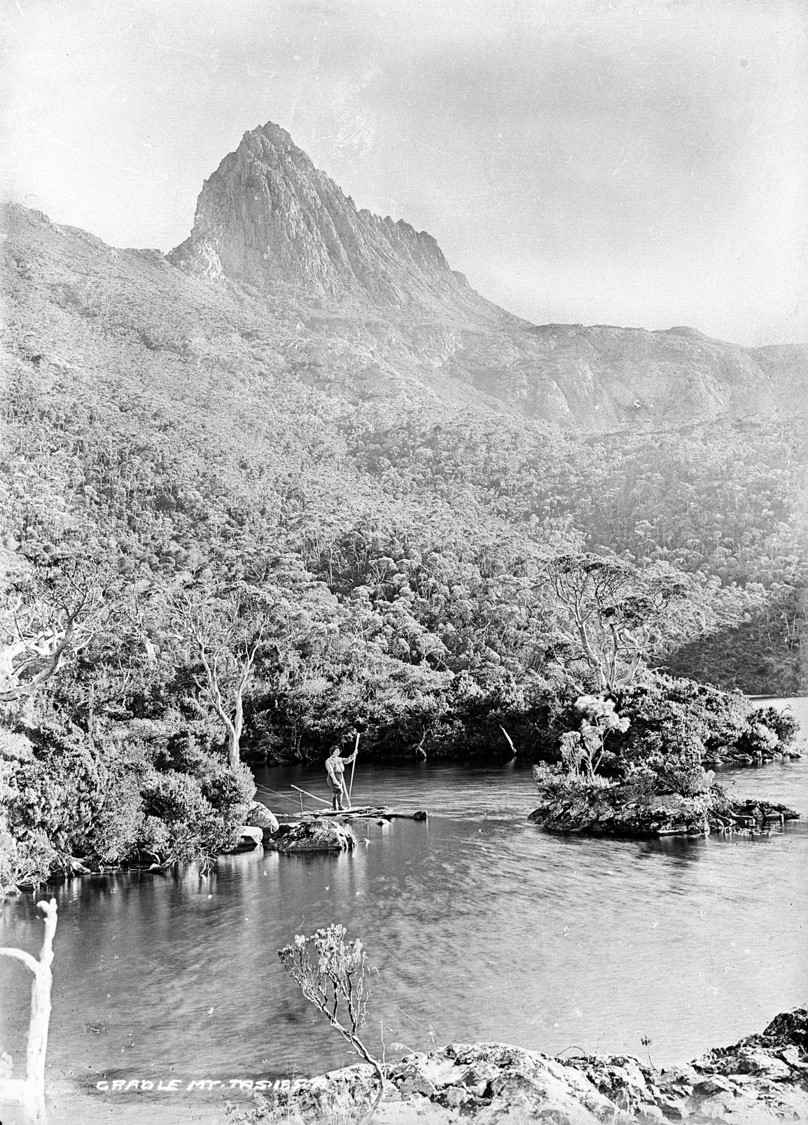
The Honeymoon Islands at the southern end of Dove Lake, with Beulah Hills on a pine driftwood and kerosene tin raft. Stephen Spurling III photo, 1922 (QVMAG).
My Dear Margaret,
It is 2 o’clock in the morning and I am sitting up in my bunk writing this by candlelight. I am far too happy to sleep so I will tell you of the wonderful thing that has happened. Mona was quite knocked up when we got back [from] Cradle and so it happened that I did not see the arrival of some new guests. I was busy putting her to bed and stayed with her till she was fast asleep. Then I slipped out to the group by the fire. Most of the men were so deep in the discussion of some mining affair that they did not notice me — all but one, quietly smoking and listening, on the edge of the group. He looked up and my dear! It was Dick! How long we stared at each other I do not know, nor how much of the wild gladness at my heart found its way into my face. But presently very quietly he rose, slipped back the curtain and drew me to the porch outside and oh my dear! Such a tangle of mistakes and misunderstandings we cleared up! All the happiness I ever dreamed of is mine. I know how glad you will be. And I am to be married to-morrow — no! It is to-day — I got into a panic at the bare idea but [Dick] only laughed at me and would have his way.
Yours Claudia,
(in a maze of happiness)
MRS JOHN MOORE TO HER SISTER.
My dear Mary,
The most unheard of thing has happened. Here we are at Wilmot and have left Claudia behind at that outlandish place. On our last night there John and myself happened to be left alone round the fire, when Dick Grey walked into the room and calmly asked John’s consent to marry Claudia next day.[34] He had turned up here early in the evening. Really for a moment I could only gasp. It appeared he met a parson staying at Daisy Dell as he came through and as it was bright moonlight, he proposed riding there at once, and bringing him here in the morning. I was really upset at the insane idea and as soon as I found breath enough I started straight for Claudia’s room. There she was, sitting on her bunk in the dark, ‘Claudia Crane, are you mad’? I demanded. When I had got the candle alight I could only gasp again. The little pale face was transfigured — flushed and smiling and sparkling the big eyes soft and shining. At sight of the radiant happiness shining in those eyes my irritation fell away like a garment. I did try to persuade her to come back to town and have a proper wedding but she was softly obstinate, she didn’t seem to think it mattered in the least that she had no trousseau or engagement ring or anything. And after all did it? As she had no relative nearer than ourselves, and we were all here, they were both old enough to be sure of themselves and they had wasted so much time already.
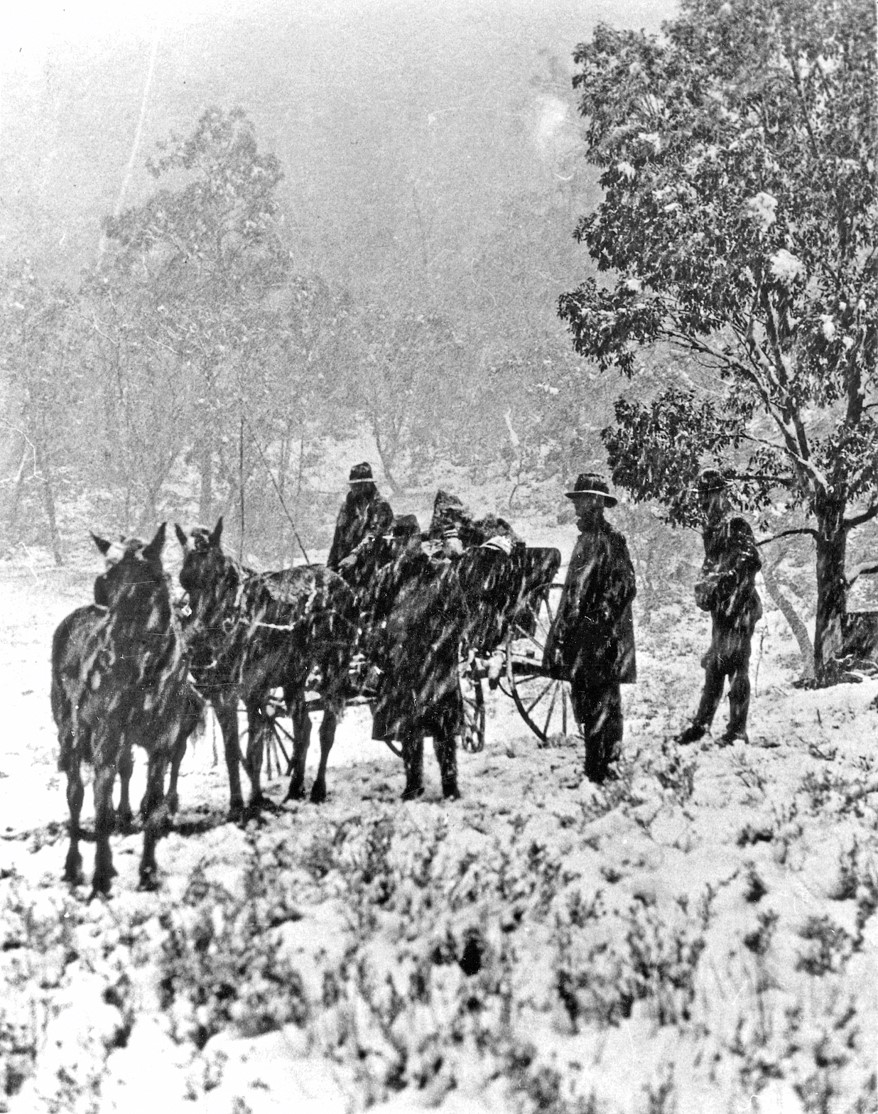
‘Starting for home from the Old Dump’, Bob Quaile at the reins of his horse team as he prepares to return a Waldheim party to Wilmot, 1925, with (left to right) Charlie Monds, Ron Smith and Gustav Weindorfer standing. Fred Smithies photo (TA).
Why should they wait longer? So I had to give in, for after all I had not the slightest right to object. When Mona heard the news in the morning, she was wild with excitement and promptly took charge with all girl’s delight in a wedding. She insisted on doing the thing properly, invited herself to be bridesmaid, and Percy to be the best man, hunted out the one soft little white frock Claudia had with her and fixed up a big tulle scarf of mine for a veil. A wreath of ginsen flowers and sweet scented white daisies nestled in the soft hair, holding the veil in place. My tender-hearted little girl had carefully draped it so that the slight deformity about which Claudia is so sensitive, was scarcely apparent. She had even a bouquet of lovely white berries she had found growing near the house. They were married out on the porch facing the mountain. Even to my eyes the little bride was as sweet as a rose, and it did my heart good to see the rather quiet face of her groom light up at sight of her and to see his eyes grow infinitely tender as they rested on the shy winsome face and I wish you could have heard the serene confidence in the low voice of the bride. After a gay little wedding breakfast, with one of Mr W’s huge slabs of cake in the place of honour, we started for home. It was quite in keeping with the rest of the up-side-down [sic] proceedings that we should be the ones to go (to the strains of the wedding march our host put on the Gramophone) leaving the bride and groom behind for their honeymoon and I am afraid they were not quite as sorry to see the last of us as they should have been — if they were the content in their faces belied them. I am afraid you will be inclined to blame me for lack of firmness but really I do not see how I could have acted differently.
Your affectionate Sister
Grace.
[1] Kate Legge, Kindred: a Cradle Mountain love story, Melbourne University Press, 2019.
[2] NS573/1/1/11 (Tasmanian Archives, afterwards TA).
[3] Maude van der Riet, ‘The Cradle Mountain: a climb to the peak: the world’s view’, Daily Telegraph, 15 December 1923, p.9.
[4] Waldheim visitors book, vol.1, 1991:MS:0004 (Queen Victoria Museum and Art Gallery).
[5] Electoral roll, Division of Bass, Subdivision of Launceston West, 1922, p.31; entry for Harriet Mary (Addie) Cumings, Launceston Family Album, written by Lesley Morgan Blythe and Marion Sargent, https://www.launcestonfamilyalbum.org.au/detail/1030945/harriet-mary-addie-cumings, accessed 10 June 2023.
[6] Electoral roll, Division of Bass, Subdivision of Launceston West, 1922, p.43. Piper married Ada Letitia Isabel Scott, unrelated to Vera May Scott, in 1923.
[7] Years are from headstone, Carr Villa Memorial Park, Launceston; plus 1901 British Census as below.
[8] British Census, 1901, Administrative County of London, Civil Parish of Heathorn, p.22 (accessed through Ancestry.com.au).
[9] Electoral roll, Division of Bass, Subdivision of West Launceston, 1922, p.48. See also will of Henry Sidney Scott, in which he made his daughter Vera May Scott his sole executrix and beneficiary, will no.18727, AD960/1/56 (TA).
[10] ‘Thanks’, Examiner, 23 October 1945, p.2.
[11] See will no.43508, AD960/1/94 (TA).
[12] Years are from headstone, Carr Villa Memorial Park, Launceston.
[13] Passenger list for the Orana, October 1891, Series BT27, British National Archives (accessed through Ancestry.com.au).
[14] Electoral roll, Division of Bass, Subdivision of Launceston Central, 1922, p.34.
[15] Electoral roll, Division of Bass, Subdivision of Launceston Central, 1968, p.16.
[16] Descriptive list of immigrants, ss Coptic, arriving in Hobart 27 July 1888,. CB7/12/1/12–13, p.40 (TA), https://librariestas.ent.sirsidynix.net.au/client/en_AU/names/search/results?s=harriet+cumings&searchTarget=library&qu=harriet&qu=cumings, accessed 10 June 2023.
[17] ‘Current topics’, Launceston Examiner, 13 May 1893, p.5.
[18] See, for example, ‘Education’, Launceston Examiner, 4 January 1893, p.2; ‘Educational’, Daily Telegraph, 21 January 1896, p.4; ‘Diamond jubilee’, Launceston Examiner, 15 June 1897, p.6.
[19] Married 21 January 1903, registration no.608/1903, at St Paul’s Church, Launceston (TA).
[20] Gustav Weindorfer to RE Smith, 20 March 1920, NS234/17/1/4 (TA).
[21] Bob Quaile (1862–1942) was a well-known Wilmot identity, whose farmhouse just north of the village remains today as a barn. Quaile did much to open up Cradle Mountain as a tourist destination. For many years he operated a horse and wagonette service to Waldheim which was Gustav Weindorfer’s lifeline, the trip being broken at Quaile’s halfway house Daisy Dell. Quaile was a Kentish councillor and member of the Cradle Mountain Reserve Board.
[22] In 1922 Quaile had only one unmarried daughter, Sarah Ellen Quaile, born in 1897 and therefore 25 years old at the time of the Joscelyne party’s visit to Waldheim.
[23] Quaile was not a miner but had shares in the revamped Great Caledonian Gold Mine at Middlesex.
[24] The Great Caledonian Gold Mine.
[25] The FH Haines sawmill was on the site of the present-day Peppers Cradle Mountain Lodge.
[26] That is, Percy Lane’s father was involved in the Tasman Oil Company mine at Barn Bluff.
[27] Nothofagus gunnii.
[28] Claudia is describing the track through what is now known as Weindorfers Forest to Hounslow (not Hampstead) Heath. Weindorfer’s track was later replaced by the present track in that direction, cut by Lionel Connell and his sons.
[29] Lemonthyme (Boronia citriodora). It has a strong scent which some liken to that of lemon.
[30] Several Tasmanian plants seem to have borne the colloquial name ‘kerosene bush’ because of their flammability, but here the author seems to be referring to Richea pandanifolia.
[31] Claudia refers to her physical form rather than her sexual orientation!
[32] Richea pandanifolia.
[33] The ‘lake named after a Launceston lady’ is Lake Lilla, named by Stephen Spurling III after his sister in 1905.
[34] The idea of a Waldheim wedding was perhaps inspired by the legend of the naming of the Honeymoon Islands in Dove Lake. Weindorfer is meant to have rowed a couple to this improbable honeymoon spot, serenading them as he dipped the oar.
by Nic Haygarth | 08/06/23 | Uncategorized
Mining in a scenic reserve? A fur farm as well? How about damming a protected lake to generate power? Bring it all on. During its first 25 years the Cradle Mountain–Lake St Clair National Park was a free-for all.
The national park might have been sparked by a sermon on Cradle Mount but its implementation was more like a meditation on patience. In the 1920s economy reigned over ecology in Tasmania. With the state considered an economic basket case, government had little appetite for funding national parks or for standing in the way of resource exploitation. The Scenery Preservation Board which nominally managed the park had only advisory powers and was, as Gerard Castles suggested, ‘handcuffed’ to this development ethos.[1] Voluntary park administrators attacked their task with a passion. However, their efforts were clouded by conflicts of ideology and pecuniary interest. The first two decades of park management were beset with challenges from the mining, fur and timber industries and the government mantra of hydro-industrialisation. Even the local experts employed to build, maintain and oversee park infrastructure and guide tourists were ‘exploiters’—fur hunters and mineral prospectors. The idea of a road from Cradle Mountain to Lake St Clair was entertained on the ‘bigger, better and more accessible’ social justice principle that has been used time and time again in Tasmania to justify development of natural assets. What a mess!
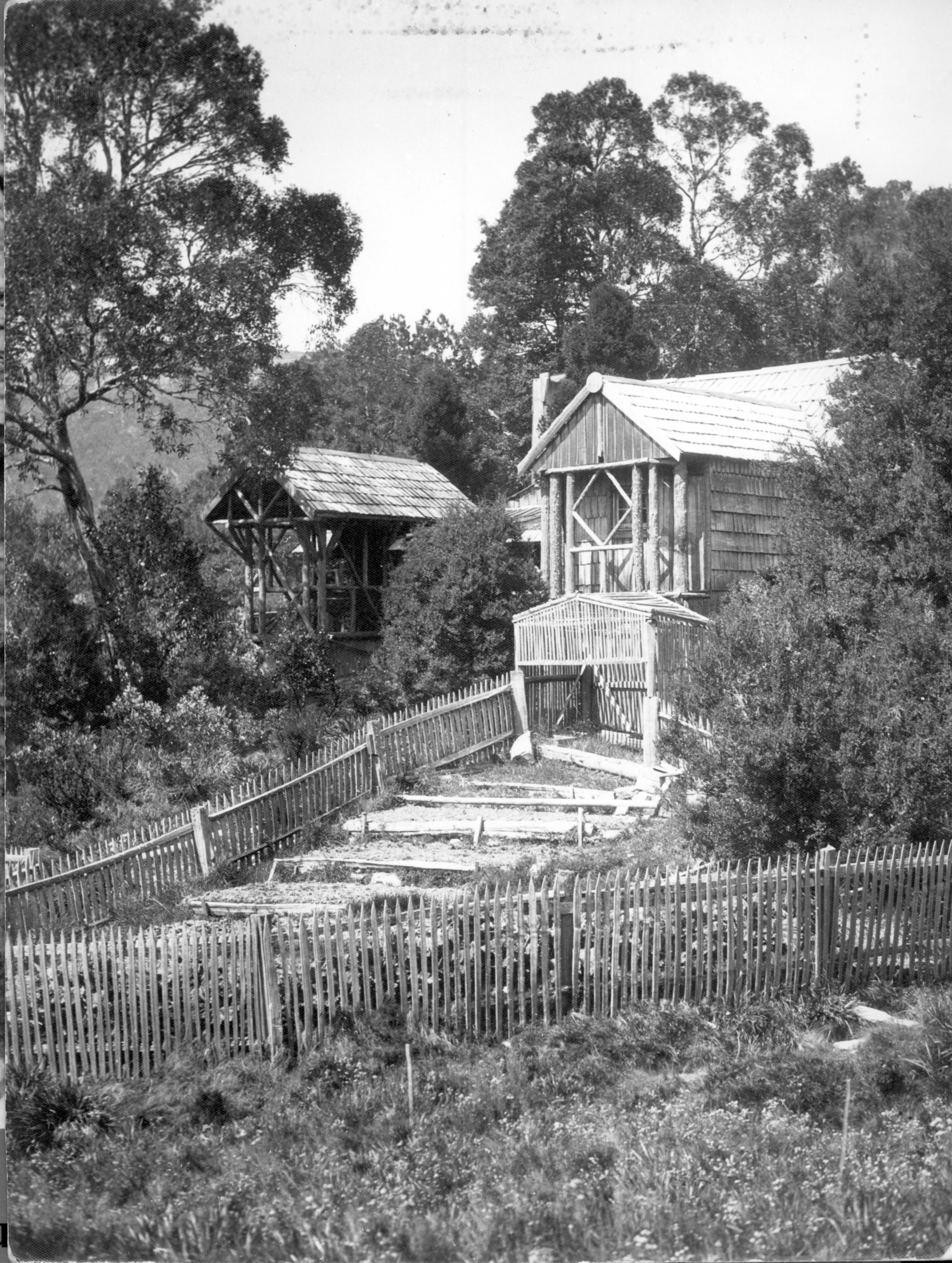
Waldheim in the Weindorfer era. Fred Smithies photo, courtesy of Margaret Carrington.
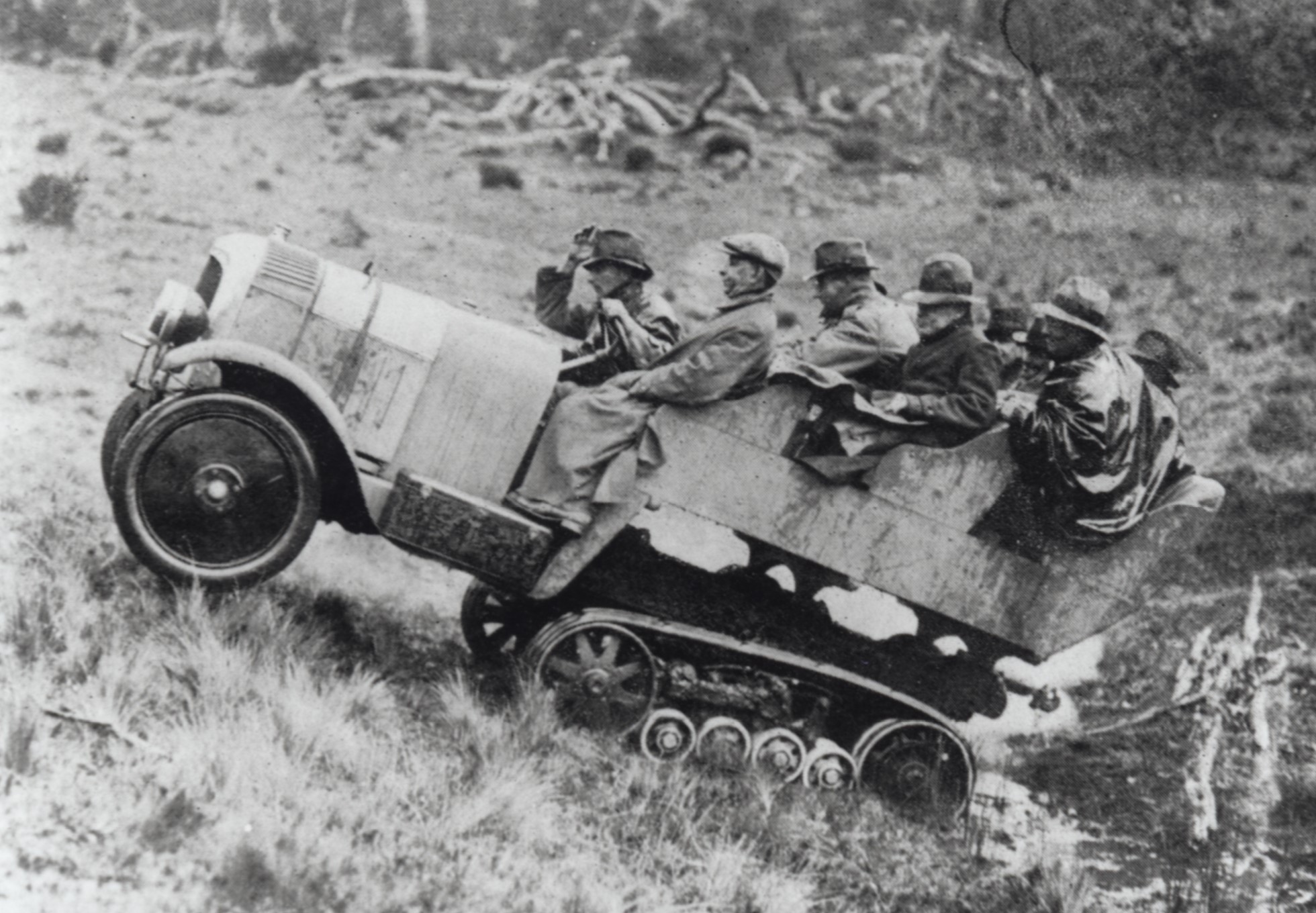
Getting to Cradle Mountain in 1924, the Citroen-Kegresse prototype, which Weindorfer called the ‘platypus motor’. Stephen Spurling III photo.
Origins of the park
The Cradle Mountain–Lake St Clair National Park had three starting points: Cradle Mountain, the Pelion/Du Cane region, and Lake St Clair. At Cradle Valley Gustav and Kate Weindorfer established a tourist resort called Waldhiem in 1912. The story of how they built it and almost no-one came has been told a thousand times. In the Pelion/Du Cane region hunter/prospector Paddy Hartnett had a network of huts, some of which doubled as staging posts for his guided tours as far south as Lake St Clair. Three industrial-size skin drying sheds which stood near Pelion Gap, at Kia Ora Creek and in the Du Cane Gap give some idea of the scale of hunting operations before and after World War One (1914–18). Hartnett’s Du Cane Hut remains today. Lake St Clair had been visited fairly regularly by Europeans for almost a century. It was effectively reserved in 1885 when a half-mile-wide zone around its shores was withdrawn from selection. The Pearce brothers built a government accommodation house, boat house and horse paddock at Cynthia Bay 1894–95 but the buildings were destroyed by fire in 1916.
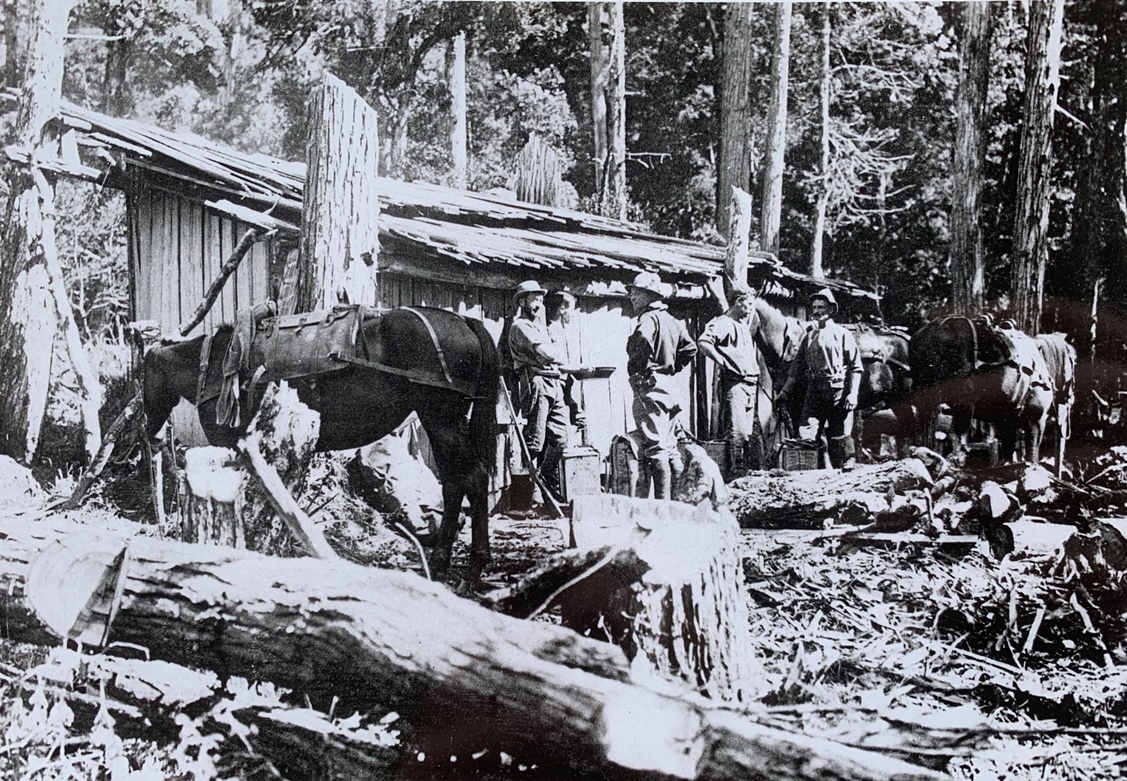
Paddy Hartnett’s massive skin shed near Kia Ora Creek, 1913. Stephen Spurling III photo courtesy of Stephen Hiller.
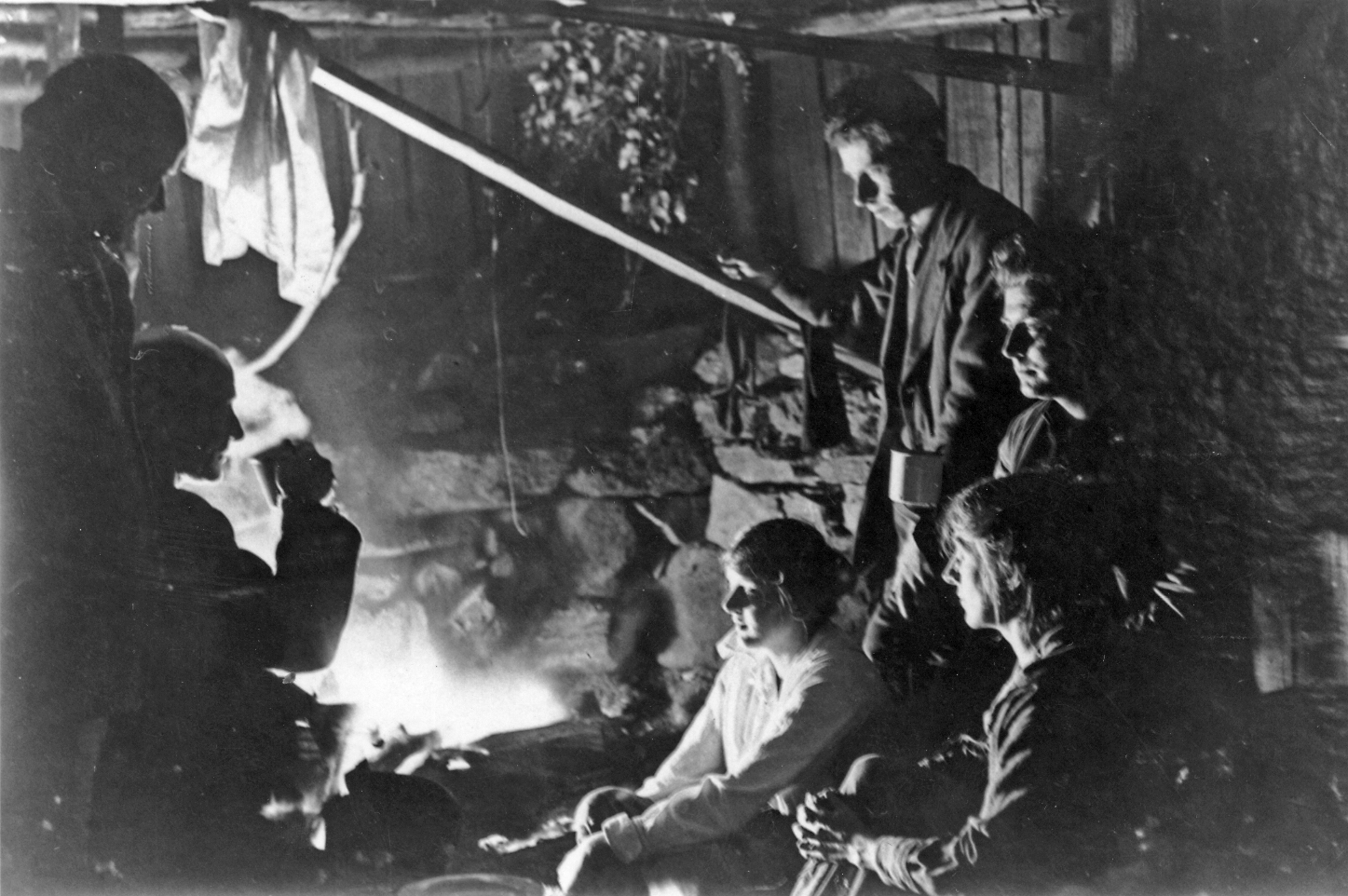
When Gustav Weindorfer declared famously that ‘this should be a park for the people for all time’, he meant only the Cradle Mountain–Barn Bluff area in which he later operated. Other park proponents, including Director of the Tasmanian Government Tourist and Information Bureau ET Emmett, and bushwalker photographers Fred Smithies, Ray McClinton and HJ King, were familiar with a much greater area. They wanted to include the swathe of land from Dove Lake to Lake St Clair, making an area about six times the size of the Mount Field National Park.
The Scenery Preservation Act (1915), under which the Freycinet Scenic Reserve and National Park (Mount Field National Park) were gazetted in 1916, forbade the lighting of fires, cutting of timber, shooting of guns, removal or killing of birds and native or imported game and damage to scenic or historic features on reserved land. The Act therefore effectively forbade hunting but it did not expressly forbid mining, even though mining always included the lighting of fires and cutting of timber. Parts of the proposed national park area were already logged, grazed, hunted and mined, and to allay fears of these primary industries being locked out of a proclaimed reserve, in 1921 the Act was amended to allow exemptions from the provisions of the original Act.[2]
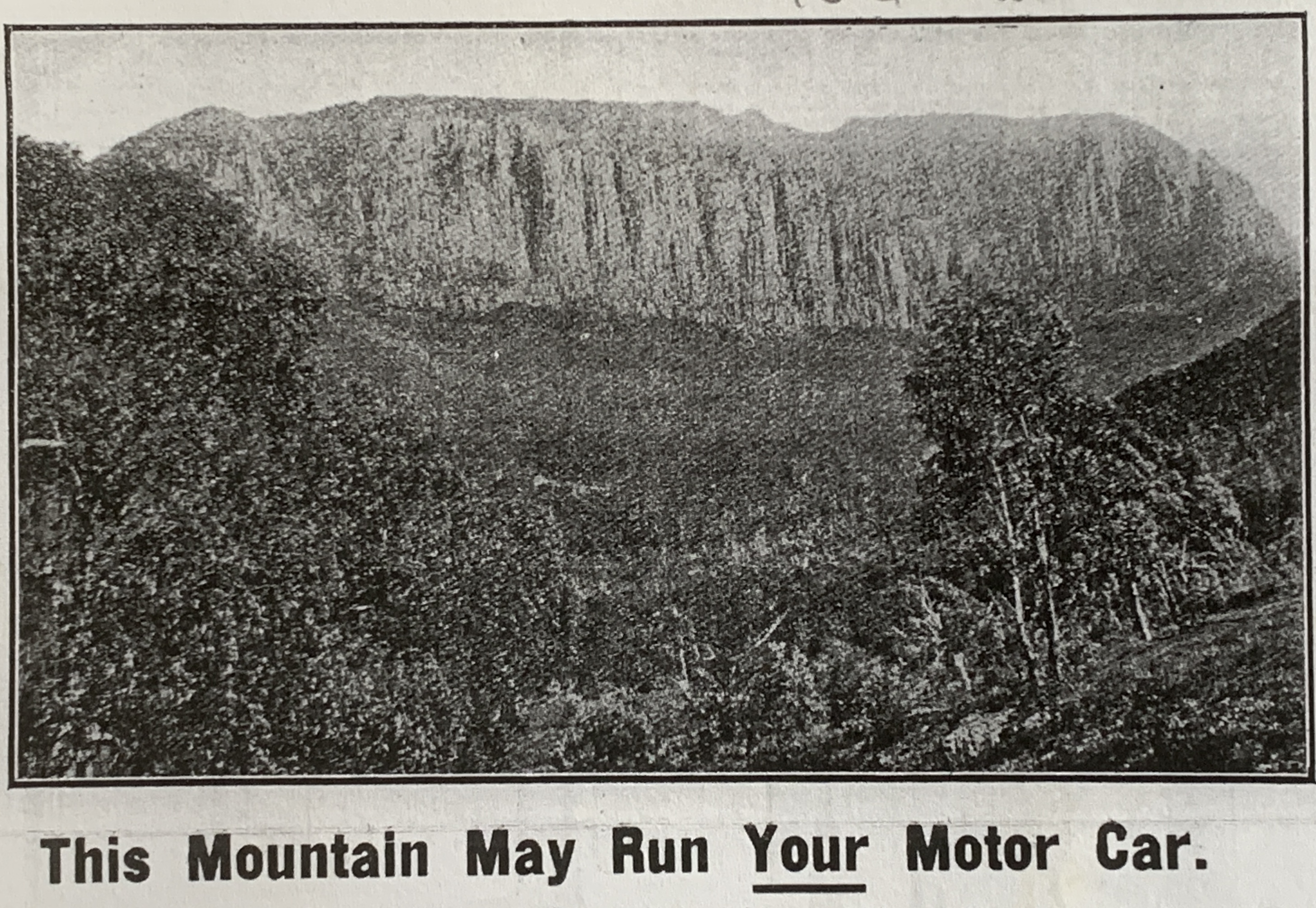
Stephen Spurling III photo, from file AB948/1/225, Tasmanian Archives.
The Pelion oil field
World War One (1914–18) had created anxiety about resource security in Australia and precipitated revolution and civil war in Russia. Outcomes for Tasmania included the search for shale oil reserves and a boom in the Tasmanian fur industry, with brush possum skins helping to make up for the loss of Russian fur reserves. While a lantern lecture campaign promoted the idea of a Cradle Mountain national park in 1921, about 80,000 acres of the land in question was under exploration lease in the search for shale oil (‘inspissated asphalite’). The Adelaide Oil Exploration Company used a Spurling photo to push the idea that Mount Pelion West was a motor oil bonanza. Its proponents assured would-be investors that its lease contained ‘the greatest potential amount of wealth hitherto controlled by any one concern in the British Empire, and, probably, in the whole world, outside the United States of America’. Faith might be able to move mountains, but the government geologist assured them it couldn’t put oil in these mountains. The only lasting impact of oil exploration was the Horse Track south from Waldheim, which was marked to enable pack horses to supply coal/oil operations at Lake Will.
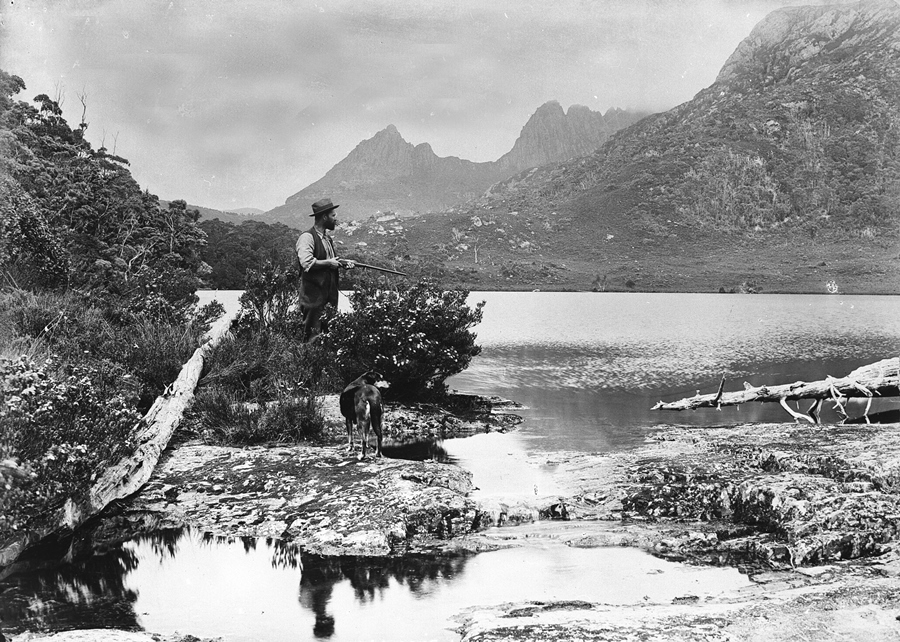
Gustav Weindorfer hunting at Lake Lilla with his dog Flock, 1922.
Stephen Spurling III photo courtesy of Stephen Hiller.
The Cradle Mountain fur farm
The Cradle Mountain and Lake St Clair Scenic Reserves were gazetted under the amended Act in 1922 but at first neither was a fauna sanctuary under the Animals and Birds Protection Act (1919). With the surge in hunting it was inevitable that fur farming on the Canadian model was proposed for Tasmania. The Fur Farming Encouragement Act (1924) reserved 30,000 acres at Cradle Mountain for a fur farm, but before local hunters could protest, in 1925 this area was dismissed as unsuitable by two of the scheme’s proponents, Melbourne skin buyers who, extraordinarily, believed that ‘furs grown at a high altitude have not the good texture of those grown on the low lying country’.[3] Nobody seems to have counselled Tasmanian hunters that high country furs were inferior. Working at Lake St Clair in the winter season of 1925, Bert Nichols reportedly made the small fortune of £500, his possum skins fetching 17 shillings 11 pence and his wallaby skins more than 12 shillings each at the Sheffield Skin Sale.[4] This was at a time when the average annual wage for a farm worker was about £110 to £125.[5]
Two subsidiary management boards
Two subsidiary bodies were appointed to advise the Scenery Preservation Board on matters relating to the two adjoining scenic reserves. One, the National Park Board, already helped manage the Mount Field National Park. Chaired by botanist Leonard Rodway, with Tasmanian Museum director Clive Lord as its secretary, it now added the Lake St Clair Scenic Reserve to its purview. The other body, which administered the Cradle Mountain Scenic Reserve, was created from nominated representatives of interested organisations and municipal councils plus several people who had campaigned for the reserve’s creation.[6] Ron Smith (Cradle Mountain Reserve Board secretary from 1930) and Fred Smithies became standard bearers for the 68,000-acre Cradle Mountain Reserve, but their simultaneous ownership of land at Cradle Valley inevitably led to a conflict-of-interest situation.
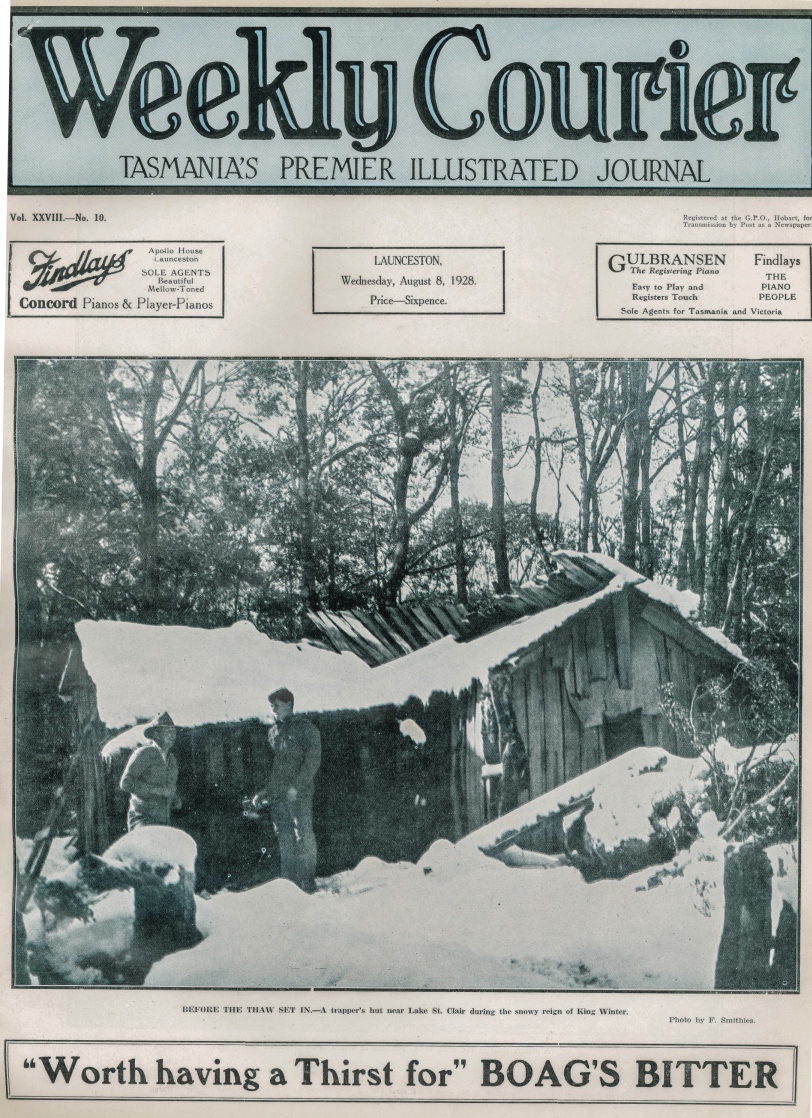
Fred Smithies’ photo of ‘a trapper’s hut near Lake St Clair’,
Weekly Courier, 8 August 1928. Courtesy of Libraries Tasmania.
During 1927 the Cradle Mountain and Lake St Clair Scenic Reserves were gazetted as fauna sanctuaries.[7] Two months later the hunter/prospector Dick Nichols was nabbed for poaching at a hunting hut in the Cuvier Valley. His brother Bert was probably around somewhere too but escaped detection, and it became clear that they had a network of hunting huts around Lake St Clair and in the Cuvier Valley.[8] Fred Smithies, a member of the CMRB, was used to sleeping among the drying pelts in Bert Nichols’ Marion Creek Hut.[9] In the winter of 1928 he took a lovely photo of it under snow and this poacher’s hut in a fauna sanctuary made the front cover of the Weekly Courier newspaper![10] Nichols later duplicated the hut for the use of Overland Track walkers.
The Overland Track
The idea of threading a track through the two reserves to unite them seems to have started with Ron Smith, who in 1928 envisaged an ‘overland track’ connecting Cradle Mountain and Lake St Clair, including a motor boat service on the lake.[11] Sections of track that could be linked already existed, including that marked by Weindorfer from Waldheim to Lake Will (the basis of the Horse Track), the Mole Creek Track between Pelion Plain and Pine Forest Moor, and hunters’ tracks from Pelion Plain through to Lake St Clair and the Cuvier Valley. Paddy Hartnett offered to cut the Overland Track for £440, but Bert Nichols did it for only £15.[12] He connected up sections of track and cleared others south of Pelion Plain to form the Overland Track in 1931.[13] Mining, hunting and tourism huts like Old Pelion, Lake Windermere and DuCane were adopted as staging posts along the track.
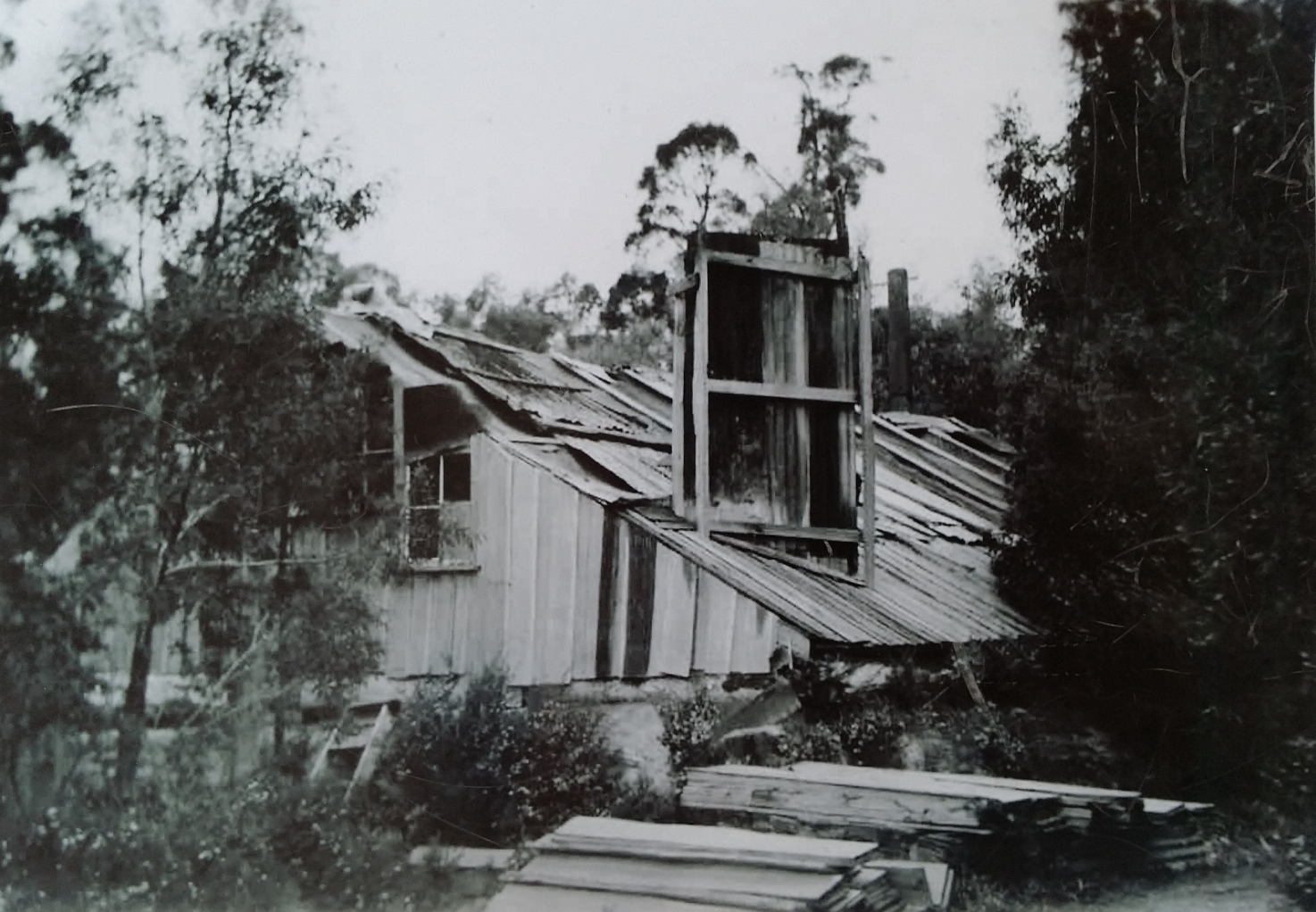
In 1934 Fergy established this dining room and associated huts at Cynthia Bay, Lake St Clair. Norton Harvey photo.
Although the official Overland Track went through the Cuvier Valley, it soon became standard procedure to cross Lake St Clair instead on tourist operator Albert ‘Fergy’ Fergusson’s motorboat. During the Great Depression Miss Velocity was an integral part of Bert Nichols’ guided tours on the Overland Track. Fergy’s tourist camp of sixteen tent-huts with earthen floors and a communal rustic dining room rivalled Weindorfer’s set-up at Cradle Valley.[14] He employed a housekeeper and owned a ‘frightful old bus’ with sawn-off cane kitchen chairs for seats, with which he drove walkers out to the Lyell Highway at Derwent Bridge.[15]
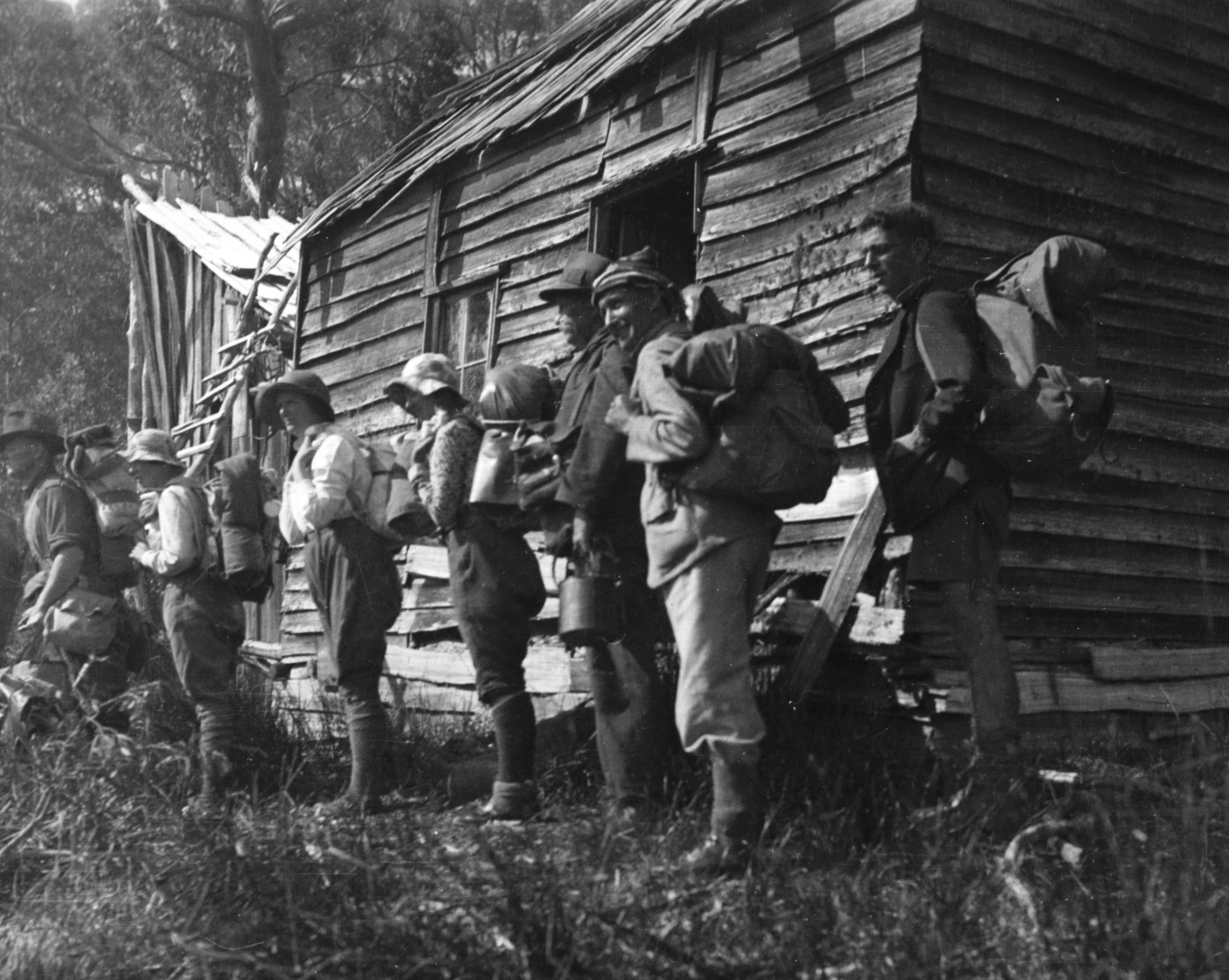
A 1929 Bert Nichols party at Windermere Hut. Marjorie Smith photo courtesy of the late Ian Smith.
Fergy’s racing boat Miss Velocity at rest in front of Mount Ida, Lake St Clair, 1929. Marjorie Smith photo courtesy of Ian Smith.
The death and wake of Gustav Weindorfer
Gustav Weindorfer died of cardiac arrest in Cradle Valley in May 1932, apparently in the act of trying to start his Indian motorcycle.[16] His name was already inscribed on his wife Kate’s headstone at Don in anticipation of him joining her there but a group of his friends arranged his interment in front of Waldheim.[17] Ironically, despite his love of the place, for years Weindorfer had been trying to sell and leave Waldheim.[18] Now he was stuck there!
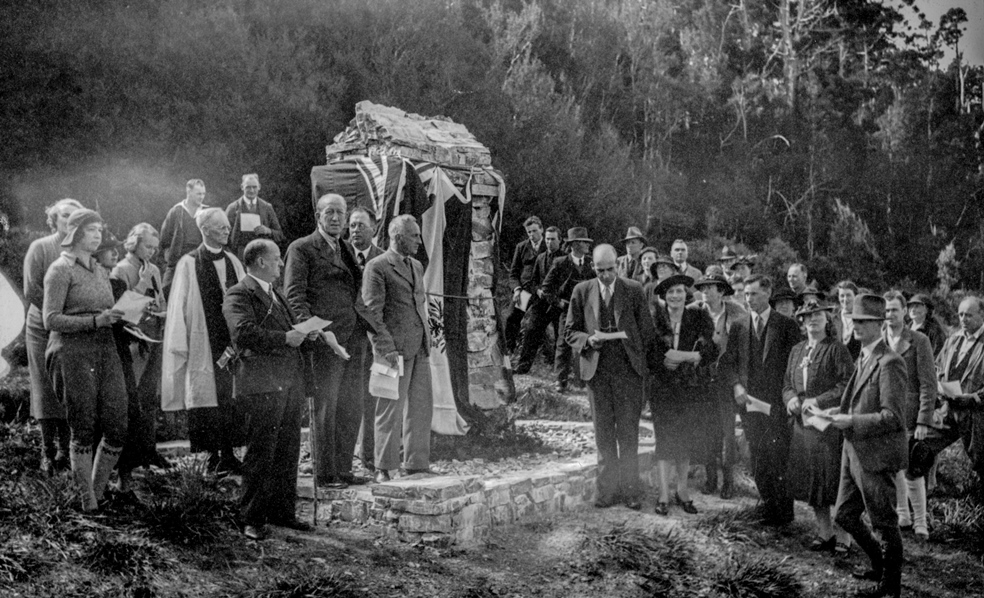
The ceremony to unveil the memorial to Gustav Weindorfer at Waldheim, 1938, with Ron Smith in the foreground at right. Fred Smithies photo courtesy of Margaret Carrington.
The Austrian secular tradition of remembering departed loved ones was adopted at Weindorfer’s grave after his sister Rosa Moritsch sent a bunch of flowers and four small candles from his native land. These were placed on his grave on New Year’s Day 1933. For several decades Weindorfer’s good friend Ron Smith organised the annual New Year’s Day ceremony. The annual commemoration of Weindorfer’s life has assumed possibly unparalleled longevity among Australian public figures.
The work of the Connells
First Bert Nichols and then Barrington farmers Lionel and Maggie Connell looked after Waldheim before a syndicate of Weindorfer’s Launceston friends (George Perrin, Charlie Monds, Karl Stackhouse and Fred Smithies) bought the chalet from his estate.[19] They asked the Connells to stay on as managers. Lionel Connell had been snaring around Cradle Mountain for two decades and knew the country well. The Connells, with six sons and daughters to help them, set about making Waldheim financially viable by extending the building and improving access to it.
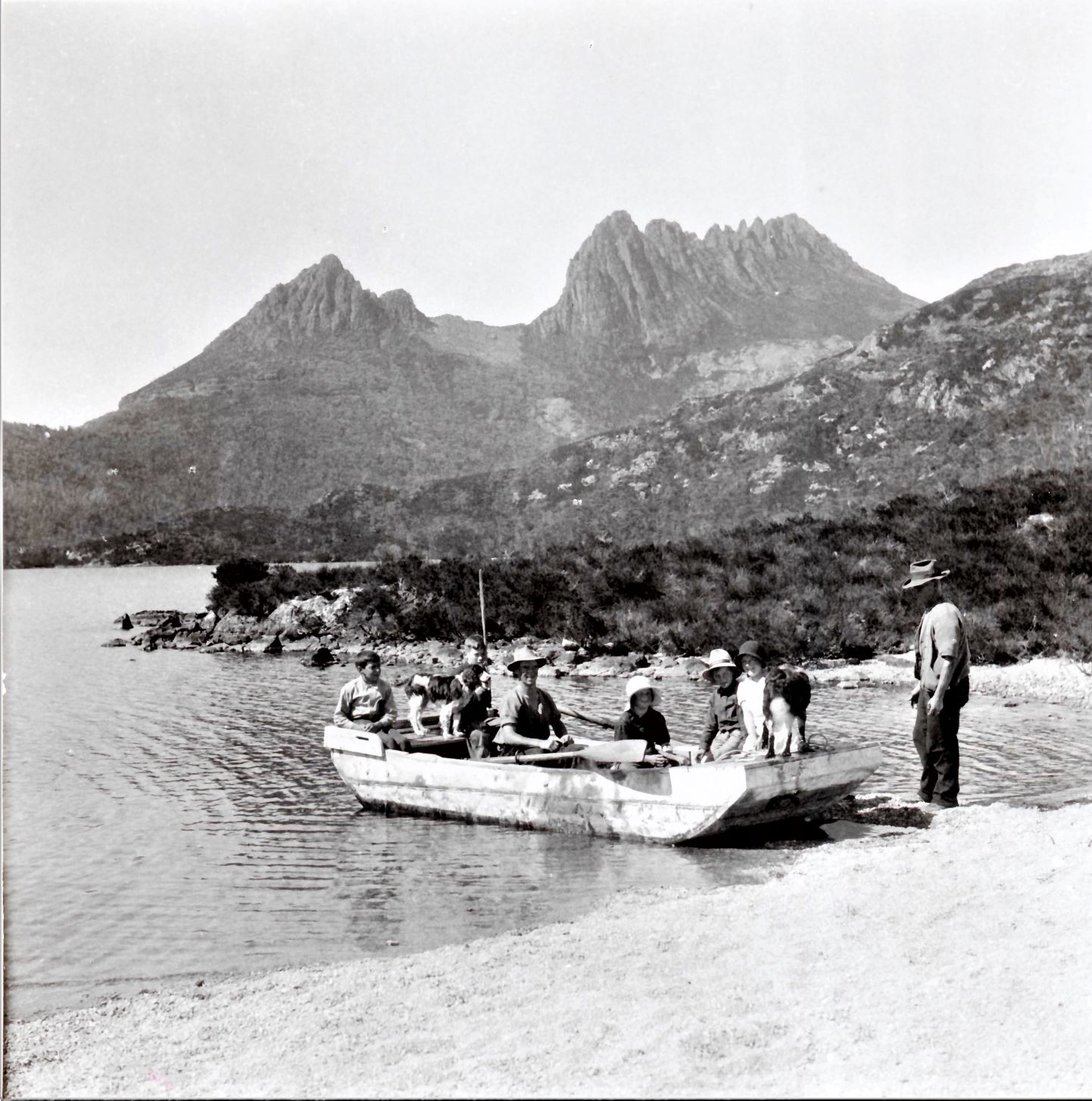
Lionel Connell loading up Weindorfer’s punt on Dove Lake, 1936. Ron Smith photo courtesy of Charles Smith.
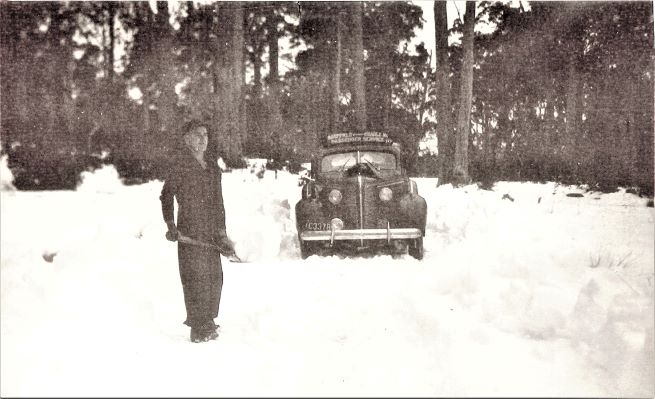
Os Connell digging out his family’s Sheffield–Cradle Mountain Passenger Service, 1943. Photo courtesy of Es Connell.
In the late 1930s the Connells had a tourism package for the Northern Reserve that far exceeded that of Gustav Weindorfer, ferrying visitors to and from Waldheim in their car, accommodating visitors, feeding them with produce from the farm at Barrington, guiding them around Cradle Mountain and even guiding them on pack-horse tours on the Overland Track.
Fergy’s other tub: early rangers
Ex-hunter and Overland Track guide Bert Nichols is said to have removed Overland Track markers when they were not needed in order to snare undetected in the fauna sanctuary. Nichols did other infrastructure work and was appointed ranger for two months in 1935. However, when the time came to appoint a permanent ranger the known poacher was not considered for the job.
A Lionel Connell hunting hut built with Dick Nichols still stood south of Lake Rodway as a reminder of the former’s past. Yet Connell was considered fit for a permanent posting as ranger.[20] The Connell family demonstrated great enterprise in their work at Cradle but conflict between Lionel’s roles of privately-employed tourism operator and government-employed ranger at the same location were soon obvious. To compound the issue, Connell managed Waldheim for Smithies and Karl Stackhouse. These men, as members of the CMRB, also effectively employed him as a ranger. CMRB Secretary Smith also had a family tie with the Connells.
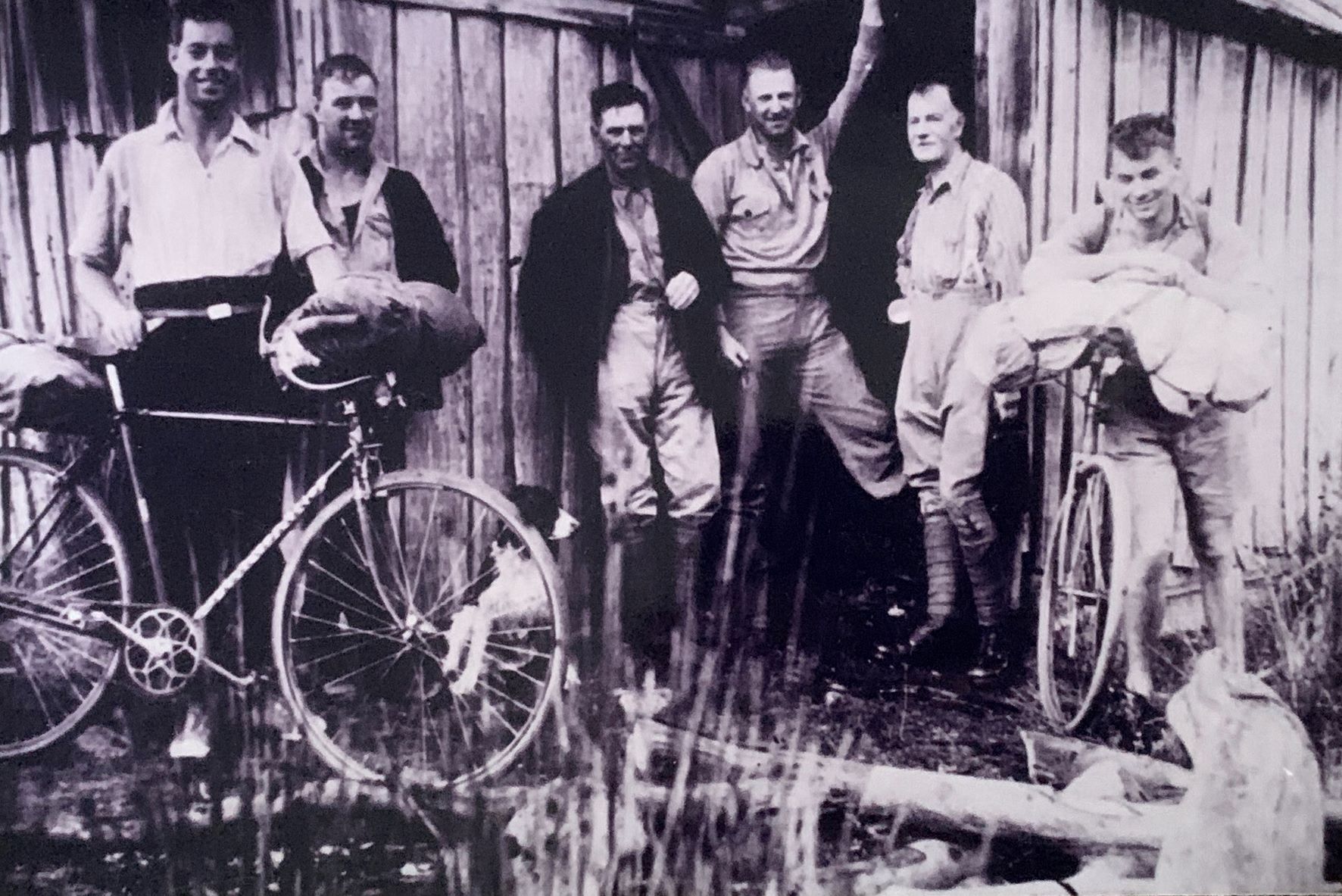
Cyclists arriving at Old Pelion Hut, 1936. With them (left to right) are (possibly) Os Connell, Lionel Connell, Mount Field ranger HE Belcher and Director of the Government Tourist Bureau, ET Emmett. Photo courtesy of Es Connell.
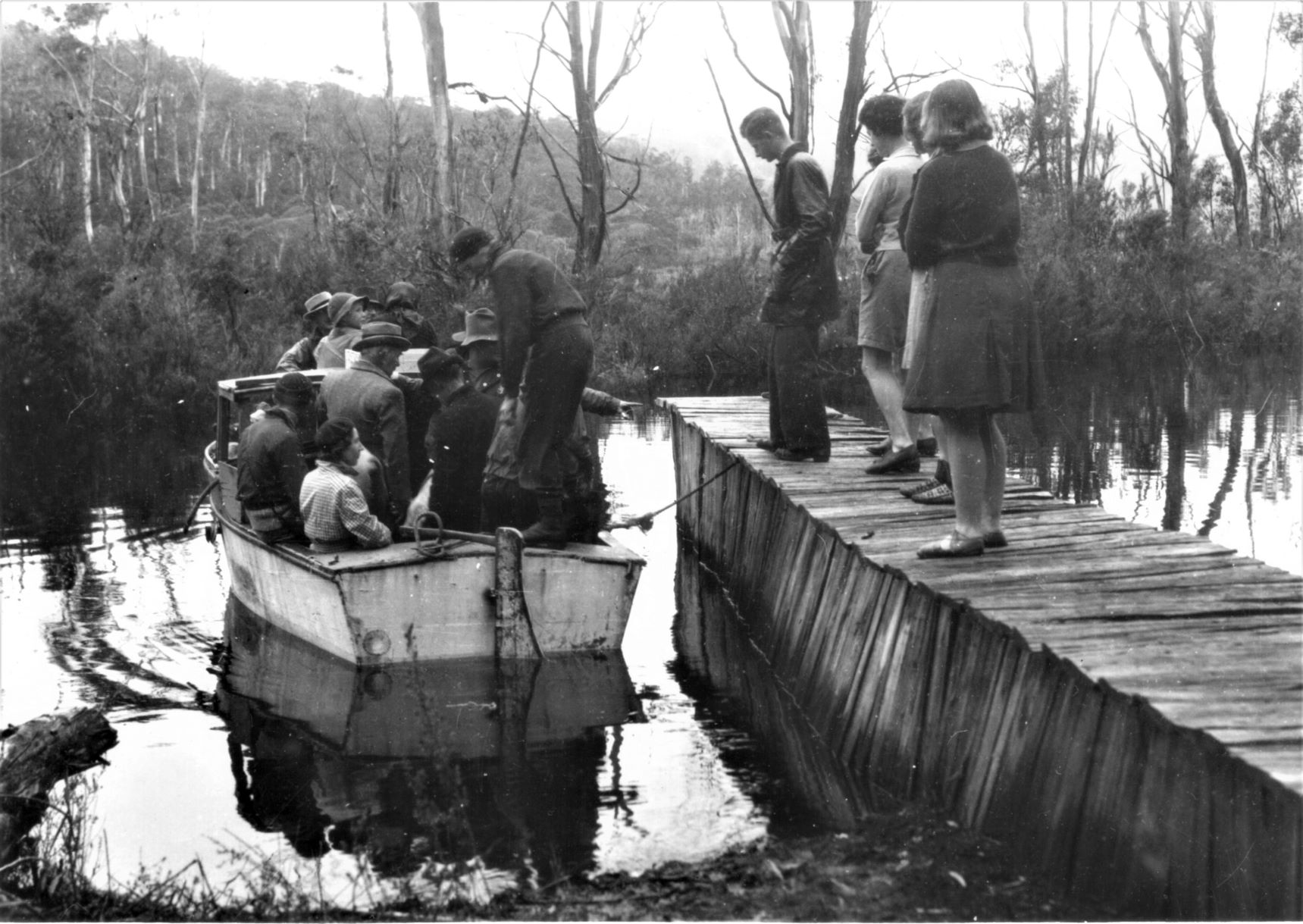
Fergy overloading Miss Velocity’s more mundane replacement at Narcissus Landing, 1940. Ron Smith photo courtesy of Charles Smith.
The other remarkable early ranger was Fergy who, like Lionel Connell, combined the job with that of tourism operator. His toughest journey was not on the lake but in an upside-down bath. While building the original Pine Valley Hut, the Lake St Clair ranger lugged an iron tub to it about 10 km from Narcissus Landing by balancing it upside down on his shoulders and head, his forehead reputedly having been reinforced to mend a war wound (his World War One record suggests only that he suffered from shell shock and deafness). Stripping off in the heat, his curses echoing inside the bath, he was stark naked when he ran into a party of bushwalkers.
Extension of eastern and western reserve boundaries 1935 and 1939
The extension of fauna sanctuary boundaries to natural features was done with the intention of negating claims by hunters that they weren’t sure where the boundaries were. Tommy McCoy seems to have known. His Lake Ayr Hut was cheekily perched within sight of the reserve boundary. Reactions to it showed the distinction between the old-style conservationists in the park administration and the new ones of the bushwalking community. Cradle Mountain Reserve Board Secretary Ron Smith, a former possum shooter, respectfully left payment of threepence for a candle he removed from McCoy’s camp.[21] Hobart hikers, on the other hand, became conservation activists, puncturing McCoy’s canned food with a geological pick when they found his hut in 1948.[22] McCoy, like fellow snarers Paddy Hartnett, Bert Nichols and Lionel Connell before him, embraced the opportunities offered by tourism, building and repairing Overland Track huts. He was proprietor of Waldheim Chalet when he died in 1952.
Some of JW Beattie’s islands, southern end of Lake St Clair. Beattie photo, courtesy of Alma McKay.
Damming Lake St Clair 1937
The Art Deco Pump-house Hotel which juts into southern Lake St Clair, as if walking the plank for its crimes, is a symbol of gradually changing values. In 1922, in a joint lecture about ‘preserving’ the tract of land south from Cradle Mountain, Ray McClinton and Fred Smithies deplored the ‘firestick of the destroyer’ and the ‘ravages of the trapper’ but spruiked the hydro-electric potential of the region’s lakes.[23] Fifteen years later the naivety of this position became apparent when the Hydro-Electric Department dammed the Derwent River as part of the Tarraleah Power Scheme. After assuring the National Park Board that Lake St Clair would be unaffected, it raised the lake’s water level by more than a metre, sinking the golden moraine sand (the Frankland Beaches) and the accompanying islands once painted by Piguenit and photographed by Beattie.[24] A fringe of dead trees around the lake’s edge now greeted visitors. When photographers Stephen Spurling III and Frank Hurley joined the National Park Board in attacking the Hydro, Minister for Lands and Works Major TH Davies sprang to the institution’s defence, describing the damage as ‘unavoidable’.[25] This was a taste of what was to come at Cataract Gorge, Lake Pedder, the Pieman River and the Lower Gordon River.
Excision of the Wolfram Mine
With rearmament taking place in Europe in 1938, the raised price of tungsten (wolfram), used for strengthening steel, prompted an application to reopen the (Mount Oakleigh) Wolfram Mine, which was then included in the Cradle Mountain Reserve. CMRB Secretary Ron Smith penned the board’s opposition to the proposal, stating that no payable lode was likely to be found and that a successful application would set a bad precedent in terms of mining the reserve.[26] The subsidiary board’s concerns were not heeded. In a forerunner to national park and/or Wilderness World Heritage Area excisions at Mount Field, the Hartz Mountains and Exit Cave, the mine was temporarily excised from the scenic reserve as the Mount Oakleigh Conservation Area.[27] No Tasmanian reserved land ever seemed inalienable after this.
First load of logs from Mount Kate, 1943, with (left to right) George, Bernard and Leo Stubbs. Ron Smith photo, courtesy of Charles Smith.
The Mount Kate sawmill dispute and dissolution of the CMRB
The pitfalls of having vested interests on a government board again became apparent in December 1943 when Ron Smith took advantage of wartime stringency, rising timber prices and a finished access road to start harvesting King Billy pine on his property at Mount Kate. Over the next few years the definition of conflict of interest and the limits of official jurisdiction became increasingly blurred, as private land was resumed at Cradle Valley and the problematic CMRB was dissolved. Ironically, Smith and the Launceston syndicate had previously offered their land to the government but been refused. With Waldheim compulsorily acquired, Lionel Connell resigned as ranger. His sons Esrom and Wal were later reemployed in their own right as rangers at Cradle Mountain and Lake St Clair. The appointment of the Cradle Mountain National Park Board in 1947 was the first step in placing the national park—as it was now known for the first time—on a sound footing, 25 years after the scenic reserves were initially gazetted. But the battle of ecology and economy continued.
[1] Gerard Castles, ‘Handcuffed volunteers: a history of the Scenery Preservation Board in Tasmania 1915–1971’, BA (Hons) thesis, University of Tasmania, Hobart, 1986.
[2] This was the Scenery Preservation Act (1921). For an example of fears of loggers being locked out of the Cradle Mountain and Lake St Clair Scenic Reserves, see E Alexander, ‘Cradle Mountain park: claims of timber area’, Advocate, 22 August 1921, p.5.
[3] ‘Fur farming: Cradle Mountain unsuitable: area further south chosen’, Mercury, 17 August 1925, p.6.
[4] ‘Lure of the skins’, Advocate, 22 August 1925, p.12.
[5] Statistics of Tasmania, 1922–23, p.58.
[6] Proclamation, Tasmanian Government Gazette, 8 March 1927, p.753.
[7] Proclamation, Tasmanian Government Gazette, 31 May 1927, pp.1412–13.
[8] Gerald Propsting to the secretary for Public Works, 4 August 1927, AA580/1/1 (TA); ‘Game Protection Act: illegal possession of skins’, Mercury, 17 August 1927, p.5.
[9] Fred Smithies, transcript of an interview by Margaret Bryant, 15 June 1977, NS573/3/3 (TA).
[10] Weekly Courier, 8 August 1928, p.1.
[11] Ron Smith to National Park Board Secretary Clive Lord, 27 August 1928, NS234/19/1/20 (TA).
[12] Paddy Hartnett to ET Emmett, 26 November 1928, PWD24/1/3; Director of Public Works to LM Shoobridge, Chairman of the National Parks Board, 13 March 1931, NS234/17/1/17 (TA).
[13] Bert Nichols to Ron Smith, 26 April 1931, NS573/1/1/4 (TA).
[14] Kevin Anderson, ‘Tasmania revisited: being the diary of Kevin Anderson, in which he related the incidents of his travelling to and through Tasmania with his companion, William Foo, from 12th April 1939 to the 26th April 1939’, unpublished manuscript (QVMAG), p.27.
[15] Jessie Luckman interviewed by Nic Haygarth.
[16] Bernard Stubbs interviewed by Nic Haygarth, c1993; Esrom Connell, in writing to Percy Mulligan, 20 September 1963 (NS234/19/122, TA), claimed to possess a diary in which Weindorfer recorded the failure of the motorbike to start. The present whereabouts of the diary are unknown. For the coronial inquiry into Weindorfer’s death, see AE313/1/1 (TA). The coroner determined the cause of death to be heart failure.
[17] ‘Papers relating to Coronial Enquiry into death of Gustav Weindorfer’, AE313/1/1 (TA).
[18] On 17 April 1928 Weindorfer wrote in his dairy, ‘This is very likely my last trip on the mountain’ (QVMAG). If he had a buyer for Waldheim then, the deal must have fallen through.
[19] Public Trustee to Fred Smithies, 11 November 1932, NS573/1/1/7 (TA).
[20] Minutes of the Cradle Mountain Reserve Board meeting, 26 April 1935, AF363/1/1, p.185 (TA).
[21] Ron Smith diary, 1940, NS234/16/1/41 (TA).
[22] Jessie Luckman interviewed by Nic Haygarth.
[23] ‘Cradle Mountain’, Advocate, 31 July 1922, p.2.
[24] ‘Level of water raised’, Mercury, 12 October 1938, p.13.
[25] National Park Board: ‘Level of water raised’, Mercury, 12 October 1938, p.13; Davies: ‘Lake St Clair: high level “unavoidable”’, Advocate, 13 October 1938, p.6; Hurley: ‘Tasmanians asleep’, Mercury, 30 January 1939, p.8; Spurling: S Spurling, ‘Scenic vandalism’, Examiner, 5 October 1940, p.3.
[26] Ron Smith to Minister for Mines, 3 May 1938, NS234/19/1/4 (TA).
[27] For an overview of the Wolfram Mine dispute, see Gerard Castles, ‘Handcuffed volunteers: a history of the Scenery Preservation Board in Tasmania 1915–1971’, pp.51–52.
by Nic Haygarth | 22/10/20 | Circular Head history, Story of the thylacine
By the 1890s farmers like Joseph Clifford and Robert Stevenson were effectively adding Tasmanian tiger farming to their portfolios of raising stock, growing crops and hunting. Since thylacines appeared on their property, they made a conscious effort to catch them alive in a footer snare or pit rather than dead in a necker snare. A tiger grew no valuable wool, but in 1890 a live wether might fetch 13 shillings, compared to £6 for an adult thylacine delivered to Sydney.[1] A dead adult thylacine, on the other hand, was worth only £1 under the government bounty scheme.
The problem with these special efforts to catch tigers alive was that hunters only had a certain amount of control over what animals ended up in their snares or pits. Twentieth-century hunters often complained about city regulators who thought it feasible to close the season on brush possum but open it for wallabies and pademelons. Inevitably, hunters caught some brush possum in their wallaby and pademelon snares during the course of the season, which could land them a hefty fine in court unless they destroyed the precious but unlawful skins.[2] John Pearce junior in the upper Derwent district claimed that he and his brothers caught seventeen tigers in ‘special neck snares’ set alongside their kangaroo snares.[3] How did the tigers recognise the ‘special neck snares’ provided for their specific use? All you could do was vary the height of the necker snare to catch the desired animal’s head as it walked. Too bad if something else stuck its head in the noose. Wombats, for example, were a hazard. Gustav Weindorfer of Cradle Valley set snares at the right height to catch Bennett’s wallabies by the neck, but also caught wombats in them.[4] Wombats were good for ‘badger’ stew and for hearth mats but the skins had no value. Robert Stevenson of Aplico, Blessington, caught wombats alive in his tiger pits—which they then set about destroying by burrowing their way out.[5]
George Wainwright senior, Matilda Wainwright and children at Mount Cameron West (Preminghana) c1900. Courtesy of Kath Medwin.
These problems aside, it seems odd that the pragmatic Van Diemen’s Land Company (VDL Co), which later added fur hunting to its income stream, didn’t cotton on to the live tiger trade. They could have followed the example of George Wainwright senior, who sold a Woolnorth tiger to Fitzgerald’s Circus in 1896.[6] In 1900, for example, 22 thylacines were killed on Woolnorth, a potential income of more than £100 had the animals been taken alive. Even when, later, four living Woolnorth tigers were sold, the money stayed with the employees, with the VDL Co not even taking a commission. (It should be noted that four young tigers caught by Walter Pinkard on Woolnorth in 1901 were not accounted for in bounty payments.[7] It is possible that they were sold alive—but there are no records of a sale or even correspondence about the animals. Their fate is unknown.)
William Le Souef to Kruger, 22 October 1901: ‘The Tasmanian Wolves are all
right, so far’. Did he get them from Woolnorth? Postcard courtesy of Mike Simco.
The VDL Co’s failure to exploit the live trade for its perceived arch enemy can possibly be explained by the tunnel vision of its directors and departing Tasmanian agent and the inexperience of his successor. James Norton Smith resigned as local manager in 1902. His replacement, Scotsman Andrew Kidd (AK) McGaw, harnessed Norton Smith’s 33-year corporate knowledge by re-engaging him as farm manager. It would not have been easy for McGaw to learn the ropes in a new country, among business associates cultivated by his predecessor, and the re-engagement of Norton Smith as his second allowed him to transition into the manager position. As would be expected, McGaw stamped his authority on the agency by criticising some of Norton Smith’s policies and distancing himself from them.[8] Ahead of Ernest Warde’s engagement as ‘tigerman’, the VDL Co’s shepherd at Mount Cameron West, he scrapped Norton Smith’s recent bounty incentive scheme of £2 for a tiger killed by a man out hunting with dogs.
Woolnorth, showing main property features and the original boundary. Base map courtesy of DPIPWE.
After Warde’s departure in 1905, the tiger snares at Mount Cameron and Studland Bay were checked intermittently. Woolnorth overseer Thomas Lovell killed a tiger at Studland Bay in 1906, but the number of tigers and dogs reported on the property was now negligible.[9] This reflected the statewide situation, with only eighteen government thylacine bounties being paid in 1907, and only thirteen in 1908.[10]
However, the value of live tigers continued to climb as they became rarer. The first documented approach to the VDL Co for live tigers came in July 1902 from AS Le Souef of the Zoological Gardens in Melbourne, who offered £8 for a pair of adults and £5 for a pair of juveniles. He also wanted devils and tiger cats, in response to which George Wainwright junior supplied two tiger cats (spotted quolls, Dasyurus maculatus).[11] Given the tiger’s reputation as a sheep killer, native animal farming might have been a hard sell to the directors, and the company continued to use necker snares which were generally fatal to thylacines. What price would it take to change that behaviour? In July 1908 McGaw read a newspaper advertisement:
‘WANTED—Five Tasmanian tigers, handsome price for good specimens. Apply Beaumaris, Hobart.’[12]
He discovered that the proprietor of the private Beaumaris Zoo at Battery Point, Mary Grant Roberts, wanted a pair of living tigers immediately to freight to the London Zoo.[13] The Orient steamer Ortona was departing for London at the end of the month. She offered McGaw £10 for a living, uninjured pair of adults. Roberts hoped to secure the tiger caught recently by George Tripp at Watery Plains, but felt that she was competing for live captures with William McGowan of the City Park Zoo, Launceston, who advertised in the same month.[14] Eroni Brothers Circus was also in the market for living tigers.[15]
A young Mary Grant Roberts, from NS823/1/69 (Tasmanian Archive and Heritage Office).
Almost as Roberts made her offer, George Wainwright junior tracked a tiger at Mount Cameron West, but it evaded capture.[16] In the meantime Roberts was able to secure her first thylacine from the Dee River.[17]
Almost a year passed before the chance arose for the VDL Co do business, when in May 1909 Wainwright retrieved a three-quarters-grown male tiger uninjured from a necker snare.[18] Perhaps not appreciating the tiger’s youth, Roberts offered £5 plus the rail freight from either Burnie or Launceston. She wanted the animal delivered to her in Hobart within ten days in order to ship it to the London Zoo on the Persic. It would thereby replace one which had died of heat exhaustion in transit to the same destination a few months earlier.[19]
However, the overseer of a remote stock station could not meet that deadline. The delay came with a bonus—the capture of three more members of the first tiger’s family, his sisters and mother.[20] Bob Wainwright recalled his stepfather Thomas Lovell and brother George placing the animals in a cage. There was also a familiar story of tigers refusing to eat dead game: ‘They had to catch a live wallaby and throw it in, alive, and then they [the thylacines] killed it’.[21] With McGaw continuing to act as intermediary between buyer and supplier, a price of £15 was settled on for the family of four.[22]
Roberts and McGaw communicated as social equals, but their social inferiors—hunters, stockmen and an overseer—were not named in their correspondence. This made for frustrating reading when Roberts discussed hunters (‘the man’) with whom she was dealing over live tigers. She had been expecting to receive two young tigers from a Hamilton hunter for her own zoo, but these had now died, causing her to reconsider her plans for the Woolnorth family.[23]
The mother thylacine (centre) and her three young captured at Woolnorth in 1909. W Williamson photo from the Tasmanian Mail, 25 May 1916, p.18.
It wasn’t until the first week in July 1909 that the auxiliary ketch Gladys bore the crate of thylacines to Burnie, where they began the train journey to Hobart.[24] A week later they were said to be thriving in captivity.[25] Roberts was so pleased with the animals’ progress that after eight months she sent a postal order to Lovell and Wainwright as a mark of appreciation. She was impressed with the mother’s devotion to her young, believing that the death of the two Hamilton cubs was attributable to their mother’s absence.[26] However, money was becoming a concern. Buying all the tigers’ feed from a butcher was expensive, and when she received a potentially lucrative order for a tiger from a New York Zoo, she found the cost of insuring the animal over such a long journey prohibitive. On 1 March 1910 she ‘very reluctantly’ broke up the family group by dispatching the young male to the London Zoo. ‘I am keeping on the two [other juveniles]’, she wrote, ‘in the hope that they may breed, and the mother all along has been very happy with the three young ones’.[27]
Roberts was now offering £10 per adult thylacine—but there was none to sell at Woolnorth. Seventeen months later she paid Power £12 10s for his large tiger from Tyenna, and scored £30 shipping to London the last of the three young from the 1909 family group.[28] Her tiger breeding program was over, probably defeated by economics—but what might have been the rewards for perseverance? Perhaps she would have been the greatest tiger farmer of all.
[1] See, for example, ‘Commercial’, Mercury, 5 August 1890, p.2; Sarah Mitchell diary, 9 June 1890, RS32/20, Royal Society Collection (University of Tasmania Archives).
[2] See, for example, ‘Trappers fined’, Advocate, 22 October 1943, p.4.
[3] ‘Direct communication with the west coast initiated’, Mercury, 1 September 1932, p.12.
[4] G Weindorfer and G Francis, ‘Wild life in Tasmania’, Journal of the Victorian Naturalists Society, vol.36, March 1920, p.159.
[5] Lewis Stevenson, interviewed by Bob Brown, 1 December 1972 (QVMAG).
[6] ‘Circular Head notes’, Wellington Times and Agricultural and Mining Gazette, 25 June 1896, p.2.
[7] Walter Pinkard to James Norton Smith, 19 July 1901, VDL22/1/27 (TAHO).
[8] In Outward Despatch no.46, 4 January 1904, p.366, McGaw criticised Norton Smith for not doing more to arrest the encroachment of sand at Studland Bay and Mount Cameron (VDL7/1/13).
[9] Woolnorth farm diary, 30 September 1906 (VDL277/1/34). This VDL Co bounty was not paid until the following year (December 1907, p.95, VDL129/1/4). C Wilson was paid for killing two dogs found worrying sheep in 1906 (December 1906, p.58, VDL129/1/4 (TAHO).
[10] See thylacine bounty payment records in LSD247/1/3 (TAHO).
[11] AS Le Souef to James Norton Smith, 11 July 1902; Walter Pinkard to James Norton Smith, 4 August 1902, VDL22/1/28 (TAHO).
[12] ‘Wanted’, North Western Advocate and the Emu Bay Times, 1 July 1908, p.3.
[13] For Roberts, see Robert Paddle, ‘The most photographed of thylacines: Mary Roberts’ Tyenna male—including a response to Freeman (2005) and a farewell to Laird (1968)’, Australian Zoologist, vol.34, no.4, January 2008, pp.459–70.
[14] In ‘Wanted to buy’, Mercury, 18 July 1908, p.2, McGowan asked for tigers ‘dead or alive’. He had also advertised for ‘tigers … good, sound specimens, high price; also 2 or 3 dead or damaged specimens’ in the previous year (‘Wanted’, Mercury, 21 June 1907, p.2). George Tripp’s tiger must have died before it could be sold alive, since he claimed a government bounty for it (no.35, 25 July 1908, LSD247/1/3 [TAHO]).
[15] See, for example, ‘Wanted’, North Western Advocate and the Emu Bay Times, 7 March 1908, p.6.
[16] Thomas Lovell to AK McGaw, 17 July 1908, VDL22/1/34 (TAHO).
[17] ‘The Tasmanian tiger’, Mercury, 7 October 1908, p.4.
[18] Thomas Lovell to AK McGaw, 24 May 1909, VDL22/135 (TAHO). This thylacine was originally thought to be a young female, but McGaw later stated that it was a young male.
[19] Mary G Roberts to AK McGaw, 31 May 1909, VDL22/1/35 (TAHO).
[20] Thomas Lovell to AK McGaw, 1 June 1909, VDL22/1/35 (TAHO).
[21] Bob Wainwright, 86 years old, interviewed in Launceston, 27 October 1980.
[22] AK McGaw to Mary G Roberts, 9 June 1909, VDL52/1/29; Mary G Roberts to AK McGaw, 10 June 1909, VDL22/1/35 (TAHO).
[23] Mary G Roberts to AK McGaw, 21 June 1909, VDL22/1/35 (TAHO).
[24] AK McGaw to Mary G Roberts, 7 July 1909, VDL52/1/29 (TAHO); ‘Stanley’, North Western Advocate and the Emu Bay Times, 6 July 1909, p.2.
[25] W Roberts to AK McGaw, 15 July 1909, VDL22/1/35 (TAHO).
[26] In May 1912 she received two young tigers from buyer EJ Sidebottom in Launceston, paying him £20 in the belief that they were adults. They died three days later (Mary Grant Roberts diary, 6, 7 and 10 May 1912, NS823/1/8 [TAHO]).
[27] Mary G Roberts to AK McGaw, 14 March 1910, VDL22/1/36 (TAHO).
[28] Mary Grant Roberts diary, 12 August, 26 September and 24 December 1911, NS823/1/8 (TAHO).
by Nic Haygarth | 18/04/20 | Tasmanian high country history
When 52-year-old Maria Francis died of heart disease at Middlesex Station in 1883, Jack Francis lost not only his partner and mother to his child but his scribe.[1] For years his more literate half had been penning his letters. Delivering her corpse to Chudleigh for inquest and burial was probably a task beyond any grieving husband, and the job fell to Constable Billy Roden, who endured the gruesome homeward journey with the body tied to a pack horse.[2]
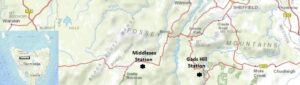
Base map courtesy of DPIPWE.
By then Jack seems to have been considering retirement. He had bought two bush blocks totalling 80 acres west of Mole Creek, and through the early 1890s appears to have alternated between one of these properties and Middlesex, probably developing a farm in collaboration with son George Francis on the 49-acre block in limestone country at Circular Ponds.[3]
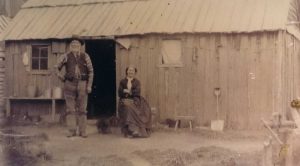
Jack Francis and second partner Mary Ann Francis (Sarah Wilcox), probably at their home at Circular Ponds (Mayberry) in the 1890s. Photo courtesy of Shirley Powley.
Here Jack took up with the twice-married Mary Ann (real name Sarah) Wilcox (1841–1915), who had eight adult children of her own.[4] Shockingly, as the passing photographer Frank Styant Browne discovered in 1899, Mary Ann’s riding style emulated that of her predecessor Maria Francis (see ‘Jack the Shepherd or Barometer Boy: Middlesex Plains stockman Jack Francis’). However, Mary Ann was decidedly cagey about her masculine riding gait, dismounting to deny Styant Browne the opportunity to commit it to posterity with one of his ‘vicious little hand cameras’.[5]
Perhaps Mary Ann didn’t fancy the high country lifestyle, because when Richard Field offered Jack the overseer’s job at Gads Hill in about 1901 he took the gig alone.[6] This encore performance from the highland stockman continued until he grew feeble within a few years of his death in 1912.[7]
Mary Ann seems to have been missing when the old man died. Son George Francis and Mary Ann’s married daughter Christina Holmes thanked the sympathisers—and Christina, not George or Mary Ann, received the Circular Ponds property in Jack’s will.[8] Perhaps Jack had already given George the proceeds of the other, 31-acre block at Mole Creek.[9]
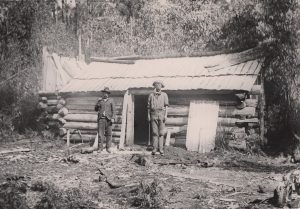
Field stockmen Dick Brown (left) and George Francis (right) renovating the hut at the Lea River (Black Bluff) Gold Mine for WM Black in 1905. Ronald Smith photo courtesy of the late Charles Smith.
By the time Mary Ann Wilcox died in Launceston three years later, George Francis had long abandoned the farming life for the high country. He was at Middlesex in 1905 when he renovated a hut and took part in the search for missing hunter Bert Hanson at Cradle Mountain.[10] Working out of Middlesex station, he combined stock-riding for JT Field with hunting and prospecting.
Like fellow hunters Paddy Hartnett and Frank Brown, Francis lost a small fortune when the declaration of World War One in July 1914 closed access to the European fur market, rendering his winter’s work officially worthless. At the time he had 4 cwt of ‘kangaroo and wallaby’ (Bennett’s wallaby and pademelon) and 60 ‘opossum’ (brush possum?). By the prices obtaining just before the closure they would have been worth hundreds of pounds.[11] Sheffield Police confiscated the season’s hauls from hunters, who could not legally possess unsold skins out of season.
The full list of skins confiscated by Sheffield Police on 1 August 1914 gives a snapshot of the hunting industry in the Kentish back country. Some famous names are missing from the list. Experienced high country snarer William Aylett junior was now Waratah-based and may have been snaring elsewhere.[12] Bert Nichols was splitting palings at Middlesex by 1914 but may not have yet started snaring there.[13] Paddy Hartnett concentrated his efforts in the Upper Mersey, probably never snaring the Middlesex/Cradle region. His double failure at the start of the war—losing his income from nearly a ton of skins, and being rejected for military service—drove him to drink.[14]
‘Return of skins on hand on the 1st day of August [1914] and in my possession’, Sheffield Police Station.
| Name |
Location |
Kangaroo/wallaby |
Wallaby |
Possum |
| George Francis |
Msex Station |
448 lbs |
|
60 skins |
| Frank Brown |
Msex Station |
562 skins+ 560 lbs |
|
108 skins |
| DW Thomas |
Lorinna |
960 lbs |
|
310 skins |
| William McCoy |
Claude Road |
600 lbs |
|
66 skins |
| Charles McCoy |
Claude Road |
40 lbs |
|
|
| Geo [sic] Weindorfer |
Cradle Valley |
31 skins |
|
4 skins |
| Percy Lucas |
Wilmot |
408 skins |
|
56 skins |
| G Coles |
Storekeeper, Wilmot |
|
5 skins |
|
| Jack Linnane |
Wilmot |
|
15 skins |
|
| WM Black |
Black Bluff |
50 skins |
|
3 skins |
| James Perry |
Lower Wilmot |
|
2 skins |
13 skins |
Most of those deprived of skins were bush farmers or farm labourers who hunted as a secondary (primary?) income, while George Coles was probably a middleman between hunter and skin buyer:
Frank Brown (1862–1923). Son of ex-convict Field stockman John Brown, he was one of four brothers who followed in their father’s footsteps (the others were Humphrey Brown c1855–1925, John Thomas [Jacky] Brown, 1857–c1910 and Richard [Dick] Brown). He appears to have been resident stockman at Field brothers’ Gads Hill Station in 1892.[15] Frank and Louisa Brown were resident at JT Field’s Middlesex Station c1905–17. He died when based at Richard Field’s Gads Hill run in 1923, aged 59, while inspecting or setting snares on Bald Hill.[16]
David William Thomas (c1886–1932) of Railton bought an 88-acre farm on the main road at Lorinna from Harry Forward in 1912.[17] His 1914 skins tally suggests that farming was not his main source of income—so the loss must have been devastating. Other Lorinna hunters like Harold Tuson were working in the Wallace River Gorge between the Du Cane Range and the Ossa range of the mountains.
William Ernest (Cloggy) McCoy (1879–1968), brother of Charles Arthur McCoy below, was born to VDL-born William McCoy and Berkshire-born immigrant Mary Smith at Sheffield.[18] He was the grandson of ex-convict John McCoy and the uncle of the well-known snarer Tommy McCoy (1899–1952).[19]
Charles Arthur (Tibbly) McCoy (1870–1962) was born to VDL-born William McCoy and Berkshire-born immigrant Mary Smith at Barrington.[20] He was the grandson of ex-convict John McCoy. Charles McCoy caught a tiger at Middlesex, depositing its skins at the Sheffield Police Office on 30 December 1901.[21] He was the uncle of the later well-known snarer Tommy McCoy.
Gustav Weindorfer (1874–1932), tourism operator at Waldheim, Cradle Valley, during the years 1912 to 1932. By his own accounts during 1914 he shot 30 ‘kangaroos’, eight wombats, six ringtails and one brush possum, as well as taking one ‘kangaroo’ in a necker snare.[22] While the closure of the skins market would have handicapped this struggling businessman, these skins would have been useful domestically, and the wombat and wallaby meat would have gone in the stew.
Percy Theodore Lucas (c1886–1965) was a Wilmot labourer in 1914, which probably means that he worked on a farm.[23] Nothing is known about his hunting activities.
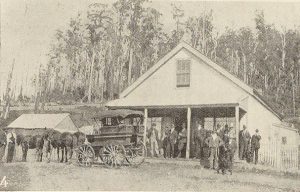
TJ Clerke’s Wilmot store, Percy Lodge photo from the Weekly Courier, 22 April 1905, p.19.
George Coles (1855–1931) was the Wilmot storekeeper whose sons, including George James Coles (1885–1977), started the chain of Coles stores in Collingwood, Victoria.[24] George Coles bought TJ Clerke’s Wilmot store in 1912, operating it until after World War One. In 1921 the store was totally destroyed by fire, although a general store has continued to operate on the same site up to the present.[25] The five skins in George Coles’ possession had probably been traded by a hunter for stores. Coles probably sold them to a visiting skin buyer when the opportunity arose.[26]
John Augustus (Jack) Linnane (1873–1949) was born at Ulverstone but arrived in the Wilmot district in 1893 at the age of nineteen, becoming a farmer there.[27] Like George Francis, Linnane joined the search party for missing hunter Bert Hanson at Cradle Mountain in 1905, suggesting that he knew the country well.[28] His abandoned hunting camp near the base of Mount Kate was still visible in 1908.[29] Enough remained to show that Linnane was one of the first to adopt the skin shed chimney for drying skins.[30] He also engaged in rabbit trapping.[31] In 1914 he was listed on the electoral roll as a Wilmot labourer, but exactly where he was hunting at that time is unknown.[32]
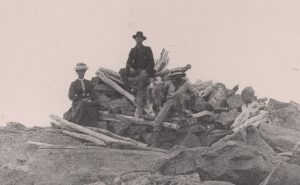
Kate Weindorfer, Ronald Smith and WM Black on top of Cradle Mountain, 4 January 1910. Gustav Weindorfer photo courtesy of the late Charles Smith.
Walter Malcolm (WM) Black (1864–1923) was a gold miner and hunter at the Lea River/Black Bluff Gold Mine in the years 1905–15. The son of Victorian grazier Archibald Black, WM Black was a ‘remittance man’, that is, he was paid to stay away from his family under the terms an out-of-court payment of £7124 from his father’s will.[33] He joined the First Remounts (Australian Imperial Force) in October 1915 by falsifying his age in order to qualify.[34] See my earlier blog ‘The rain on the plain falls mainly outside the gauge, or how a black sheep brought meteorology to Middlesex’.[35]
James Perry (1871–1948), brother of a well-known Middlesex area hunter, Tom Perry (1869–1928), who was active in the high country by about 1905. Whether James Perry’s few skins were taken around Wilmot or further afield is unknown.
No tigers at Middlesex/Cradle Mountain?
George Francis survived the financial setback of 1914. Gustav Weindorfer in his diaries alluded to collaboration with him on prospecting and mining activities, but they hunted in different areas. In 1919 Francis co-authored the three-part paper ‘Wild life in Tasmania’ with Weindorfer, which documented their extensive knowledge of native animals, principally gained by hunting them. At the time, the authors claimed, they were the only permanent inhabitants of the Middlesex-Cradle Mountain area, boasting nine years (Weindorfer) and 50 years’ (Francis) residency. They also made the interesting claim that the ‘stupid’ wombat survived as well as it did in this area because it had no natural predators, since the thylacine did not then and probably never had frequented ‘the open bush land of these higher elevations’.[36] While this suggests that George Francis had never encountered a thylacine around Middlesex, it’s hard to believe that his father Jack Francis didn’t, especially given the story that Jack’s early foray into the Vale of Belvoir as a shepherd for William Kimberley was tiger-riddled.[37] It’s also a pity the authors didn’t consult the likes of Middlesex tiger slayers Charlie McCoy (see above) and James Mapps—or rig up a séance with the late George Augustus Robinson and James ‘Philosopher’ Smith.
The dog of GA Robinson, the so-called ‘conciliator’ of the Tasmanian Aborigines, killed a mother thylacine on the Middlesex Plains in 1830.[38] Decades later, ‘Philosopher’ Smith the mineral prospector came to regard Tiger Plain, on the northern edge of the Lea River, as the most tiger-infested place he visited during his expeditions. It was popular among the carnivores, he thought, because the Middlesex stockman’s dogs by driving game in that direction provided a ready food source. ‘I thought it necessary’, he wrote about his experience with tigers,
‘to be on my guard against them by keeping a fire as much as I could and having at hand a weapon with which to defend myself in the event of being attacked by one or more of them … ‘[39]
Smith killed a female tiger on Tiger Plain and took its four pups from her pouch but found they could not digest prospector food (presumably damper, potatoes, bully beef, wallaby or wombat).[40] Philosopher’s son Ron Smith had no reason to doubt his father, as he found a thylacine skull on his property at Cradle Valley in 1913 which is now lodged in Launceston’s Queen Victoria Museum and Art Gallery.[41] There were still tigers in the Middlesex region at the cusp of the twentieth century. Like ‘Tibbly’ McCoy, James Mapps claimed a government thylacine bounty at this time, probably while working as a tributor at the Glynn Gold Mine at the top of the Five Mile Rise near Middlesex.[42]
George Francis in his will described himself as a ‘shepherd of Middlesex Plains’, yet he met his maker in the Campbell Town Hospital. His parents were dead and he had no remaining relatives. The sole beneficiary of his will was Golconda farmer and road contractor William Thomas Knight (1862–1938), probably an old hunting mate.[43] Francis’s job at Middlesex was filled by the so-called ‘mystery man’ Dave Courtney (see my blog ‘Eskimos and polar bears: Dave Courtney comes in from the cold’), whose life, as it turns out, is an open book compared to that of his elusive predecessor.
[1] Died 11 October 1883, death record no.167/1883, registered at Deloraine, RGD35/1/52 (TAHO), https://librariestas.ent.sirsidynix.net.au/client/en_AU/names/search/results?qu=maria&qu=francis#, accessed 15 February 2020; inquest dated 13 October 1883, SC195/1/63/8739 (TAHO), https://stors.tas.gov.au/SC195-1-63-8739, accessed 15 February 2020. A pre-inquest newspaper reporter incorrectly attributed her death to suicide by strychnine poisoning (editorial, Launceston Examiner, 23 October 1883, p.1).
[2] It is likely that Jack Francis and Gads Hill stockman Harry Stanley conveyed Maria Francis’s body to Gads Hill Station, where Roden took delivery of it. See ‘A veteran drover’, Examiner, 7 March 1912, p.4; and ‘Supposed case of poisoning at Chudleigh’, Launceston Examiner, 13 October 1883, p.2. Later Roden had the job of removing Stanley’s body for an inquest at Chudleigh (Dan Griffin, ‘Deloraine’, Tasmanian Mail, 13 August 1898, p.26).
[3][3] For the land grant, see Deeds of land grants, Lot 5654RD1/1/069–71In 1890, 1892 and 1894 John and George Francis were both listed as farmers at Mole Creek (Wise’s Tasmanian Post Office directory, 1890–91, p.200; 1892–93, p.288; 1894–95, p.260). Jack Francis was reported to have left Middlesex in March 1885, being replaced by Jacky Brown (James Rowe to James Norton Smith, 10 March 1885; and to RA Murray, 24 September 1885, VDL22/1/13 [TAHO]). However, he appears to have returned periodically.
[4] She was born to splitter John Wilcox and Rosetta Graves at Longford on 17 July 1841, birth record no.3183/1847 (sic), registered at Longford, RGD32/1/3 (TAHO), https://librariestas.ent.sirsidynix.net.au/client/en_AU/all/search/results?qu=sarah&qu=wilcox, accessed 14 March 2020; died 25 October 1915 at Launceston (‘Deaths’, Examiner, 8 November 1915, p.1). Mary Ann’s youngest child, Eva Grace Lowe, was born in 1879.
[5] Frank Styant Browne, Voyages in a caravan: the illustrated logs of Frank Styant Browne (ed. Paul AC Richards, Barbara Valentine and Peter Richardson), Launceston Library, Brobok and Friends of the Library, 2002, p.84.
[6] Wise’s Tasmanian Post Office directory for the period 1901–08 listed Jack Francis as an overseer at Gads Hill or Liena, while Mary, as she was described, was listed as a farmer at Liena, meaning Circular Ponds (1901, p.322; 1902, p.341; 1904, p.204; 1906, p.189; 1907, p.192; 1908, p.197).
[7] ‘A veteran drover’.
[8] ‘Return thanks’, Examiner, 2 March 1912, p.1; purchase grant, vol.36, folio 116, application no.3454 RP, 1 July 1912.
[9] Jack Francis bought purchase grant vol.18, folio 113, Lot 5654, on 25 November 1872. He divided it in half, selling the two lots on 6 May 1902 to Arthur Joseph How and Andrew Ambrose How for £30 each.
[10] ‘The mountain mystery: search for Bert Hanson’, North Western Advocate and the Emu Bay Times, 1 August 1905, p.3.
[11] 1 August 1914, ‘Daily Record of Crime Occurrences Sheffield 1901–1916’, POL386/1/1 (TAHO).
[12] See ‘William Aylett: career bushman’ in Simon Cubit and Nic Haygarth, Mountain men: stories from the Tasmanian high country, Forty South Publishing, Hobart, 2015, pp.42–43.
[13] See ‘Bert Nichols: hunter and overland track pioneer’, in Simon Cubit and Nic Haygarth, Mountain men: stories from the Tasmanian high country, Forty South Publishing, Hobart, 2015, p.114.
[14] See ‘Paddy Hartnett: bushman and highland guide’, in Simon Cubit and Nic Haygarth, Mountain men: stories from the Tasmanian high country, Forty South Publishing, Hobart, 2015, p.93.
[15] On 20 April 1892 (p.179) Frank Brown reported stolen a horse which was kept at Gads Hill, Deloraine Police felony reports, POL126/1/2 (TAHO).
[16] ‘Well-known stockrider’s death’, Advocate, 4 June 1923, p.2.
[17] ‘Lorinna’, North West Post, 28 August 1912, p.2; ‘Obituary: Mr DW Thomas, Railton’, Advocate, 21 April 1932, p.2.
[18] Born 21 March 1879, birth record no.2069, registered at Port Sorell, RGD33/1/57 (TAHO), https://librariestas.ent.sirsidynix.net.au/client/en_AU/names/search/results?qu=william&qu=ernest&qu=mccoy. Accessed 10 April 2020.
[19] Born 26 June 1870, birth record no.1409/1870, registered at Port Sorell, RGD33/1/48 (TAHO), https://librariestas.ent.sirsidynix.net.au/client/en_AU/names/search/results?qu=charles&qu=mccoy, accessed 15 September 2019; died 23 September 1962, buried in the Claude Road Methodist Cemetery (TAMIOT). For John McCoy as a convict tried at Perth, Scotland in 1792 and transported on the Pitt in 1811, see Australian convict musters, 1811, p.196, microfilm HO10, pieces 5, 19‒20, 32‒51 (National Archives of the UK, Kew, England).
[20] Born 26 June 1870, birth record no.1409/1870, registered at Port Sorell, RGD33/1/48 (TAHO), https://librariestas.ent.sirsidynix.net.au/client/en_AU/names/search/results?qu=charles&qu=mccoy, accessed 15 September 2019; died 23 September 1962, buried in the Claude Road Methodist Cemetery (TAMIOT). For John McCoy as a convict tried at Perth, Scotland in 1792 and transported on the Pitt in 1811, see Australian convict musters, 1811, p.196, microfilm HO10, pieces 5, 19‒20, 32‒51 (National Archives of the UK, Kew, England).
[21] 30 December 1901, ‘Daily Record of Crime Occurrences Sheffield 1901–1916’, POL386/1/1 (TAHO).
[22] Gustav Weindorfer diaries, 1914, NS234/27/1/4 (TAHO).
[23] Commonwealth Electoral Roll, Division of Wilmot, Subdivision of Kentish, 1914, p.27.
[24] ‘About people’, Age, 22 December 1931, p.8.
[25] ‘Fire at Sheffield [sic]’, Mercury, 8 November 1921, p.5.
[26] Coles held a tanner’s licence in 1914 (‘Tanners’ licences’, Tasmania Police Gazette, 1 May 1914, p.109), but the legal requirement was that skins had to be sold to a registered skin buyer. Despite this, plenty of people tanned and sold their own skins privately.
[27] ‘”Back to Wilmot” celebration’, Advocate, 12 April 1948, p.2.
[28] 10 July 1905, ‘Daily Record of Crime Occurrences Sheffield 1901–1916’, POL386/1/1 (TAHO).
[29] Ronald Smith, account of trip to Cradle Mountain with Bob and Ted Addams, January 1908, held by Peter Smith, Legana.
[30] Ronald Smith, account of trip to Cradle Mountain with Bob and Ted Addams, January 1908, held by Peter Smith, Legana.
[31] On 18 April 1910, Linnane reported the theft of 200 rabbit skins from his hut valued at £2, ‘Daily Record of Crime Occurrences Sheffield 1901–1916’, POL386/1/1 (TAHO).
[32] Commonwealth Electoral Roll, Division of Wilmot, Subdivision of Kentish, 1914, p.26.
[33] ‘Supreme Court’, Age, 27 February 1885, p.6.
[34] World War One service record, https://www.awm.gov.au/people/rolls/R1791278/, accessed 22 March 2020.
[35] Nic Haygarth website, http://nichaygarth.com/index.php/tag/walter-malcom-black/, accessed 22 March 2020.
[36] G Weindorfer and G Francis, ‘Wild life in Tasmania’, Victorian Naturalist, vol.36, March 1920, p.158.
[37] ‘The Tramp’ (Dan Griffin), ’In the Vale of Belvoir’, Mercury, 15 February 1897, p.2.
[38] George Augustus Robinson, Friendly mission: the Tasmanian journals and papers of George Augustus Robinson, 1829-1834 (ed. Brian Plomley), Tasmanian Historical Research Association, Hobart, 1966; 22 August 1830, p.159.
[39] James Smith to James Fenton, 14 November 1890, no.450, NS234/ 2/1/15 (TAHO).
[40] ‘JS (Forth)’ (James Smith), ‘Tasmanian tigers’, Launceston Examiner, 22 November 1862, p.2.
[41] Ron Smith to Kathie Carruthers, 26 September 1911, NS234/22/1/1 (TAHO); email from Tammy Gordon, QVMAG, 2019.
[42] Bounty no.242, 30 August 1898, LSD247/1/ 2 (TAHO); ‘Court of Mines’, Launceston Examiner, 22 September 1897, p.3; 30 September 1897, p.3.
[43] Will no.14589, administered 7 March 1924, AD960/1/48, p.189 (TAHO), https://librariestas.ent.sirsidynix.net.au/client/en_AU/names/search/results?qu=george&qu=francis, accessed 15 March 2020; ‘Funeral of Mr WF [sic] Knight’, Examiner, 15 April 1938, p.15.