
In the summer of 1922–23 the Tiger Hill Cricket Team played two matches, for a win and a loss.[1] The club’s very existence is intriguing. Which of Tasmania’s Tiger Hills was sufficiently populated to spawn a cricket team? The thylacine intimidated so many nineteenth-century farmers that there are several sites to choose from.
A range on the western side of the Florentine River
This Tiger Hill was probably named during early attempts to farm at the Great Bend of the Gordon River via the 1850s Dawsons Road. In 1855 Norfolk-Island-born Eugene Hibbens of Tiger Hill, Gordon River, advertised himself as a money lender.[2] Perhaps graziers at the Huntley Plains needed financial help—because of predation upon their sheep by a real or imagined foe.[3] Tiger Hill was still known during the Adams River osmiridium rush of 1925 and later became the Tiger Range, as it remains today.[4] Tiger Creek probably took its name from the associated hill/range.
A spur of Mount Jacob, Black Bluff Range
Mineral prospector James ‘Philosopher’ Smith supposedly advised a gold seeker to climb the Wilmot River to a creek entering it near Tiger Hill, that is, the eastern spur of Mount Jacob.[5] The anonymous author of this and a similar story about the Bell Goldfield was probably Les Smith, Philosopher’s eldest son, who prospected with his father during the 1890s. Tiger Hill was possibly named for an encounter Philosopher Smith had with two tigers sometime before 1862, in which he smashed the skull of one with a tomahawk.[6]
A hill near Stonehenge, Eastern Marshes
A hill cleared of scrub and farmed by Charles Weeding junior early in the twentieth century.[7] Its tiger association is unknown.
A hill on the Mount Serat property near Woods Quoin, north-east of Bothwell
Here tigers supposedly killed Norfolk Wise’s sheep punctually on 12–14 April each year up until about 1916. Les Skelly’s father Jim Skelly (1884–1961), a former shepherd on the property, told him that the tigers arrived there as part of an annual cycle. According to Cynthia Mitchell, shepherd George Wells (1876–1928) worked here in the 1920s. She claimed that he collected tiger bounties but there is no known record of this.[8]
A hill north of Buckland
Bingo. The presence of Cornishes, Raspins and Frenches in the Tiger Hill Cricket Team gives it away. All these families had a tiger connection. In 1884 travelling newspaper correspondent Theophilus Jones dubbed Buckland ‘the Tasmanian tiger country’.He described the Cornish and Cox properties ‘under the shadow of Tiger Hill’.[9] Both these families later claimed bounties.
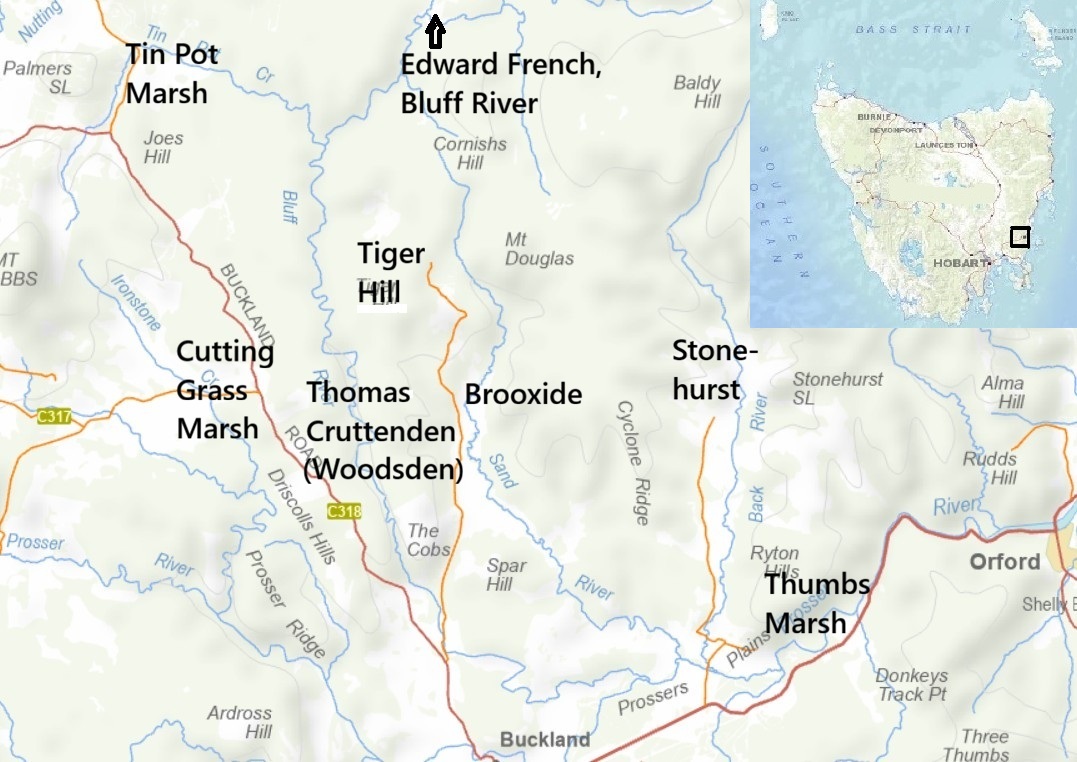
Topographic basemap from TheLIST © State of Tasmania.
The French brothers of Tiger Hill, Tin Pot Marsh and Bluff River
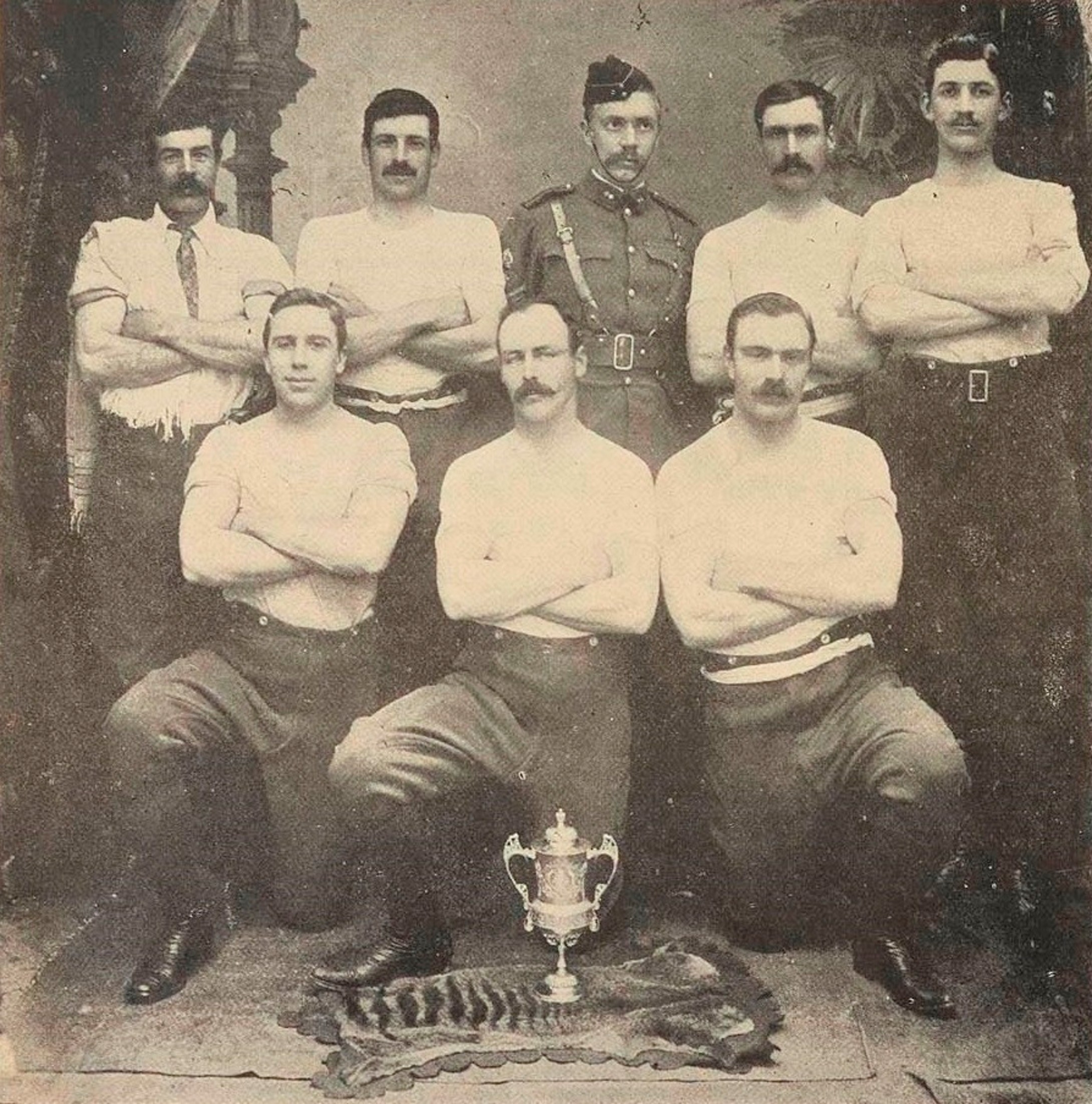
The major subject of Jones’s visit to this area was the tiger killing exploits of brothers Edward (c1855–1937) and Joseph French (c1847–94), who then leased land at Tiger Hill—but their killing field of the time was at Tin Pot Marsh, 7 km away to the north-west. Jones visited the latter property in their absence and reported finding eighteen tiger heads nailed to a tree,
several being very large, the largest, whose jaws were kept asunder by a peg, having a mouth big enough to bite a sheep dog in two at the loins, and full of long serrated teeth. This animal’s skin is fully the size of a good-sized sheep, say between nine and ten square feet, and its paws are like those of a large kangaroo dog.
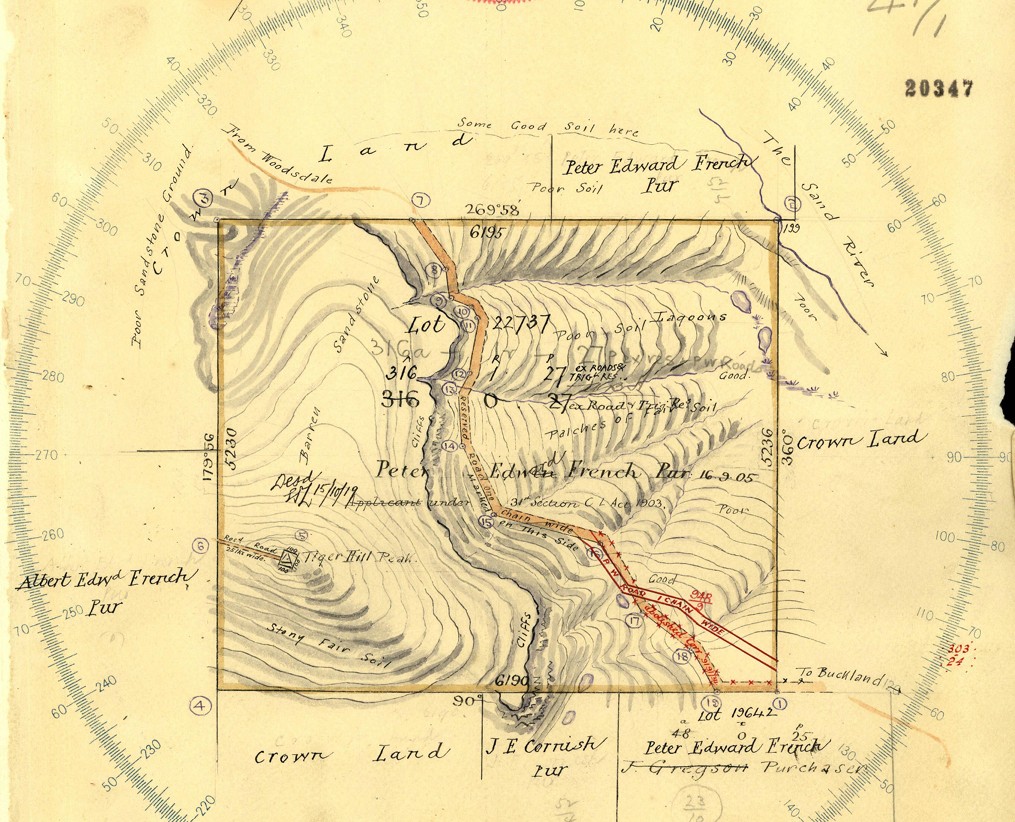
The brothers’ snaring method appears to have been conventional. Their Tin Pot Marsh property, according to Jones, had a high fence, with 900 snares set in gaps left in the fence, which caught tigers and other native animals. In July 1884 Jones claimed that here these sons of Irish immigrants had killed 30 tigers in two years.[10]
Their Jones-given celebrity is backed up by surviving correspondence. Letters to the Frenches include one from Sarah Mitchell (Lisdillon), two from Alex Morton (Tasmanian Museum, Hobart) requesting thylacine carcasses, skulls or pelts, and another from William McGowan senior requesting a living thylacine for Launceston’s City Park Zoo.[11]
The Buckland and Spring Bay Tiger and Eagle Extermination Association (BASBTAEEA), a locally subscribed bounty scheme, was formed at Buckland in August 1884 when Jones was touring the area.[12] He applauded its efforts, hoping that it would reduce eagles and tigers ‘to the last specimen’.[13] That is, drive them to extinction. The BASBTAEEA rewarded the French brothers for their tiger snaring. By September of that year their tally was said to have reached 34.[14]
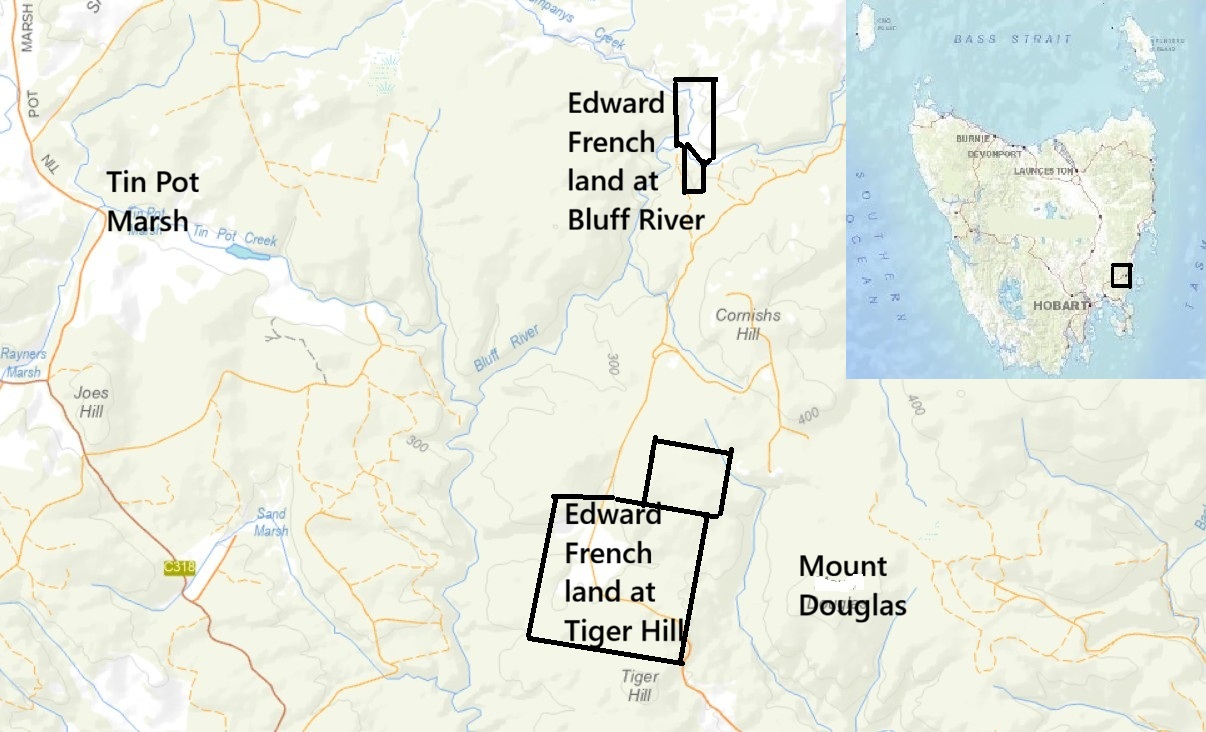
Topographic basemap from TheLIST © State of Tasmania.
Working with Fred Mace, they were also said to have submitted three tigers to the Tasmanian Museum in May 1885.[15] By the end of 1885 the Frenches’ tiger tally must have approached 40. In June of that year the ‘Tiger killing association’ paid them a reward and before Christmas they killed two more thylacines.[16] In 1887 they rejected a £6 offer for a tiger they snared alive at the Bluff River, the Mercury’s local correspondent assuring his readers that at this location they had ‘killed and destroyed a great number of tigers’.[17]
[1] ‘Tiger Hill v Levendale’, Mercury, 21 December 1922, p.2; 18 January 1923, p.6.
[2] ‘For loan’, Hobart Town Advertiser, 14 November 1855, p.3. Hibbins (1803–65) was the son of Norfolk Islanders Thomas Hibbins and Elizabeth Busby.
[3] ‘Land settlement’, Tasmanian News, 22 July 1907, p.2.’ ‘The Florentine Valley’, Tasmanian News, 22 May 1908, p.2.
[4] R Parker, H Sharpe and J Peters, ‘Route to osmiridium field’, Mercury, 29 September 1925, p.4.
[5] ‘Bell Mount gold rush’, North Western Advocate and the Emu Bay Times, 11 January 1909, p.4.
[6] ‘JS’ (James Smith), ‘Tasmanian tigers’, Launceston Examiner, 22 November 1862, p.2.
[7] ‘Parattah Spring Show’, Mercury, 24 September 1913, p.2.
[8] Les Skelly, interviewed by Cynthia Mitchell, NS1391/1/1 (TA), https://www.youtube.com/redirect?event=video_description&redir_token=QUM4Zm9rVHY5Y3JieDdTaFN2cG1jQWlOYmFRa3xBR3JiS2FsamtJR01uX0U5LTQya3pSUDV5cjNIbi01RUppWkJ2a1NOckZMN1QxVDJiZWJkR3BYUTJvMEM2X2ZrTXVnWHduWm80OVdCeF8xaDJzQlJ4UFI3SnZ4dEI3NXRrZHVx&q=https%3A%2F%2Fstors.tas.gov.au%2FAI%2FNS1391-1-1&v=s3KsTjoUzzE, accessed 6 August 2026.
[9] ‘Our Special Correspondent’ (Theophilus Jones), ‘Through Tasmania: no.48’, Mercury, 17 July 1884, p.1.
[10] ‘Tasmanian telegrams’, Mercury, 5 July 1884, p.3.
[11] Sarah Mitchell requested six tiger skins for a rug, one skin with the head and feet left on, letter dated 18 July 1884. McGowan offered £6 for ‘good, sound animals, young if possible’, that is, living tigers (3 July 1885). Alex Morton wanted tiger and devil carcasses (29 June 1886); but also skulls of ‘tigers, Devils and native cats’ (3 October 1887). All letters are held by the Spring Bay-Glamorgan Historical Society, Swansea.
[12] ‘Buckland’, Mercury, 15 August 1884, p.3.
[13] Theophilus Jones, ‘Through Tasmania: no.56’, Mercury,20 September 1884, p.2.
[14] ‘Our Special Correspondent’ (Theophilus Jones), ‘Through Tasmania: no.48’; ‘The Museum’, Mercury, 1 September 1884, p.2.
[15] ‘Telegrams’, Daily Telegraph, 29 May 1885, p.2.
[16] ‘Country news’, Mercury, 3 June 1885, p.3.
[17] ‘A tiger capture’, Mercury, 25 April 1887, p.2.