
From 1852 to 1871 pioneering wool-grower the Van Diemen’s Land Company (VDL Co) was an absentee landlord in Van Diemen’s Land/Tasmania. During this time, as a rental property, its flagship Woolnorth estate at Cape Grim in the far north-west developed a reputation for being overrun by thylacines and wild dogs, in that order of influence. The standard bearer for this reputation was Dr James Grant (1813–65), a Scottish-born Launceston surgeon, naturalist and sheep breeder. Having helped his friend Ronald Campbell Gunn ship the first two living thylacines to the London Zoo in 1850, and offered a reward for living specimens of the animal, Grant changed his tune when he became a wool-grower.[1] As the Woolnorth tenant 1852–65, he appears to have inaugurated the role of the Mount Cameron West hunter-stockman who was paid a bonus for destroying thylacines, with Lawrence ‘Larry’ Quinn (c1824–79) receiving £3 per kill.[2] This was in response to Grant’s belief that he was losing ‘thousands’ of his half-breed Cheviot sheep to thylacines.[3]
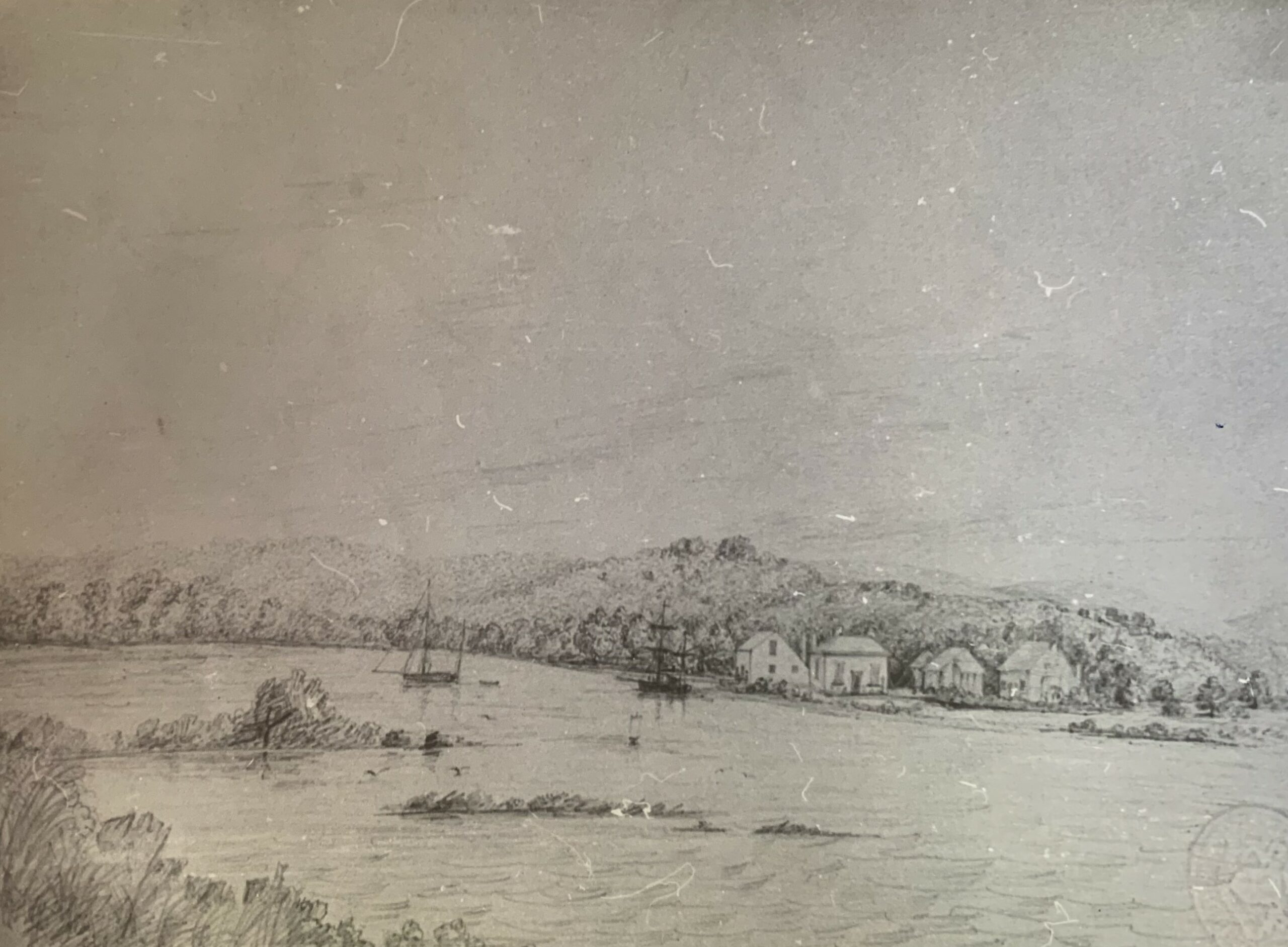
Grant seems to have entertained the idea of establishing a town of tenant farmers at Woolnorth, but his hopes for the property were soon dashed.[4] He replaced the VDL Co’s Woolnorth staff with Bothwell-born overseer Douglas McDowall, two shepherds known to McDowall and three probation pass holders.[5] Grant was involved in the St Andrews’ Immigration Society, a scheme to bring Scottish farm labourers to Tasmania, and at least two Scottish immigrants, the brothers Charles and Thomas Lillico, are known to have worked at Woolnorth.[6] The only old Woolnorth servant re-employed was William Procter, who was eventually driven off the property under threat of prosecution.[7] The loss of corporate knowledge, Woolnorth’s remoteness and exposure to hunters’ dogs may explain how a property with a few previous predation problems ended up with an alarming reputation.
When he arrived in 1852, McDowall was rightly concerned about the unchecked hunting that was going on in the region, exposing his flocks to kangaroo dogs:
I am afraid I shall have some trouble with kangaroo hunters. I am told there are 15 persons and 20 dogs hunting between the Montagu and the Welcome. I scarcely know what plan to adopt to get rid of them.[8]
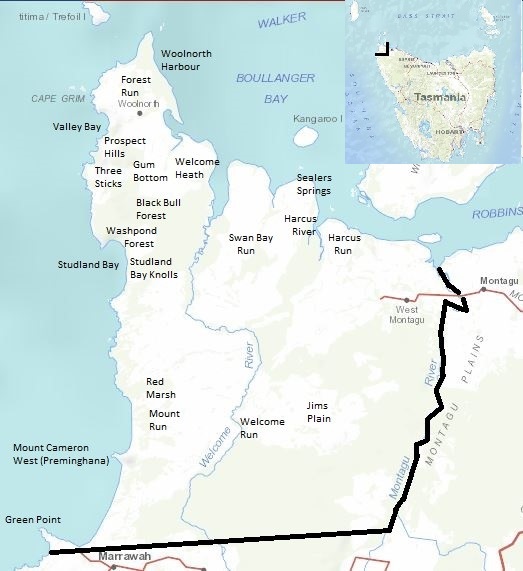
showing the original estate boundary. Topographic basemap from TheLIST copyright State of Tasmania.
Ironically, while the VDL Co’s fortunes began to improve, with a 10-shilling dividend being declared in 1854, Grant’s took a downturn.[9] By January 1858 he regretted taking the lease. ‘We have had a good lambing,’ Grant wrote then,
and if we could only keep down those destructive animals the Thylacines we might do well with Woolnorth in spite of all the losses. I have sold very few sheep—not so many as I have sent down—and yet I have not increased my flock since the day you made delivery six years ago. What a different result there would have been in Victoria or even in New Zealand.[10]
Things had not improved by September of that year when Grant made his claim that he had
lost thousands of sheep killed by the Thylacines or Native Wolves which are so [unceasing?] that I have been compelled to abandon my best ewes in consequence of the nightly destruction.[11]
Larry Quinn, son of the George Town gaoler, seems to have fared better than the Cheviots.[12] In 1864 the former gold prospector was reported to have recently dispatched 10 tiger skins worth a reward of £3 each to Launceston. Cornwall Chronicle proprietor Sophia Goodwin echoed Grant when she commented that
Tiger hunting in Tasmania appears to be a profitable, as well as a healthful and sporting occupation … The Tiger is a most destructive foe to sheep. Its appearance disperses a flock in various directions. Though not very swift, it is untiring in its pursuit, and invariably follows its victim until it secures it. The Tiger is such an epicure that it ‘turns up its nose’ at ‘cold mutton’, and declines to dine more than once off a sheep, as long as he can secure another from the flock. The extent of havoc that ten of these bloodthirsty animals would consequently make in the Woolnorth flocks in a year, would be a serious item to deduct from the profits of the station.[13]
Quinn probably scored again in the following year when a bundle of Woolnorth ‘hyena’ skins were shipped to the VDL Co’s Board of Directors in London.[14] He even managed to hang onto his job for almost two years after Grant’s death in 1865.[15] It is unknown how many tigers—or dogs—Quinn killed at Woolnorth.
A swashbuckler named Charles Winter glorified Quinn’s job in a manner which probably would have suited Grant. Winter claimed to have spent two years at Woolnorth with Quinn, ‘hunting the native tigers with bloodhounds’.[16] He recalled a tiger springing at one of the dogs, invoking a ‘life-and-death struggle’ between the animals. ‘It was some time’ he claimed, ‘before the writer could get a chance to shoot the tiger without the risk of injuring the dog, but he finally dropped him with a charge of buckshot’.[17] Winter would have known his way around when in 1867 he reached Woolnorth after surviving the wreck of the pining schooner Rose Ann about 70 km away at the Pieman River.[18] He retained the strength to pot more tigers during his northward trek.[19]
[1] EOG Scott, ‘Tasmanian tigers for London Zoo: gift of ninety years ago’, Examiner, 30 March 1940, p.12.
[2] Sophia Goodwin, editorial, Cornwall Chronicle, 10 September 1864, p.5.
[3] James Grant to James Gibson, 10 September 1858, VDL25/1/1 (Tasmanian Archives, hereafter TA).
[4] See VDL25/1/1 (TA).
[5] James Grant to James Gibson, 17 February 1852, VDL22/1/1 (TA).
[6] ‘Personal’, North Western Advocate and the Emu Bay Times, 17 August 1908, p.2; ‘Don’, North Western Advocate and the Emu Bay Times, 22 April 1910, p.4.
[7] ‘One hundred pounds reward’, Cornwall Chronicle, 19 September 1855, p.8.
[8] Douglas McDowall to James Gibson, 26 February 1852, VDL22/1/1 (TA).
[9] ‘Van Diemen’s Land Company’, Courier, 26 June 1854, p.3
[10] James Grant to James Gibson, 28 January 1858, VDL22/1/2 (TA).
[11] James Grant to James Gibson, 10 September 1858, VDL34/1/1 (TA).
[12] Quinn was the son of probable ex-convict George Town gaoler Thomas Quinn (1827 census, CSO1/1/918, p.66, TA), https://librariestas.ent.sirsidynix.net.au/client/en_AU/names/search/results?qu=lawrence&qu=quinn, accessed 2 August 2020. Larry Quinn was a George Town gold prospector as early as 1857 (‘Gold at George Town’, Tasmanian Daily News, 21 July 1857, p.2). After his time at Woolnorth, he was a farmer, hunter and gold prospector in what became the Lefroy district. In 1869 he found gold while working with Samuel Richards, the man later recognised as the discoverer of payable gold at Nine Mile Springs (Lefroy) (‘Gold Rewards Commission’, Launceston Examiner, 1 October 1881, p.3). A 40-year-old miner named Lawrence Quinn married 44-year-old Julia Clarke at George Town in 1870 (no.103/1870, RGD37/1/29, TA, https://linctas.ent.sirsidynix.net.au/client/en_AU/names/search/results?qu=laurence&qu=quinn#, accessed 27 December 2017). Quinn offered his Enfield Farm for lease in 1873 (‘To let or sell’, Launceston Examiner, 15 November 1873, p.1). He died on 20 February 1879 of enteritis and exhaustion, the death being registered at George Town (no.192/1879, RGD35/1/48, TA, https://linctas.ent.sirsidynix.net.au/client/en_AU/names/search/results?qu=laurence&qu=quinn, accessed 27 December 2017). His age was give as 67 years, which conflicts with the age given on the 1827 census and his marriage certificate. Julia Quinn appeared on her late husband’s behalf at an 1881 hearing in a vain effort to obtain some financial benefit from the first discovery of payable gold at Lefroy (‘Goldfield Reward Commission’, Mercury, 24 September 1881, p.3).
[13] Sophia Goodwin, editorial, Cornwall Chronicle, 10 September 1864, p.5.
[14] Charles Nichols, Outward Despatch no.70, 26 August 1865, VDL1/6 (TA).
[15] ‘Death of Dr Grant’, Cornwall Chronicle, 28 October 1865, p.4; ‘Wreck of the Moyne’, Launceston Examiner, 29 June 1867, p.3.
[16] Charles Winter, ‘Do snakes swallow their young?’, Argus, 9 January 1904, p.18.
[17] ‘Nature notes and queries’, Argus, 22 April 1910, p.5.
[18] ‘An old salt’s memories: tales of Bass Strait pirates’, Age, 2 February 1921, p.17; ‘Wrecks at Pieman’s River’, Launceston Examiner, 18 April 1867, p.2.
[19] ‘An old salt’s memories: tales of Bass Strait pirates’, Age, 2 February 1921, p.17.