by Nic Haygarth | 13/11/16 | Tasmanian high country history
In May 1914 Ron Smith’s former Forth mate Ted Adams invited him to go hiking at Lake St Clair. Smith, who would be one of the major figures in the establishment of the Cradle Mountain-Lake St Clair National Park, could not make the appointed time.[1] He had business to attend to at Cradle Valley, but perhaps when that was done a cross-country short-cut would bring them together. ‘I thought … I could go overland to Lake St Clair to meet you there’, he told Adams.[2] It was perhaps in that instant that Ron Smith conceived the idea of the Overland Track between Cradle Valley and Lake St Clair. Ironically, it would take him another 27 years to walk it.
The opportunity finally came in late December 1940. Now fifty-nine years old and an invalid pensioner as the result of World War I service, Smith was also the secretary of the Cradle Mountain Reserve Board, a land owner at Cradle Mountain and the major documenter of the area’s European history, flora and fauna. The Overland Track, the southern section of which was roughly marked by Bert Nichols in 1931, had only become suitable for independent travellers in 1935–36 after additional track and hut work by Nichols, Lionel Connell and his sons.[3] Few people had then taken up the challenge of tramping a track that now attracts about 10,000 per year from all over the world.
Ron’s early trips from his home at Forth to Cradle Mountain were accomplished on bicycle and on foot, with stopovers at Middlesex Station, but in 1940 he was able to drive from his new home at Launceston to Waldheim Chalet, Cradle Valley, in less than five hours. From 1925 to 1936 the Smiths had had their own house at Cradle Valley, and they would have one again, Mount Kate house, from 1947.[4] However, in 1940 they were content to stay in the late Gustav Weindorfer’s Waldheim Chalet, then managed by Lionel and Maggie Connell. In fact it was almost a second home for the Smith family, since Ron’s oldest son, whom he called Ronny, and Kitty Connell, daughter of Lionel and Maggie, were courting. And yet, despite the stringencies imposed by the war raging in in Europe, people continued to enjoy the major holiday period of the year. On Christmas Day 1940 Waldheim was bursting at the seams with hikers, 50 guests in all. What a peaceful Christmas for head chef Maggie Connell! Ron slept on a sofa in the dining room, his sixteen-year-old son Charlie on the floor of the same room.
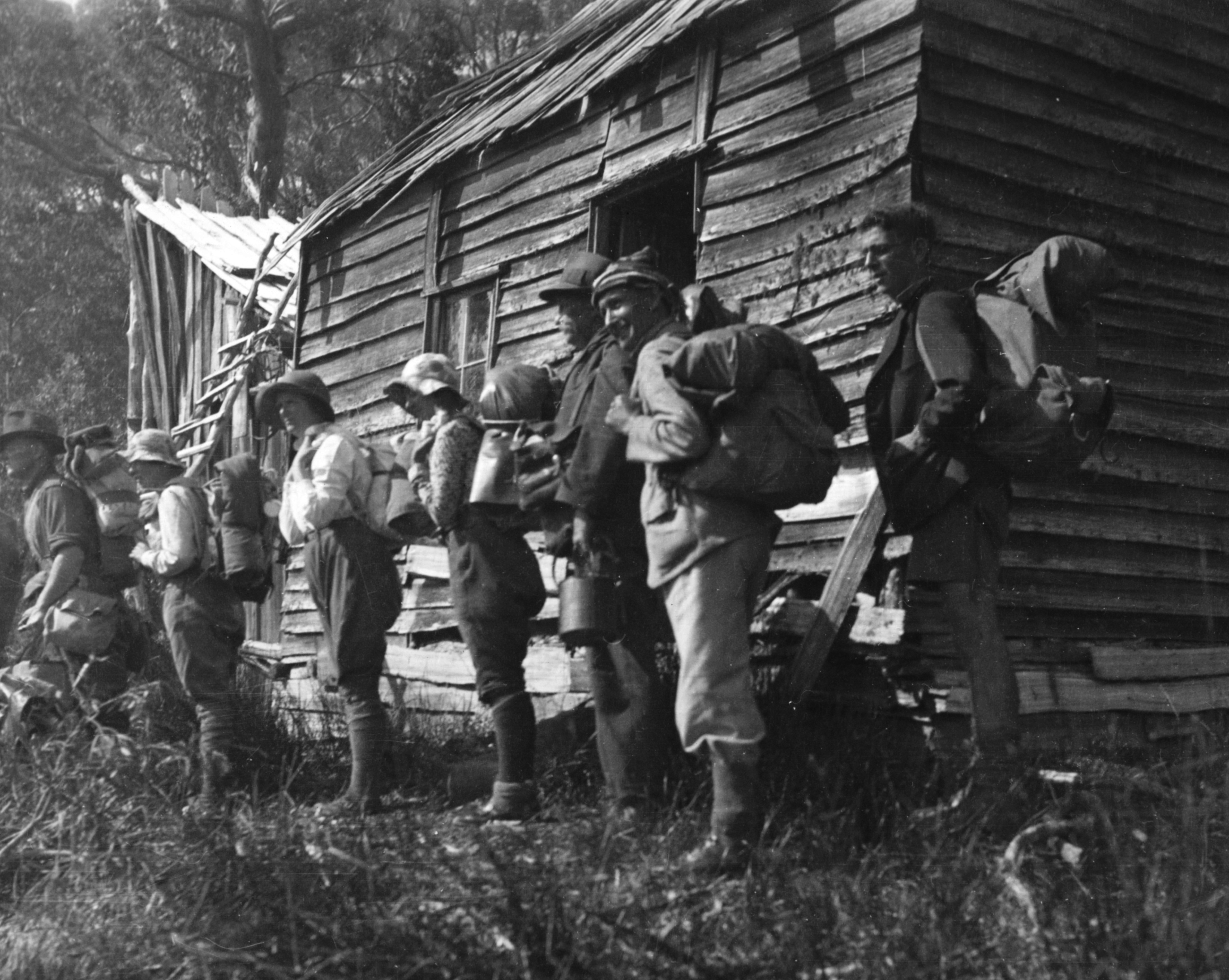
Ron Smith was always a formidable record keeper, and in his diary he recorded with typical precision that he and Charlie were on their way at 7.38 next morning, each of their knapsacks weighing 40 lbs (18 kg). After regular bouts of illness, Ron possibly doubted his own endurance. Two fit young men, Wally Connell and Ronny Smith, carried those heavy packs up to Kitchen Hut, sparing the hikers the full rigours of the tough climb up the Horse Track. After breakfast, Ron and Charlie continued alone, being passed by a party of five women who had started from Waldheim after them. Kitchen Hut was then only a three-sided shelter. There was no proper hut between Waldheim and Lake Windermere, making day one of an Overland Track trip a long and potentially dangerous one. Ron and Charlie reached Waterfall Valley before meeting their first fellow hikers—two young Sydney men—walking in the opposite direction (from Lake St Clair to Cradle Mountain, now prohibited).
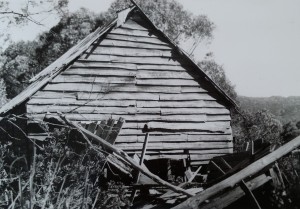
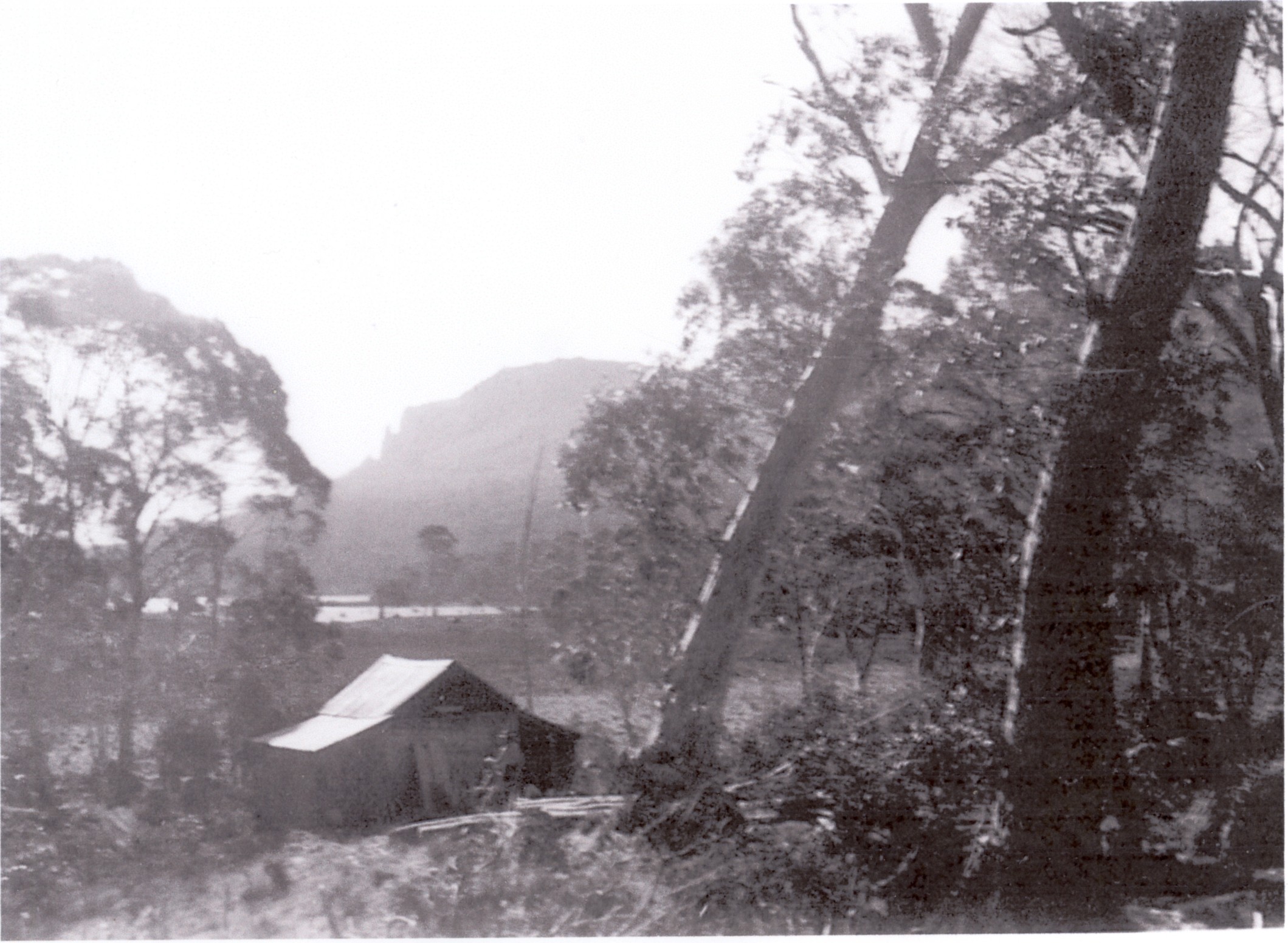
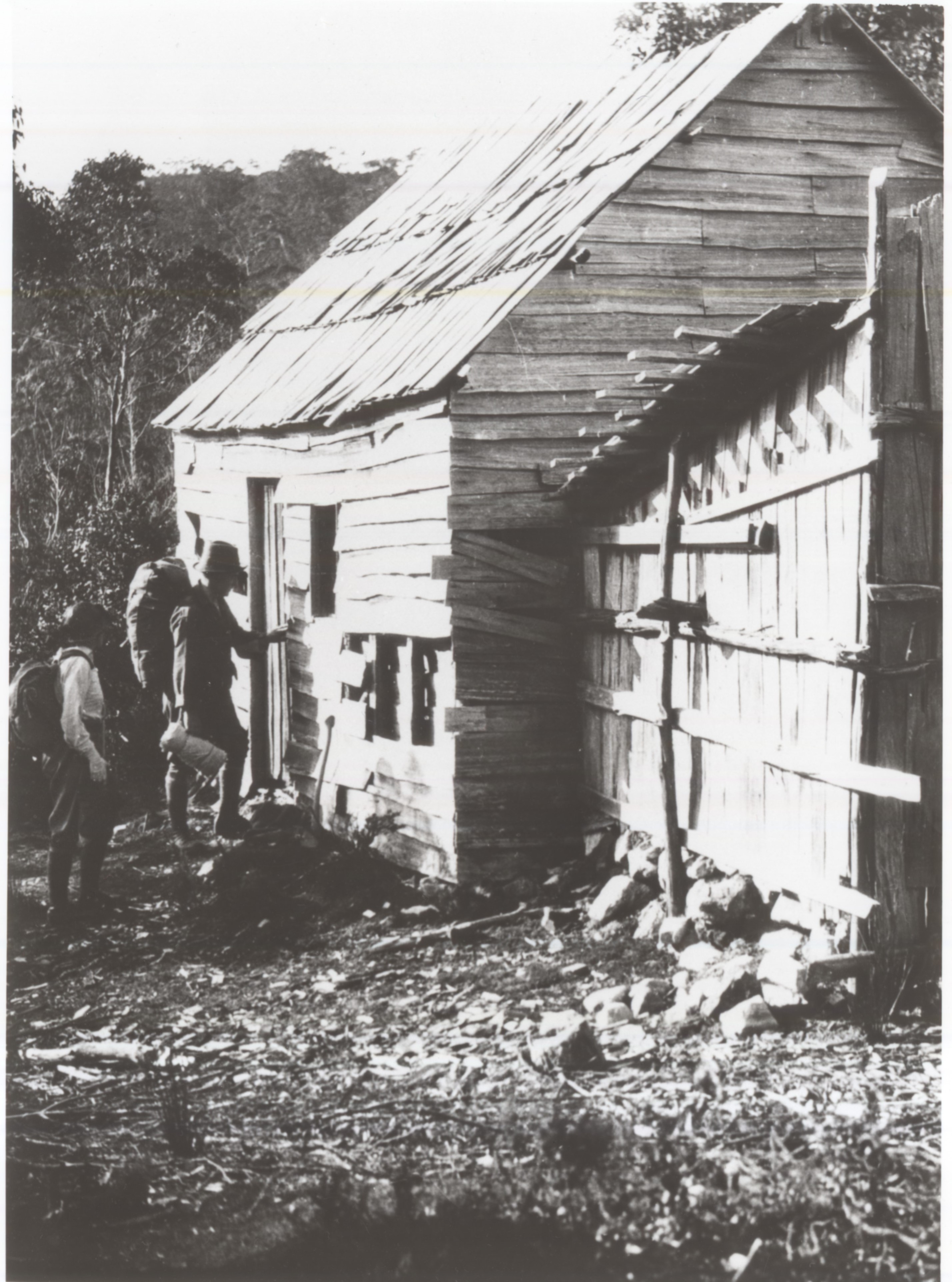
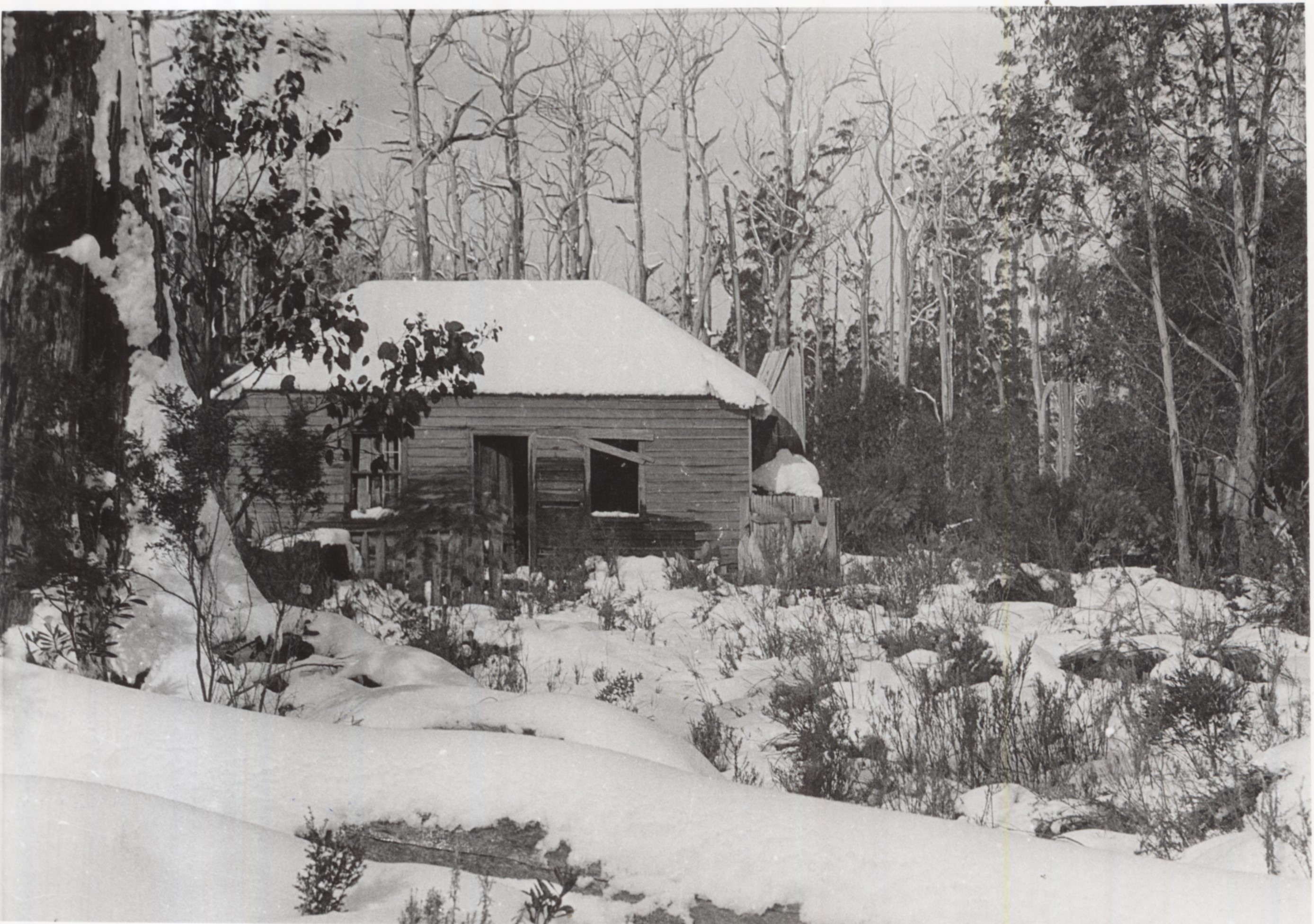
The old miners’ hut at Lake Windermere, 27 December 1940. Ron Smith photo courtesy of the late Charles Smith.
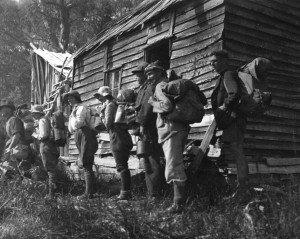
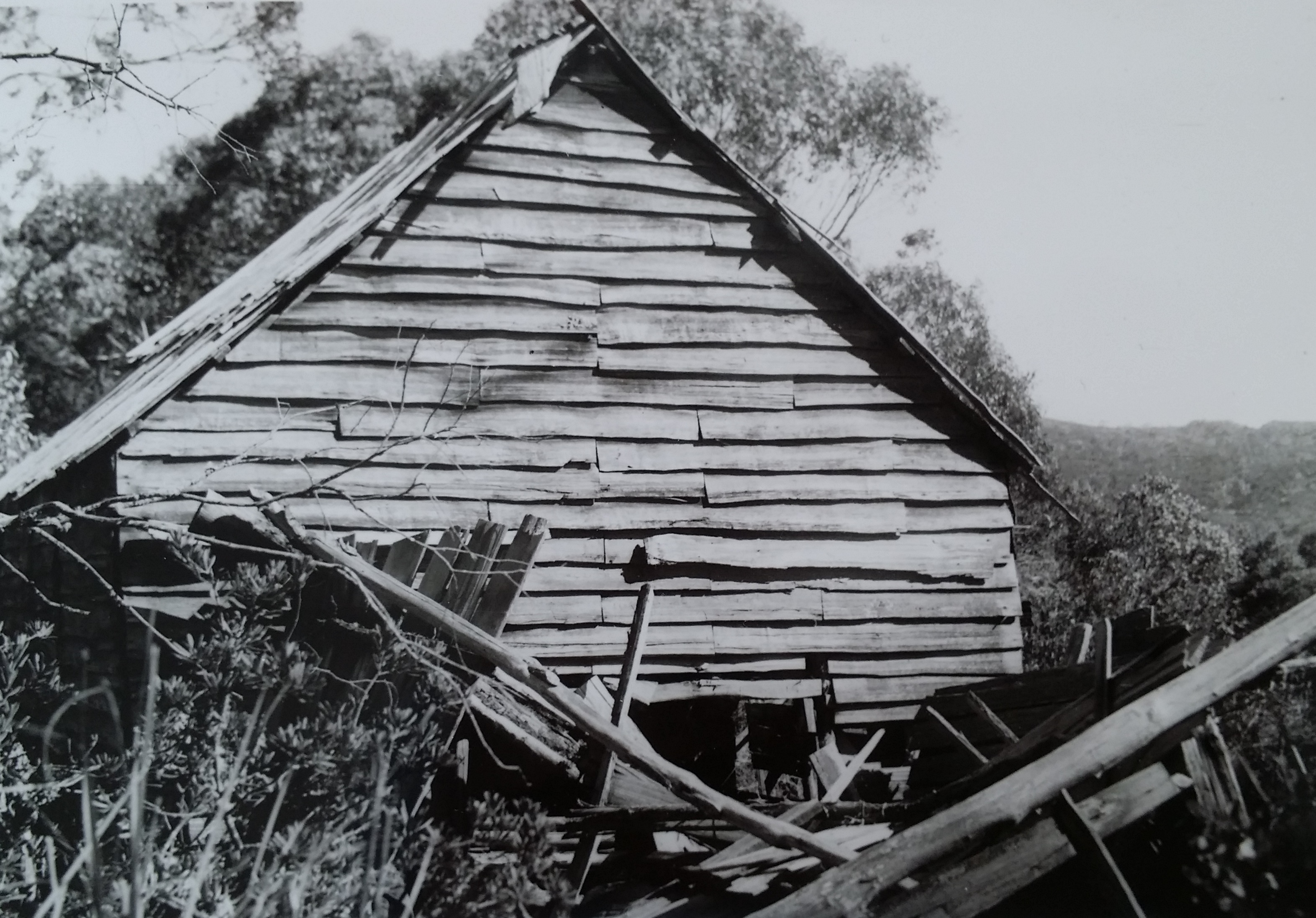
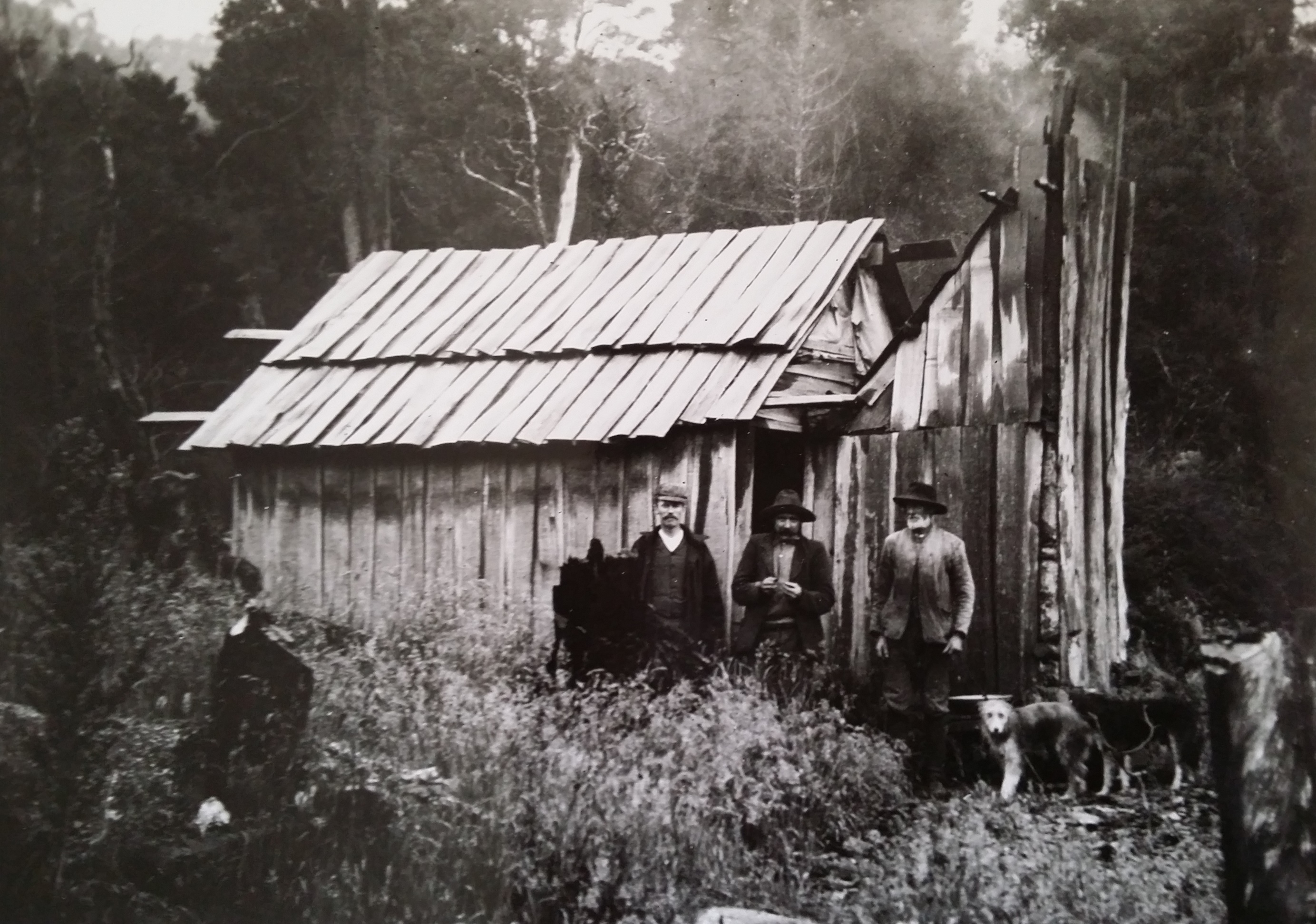
A Fred Smithies shot showing the rest of the old Windermere Hut, taken during an Overland Track tramp. Courtesy of Margaret Carrington.
Father and son reached the Connells’ new Windermere Hut at 4.23 pm, nearly nine hours after setting out from Waldheim. The party of five women camped outside, leaving the hut to the men—and two grey possums, which entered, in what became Windermere tradition, via the chimney in their quest for food. Next morning, Ron and Charlie visited the c1901 Windermere miners’ hut, now in ‘great disrepair; the chimney fallen down and the roof very leaky’. Ron had reached the old hut with Gustav Weindorfer in 1911 and 1914; it was the furthest south he had so far travelled on the route of what became the Overland Track.[5]
Day two, from Windermere along the watershed of the Forth and the Pieman, then around the Forth Gorge and through to Pelion Plain, was another tiring one. They boiled the billy for lunch on the edge of the forest at Pine Forest Moor, with the dolerite ‘organ pipes’ of Mount Pelion West looming large ahead of them. At New Pelion Hut they re-joined the party of five women, greeted a married couple called Calver who arrived from Lake St Clair, plus four Victorian men who were returning to Waldheim after climbing Mount Ossa. There were ten in the Connells’ new hut, which had two rooms so that men and women could be separated. For Ron every new meeting was noteworthy. Names and sometimes addresses were exchanged, and it was a chance to chat and learn. The leisurely experience was far removed from that of more recent times, when the two-way traffic could make the Overland Track feel rather like a scenic Hume Highway.
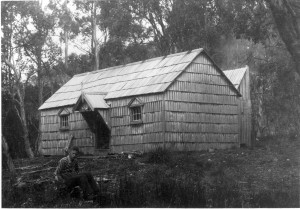
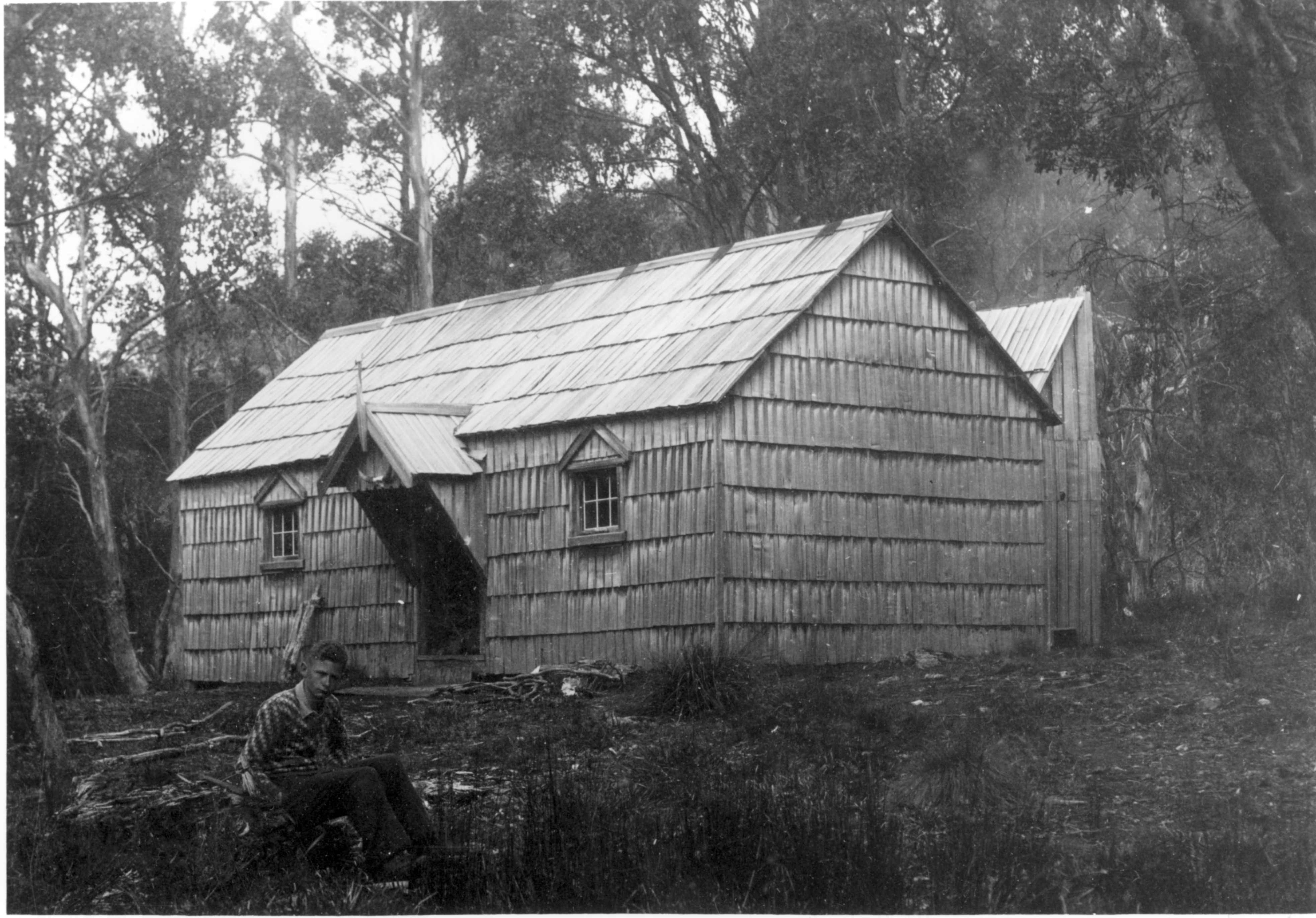
Flourishes of Federation Queen Anne and Arts and Crafts architecture in the Connells’ King Billy pine shingle New Pelion Hut, 28 December 1940, Charles Smith in the foreground. Ron Smith photo courtesy of the late Charles Smith.
With rain threatening, the Smiths decided to spend a day close to shelter at Pelion. Ron had now ventured further south than his departed friend, Gustav Weindorfer, who had taken the census at the Pelion copper mine and climbed Mount Pelion West in April 1921.[6] The mine manager’s hut (Old Pelion) and the workers’ hut from that period were both in good repair. Leaving these huts, Ron and Charlie crossed Douglas Creek and followed the southern edge of Lake Ayr until they met the Mole Creek (Innes) Track near the rock cairns and poles marking the then Cradle Mountain Reserve’s eastern boundary.
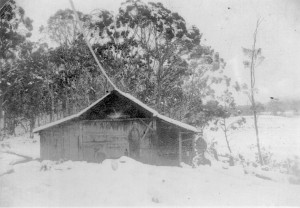
Tommy McCoy’s hunting hut near Lake Ayr. Photo courtesy of the McCoy family.
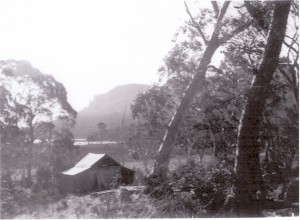
McCoy’s hut as it looked in 1951, with Mount Oakleigh and Lake Ayr for a backdrop. Photo courtesy of the McCoy family.
The reserve had been a bird and animal sanctuary since 1927. Yet, cheekily poised about 250 metres beyond the boundary, Tommy McCoy’s new hardwood paling hunting hut made his intentions clear. Hobart hikers would become conservation activists, puncturing McCoy’s food tins with a geological pick, when they came across his hut in 1948.[7] However, the Cradle Mountain Reserve Board secretary, a former possum shooter and a man of a different ilk, was much more respectful, leaving payment of threepence for a candle he removed from McCoy’s camp. Ron and Charlie also inspected the old post-and-rail stockyard near the western end of Lake Ayr on their way back to New Pelion. On their second night at Pelion propriety was dispensed with, as the Smiths and Calvers shared a room, leaving the other room for newcomers.
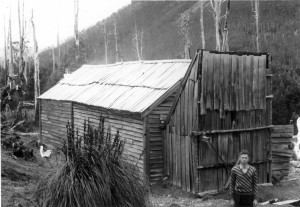
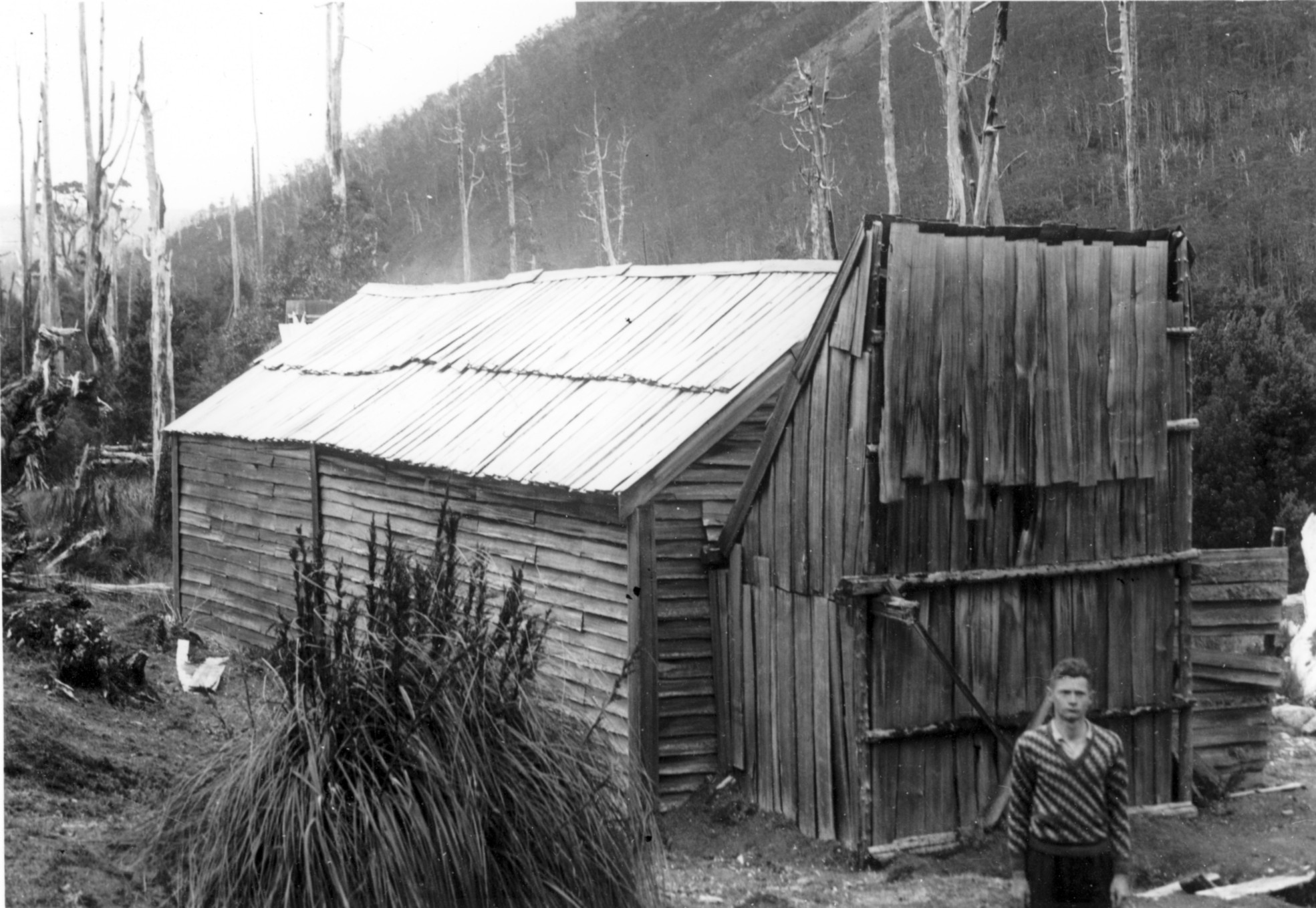
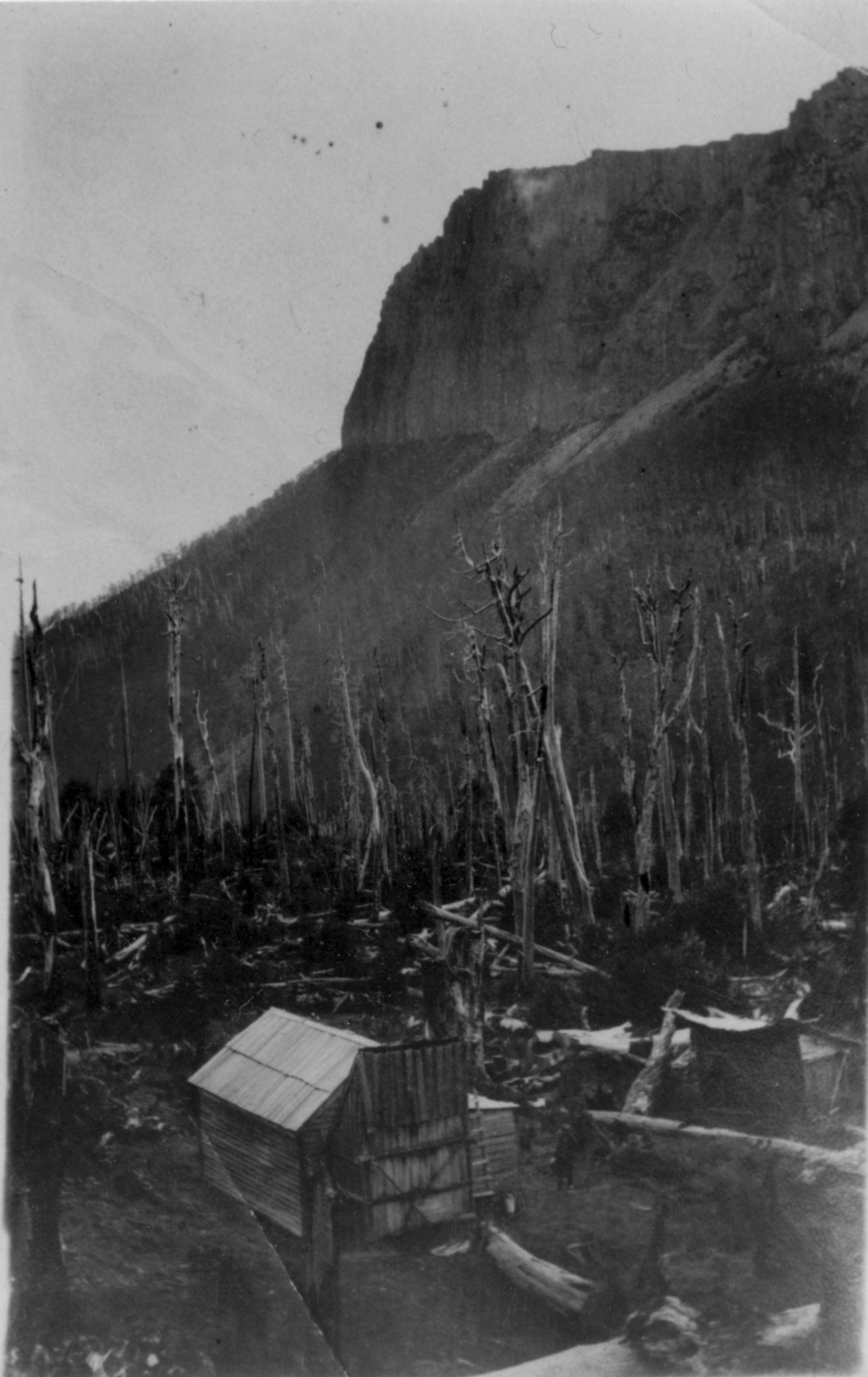
An unsympathetically cropped image of the two-room Du Cane Hut, 29 December 1940, with Cathedral Mountain omitted but Charles Smith in the foreground. Ron Smith photo courtesy of Charles Smith.
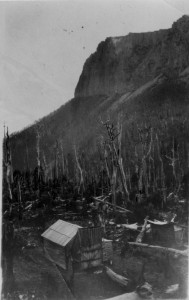
An earlier Ray McClinton or Fred Smithies shot of the original one-room Du Cane, taking full advantage of the view of Cathedral Mountain.
The party of five women motored past the Smiths on the climb up to Pelion Gap next day, marching right through to Narcissus Hut, a distance of about 27 km in a day. Ron and Charlie took a leisurely pace, visiting Kia Ora Falls and camping at Du Cane Hut (Windsor Castle or Cathedral Farm), Paddy Hartnett’s old haunt, which had been converted to a two-room building in keeping with New Pelion. Reflecting, perhaps, his reduced stamina, Ron elected to wait on the main track while Charlie viewed Hartnett Falls. The pair also made a diversion to Nichols Hut, the walkers’ hut Bert Nichols had erected beside his old hunting hut. For a man who in his younger days rarely left a bush setting or bush person unsnapped, Ron Smith was relatively parsimonious with his photos on this trip, neglecting these buildings, McCoy’s hut and the old Mount Pelion Mines NL huts. He appears to have been ignorant of the other hunters’ huts located near the track between Pelion Plain and Narcissus River.
Ron and Charlie were accompanied most of the way from Pelion to Narcissus Hut by the Robinsons, a Sydney couple they had first met at Waldheim. Crossing the suspension bridge over the Narcissus River, Mrs Robinson’s hat landed in the drink and disappeared, despite a group rescue effort. Narcissus Hut, the staging post for the motorboat trip down Lake St Clair, as it is today, replicated the situation at Waldheim, being full to the brim and beyond, with numerous tents being pitched outside. Among the hikers were the economist and statistician, Lyndhurst Giblin, and HR Hutchinson, Chairman of the National Park Board, the subsidiary of the Scenery Preservation Board which oversaw the Lake St Clair Reserve. Indeed, it must have seemed like the veritable busman’s holiday when the Cradle Mountain Reserve Board secretary met the Lake St Clair Reserve Board chairman on the Overland Track that united their realms.
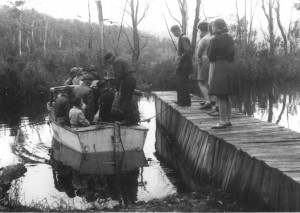
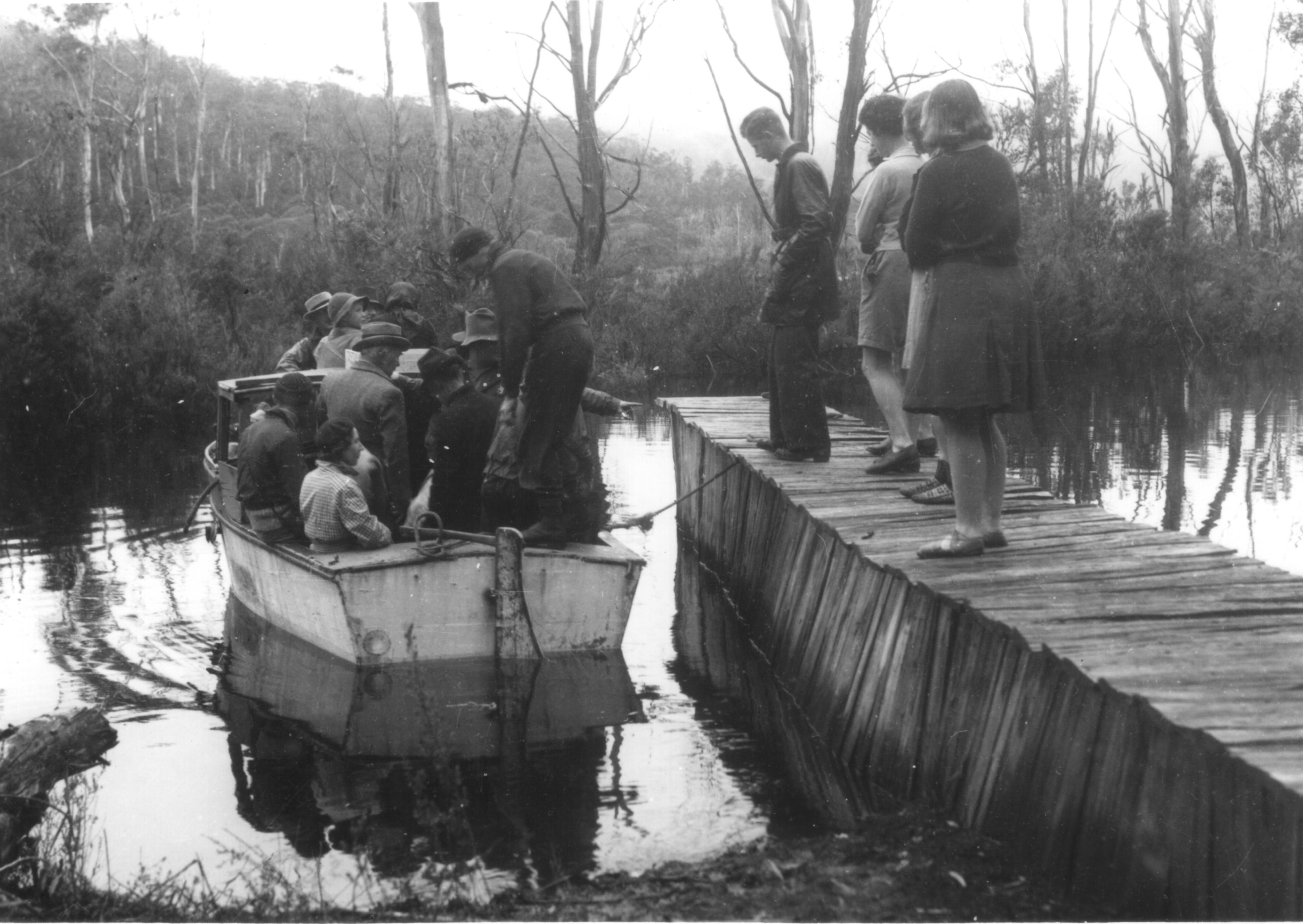
Bert Fergusson’s motorboat loading at Narcissus Landing, 31 December 1940. Seventeen to board, including the party of five women, and a tentative Charles Smith (fourth from right). Ron Smith photo courtesy of the late Charles Smith.
The trip was concluded in six days. It took 1 hour 45 minutes to traverse Lake St Clair in the famous Bert ‘Fergy’ Fergusson motorboat on New Year’s Eve, 1940. This seems extraordinarily slow progress—didn’t Paddy Hartnett row the lake faster than that 30 years earlier, against the wind?— until you realise how overloaded Fergy’s vessel was! Seventeen people were crammed aboard what was certainly not Miss Velocity. Ron and Charlie slept in Hut Twelve of Fergy’s tourist camp at Cynthia Bay, where a housekeeper, Mrs Payne, was also employed. From here Fergy operated a free ‘bus’ service (Jessie Luckman called it a ‘frightful old half bus’ sporting sawn-off kitchen chairs with basket-work seats) to Derwent Bridge, where the departing tourist joined one of Grey’s buses. The Lake St Clair tourist infrastructure of 76 years ago was surprisingly well organised. Charlie having departed with family members, Ron stayed on a day more and caught a bus back to Launceston via Rainbow Chalet at Great Lake and Deloraine, using a short stopover in that town to submit a butcher’s order for Fergy. All this recreational transport at a time when petrol was rationed for the war effort!
On 3 January 1941 Ron Smith rested at home, having at last completed the journey contemplated 27 years earlier. Perhaps the experience strengthened his belief in the need for a motor road from Cradle Mountain to Lake St Clair, thereby conferring universal reserve access.[8] Age may not have wearied him, but maybe at that moment his swollen right foot felt more comfortable on an accelerator than in a heavy boot.[9]
[1] See ‘Ron Smith: bushwalker and national park promoter’, in Simon Cubit and Nic Haygarth, Mountain men: stories from the Tasmanian high country, Forty South Publishing, Hobart, 2015, pp.132–59.
[2] Ron Smith to GES Adams, 15 May 1914, NS234/17/1/4 (TAHO).
[3] See Simon Cubit and Nic Haygarth, Mountain men, pp.122–27.
[4] See ‘Smith huts’, in Simon Cubit and Nic Haygarth, Historic Tasmanian mountain huts: through the photographer’s lens, Forty South Publishing, Hobart, 2014, pp.36–43.
[5] For the 1911 trip, see Ron Smith to Kathie Carruthers, 29 November and 1 December 1911, NS234/22/1/1 (TAHO). The pair’s arrival at the Windermere Hut in 1914 had scared the life out of its incumbent, miner/hunter Mick Rose, who feared he had been he had been nabbed engaging in out-of-season snaring.
[6] Gustav Weindorfer diary, NS234/27/1/8 (TAHO); ‘Mountain beauties: Tasmania’s charms’, Examiner, 6 January 1934, p.11.
[7] Interview with Jessie Luckman.
[8] See, for example, minutes of the Cradle Mountain Reserve Board meeting, 25 June 1947, AA595/1/2 (TAHO).
[9] This account of Ron and Charlie Smith’s walk on the Overland Track is derived from Ron Smith’s diary, NS234/16/1/41 (TAHO).
by Nic Haygarth | 11/11/16 | Tasmanian high country history
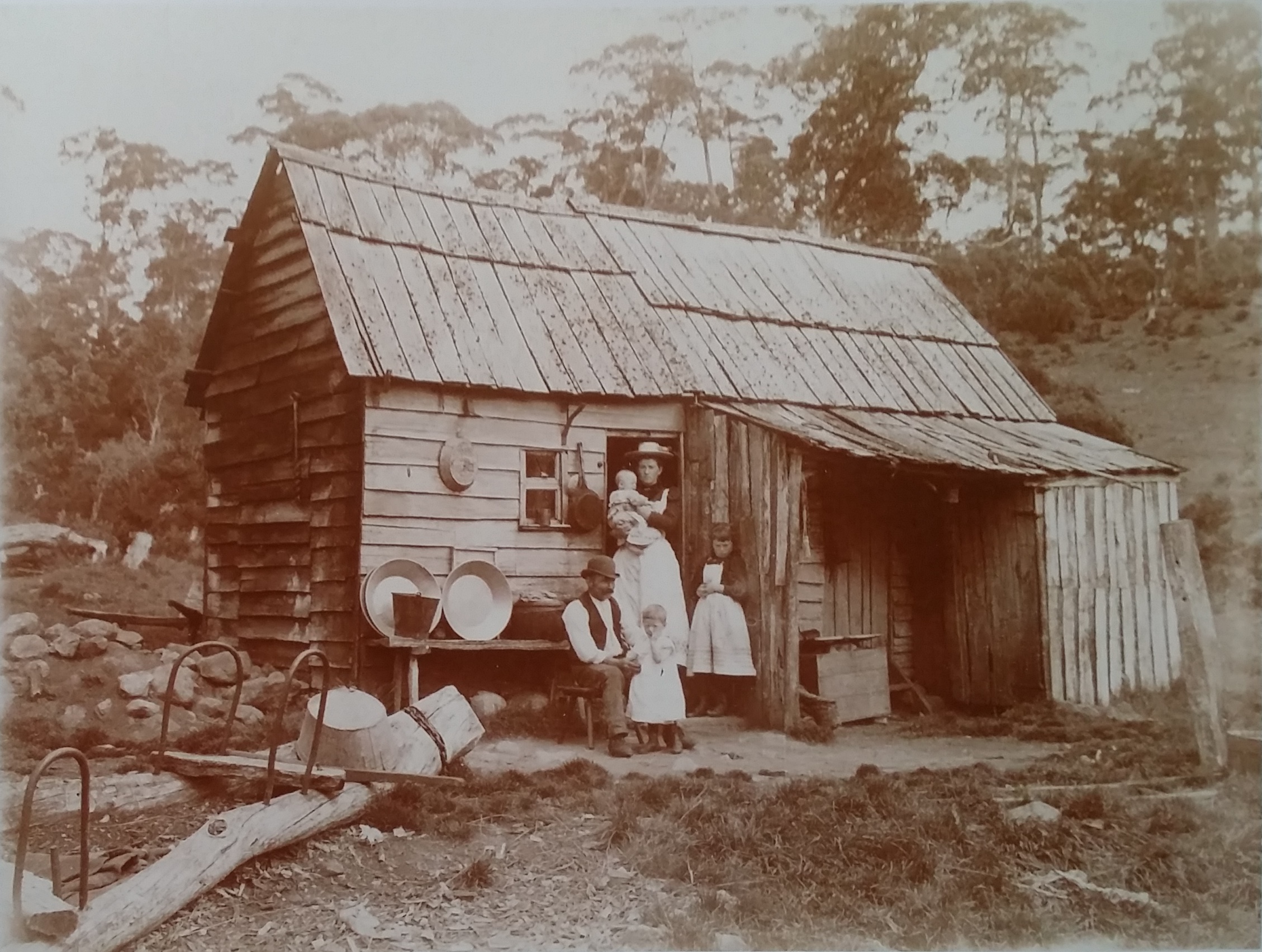
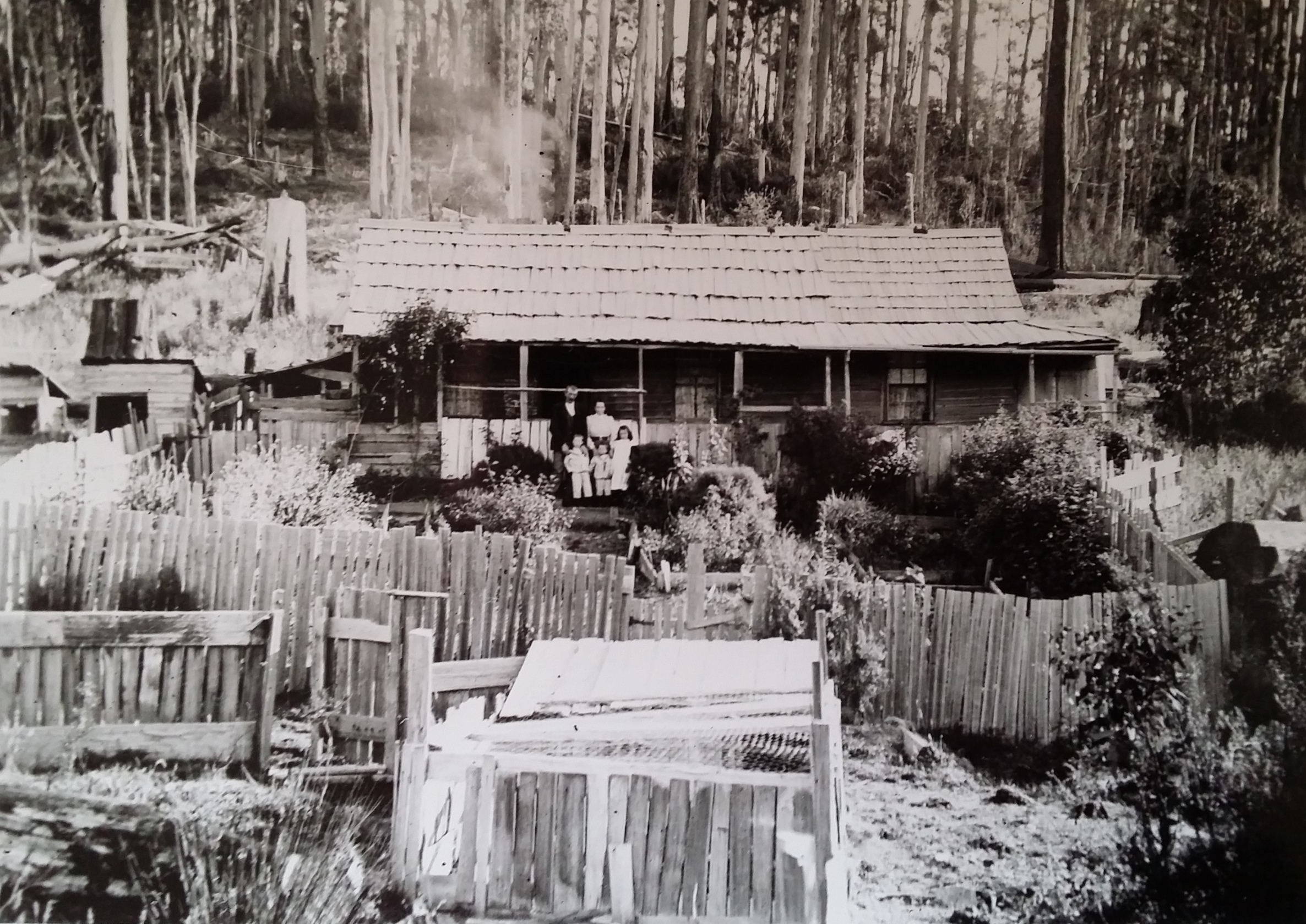
In Historic Tasmanian mountain huts, written with Simon Cubit, I told the story of a visit made to the Browns’ hut at Middlesex Station by the Anglican Bishop of Tasmania, Henry Hutchinson Montgomery and the Vicar of Sheffield, JS Roper, in February 1901.[1] Montgomery’s photo of the Brown family at their hut, featuring an eighteen-year-old Linda Brown with already two children, and the family turned out in Sunday best for the camera, tells us much about their isolated lifestyle, their social expectations and their pride.
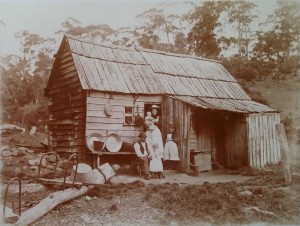
Henry Montgomery’s photo of Field stockman Jacky Brown and his wife Linda Brown at their hut, with children Mollie (the babe in arms) and William (standing with his father). The girl standing beside Linda is possibly from the Aylett family and fulfilling the role of maid. PH30-1-3836 (TAHO).
The underlying story in this photo is the decline of the Field grazing empire, which was becoming as rickety as the Middlesex hut. That empire had been established by ex-convict William Field senior (1774–1837) and his four sons William (1816–90), Thomas (1817–81), John (1821–1900) and Charles (1826–57). The death of John Field of Calstock, near Deloraine, in the previous year had closed those generations which had spread half-wild cattle from the Norfolk Plains/Longford area as far as Waratah, intimidating other graziers and dominating its impoverished landlord, the Van Diemen’s Land Company (VDL Co). The Fields were notorious for occupation by default, and they knew that legitimately occupying the VDL Co properties of the Middlesex Plains and the Hampshire and Surrey Hills would also allow them to occupy all the open plains of the north-western highlands gratis. The Fields’ power over the VDL Co increased as the company’s fortunes declined. In 1840 the Field brothers leased the 10,000-acre Middlesex from the VDL Co for 14 years at £400 per annum.[2] In 1860, after financial losses forced the VDL Co to retreat to England as an absentee landlord, they obtained a lease of the Hampshire and Surrey Hills plus Middlesex—170,000 acres in all—for the same price, £400.[3] The problem for the VDL Co was that few other graziers wanted such a large, isolated holding, and that any who did dare to take it on would have to first remove the Fields’ wild cattle. In 1888 the Fields screwed the VDL Co down further to £350 for the lot for the first two years of a seven-year lease, raising the price to £400 for the final five years.[4]
Nor were any of these negotiations straightforward. With every lease there was a battle to collect the rent, necessitating letters between the respective solicitors, Ritchie and Parker for the VDL Co, and Douglas and Collins for the Fields. Thomas or John Field would stall, demanding a reduction in rent for fencing, rates or police tax. On one occasion they requested the right to seek minerals, and to make roads and tramways on the leased land—and to take timber for the construction of this infrastructure.[5] Worse yet, in 1871 some of Fields’ wild cattle from the Hampshire or Surrey Hills got confused with VDL Co stock and ended up on the Woolnorth property at Cape Grim, and the VDL Co couldn’t figure out how to get rid of them.[6] Since Fields would soon ask to rent Woolnorth—and be refused—it was as if their advance guard had infiltrated the property ahead of a storming of the battlements.[7] The VDL Co’s solicitor told them that to shoot the offending animals would be to risk a Field law suit, leaving the company no option but to buy them from Fields and then weed them out for slaughter.[8]
However, now things were changing. By the 1890s reduced meat prices and natural attrition had taken their toll on the Field empire. John Field was the only one of the four brothers still standing. The VDL Co was now fielding offers from potential buyers of the large Surrey Hills block, as the company looked to land sales and timber for financial redemption. John Field’s final gesture in 1900 was to offer the VDL Co £75 per year for Middlesex.[9] The VDL Co wanted £125, and in the new year of 1901 the executors of John Field’s estate haggled for a concession. They wanted their landlord to offset some of the increased rental by paying for improvements to the station. ‘The place is greatly out of repair and the house would require to be a new one throughout’, WL Field told VDL Co local agent James Norton Smith. ‘The outbuildings are none and there is not a fence on the place’.[10]
We can see for ourselves that some of this, at least, was true. The unfenced, out-of-repair Middlesex ‘house’ in Montgomery’s photo had already undergone renovations, a chimney having been removed from its eastern end. However, Field was probably exaggerating a little. Perhaps there were no outbuildings, but Fields probably always kept a second hut at Middlesex for the stockmen who came up for the muster.
Silence spoke for the VDL Co. Receiving no reply to his request, WL Field agreed to the annual rental of £125 for seven years, with an option of seven years more at £150 per annum, noting that ‘we have the 10,000 acres of govt land adjoining it at a rental of £60 and I consider the block as good as the co’s and it will save a lot of fencing having both …’.[11]
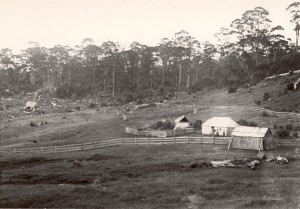
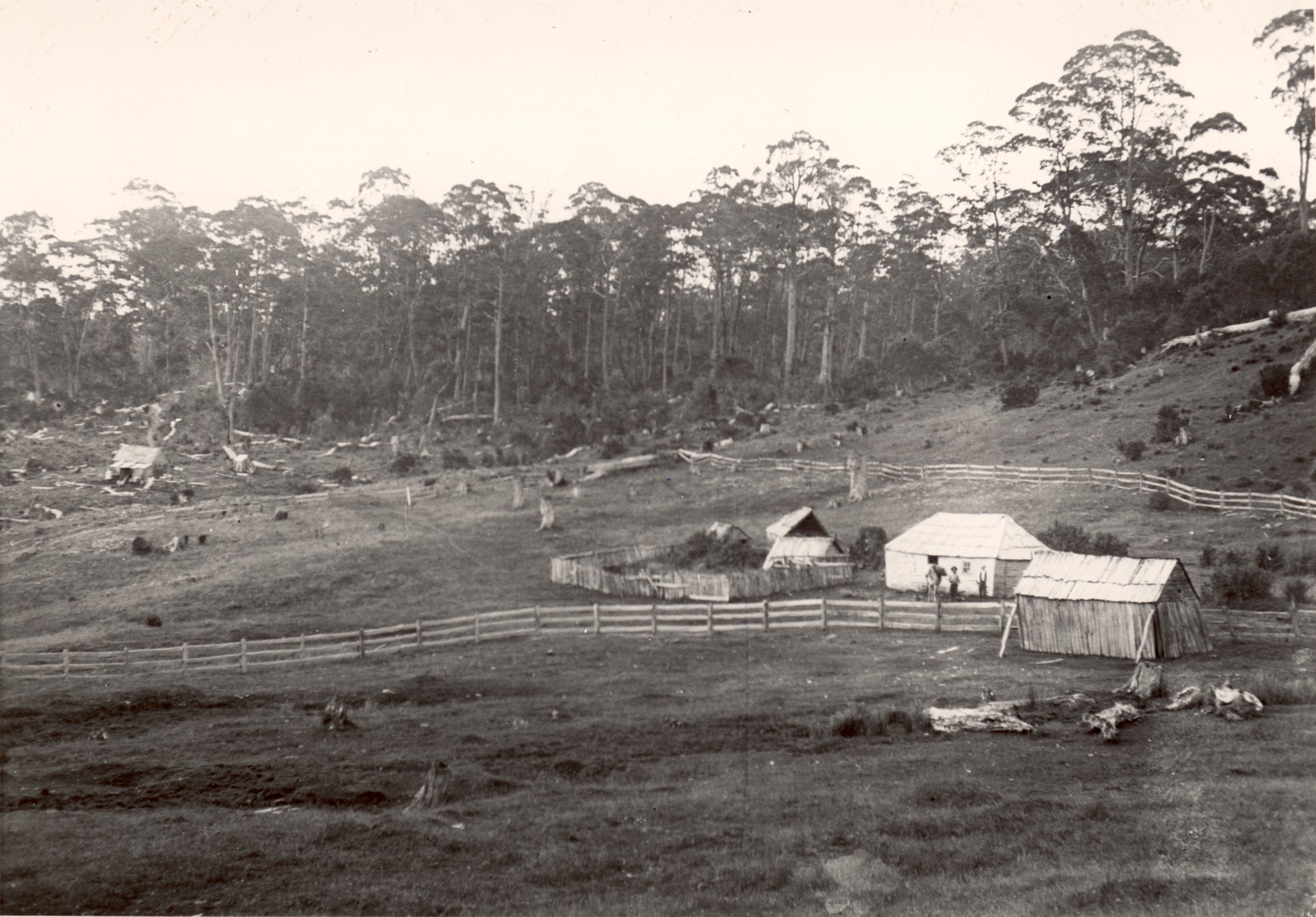
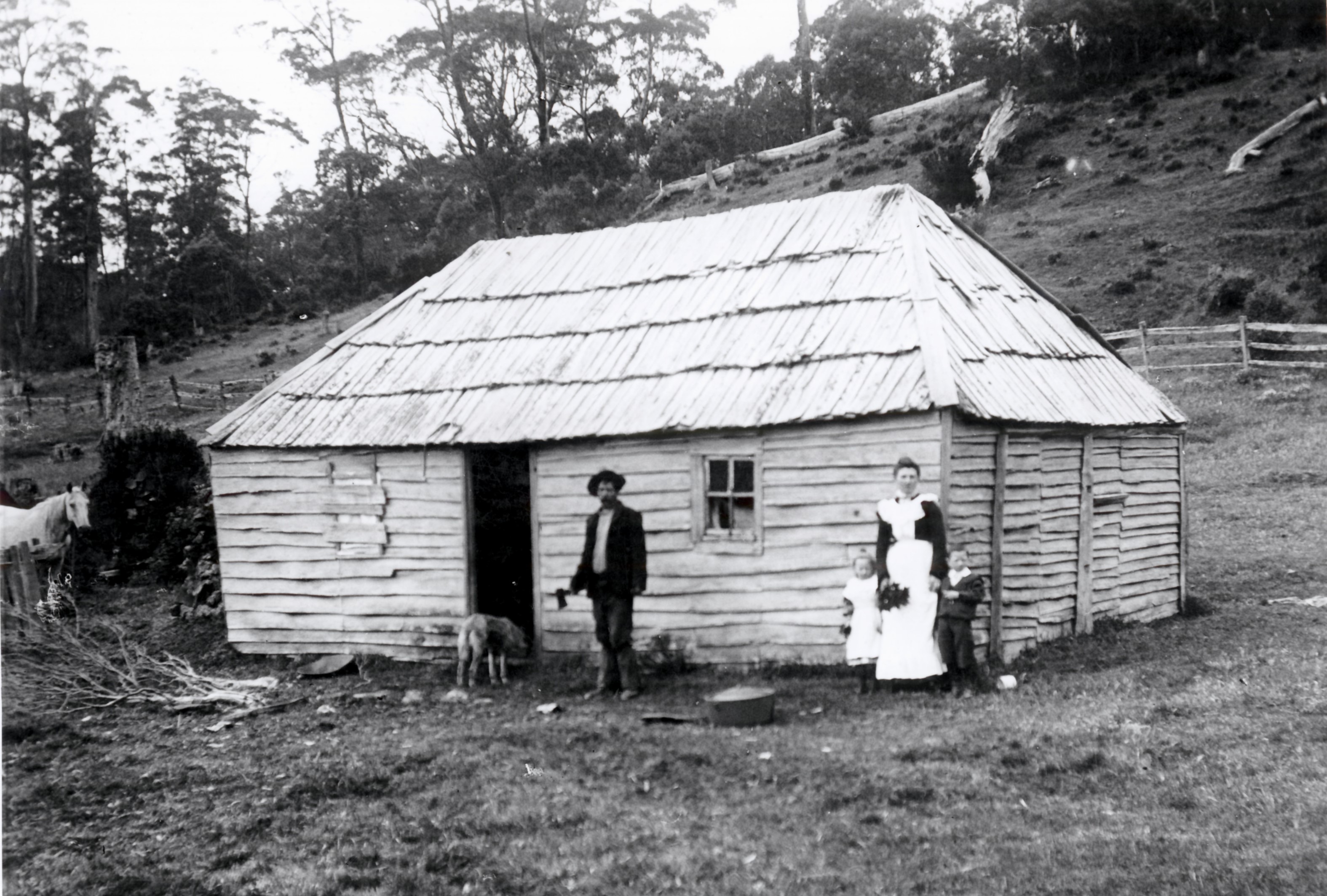
The Middlesex Station huts in February 1905, with Jacky, Linda Brown and two children standing in front of the second (mustering) hut. The hut occupied by the family can be seen at the extreme left in the left-hand photo, set well away from the others. The curl of smoke from the distant hut confirms the location of the chimney at its rear.
Ron Smith photo courtesy of the late Charles Smith.
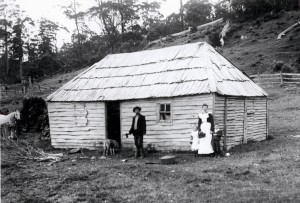
A close-up of the Browns in front of the mustering hut. Ron Smith photo courtesy of the late Charles Smith.
Perhaps the VDL Co did eventually submit to improvements. By 1905, when Jacky and Linda Brown were still in residence, there was a collection of buildings at Middlesex Station, including a ramshackle hut with a boarded-up window which was used by mustering stockmen and travellers. The main hut used by the Browns was set further east, away from these buildings, outside the House Paddock, which had now been fenced.
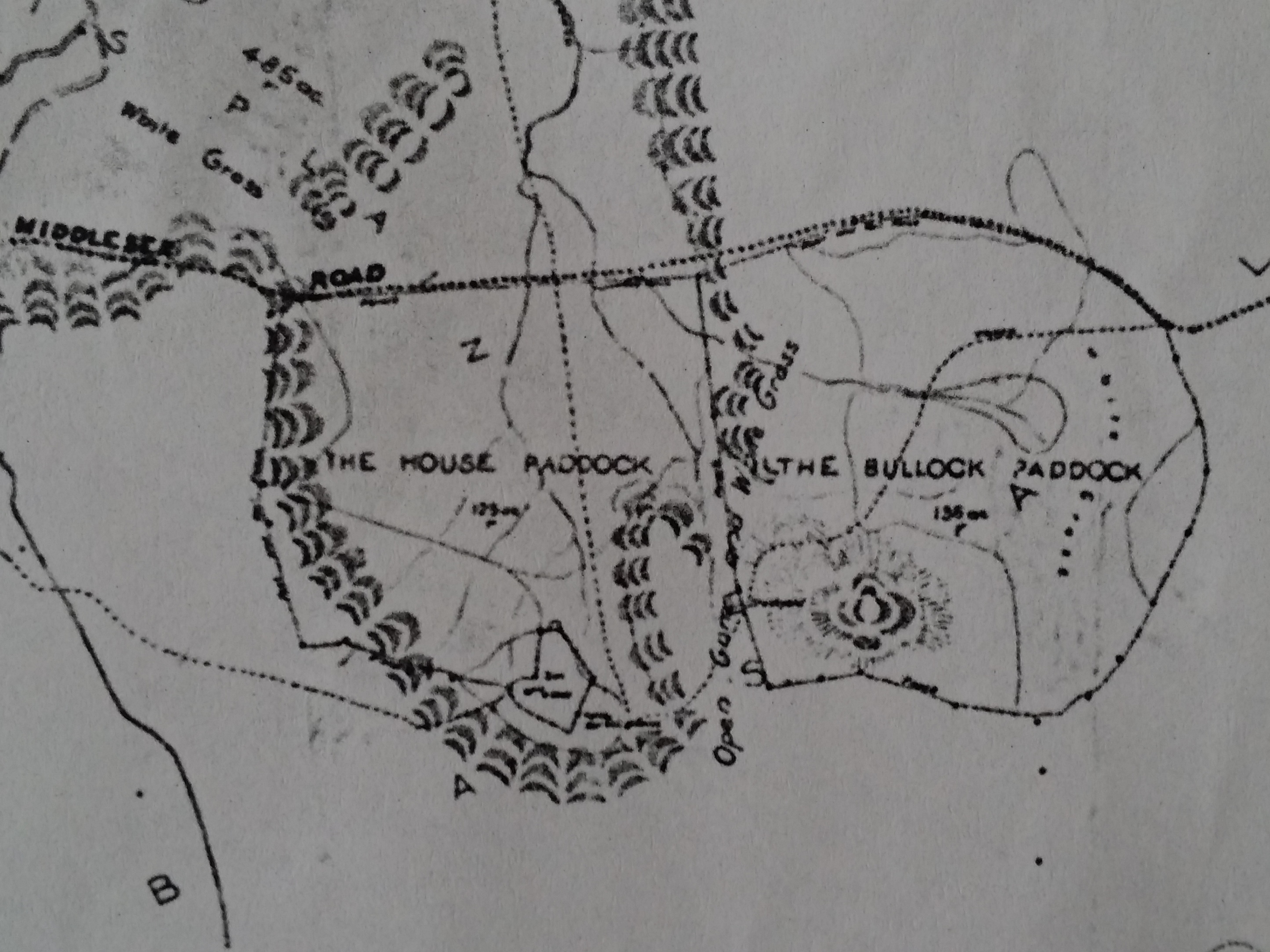
However, on the down side, the Fields were losing their unfettered reign over the highlands. A small land boom occurred in the upper Forth River country when a track was pushed through from the Moina region to Middlesex. The Davis brothers from Victoria tried to cultivate the Vale of Belvoir, and highland grazing runs were selected.[12] Frank and Louisa Brown were Fields’ Middlesex residents in November 1906 when Jack Geale, the new owner of the Weaning Paddock, asked new VDL Co agent AK McGaw to pay half the cost of fencing the eastern side of the Middlesex block, which would enable him to separate his herd from the Fields’.[13] McGaw sent surveyor GF Jakins with a team of men to Middlesex to re-mark the boundaries. The resulting survey shows the fenced paddock, the collection of buildings and the separate stockman’s hut.
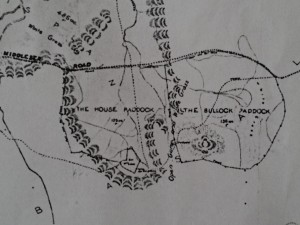
A crop from GF Jakins’ 1908 survey of the Middlesex Plains block, showing the House and Bullock Paddocks and the collection of buildings at the head of the House Paddock. From VDL343-1-359, TAHO, courtesy of the VDL Co.
Jakins also marked Olivia Falls (‘falls 300 ft’, ‘falls 60 ft’)—better known today as Quaile Falls—just outside the south-east corner of the Middlesex block. This casts doubt on the story of Quaile Falls being discovered by Roy Quaile while searching for stock.[14] The falls were probably known to the miners who worked the Sirdar silver mine nearby in the Dove River gorge from 1899—and were possibly given their present name in recognition of Wilmot farmer Bob Quaile’s visits there with tourists.[15] And what did the Aborigines call this ‘second Niagara’ long before that?
Perhaps it was knowledge of the ‘red’ pine growing on the south-western corner of the Middlesex Plains block that prompted Ron Smith of Forth to enquire about buying the block from the VDL Co.[16] That land owner would have enjoyed this attention. In 1908 Fields signed up for their second seven-year lease on Middlesex, at the increased rental of £150 per year. They had to agree to allow the VDL Co to sell any part of the Middlesex Plains block during that term excepting the 640 acres around the ‘homestead’.[17] As a regular visitor to Middlesex Station on his way to and from Cradle Mountain, Smith had no illusions about the standard of accommodation provided there. In January 1908 he and his party stayed in a new hut that had been built for the mustering stockmen. ‘We were very glad to do so’, Smith noted, ‘as the old hut was very much out of repair … ‘ It was a two-room hut with a moveable partition, so that it could be converted into one room as needed.[18]
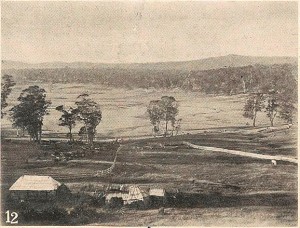
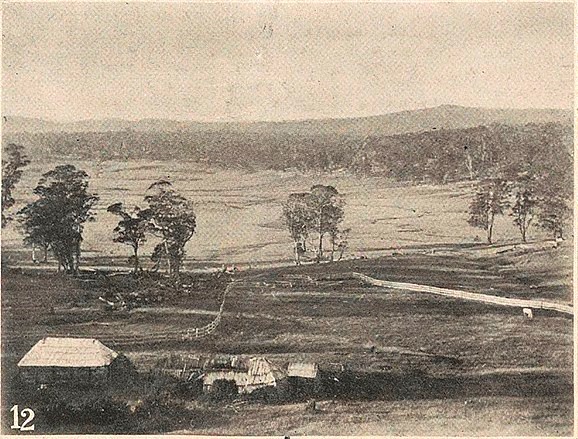
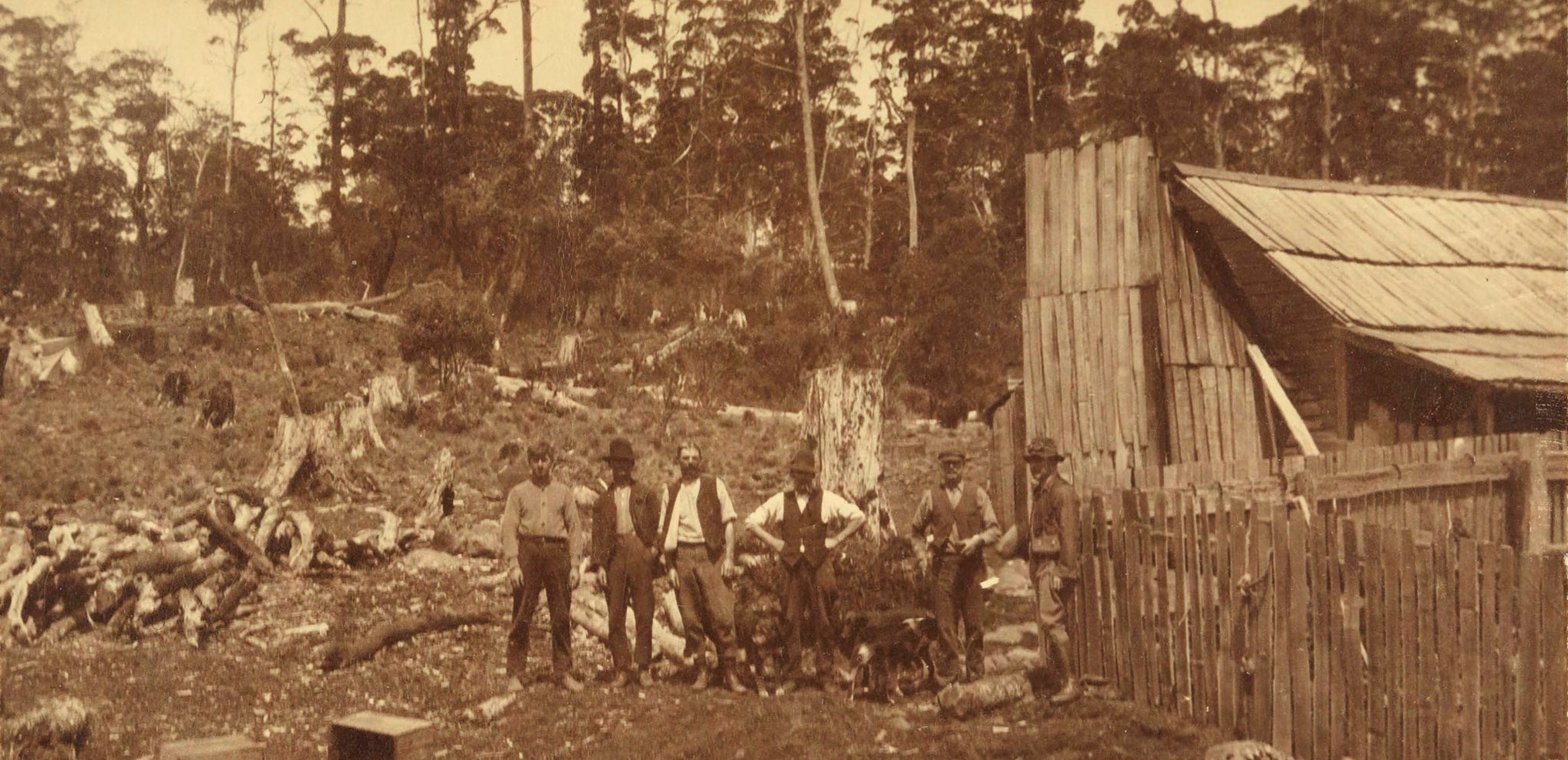
A collection of Middlesex buildings in December 1909 or January 1910. These seem to be the same buildings visible in the 1905 photo. The main hut further east is not shown here. Ron Smith photo from the Weekly Courier, 22 September 1910, p.17.
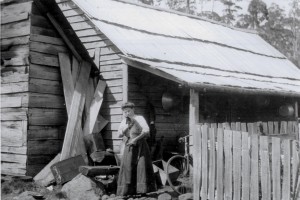
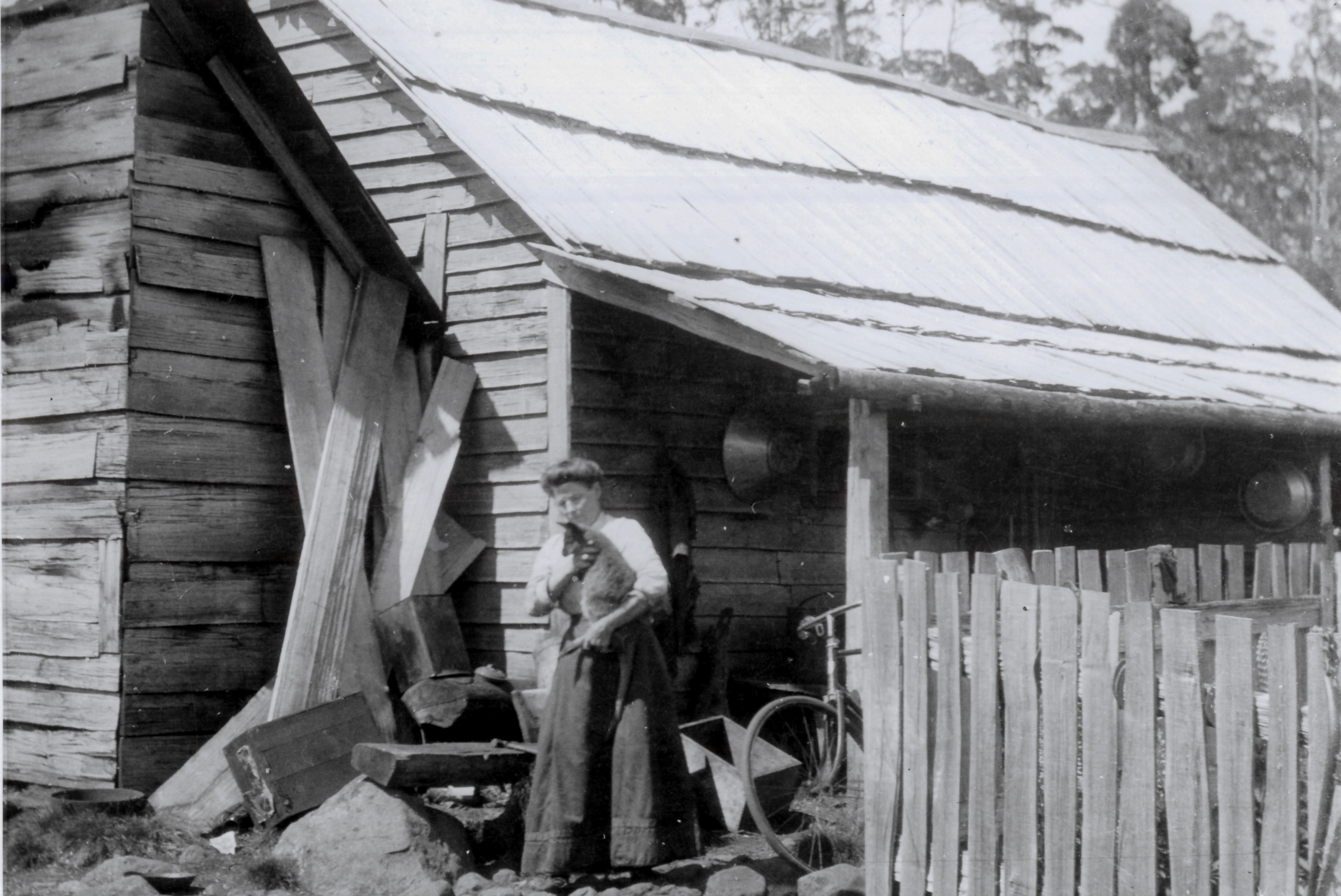
Louisa Brown with a pet wallaby, January 1910. This appears to be the same main hut photographed by Montgomery in 1901. Ron Smith photo courtesy of the late Charles Smith.
By December 1910 that hut was also in a state of disrepair. The Fields asked the VDL Co to renew or extend the two-roomed hut in time for the muster in the following month: ‘Up to now they have lived in the old house, but it is really unsafe. Mr Sanderson [VDL Co accountant] has seen the house that was built by us about four years ago, as he was there and stayed in it just after it was built. There is a man living there [Frank Brown] who would split the timber & do it’.[19]
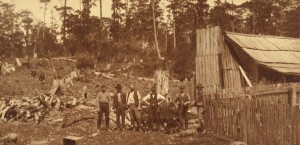
Main hut at Middlesex Station, Christmas 1920. The figure second from right appears to be Dave Courtney, with moustaches but as yet no beard.
Ray McClinton photo, LPIC27-1-2 (TAHO)
Such is the incomplete photographic record of Middlesex Station at the time that it is unknown whether the mustering hut was replaced. However, we can say more about the main hut used by the stockman. The hut shown in the 1901 and 1910 photos appears to have remained the stockman’s hut in 1920 when Ray McClinton snapped it, this time with Dave Courtney the resident stockman. The chimney had been rebuilt with a vertical arrangement of palings, and a skillion had been added at the back. A prominent stump standing beside the hut in this photo must have been just out of picture in Montgomery’s 1901 shot.
After Fields had rented Middlesex from the VDL Co for 82 years, in 1922 JT Field, son of the late John Field of Calstock, bought the block, ending the uncertainty about its future. However, the lone figure of 49-year-old stockman Dave Courtney was emblematic of the Fields’ dwindling presence in the highlands, and his long, flowing beard of the 1920s and 1930s would not have allayed the impression of a once vigorous enterprise slowly grinding to a halt.
[1] Simon Cubit and Nic Haygarth, Historic Tasmanian mountain huts: through the photographer’s lens, Forty South Publishing, Hobart, 2014, pp.24–29.
[2] Edward Curr, Outward Despatch no.215, 18 November 1840, VDL1/1/5 (TAHO).
[3] Inward Despatch no.291, 16 November 1857, VDL 1/1/6 (TAHO).
[4] Minutes of VDL Co Court of Directors, 16 February 1888, VDL201/1/10 (TAHO).
[5] Douglas & Collins to James Norton Smith, 16 April 1875, VDL22/1/5 (TAHO).
[6] John Field offered to settle the matter by selling the wild cattle to the VDL Co for £100. See Douglas & Collins to James Norton Smith, 7 July 1871. See also Douglas & Collins to James Norton Smith, 14 October 1871 and 3 September 1872, VDL22/1/4 (TAHO).
[7] Douglas & Collins to James Norton Smith, 16 February 1872, VDL22/1/4 (TAHO).
[8] Ritchie & Parker to James Norton Smith, 31 October 1871, VDL22/1/4 (TAHO).
[9] Minutes of VDL Co Court of Directors 3 October 1900, VDL201/1/11 (TAHO).
[10] WL Field to James Norton Smith, 19 January 1901, VDL22/1/32 (TAHO).
[11] WL Field to James Norton Smith, 30 April 1901 and 15 June 1901, VDL22/1/32 (TAHO).
[12] See Simon Cubit and Nic Haygarth, Historic Tasmanian mountain huts: through the photographer’s lens, Forty South Publishing, Hobart, 2014, pp.18–23.
[13] JW Geale to EK McGaw, 26 November 1906, VDL22/1/38 (TAHO).
[14] Leonard C Fisher, Wilmot: those were the days, the author, Port Sorell, 1990, p.150.
[15] See, for example, ‘The Cradle Mountain’, Examiner, 5 January 1909, p.6.
[16] AK McGaw to Ron Smith, 23 January 1905, NS234/1/18 (TAHO). The term ‘red pine’ was often used indiscriminately to describe both the King Billy (Athrotaxis selaginoides) and pencil (Athrotaxis cupressoides) pine timber.
[17] WL Field to AK McGaw, 24 September 1908, VDL22/1/40 (TAHO).
[18] Ron Smith, ‘Trip to Cradle Mountain: RE Smith and the Adams Brothers, January 1908’, in Ron Smith, Cradle Mountain, with notes on wild life and climate by Gustav Weindorfer, the author, Launceston, 1937, pp.67–77.
[19] WT and JL Field, writing on behalf of WL Field, to AK McGaw, 7 December 1910, VDL22/1/42 (TAHO).
by Nic Haygarth | 06/11/16 | Tasmanian high country history
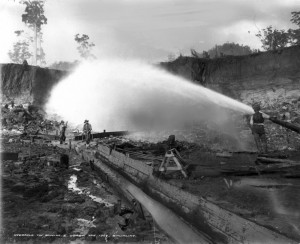
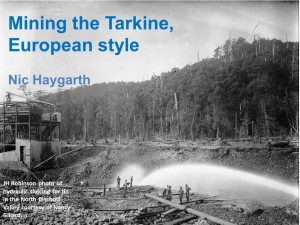
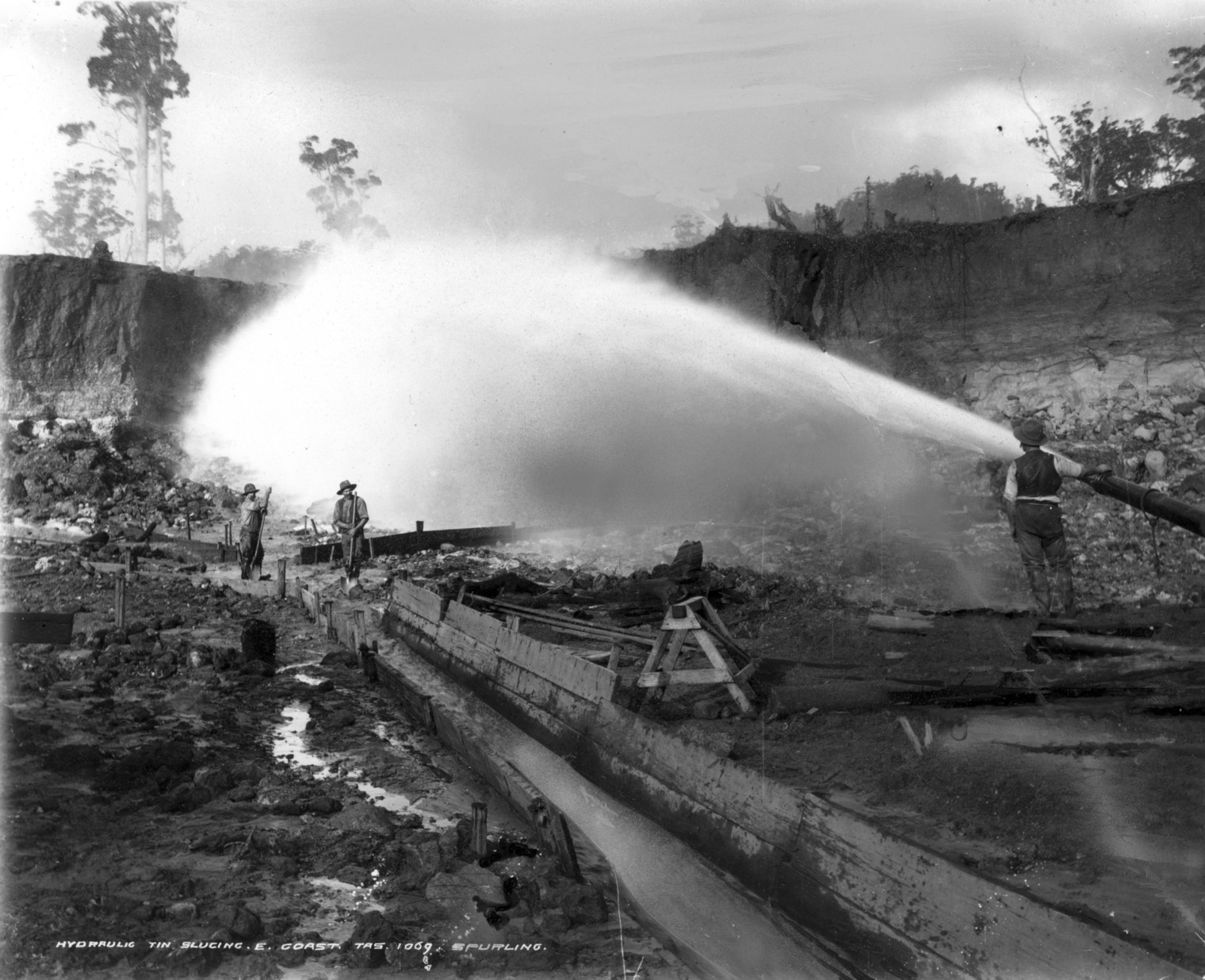
Hydraulic sluicing on the north-eastern Tasmanian tin fields. O’Rourke’s hydraulic gold mine operated in the same manner. Stephen Spurling III photo, courtesy of Stephen Hiller.
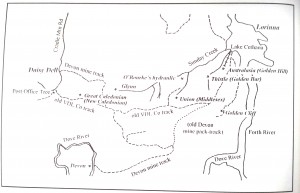
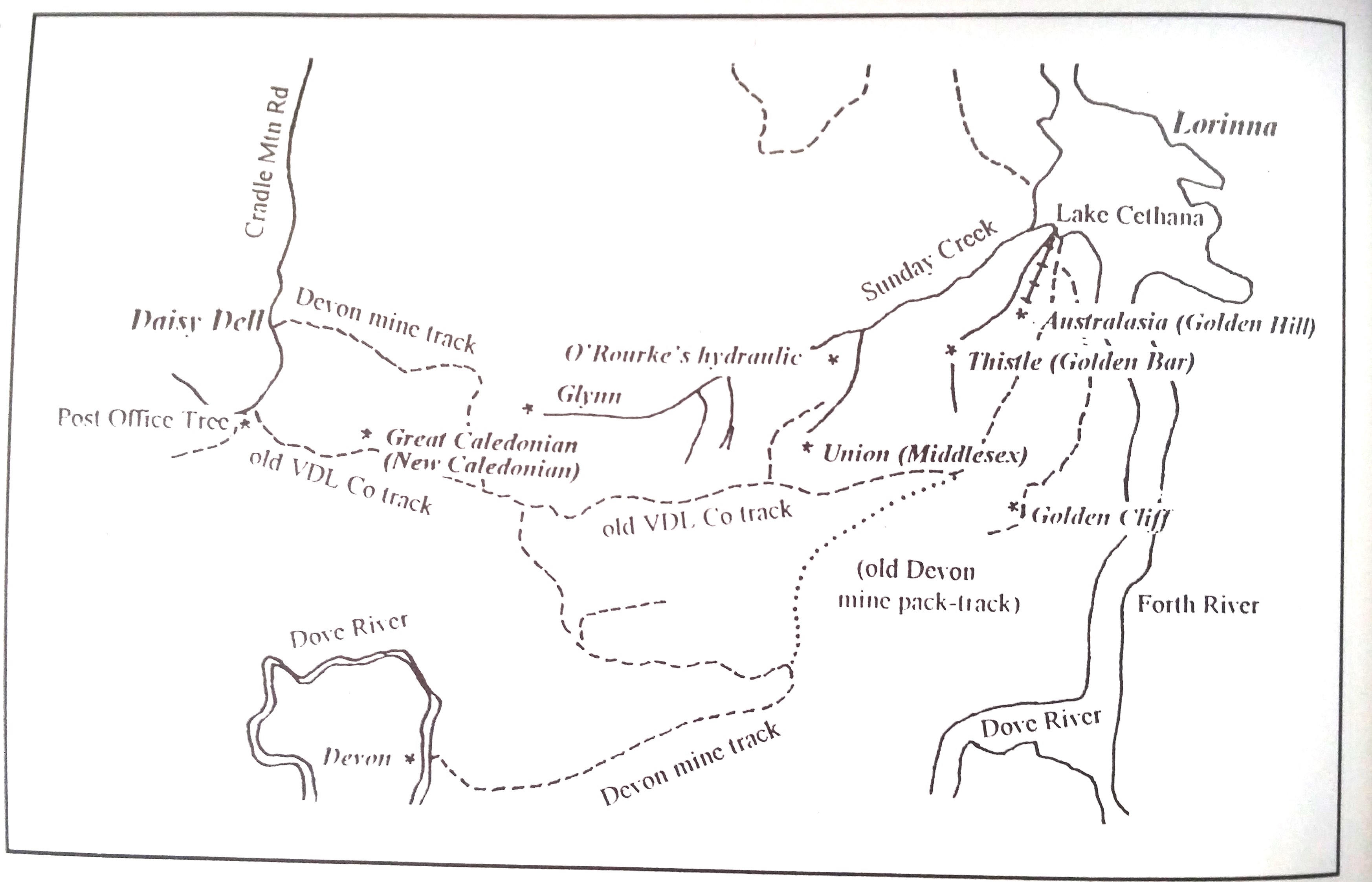
The Five Mile Rise goldfield, between the upper Forth River and the Middlesex Plains, north-western Tasmania, showing the position of the O’Rourke’s hydraulic gold mine.
Had Tasmanian miner Teddy O’Rourke been an interior decorator, he would have been a shoo-in for a colonial courtroom refit. His familiarity with magistrates’ chambers from Hobart to Deloraine, with dalliances at Kempton, Lefroy , George Town and almost a permanent booking in Launceston, must have been unsurpassed. Unfortunately, he was probably often too drunk to remember the decor. Yet Teddy also seems to have found a way to beat the bottle for two decades.
Edward Martin O’Rourke was born into an Irish Catholic family in Hobart in about 1856. A newspaper report of his mother Eliza (née O’Donnell or Donnell, a convict[1]) leaving home to escape violent attack by his father, ex-convict constable Martin O’Rourke (or Rourke), when he was an infant suggests that his was not a happy, comfortable childhood.[2] His education was probably rudimentary, as he remained illiterate.[3] By the time Martin O’Rourke drowned trying to ford the Forester River in 1876 at the age of 45, Teddy had at least five siblings.[4] It was after that that Teddy, along with his mother and sister Mary Ann Stratton, started making regular appearances in the Launceston Police Court, charged with assault (sometimes of each other), theft and drunk and disorderly behaviour.[5] The Jolly Butchers Hotel in Balfour Street kept by Eliza O’Rourke was the scene of some of this action.[6]
At the age of about 21 Teddy left Launceston for a rollicking lifestyle, racking up fines for public disturbances and learning how to handle a cradle at Brandy Creek, the alluvial goldfield that became Beaconsfield.[7] The only treatment he appears to have received for alcoholism was a stint in the slammer. One assault charge against him was dropped because his delirium tremens made him unable to testify.[8] Finally, in 1883, the judiciary lost patience and he got six months’ gaol for being idle and disorderly—followed by another three months for the same offence, this time in Hobart.[9] He served at least six terms in Hobart’s Campbell Street Gaol.[10]
Yet after 1892 O’Rourke stayed out of trouble for more than 20 years. Was mining his saviour? Men like Syd Reardon and Paddy Hartnett at Lorinna, 20 km from the nearest hotel, are said to have found an escape from the bottle in the bush. Perhaps Teddy’s experience on the Five Mile Rise when it was a diggers’ gold field in the 1880s was literally a sobering one.[11]
Then in about 1893 the New Zealand hydraulic craze hit Tasmania, and old gold fields like the Five Mile Rise got another trial, this time with the high-pressure hydraulic hose. Teddy O’Rourke took a claim on Sunday Creek, high up the Five Mile Rise, built a hut nearby and embarked on an unusual seasonal regime. Since it was only in the wet season that he could get sufficient water to operate the high-pressure hose, he combined hydraulic sluicing with hunting. April, May and June were the traditional hunting season. Prospectors and miners in the bush generally snared and shot animals for food anyway, but processing their skins for sale would have enabled O’Rourke to maximise (and perhaps sustain) his winters in the bush. A photo of what is probably O’Rourke’s hut taken by Fred Smithies shows that it was equipped with a skin drying chimney typical of those developed in the Cradle Mountain-Middlesex Plains area for the drying of possum and wallaby skins.
Teddy now revealed that not only could he make the press but he could use it. The secret to raising capital, apparently, was constant self-reference in the mining columns of newspapers. Harold Tuson grew up at Lorinna. In 1911, at the age of thirteen, he started work on gangs making tracks and roads in the upper Forth River region. During this time he came to know O’Rourke well as a fellow road worker, one of the latter’s summer jobs. He recalled the ‘big lump of a [Tasmanian-born] Irishman’ speaking with a thick Irish brogue. Having survived two or three bushfires, O’Rourke’s hut was then clearly visible from Lorinna high on the hill. Tuson recalled the miner’s struggle with alcoholism and his appearances in both the legal and mining columns of the newspaper: ‘“O’Rourke’s Hydraulic showing gold freely in the face”. That was one of Teddy’s. He’d write that to the paper to keep it going’.[12] Other stock phrases included ‘sluicing on payable gold’.
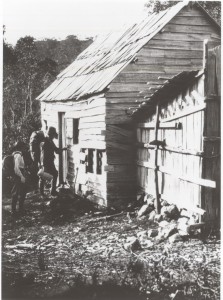
‘Hut at the top of the Forth Gorge track’, probably O’Rourke’s hut, showing the typical skin shed chimney favoured by Middlesex area hunters.
Fred Smithies photo, NS573/4/9/32 (TAHO)
O’Rourke’s hut stood near the beginning of the pack track down to the Devon mine in the Dove River Gorge. This pack track had become part of an extraordinarily steep route used by hunters to gain access to the Cradle Mountain region. On the southern side of the Dove River Gorge, the route continued up a steep hill known as Paddys Nut and crossed the Campbell River.[13] This was the route used by hunters Tom Jones and Bert Hansen in the winter of 1905 when the latter was tragically lost in a snowstorm near the lake near Cradle Mountain that now bears his name. Jones reported four-feet-deep snow as he began to make his way out to O’Rourke’s hut to raise the alarm, giving some idea of the conditions the gold miner experienced during these winter stints.[14] Since there are no mining reports to the press from O’Rourke in 1905, hunting may have been his primary activity during that wet season.
He also had business elsewhere. In 1904 O’Rourke had taken up a tungsten claim nearby, and by 1907 he was based at Ringarooma in the north-east, where he discovered the Montrose tin mine.[15] Later he turned his attention to the Colebrook tin field on the west coast, where he held a claim for a Launceston syndicate.[16] Meanwhile, in his absence, his hut on the Five Mile Rise was entered, robbed and forfeited to the Crown.[17] Thus the only property Ted O’Rourke ever owned was lost.
In 1911 he had a child, Edeline O’Rourke, with the recently widowed Annie Bissett (née Garrett) in Launceston.[18] She already had five children! Family responsibilities would have necessitated a steady income, hence, perhaps, O’Rourke’s work on the road gang. Eventually he may have got too old for bush life. Again, he was not at his best in town near the pubs. O’Rourke’s declining years contained a familiar litany of court appearances, including charges of disturbing the peace and vagrancy.[19] In 1919 the 63-year-old was found lying unconscious with a gashed head on a Launceston street.[20] In 1920 he was described as ‘an old habitue’ when defending a charge of being drunk and incapable in Albert Park on Christmas Day and in Charles Street a few days later.[21] He sported a scar over his left eye, perhaps as the result of some drunken escapade.[22] In 1922 he absconded when wanted for non-maintenance of his children, being tracked down in Deloraine.[23] In 1924, at 68 years of age, he was again found drunk and incapable in the street.[24] The trail of self-destruction stops there.
Like so many children of ex-convicts who could never escape the cycle of poverty and alcoholism into which they were born, Ted O’Rourke would have died intestate, with few possessions. His death stirred no comment in the press. Perhaps no one mourned his passing. However, I like to think of him as an innovator. He developed an unusual regime of hose, snare and, perhaps, teetotal, which kept him upright for two decades, drying out when the wet winter season brought his mining claim to life. That counts him as a success!
[1] Eliza O’Donnell was transported on the Midlothian. See permission to marry, 4 April 1855, CON52/1/7, p.408 (TAHO) and marriage certificate 473/1855, Hobart.
[2] ‘Local intelligence’, Colonial Times, 17 March 1857, p.3.
[3] Campbell Street Gaol Gate-book, warrant no.17591, 18 February 1889; records compiled by Laurie Moody; http://www.tasmanianwarcasualties.com/gravesofts%20split/Campbell%20Street%20Gaol/Rural%20Offences%20Part%209.htm
[4] See inquest, POL709/1/13, p.31 (TAHO); ‘Police Court’, Launceston Examiner, 20 January 1877, p.3. Martin Rourke was tried at Galway on 23 June 1848, sentenced to seven years, and came to Tasmania on the Lord Balhousie, being pardoned in 1855.
[5] See, for example, ‘Police Court’, Launceston Examiner, 21 September 1876, supplement p.2; ‘Police Court’, Launceston Examiner, 9 November 1876, p.4.
[6] ‘Quarterly licence meeting’, Launceston Examiner, 8 August 1876, p.3; ‘Police Court’, Launceston Examiner, 9 November 1876, p.4; ‘No true bill’, Launceston Examiner, 1 March 1877, p.2.
[7] ‘George Town’, Reports of Crime, 5 April 1878, pp.55–56.
[8] ‘Launceston Police Court’, Launceston Examiner, 26 April 1882, p.3.
[9] ‘Launceston Police Court’, Launceston Examiner, 12 November 1883, p.3; ‘City Police Court’, Mercury, 17 December 1884, p.2.
[10] Laurie Moody, ‘Campbell Street Gaol: inmates 1873–1890’, Tasmanian Ancestry, vol.26, no.2, September 2005, pp.24–30.
[11] Harold Tuson, interviewed in Canberra, 11 May 1995.
[12] Harold Tuson, interviewed in Canberra, 11 May 1995.
[13] See, for example, ‘North Western notes’, Mercury, 4 August 1905, p.2.
[14] ‘Cradle Mountain mystery’, North Western Advocate and the Emu Bay Times, 11 September 1905, p.2.
[15] ‘Iris River wolfram field’, Examiner, 20 September 1904, p.2; ‘Discovery of tin’, Examiner, 26 October 1906, p.2.
[16] See, for example, ‘Colebrook tin fields’, Examiner, 24 February 1912, p.4.
[17] POL386/1/1, Daily Record of Crime Occurrences – Sheffield 1901-1916 (TAHO).
[18] Birth registration 4877/1911, Launceston. See ‘Branxholm railway accident’, Mercury, 26 April 1910, p.2.
[19] ‘Police Courts, Hobart’, Mercury, 21 September 1915, p.6; ‘Police Court’, Launceston Examiner, 3 November 1916, p.4; ‘City Police Court’, Launceston Examiner, 13 April 1917, p.4; ‘City Police Court’, Daily Telegraph, 18 June 1918, p.4.
[20] ‘An old age pensioner’s plight’, Launceston Examiner, 26 December 1919, p.4.
[21] ‘City Police Court’, Daily Telegraph, 6 January 1920, p.2.
[22] ‘Prisoners to be discharged’, Police Gazette, 9 April 1920, p.69.
[23] ‘Persons enquired for’, Police Gazette, 23 June 1922, p.114; ‘Absconders’, Police Gazette, 14 July 1922, p.127.
[24] ‘City Police Court’, Daily Telegraph, 15 December 1924, p.4.
by Nic Haygarth | 05/11/16 | Tasmanian high country history
Stanniferous drift is a term once used to describe tin-bearing ground, but it could just as easily describe the movement of tin mining families—or mining families of any other stripe—from one field to the next in search of better opportunities. Both economics and personal tragedy prompted depopulation of the small Middlesex mining field in north-western Tasmania around the time of World War I (1914–18). The contemporary photographs of bushwalker and national park promoter Ron Smith help tell the tale.
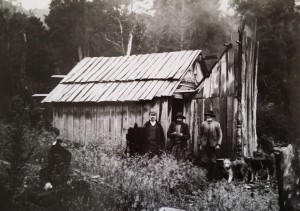
Hut at the Iris tin mine, April 1905. (Left to right) Les Smith, Tom Murphy and Richard Kirkham. Ron Smith photo courtesy of the late Charles Smith.
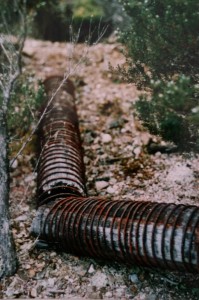
Wooden sluicing pipes, Iris tin mine, 1990s.
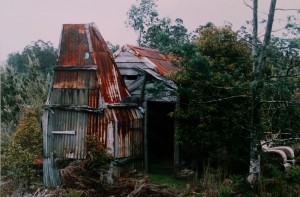
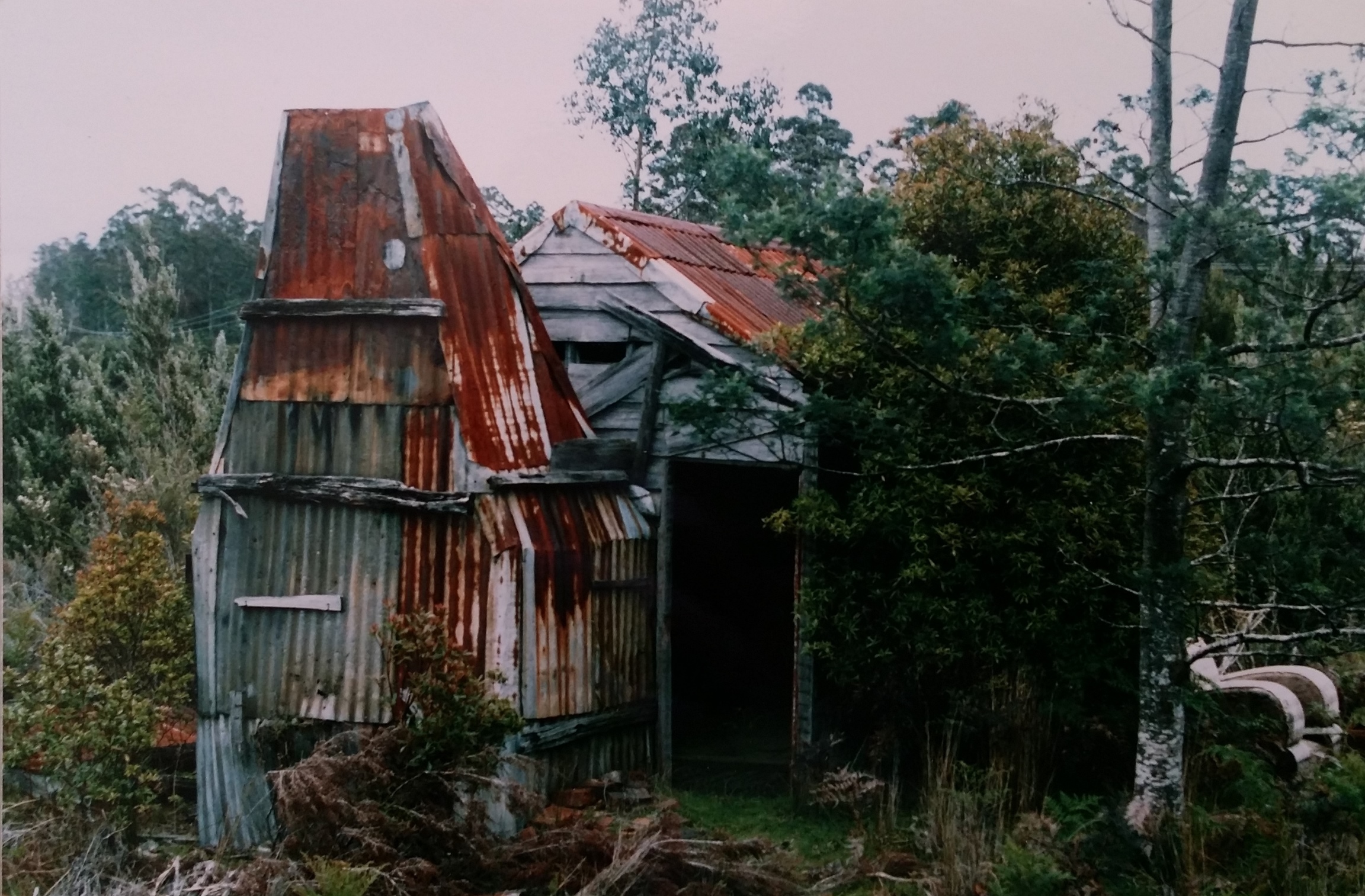
Hut at the Iris tin mine, 1990s.
In Historic Tasmanian mountain huts, Simon Cubit and I told the story of the three Davis brothers, Clarence, Sidney (Sid) and Edmund (Eddie), who came to Tasmania from Victoria and tried to farm the Vale of Belvoir near Cradle Mountain in 1903.[1] When the farming venture failed, Clarence Davis returned home, but Boer War veteran Sid Davis (1879–1913) and Eddie Davis (1888–1944) stayed on in the Tasmanian highlands, taking up the lease of the Iris tin mine near Moina.
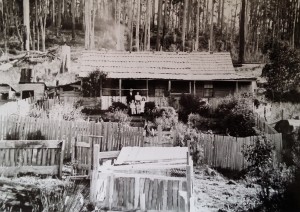
Charlie and Charlotte Adam with their three eldest children, Bell goldfield, 1905. Ron Smith photo courtesy of the late Charles Smith.
The Davis brothers’ partner in the mine was Charles Frederick Douglas Adam (c1864–1932).[2] Born in India as the son of an Anglo-Indian lieutenant, Adam had been sent home first to his parents’ house at Dover, England, to an aunt in France and to a Middlesex boarding school.[3] He is also said to have attended Eton, London and Cambridge Universities and the Sandhurst Academy—a busy schedule indeed, if it can be believed—before serving in the 81st Foot Regiment, with which he returned to India. Defective hearing prompted his retirement from the military, and he obeyed medical advice by settling in Australia. After a few years in Tasmania he arrived on the Bell Mount goldfield during the small rush there in 1892.[4] He made minor gold discoveries around the area at Golden Cliff and Stormont, and reworked the Bell goldfield when the hydraulic gold craze hit Tasmania. Charlie Adam married Charlotte Saltmarsh (1873–1946) in the nearby town of Sheffield in 1899.[5] They had children Charles William Guy Adam (1900), Mary Charlotte Adam (1902), Freda Kate Adam (1904), Frederick John Adam (1907), Robert Douglas Adam (1909) and Eileen.[6] There was also Charlotte’s daughter, Elsie (Elizabeth Mary Saltmarsh, born 1896), from a previous relationship.[7] Like many bush people, Charlie Adam used press subscriptions to keep up with the outside world, and his favourite was the weekly English illustrated newspaper The Graphic.[8]
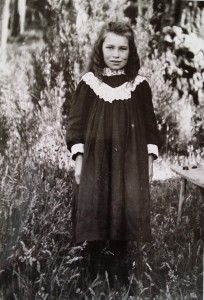
Elsie Adam, Bell goldfield, February 1905. Ron Smith photo courtesy of the late Charles Smith.
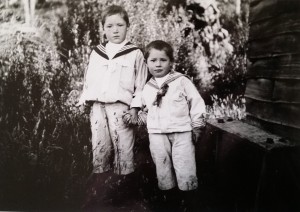
Guy and Mary Adam, Bell goldfield, February 1905. Ron Smith photo courtesy of the late Charles Smith.
However, at a time when there was no school at nearby Moina, the Adams’ most important education supplement was the tutor they employed, Mary Smith, to teach their three eldest children.[9] One of the things Mary taught was propriety. The manager of the biggest mine in the district was William Hitchcock but, offended by his surname, Mary pronounced it ‘Hitchco’. Did her silent ‘ck’ remove the problem or draw attention to it?[10]
Sid Davis came to dinner at the Adam house at the Bell goldfield, met Mary the tutor and began to court her. They married and established a farm at Black Jack, the long straight on what is now the Cradle Mountain Road south of Moina. From here Sid had a short walk to his other work at the Iris tin mine. The couple’s first child, Gladys, did not survive, but they had a second daughter, Hilda, in 1911, and another, Molly, two years later.[11]
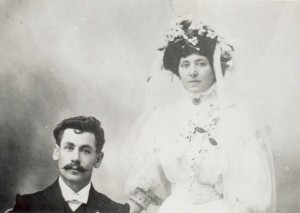
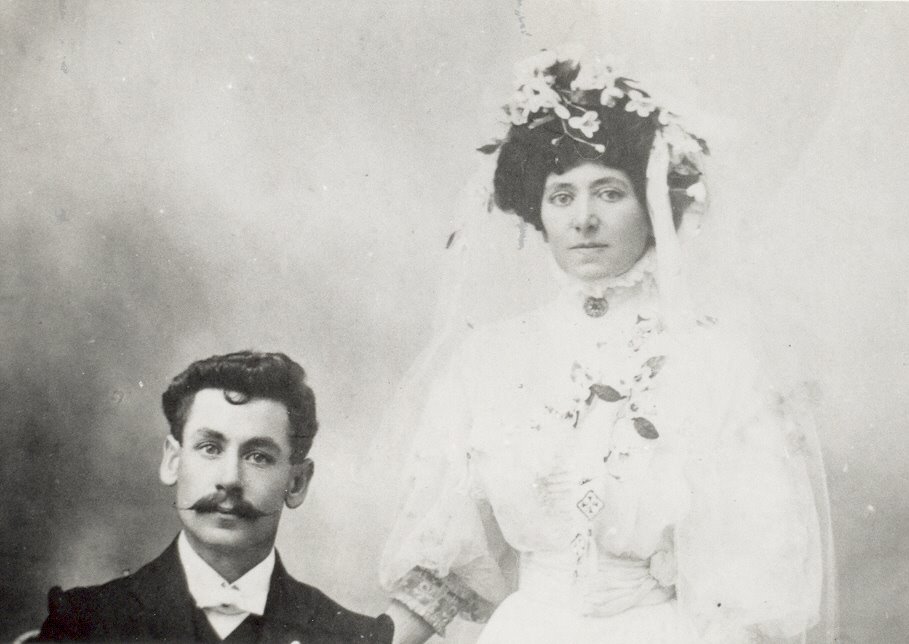
Believed to be Sid and Mary Davis on their wedding day, 1909. Courtesy of Maree Davis.
Mary found the isolation difficult. Young Harold Tuson of Lorinna, on the eastern side of the Forth River, found out how lonely she was. In contrast to Charlie Adam’s highly regimented upbringing, this thirteen-year-old had just entered the workforce on a road gang, building the Cradle Mountain Road, and was camped near the Davis house. While returning home for the weekend he ran into Sid Davis on the road:
I suppose he wanted someone to talk to … ‘Where did you come from? And what do you do?’, and … he said, ‘Call in’. Little two-room place on the left … ‘Call in and have a talk to the wife. She’s very, very lonely’. And so on the Monday I did [call in]. And I’m carrying a songbook and she and I got to work and were singing … and I decided I’d better go and she wouldn’t allow me, she didn’t want me to go. ‘Sing another song …’[12]
In 1912 Gustav and Kate Weindorfer established Waldheim Chalet, their tourist resort at Cradle Valley. Charlie Adam was one of their first guests, but Weindorfer also availed himself of the Davises’ hospitality when caught on the road in bad weather. On more than one occasion he rocked young Hilda Davis to sleep in her cradle.[13]
On 14 May 1913 Sid went to work as usual at 7 am. Two-year-old Hilda accompanied her father to the gate. The family’s dog, Bob, followed at Sid’s heels until Mary called him home. She was busy in the kitchen four hours later when she heard a horse galloping up to the house, followed by a knock at the door. It was her friend, a lady named Ward, a frequent visitor. Imagining that she had bad news to impart, Mary immediately thought of her mother. ‘Don’t tell me’, she cried, ‘go and tell Sid!’ ‘I can’t’, her visitor replied, ‘he’s dead’.[14]
Sid Davis had been working in the open cut when a tree stump fell on top of him, striking him fatally on the back of the head. He had survived guerrilla warfare in South Africa only to succumb in a mining trench in peacetime. ‘It was such a blow to Mum, really and truly’, Hilda Davis recalled,
She never got over it … She was always thinking of her days at the mine and of Dad. She never got it out of her system. She loved those days up there …[15]
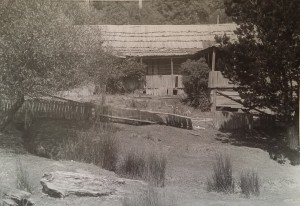
The abandoned Adam house at the Bell goldfield, February 1926. Ron Smith photo courtesy of the late Charles Smith.
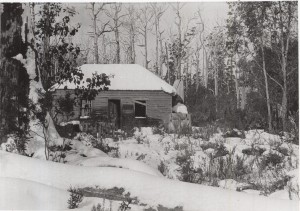
The deserted Davis house at Black Jack, Cradle Mountain road, August 1925. Ron Smith photo courtesy of the late Charles Smith.
Mary Davis tried to keep the Iris mine going, but having a four-month-old child at her breast made it impossible. Tin mining was scuppered by World War I soon after. There was an exodus from the small mining field. Mary Davis tutored children in Sheffield, but eventually returned home to her parents. Eddie Davis married Moina postmistress Lil Gurr, with whom he adjourned to Melbourne.[16] Elsie Adam married miner Watty Davis at her parents’ house but set up home at the tungsten and tin village of Storeys Creek.[17] Charlie and Charlotte Adam moved to Waratah, but eventually resettled in another mining region, the Latrobe Valley, Victoria. Three other Adam children settled in mining towns.[18] By the mid-1920s both the Adam and Davis houses, where so many children had grown and so many lives had intersected, were ruins. Of the characters of this story, only Gustav Weindorfer, the widowed proprietor of Waldheim Chalet, remained trying to eke a living from the mountains.
[1] Simon Cubit and Nic Haygarth, Historic Tasmanian mountain huts, Forty South Publishing, Hobart, 2014, pp.18–23.
[2] Australian Death Index, registration 13455/1932.
[3] British Census, 1881, Middlesex, Finchley, District 1, p.54. His birthplace was given as India; ‘Mr Chas FD Adam, Yallourn, Vic’, Advocate, 8 February 1933, p.2.
[4] ‘Mr Chas FD Adam, Yallourn, Vic’, Advocate, 8 February 1933, p.2.
[5] Married 10 May 1899, marriage registration 962/1899, Sheffield.
[6] Birth registrations 2326/1900, 2391/1902, 2518/1904 respectively. Frederick John Adam’s death certificate (7866/1972, Victoria) give his year of birth as 1907. Robert Douglas Adam’s World War II military record gives his date of birth as 29 January 1909, place of birth Moina. Eileen Adam is mentioned as a surviving child in Charlie Adam’s obituary, Mr Chas FD Adam, Yallourn, Vic’, Advocate, 8 February 1933, p.2.
[7] Born 27 August 1896, birth registration 2328/1896, Sheffield.
[8] Interview with Harold Tuson, Canberra, 11 May 1995.
[9] Interview with Hilda Amos, née Davis, daughter of Sidney and Mary Davis, by Len Fisher, 21 September 1991. Harold Tuson, interviewed in Canberra, 11 May 1995, remembered Mary Smith as being the tutor for William and Kate Hitchcock at Moina.
[10] Interview with Harold Tuson, Canberra, 11 May 1995.
[11] Rose Ellen Gladys Davis was born 8 January 1910 and died 8 April 1910, birth registration 5417/1910, death registration 928/1910. Hilda May Davis was born 2 March 1911: Molly Davis was four months old at her father’s death: both facts from interview with Hilda Amos, née Davis, daughter of Sidney and Mary Davis, by Len Fisher, 21 September 1991.
[12] Interview with Harold Tuson, Canberra, 11 May 1995.
[13] Interview with Hilda Amos, née Davis, daughter of Sidney and Mary Davis, by Len Fisher, 21 September 1991.
[14] Interview with Hilda Amos, née Davis, daughter of Sidney and Mary Davis, by Len Fisher, 21 September 1991.
[15] Interview with Hilda Amos, née Davis, daughter of Sidney and Mary Davis, by Len Fisher, 21 September 1991.
[16] Interview with Hilda Amos, née Davis, daughter of Sidney and Mary Davis, by Len Fisher, 21 September 1991.
[17] See ‘Wedding bells’, Examiner, 12 April 1920, p.6.
[18] ‘Mr Chas FD Adam, Yallourn, Vic’, Advocate, 8 February 1933, p.2.
by Nic Haygarth | 30/10/16 | Tasmanian high country history
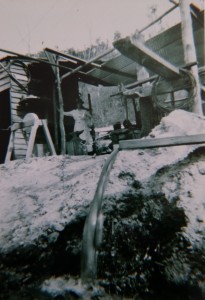
Hedley Higgs at his Narrawa Creek gold mine. No, he’s not cross dressing … that’s a metalworking apron. Photo courtesy of Sheila Slowan.
For many people the Wall Street crash of 1929 heralded an era of making do with very little. Some families still earned a crust on the mining fields. In 1931 the pound was devalued, causing a spike in the fixed price of gold.[1] Wallets sprang open like blooms in a drought-breaking downpour. On the small Middlesex mining field in north-western Tasmania new money was pumped into the old Great Caledonian gold mine. William Aylett made grand claims for the old Lea River gold mine.[2] Two-hundred-and-twenty acres were taken up on Black Bluff to work the old Devonport Prospecting Association gold mine.[3] Fossicking near the old Narrawa Creek gold mine in August 1934, Devonport mechanic Hedley Higgs (1885–1980) found extremely find gold in the roots of an upturned tree.[4]
Higgs was an engineering prodigy. He had the same love of gadgets, bikes and engines that characterised his Launceston contemporaries such as Stephen Spurling III, HJ King and Fred Smithies. However, unlike them, he did not take up photography. The Higgs family were well-known shipbuilders at the Mersey River, and Hedley was a skilled yacht builder and yachtsman. He was also an expert marksman. As a young man he zipped about on a Harley Davidson, managed his own motor garage and fixed motorbikes for the self-proclaimed Launceston ‘bike king’ Sim King.[5] The grandson of the Tasmanian amateur scientist AB Biggs, Higgs had repaired radios, tried to patent an explosive and blown himself up with acetylene gas by the time he got to the mining game.[6] He knew nothing about mineral processing until he was asked to build a plant for the Stormont bismuth mine in the early 1930s. Of course his plant was a success, but the mine was forced to close when the Iris River bridge was burnt out.[7]
Now Higgs started forking the Narrawa Creek gravel through sluice boxes. His journal entries demonstrate that mining was sometimes hazardous: ‘Lost ½ plug of gelignite warned men’.[8] Gold recovery was testing: ‘Finished cleaning up for a little under 4 oz. Gold looks clean and has a lot of larger pieces in it. Paddock worked in hollow below pines on race, amount sluiced about 110 yards but a lot of gold left on the bottom!’[9] Ingenuity was always required: ‘brought back old sterilizer from Devon Hospital …’[10]
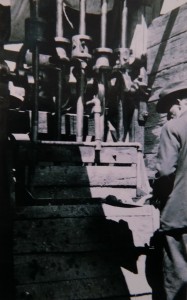
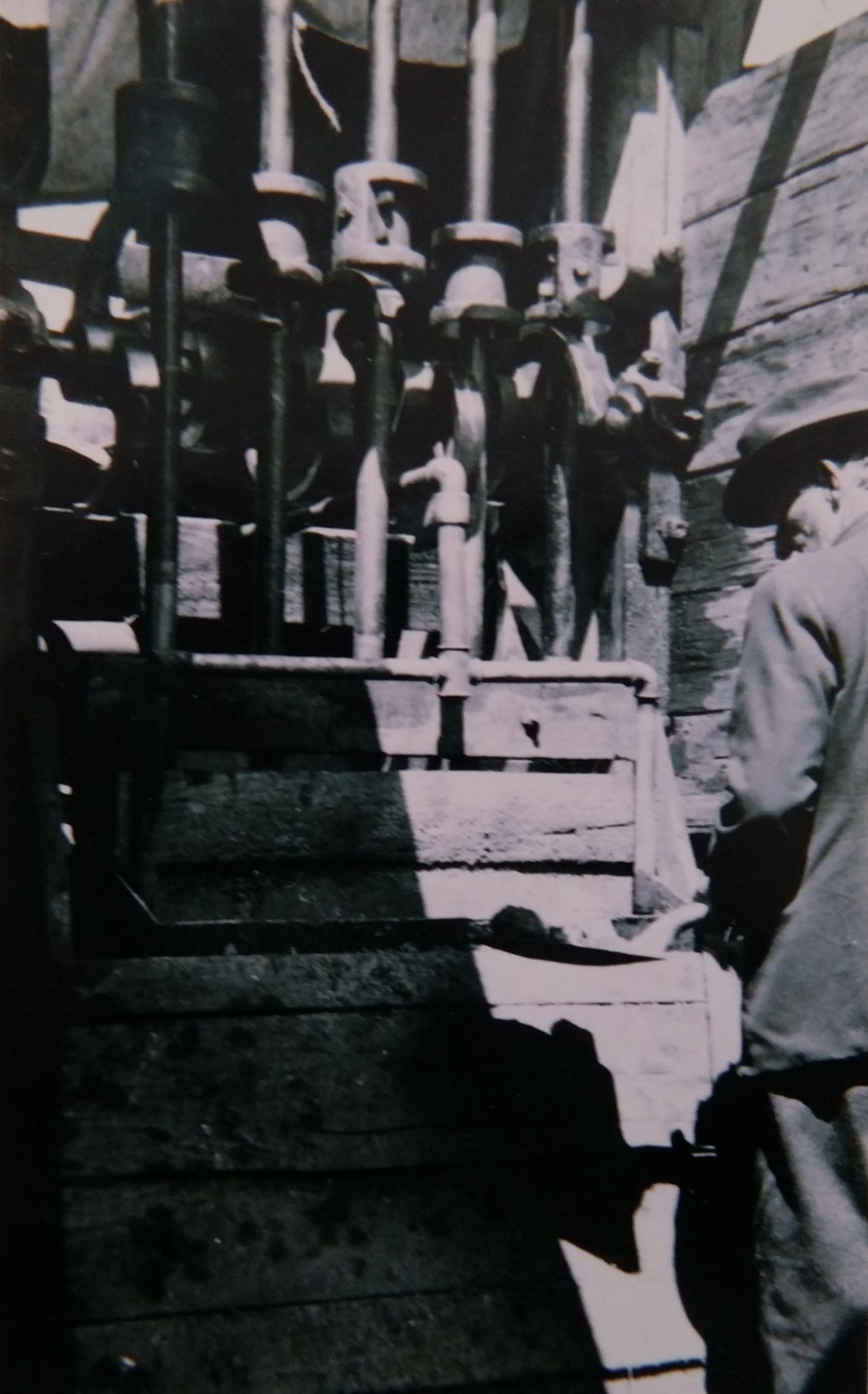
Higgs with his home-made gold battery. Photo courtesy of Sheila Slowan.
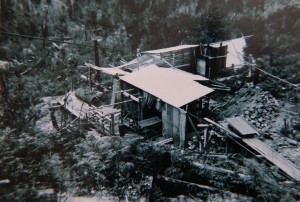
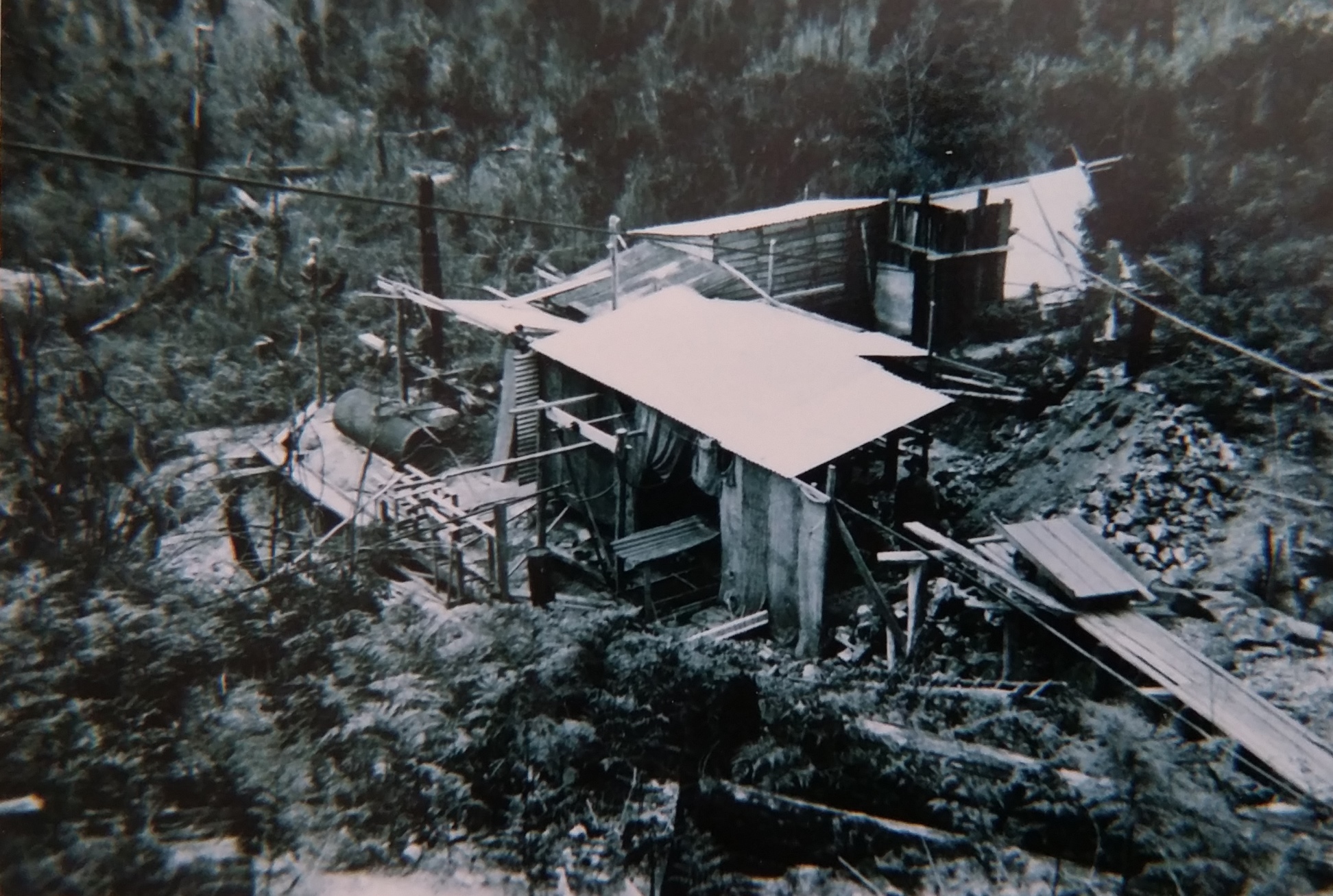
The experimental plant at Narrawa Creek. Photo courtesy of Sheila Slowan.
Then in 1935 Higgs rigged up a battery to crush the ore. Old Ford car axles became rods for the stamper battery. Even a bicycle was introduced to the works.[11] The machinery was driven by a seven-horsepower oil engine.[12] However, he still needed water for sluicing, and the weather did him few favours. Summer offered little rain, in winter it snowed.[13] Nor were the natives necessarily helpful or friendly. In March 1936 Higgs collided with two men riding a motorbike, damaging his car. ‘Reported accident to police’, he noted, ‘renewed permit to carry pistol …’[14] In the following year, one of his employees at the mine, Harry Lawson, was shot dead in a dispute over hunting territory.[15] Another, Dick Nichols, had a shot fired into his house after taking up with another man’s wife.[16]
Early sluice box and battery clean-ups were promising. By 1937 the mine had produced 188.5 oz of gold from the treatment of 1118 tons of ore.[17] Higgs drove an adit to cut the lode at greater depth, but when the oxidised zone gave way to sulphide ores, he was left with hard galena and pyrite.[18]
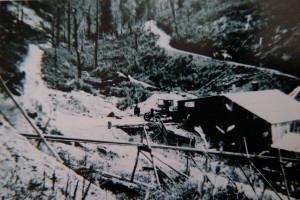
In the late 1930s the Public Works Department built a road down to the mine. Photo courtesy of Sheila Slowan.
When World War II started, the price of tungsten, used for hardening steel in munitions, soared, and Higgs turned his attention to the adjacent Squib tungsten and molybdenum mine, last worked when prices were high at the end of World War I. Everything went well until payday came at Christmas—and the mainland company had only £20 in the kitty.[19] Hedley Higgs’ brief flirtation with mining was over.
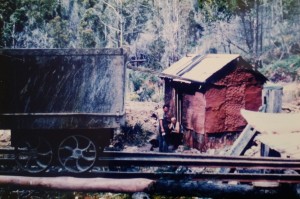
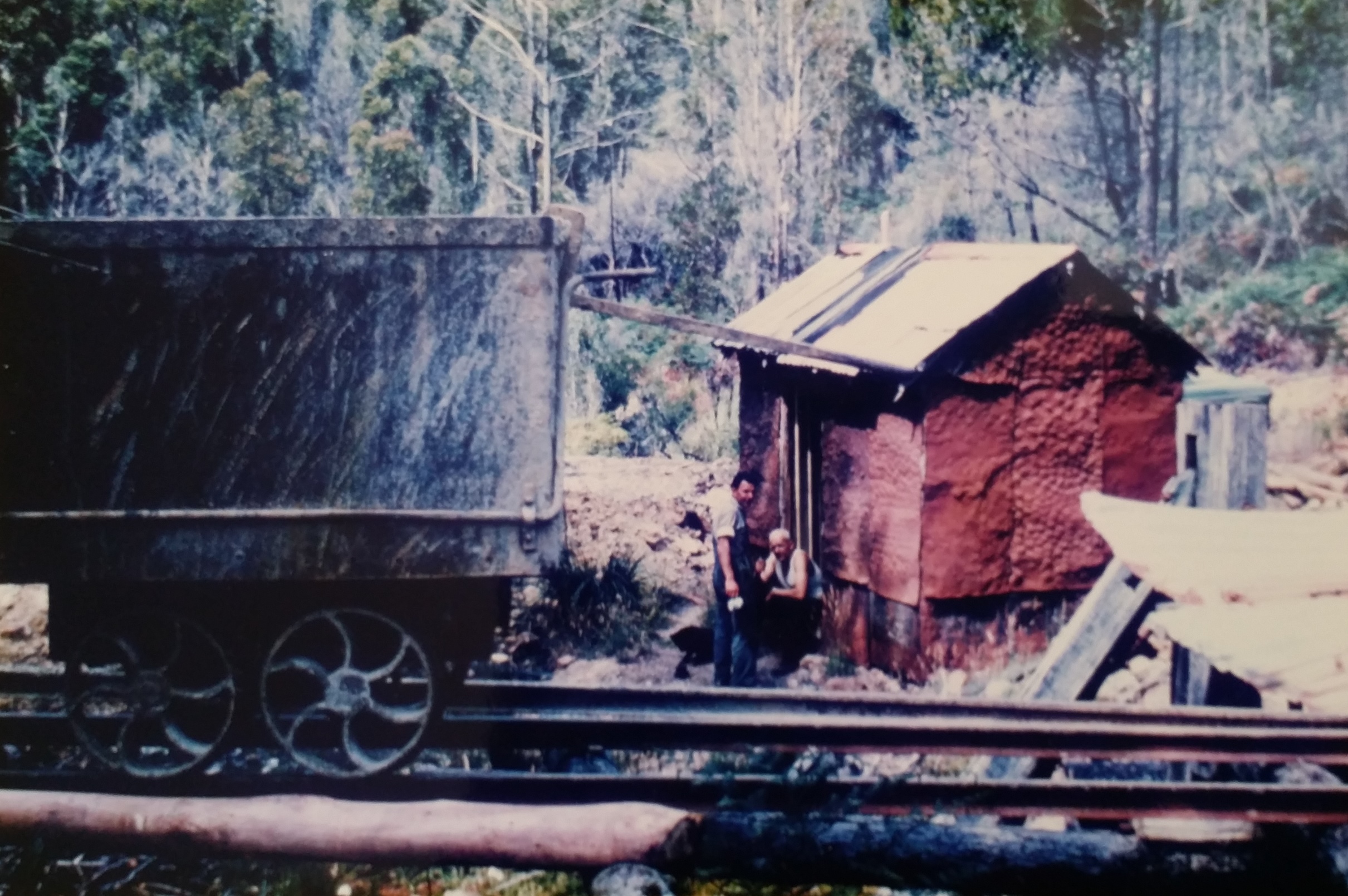
Keith Harvey and Arthur Goldsworthy at the Sunrise mine in the early 1960s. Roxley Day photo.
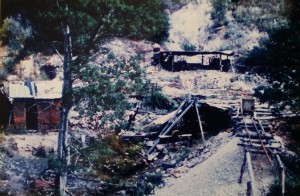
Another shot of the Sunrise operation from the same period. Roxley Day photo.
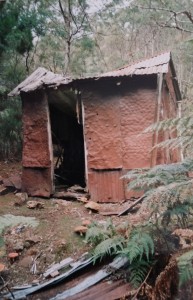
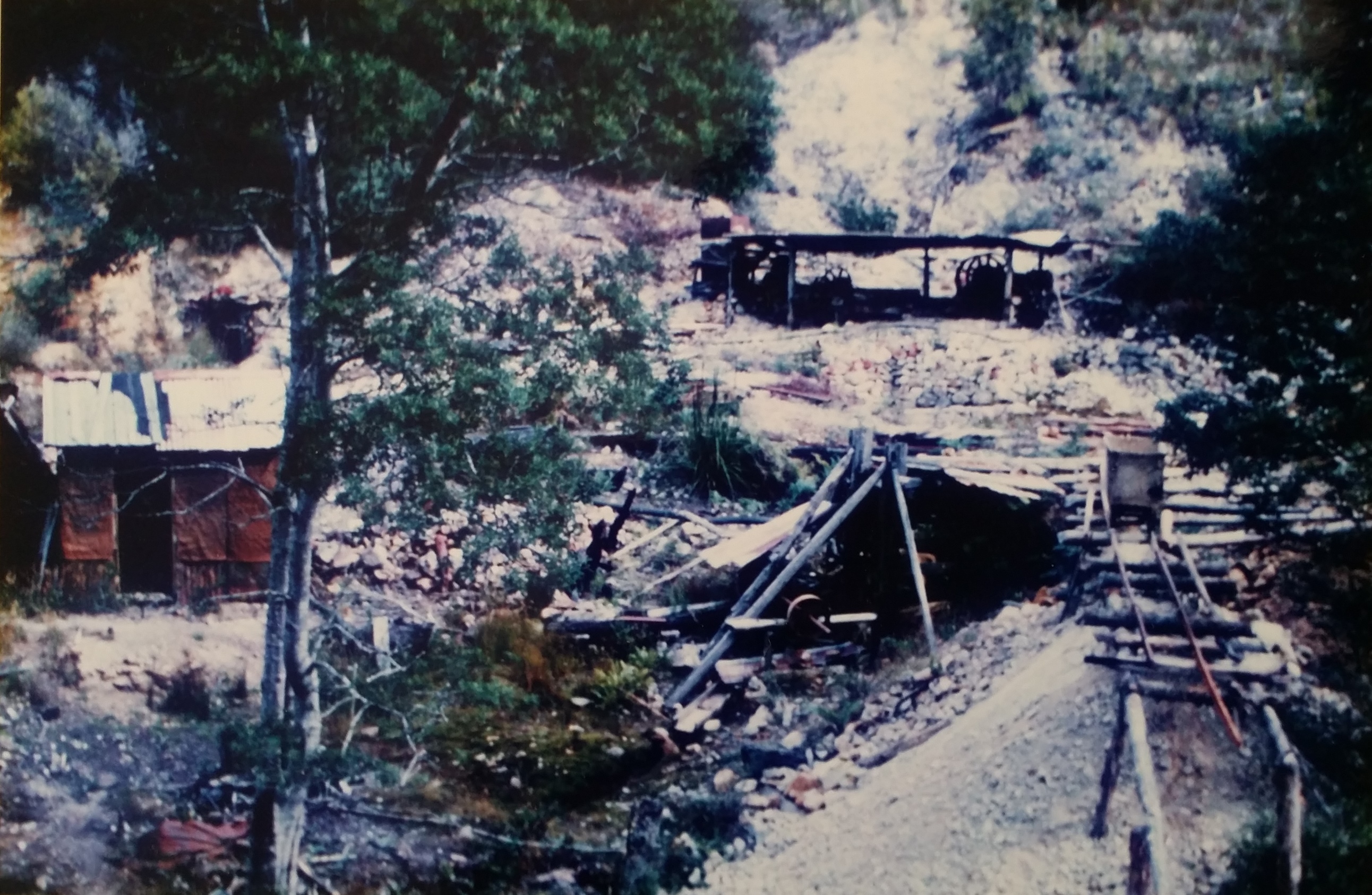
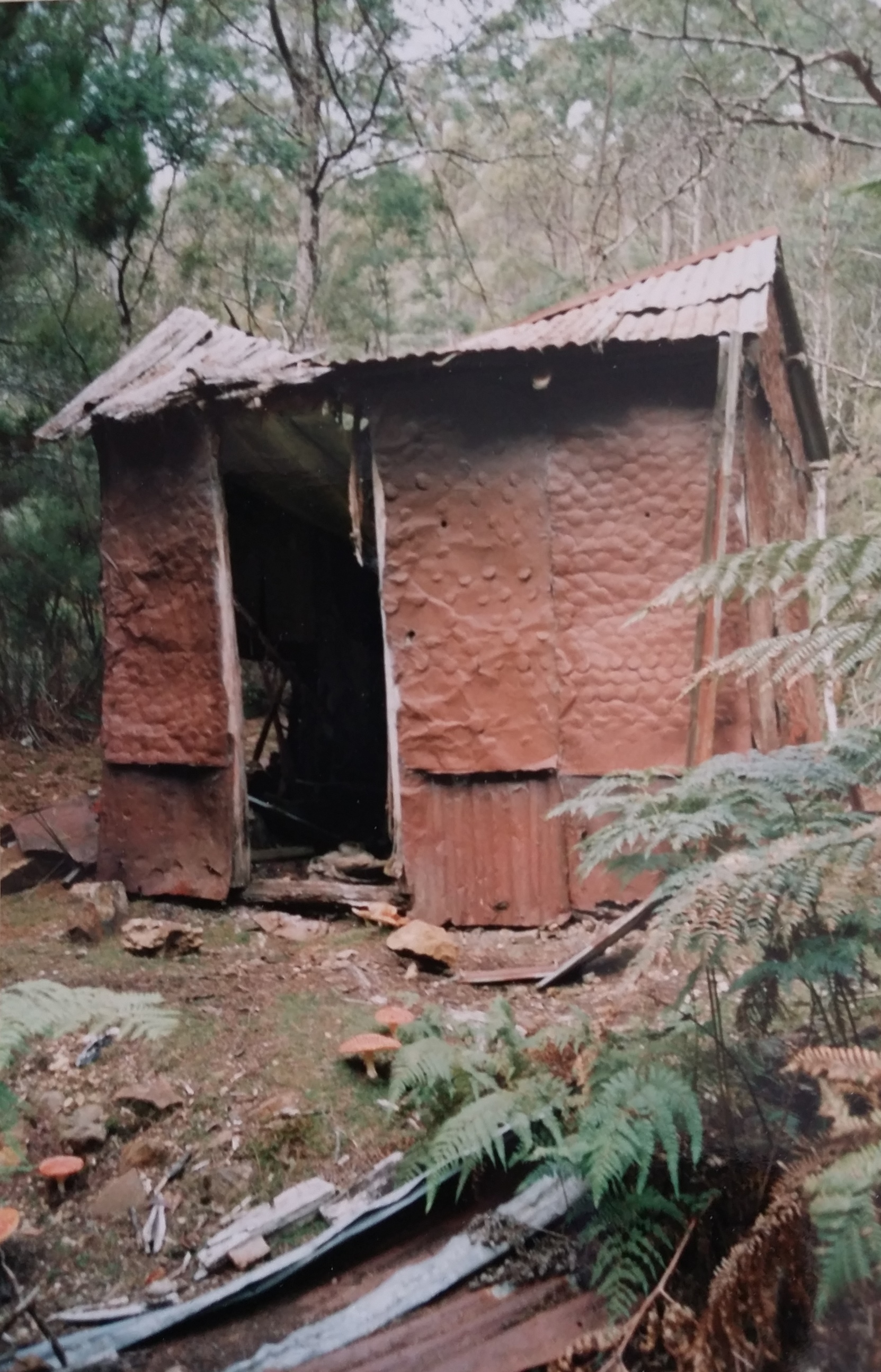
The somewhat battered Sunrise hut still standing in 1993.
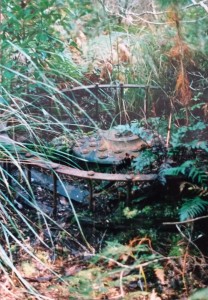
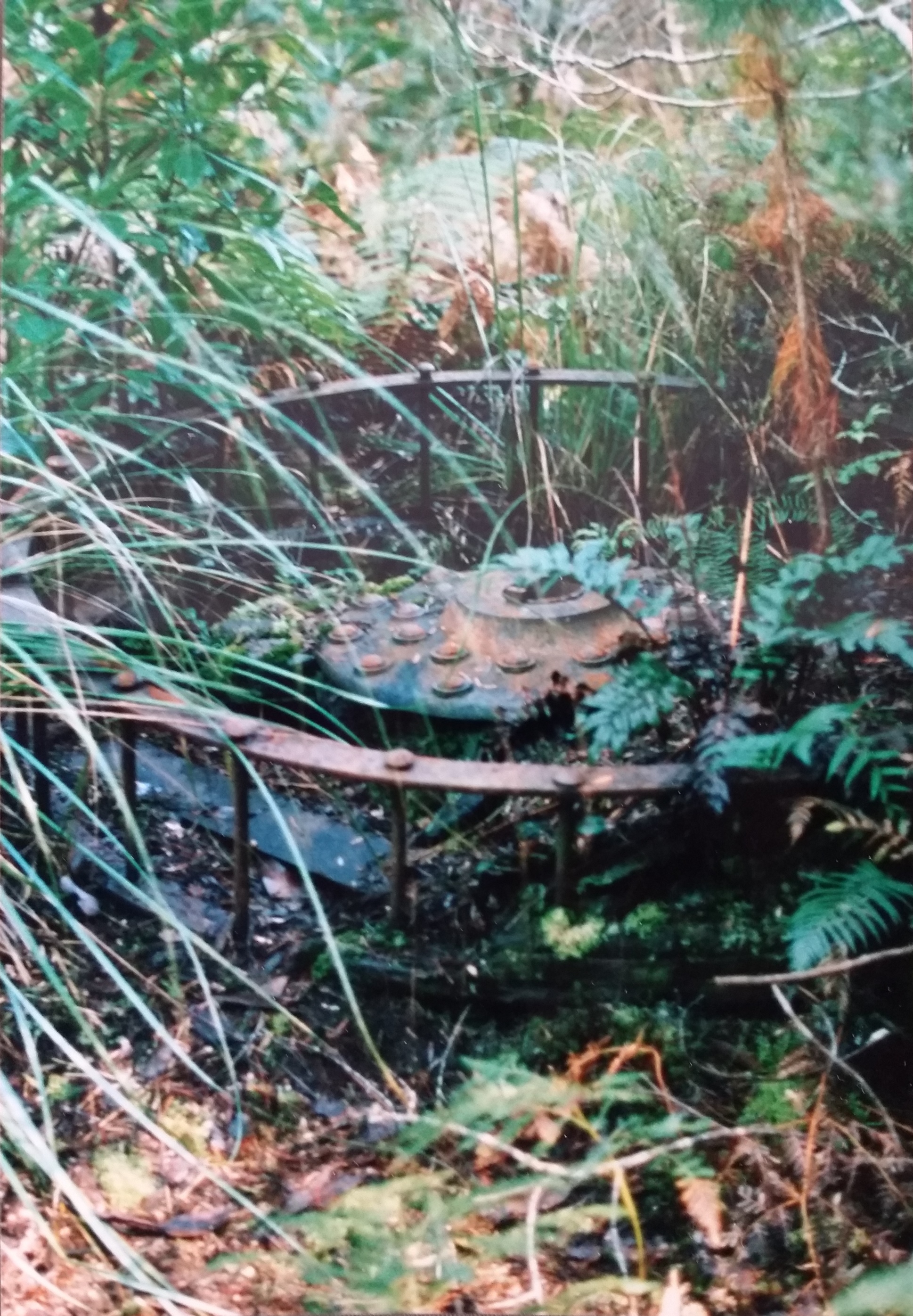
Metal wheel at the Higgs/Sunrise mine site in 1993. In his archaeological report, Parry Kostoglou suggests this could be part of an ore disintegrator.
But the Higgs gold mine was not dead. It was worked as the Sunrise mine in the 1960s by Keith Harvey and Arthur Goldworthy, the latter being a member of an old Cornish family who had come to Moina via the Moonta copper mine in South Australia’s ‘Little Cornwall’ and the Beaconsfield gold mine. Inevitably, it was reworked yet again during gold’s upward parabola after the US government placed the precious metal on the open market, churning up any evidence of Hedley Higgs’ home-grown gold plant.
[1] Geoffrey Blainey, The rush that never ended: a history of Australian mining, 5th edn, Melbourne University Press, 2003, p.307.
[2] See Simon Cubit and Nic Haygarth, Mountain men: stories from the Tasmanian high country, Forty South Publishing, Hobart, 2015, pp.52–53.
[3] ‘Middlesex gold: mainland company interested’, Advocate, 7 November 1936, p.10.
[4] Interview with Sheila Slowan, daughter of Hedley Higgs, East Devonport, c1993.
[5] Motor vehicle registrations, Police Gazette, 10 December 1920, p.237.
[6] Devon News, 20 August 1964 (newspaper clipping obtained from Sheila Slowan).
[7] Devon News, 20 August 1964 (newspaper clipping obtained from Sheila Slowan).
[8] Hedley Higgs journal entry, 9 February 1935, courtesy of Sheila Slowan.
[9] Hedley Higgs journal entries, 23 and 23 May 1935, courtesy of Sheila Slowan.
[10] Hedley Higgs journal entry, 9 March 1936, courtesy of Sheila Slowan.
[11] Interview with Sheila Slowan, daughter of Hedley Higgs, East Devonport, c1993.
[12] ‘Unique battery at Middlesex’, Examiner, 16 January 1936, p.8.
[13] Hedley Higgs journal entries, 27 January 1935 and 13 June 1936, courtesy of Sheila Slowan.
[14] Hedley Higgs journal entries, 8 and 9 March 1936, courtesy of Sheila Slowan.
[15] See ‘Twelve witnesses examined …’, Advocate, 11 May 1937
[16] Higgs alluded to this well-known incident in an interview with Kerry Pink, ‘A couple of “old timers” with no time for idleness’, Advocate story, details unknown. Nichols was listed as employee in Higgs’ journal, held by Sheila Slowan.
[17] F Blake, ‘Higgs’ gold mine—Narrawa Creek’, Unpublished Department of Mines report, 1937; cited by AE (Tony) Webster, An archaeological survey of the Higgs gold mine, near Moina, north-western Tasmania, Mining Geoscience, 1998, p.5.
[18] ‘Middlesex fields’, Mercury, 8 July 1936, p.4.
[19] Kerry Pink, ‘A couple of “old timers” with no time for idleness’, Advocate story, details unknown.
by Nic Haygarth | 25/10/16 | Tasmanian high country history