by Nic Haygarth | 11/01/17 | Story of the thylacine, Tasmanian high country history
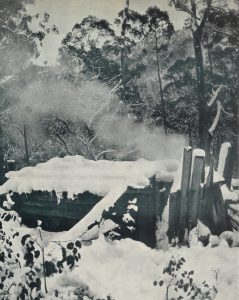
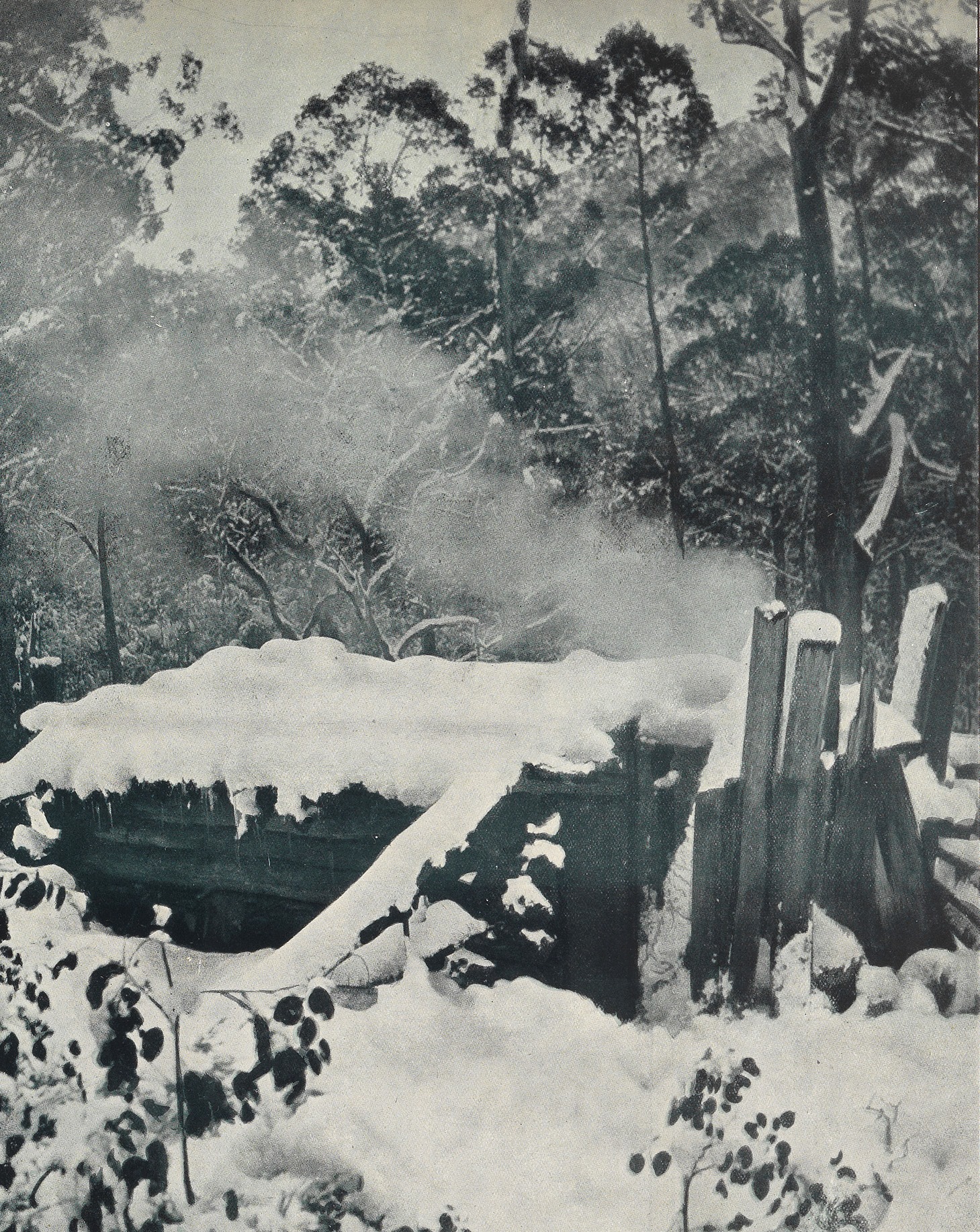
A hunter’s log cabin in the Cuvier Valley (Fred Smithies photo, from the Weekly Courier, 3 July 1929, p.27). From 1927 the Cuvier Valley was part of a game sanctuary. This was not the first time that Smithies, a member of the Cradle Mountain Reserve Board, had photographed an illegal hunting hut in the Lake St Clair Reserve.
In 1906 a newspaper contributor calling himself ‘The Rover’ wrote an account of four months’ hunting in a mountain valley near Lake St Clair. The party of four was from Queenstown. They started for the lake through heavy rain in April, each member bearing a pack weighing 23 kg up the Linda Track, precursor of the Lyell Highway—while a mule carried the rest, a mere 141 kg! First stop was the ‘cockatoo hut’, which at the time was a well-known shelter at the Franklin River.[1] Next day, high on Mount Arrowsmith, the grave of John Largan, who had frozen to death there in 1900, served to warn them of the dangers of the highlands.[2] Arriving at Lake St Clair on the second evening after their long tramp, they spent two days exploring the surrounds before settling on a ‘beautiful valley’ 11 km from the lake. Over four days the party built a log hut with a bark roof as their base.
Then, instead of laying down their snare lines, they ‘waited with feverish impatience for the first fall of snow’. Unleash the hounds! ‘The Rover’ knew what many hunters knew: that in heavy snow wallabies were easy prey for dogs:
‘As we had been at the business before, no time was lost in getting to work, two of us going out and two remaining in camp every alternate day … The same remark applies to the dogs, for they soon knock up if the work is not divided between them. The best plan is to take four dogs at a time, for if the kangaroos [Bennett’s wallabies] are plentiful the dogs will kill faster than a man can skin them, it being a common occurrence to have four or five killed within as many minutes. The fastest kangaroo falls a victim to the slowest dog when pursued through three feet of snow’.
The two men back at camp were kept busy pegging out skins, fetching wood for the fire and cooking supper. No mention was made of a skin shed—but the existence of one is implied by the volume of skins obtained and the duration of the expedition. Mouldy or frozen skins were worthless. They needed to be cleaned and kept dry. The skin shed, a unique Tasmanian invention, was developed at about the beginning of the twentieth century. Its inception was one of the reasons for an escalation in the Tasmanian fur industry, enabling longer stints and greater, more valuable hauls in the highlands where possum furs in particular grew thicker.
After one month the mule was revisited at the Clarence River, and divested of its load—which presumably it had not borne in the interim. The snow was then two feet deep, and in June it got deeper, with metre-long icicles draping the eaves of the hut. Now the ‘rough-coated mongrel’ dog showed his superiority to the purebred, with wallabies being slaughtered in all directions.
One day the hunters found the tracks of a ‘hyena, or Tasmanian tiger’. The dogs took up the scent
‘and in a few minutes discovered the enemy. Their angry growls brought us on the scene, when it was plainly to be seen that the tiger intended to fight to the bitter end. With a cry of encouragement to the dogs we urged them on, and immediately they were engaged in mortal combat with their fierce opponent. The struggle was a long one, but at last the combined strength of the four dogs began to tell, and the battle was over. We found on examination that the tiger was one of the largest of its class, measuring 5 ft 6 in [1.69 m] from the end of his nose to the tip of his tail’.
‘The Rover’ claimed a haul of 91 dozen (1092) wallaby skins—and a weight loss of from 15 to 22 kg per man.[3] The mule, not the men, would have borne the skins back to Queenstown. Providing they were in good condition, they would have fetched something in the region of £80–£140 on the fur market, or an average of about £20–£35 per man.[4] While this would have been a very useful income supplement, better money was to be had in an open season on brush possum.
How credible is this anonymous tale? Let’s start with the hunting season. No year is given, but the events described, if they are real, must have taken place in the period 1901–05. Which season is it likely to be? Throughout the period 1901–05 the season for wallaby was four months, 1 April to 31 July, with closed season for possums in 1903 and 1904 and a one-month season (July) in 1901, 1902 and 1905.[5] So wallabies would have been the focus for many hunters during these seasons, and almost without exception in 1903 and 1904. As for the very heavy snow falls, there was plenty of snow at Cradle Mountain in July 1905 when hunter Bert Hanson disappeared in a blizzard. Hanson and his mate Tom Jones were also using dogs to hunt down wallabies.[6]
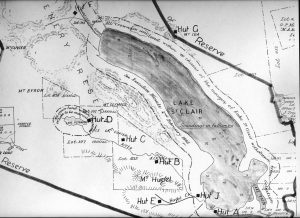
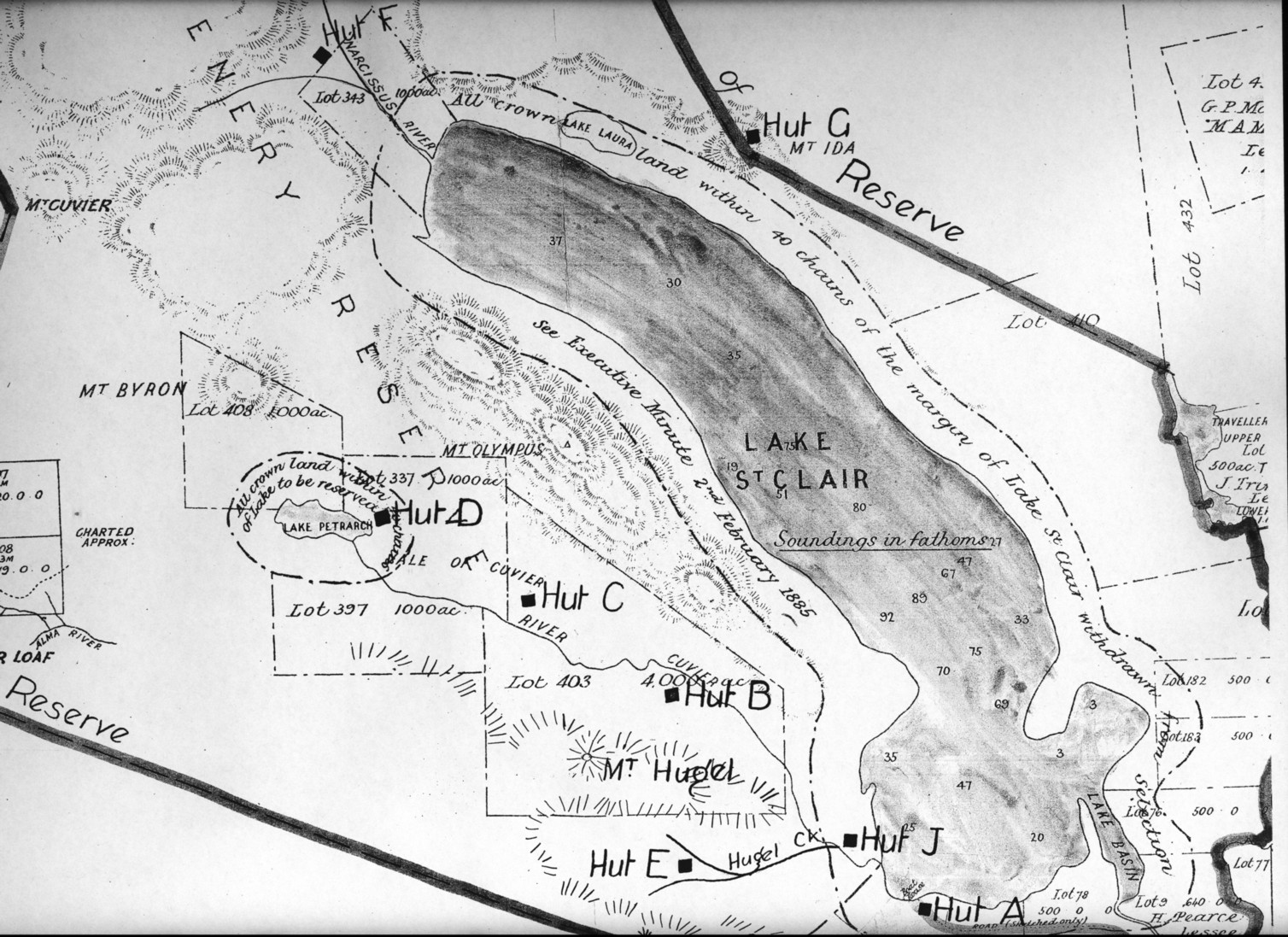
A map showing Cuvier Valley hunting huts visited during a police raid on the Lake St Clair Game Sanctuary in 1927. From AA580/1/1 (Tasmanian Archive and Heritage Office).
What was the ‘beautiful valley about 10 miles long by two in width, and bounded on each side by high ranges extending as far as the eye could reach, rising almost perpendicularly from the valley below’? Allowing for a little poetic licence, it could be the Cuvier Valley west of Mount Olympus, where hunters like Bert and Dick Nichols operated two decades later.[7]
What about the thylacine: was the carcass submitted for a government thylacine bounty? Plenty of applications were made for the bounty in the spring of the years 1901–05, but without knowing the origin of each application it is very difficult to track down ‘The Rover’ or his mates from Queenstown.[8] Given the value of the wallaby skins they obtained, carting a single thylacine carcass back to Queenstown in order to submit it for a £1 bounty may not have been a priority for them anyway.
In short, the story is plausible. I hope there are further missives from ‘The Rover’, giving more insight into the task of feeding the world’s craving for furs.
[1] See, for example, JW Beattie, ‘Out west with salmon fry’, Mercury, 18 February 1903, p.6; ‘Alluvial gold’, Mercury, 25 August 1935, p.8.
[2] See ‘Mount Arrowsmith tragedy’, Mount Lyell Standard and Strahan Gazette, 3 September 1900, p.2.
[3] ‘The Rover’, ‘A Tasmanian winter camp’, Weekly Courier, 26 May 1906, p.37.
[4] In August 1901 ‘kangaroo’ skins free from shot were fetching £0-1-6 to £0-1-8 each (‘Commercial’, Mercury, 17 August 1901, p.2); in August 1905 ‘kangaroo’ fetched from £0-1-11 to £0-2-6 (‘Commercial’, Examiner, 12 August 1905, p.4). My calculations assume that all the skins obtained were Bennett’s wallabies, when it is likely that some were pademelons. ‘The Rover’ does not specify.
[5] Editorial, Daily Telegraph, 30 July 1901, p.2; ‘To correspondents’, Zeehan and Dundas Herald, 31 July 1902, p.2; ‘Current topics’, Examiner, 31 March 1903, p.4; ‘Warning to possum poachers’, Examiner, 19 June 1903, p.6; ‘To correspondents’, Examiner, 13 April 1904, p.4; ‘Kangaroos and opossums’, Daily Telegraph, 3 May 1905, p.2.
[6] ‘The Tramp’ (Dan Griffin), ‘The mountain mystery’, Daily Telegraph, 5 August 1905, p.6.
[7] See Gerald Propsting to the Secretary for Public Works, 4 August 1927, file AA580/1/1(Tasmanian Archive and Heritage Office [afterwards TAHO]); ‘Lake St Clair Reserve: allegations of poaching’, Mercury, 26 May 1927, p.10.
[8] Government thylacine bounty payments in the years 1888—1909 are recorded in LSD247/1/2 and LSD247/1/3 (TAHO).
by Nic Haygarth | 09/01/17 | Circular Head history, Tasmanian high country history
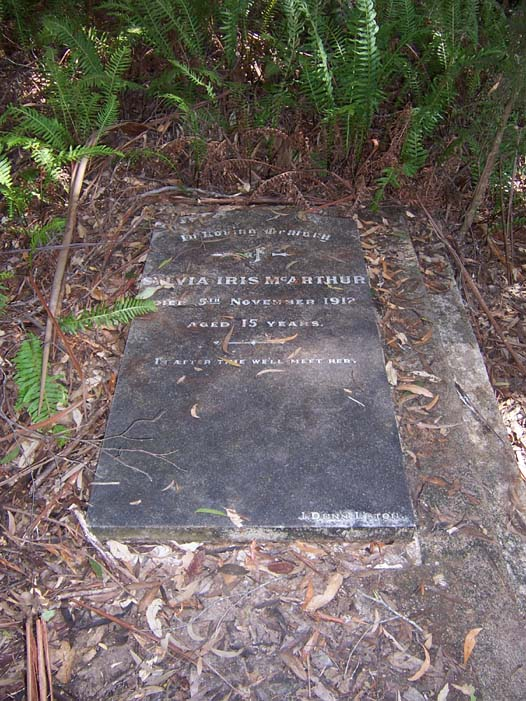
Sylvia McArthur’s slab in the ground litter at Balfour.
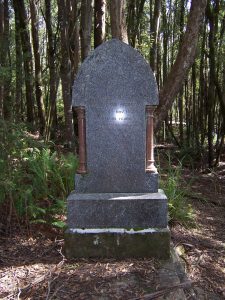
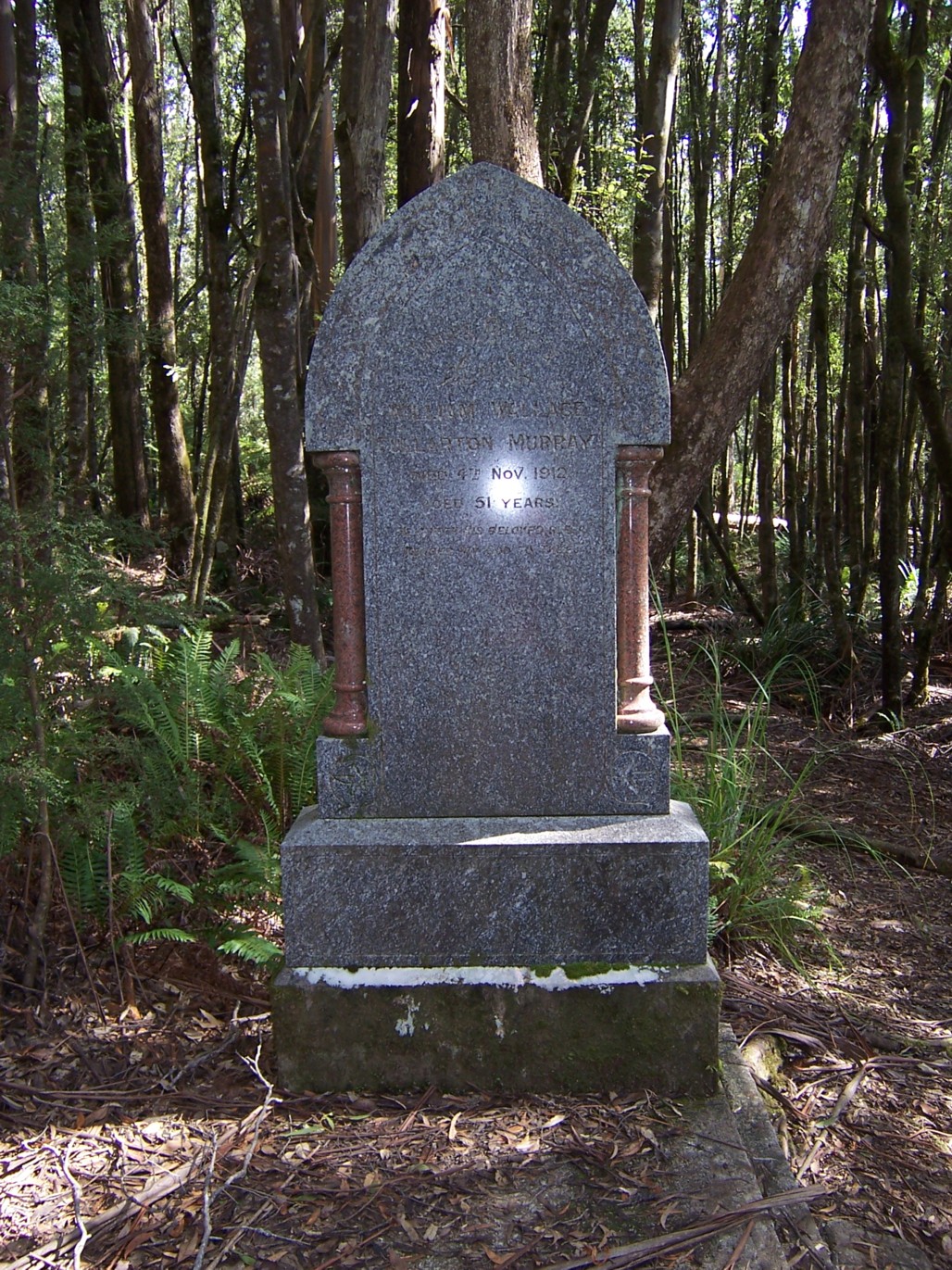
Grave of William Murray. Photo by Val Fleming.
The story of Balfour is told by two graves in a highland cemetery in north-western Tasmania. For more than a century, lying side by side, William Murray and Sylvia McArthur have been fixed silently in their interlocking roles in what historian Geoffrey Blainey called the ‘Indian summer’ of Tasmania’s first mining boom.
There is an interesting dynamic between these two people, who were interred on consecutive days in November 1912. William Murray was a 51-year-old husband and father of two, Sylvia McArthur a 15-year-old schoolgirl. He has Doric columns on his granite headstone, which is reputed to have been sent out from Scotland. She has a slab from J Dunn and Co, Launceston, and, as their graves suggest, they represented different social strata. As one of the owners of the principal mine, the Copper (Murrays’) Reward, William Murray was from the big end of town, living in what was once called ‘the mansion’. Sylvia McArthur was part of the globe-trotting fraternity of mine workers, the community that follows the speculators, grounded in the realities of remote mining towns a century ago, physical and cultural isolation, poor sanitation and health care. Sylvia would have lived in a corrugated iron hut, one of those described as looking like ‘opened out sardine cans’.[1] She is believed to have died of typhoid. William Murray died by putting a gun to his temple, reputedly because of financial and marital collapse stemming from the Copper Reward mine.[2] So, in different ways, they were both casualties of Balfour’s frenzied mining speculation.
Sylvia McArthur’s story begins with the marriage of William McArthur, one of nine children born to Scottish bounty immigrants, to Catherine Dolan, the daughter of Cygnet farmers.[3] They married in Zeehan, where he was a miner and she a housemaid.[4] Two of William’s brothers, Robert and John, likewise followed the mining profession wherever there was work.[5] At Zeehan in 1897 Catherine produced their second daughter, Sylvia Iris McArthur.[6] Emphatic endorsements of the Mount Lyell copper boom were then rising in Queenstown, Strahan and Zeehan. Built on a grand scale in 1898, Zeehan’s Gaiety Theatre and Grand Hotel had a stage larger than that of Hobart’s Theatre Royal and more seating than Hobart’s Town Hall.[7] Zeehan’s silver mines had also peaked, but the field was beset by shallow lodes and problems of ore treatment.
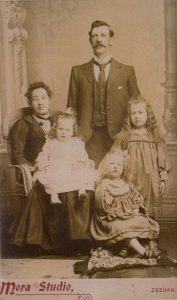
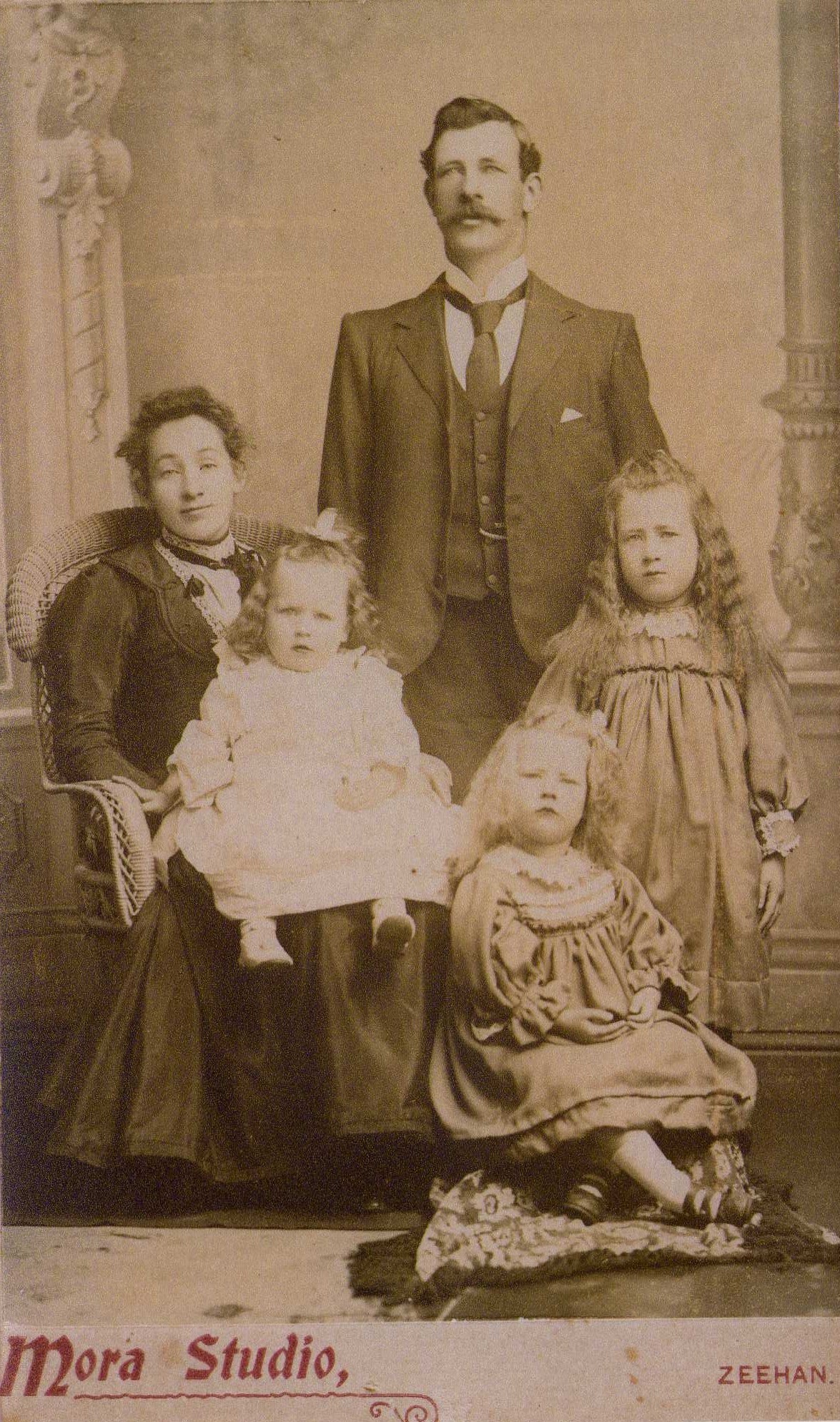
Catherine and William McArthur at Zeehan with their first three daughters, Florence, Sylvia and Gladys. Mora Studio, Zeehan, photo courtesy of Edie McArthur.
Tragically, in 1904 Catherine McArthur died after a short illness at the age of only 27, moving her husband to verse:
‘Tis hard to break the tender cord,
When love has bound the heart.
Tis hard, so hard, to speak the words:
We for a time must part.
Dearest love, we have laid thee
In the peaceful grave’s embrace,
But they memory will be cherished,
Till we see thy heavenly face’.[8]
By 1908, when William re-married, and with 20-year-old Marion May Delaney started adding boys to his four girls, Zeehan was in decline.[9]
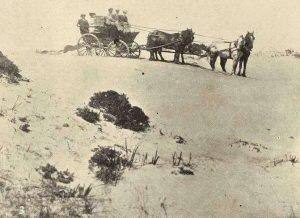
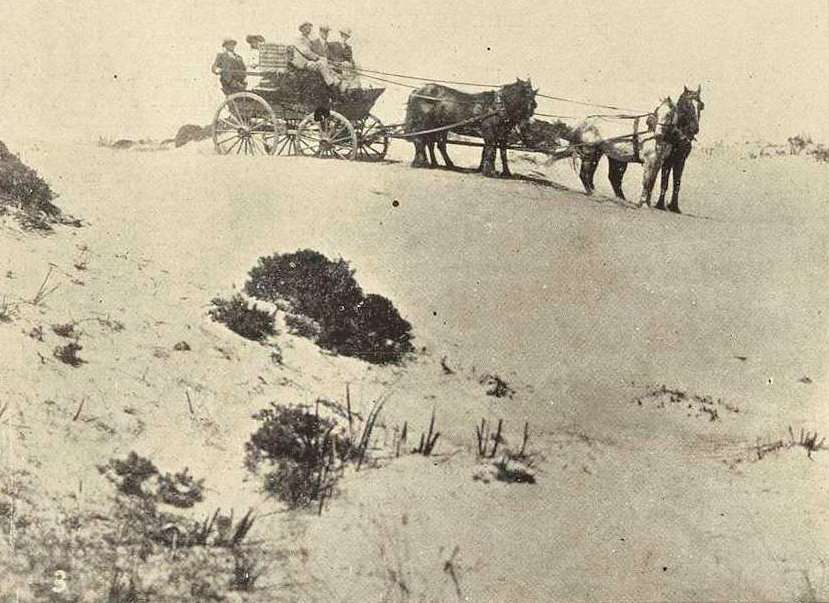
The Balfour coach negotiating a sand dune. Photo by Fritz Noetling from the Tasmanian Mail, 9 March 1911, p.24.
The new boom town was Balfour. It was remote even by mining field standards, a shanty town lodged somewhere between Circular Head and the ‘true’ west coast. No road, railway or deep-water port served it. The Balfour coach could be bogged in beach sand or swamped by the Southern Ocean. Yet by the spring of 1909, investors were agog at the 1100 tons of ore, averaging about 30% copper, which the brothers William and Tom Murray had somehow dispatched to market. In October 1909 a report circulated that the Murrays had sold their Copper Reward mine for £50,000—a claim they denied.[10] The Balfour copper field was soon being hailed as a second Mount Lyell.[11]
By October 1911 William McArthur had secured the position of engine driver at the Copper Reward. It took his family a fortnight’s travel from Zeehan via Burnie and Stanley to join him at Balfour. Rough weather held up their voyage on the ketch HJH, forcing passengers ashore five kilometres from the Woolnorth stock station. Finally, a four-hour ride on the new horse-drawn Temma-Balfour tramway delivered the family to its remote new home.[12]
Balfour had already suffered the obligatory typhoid epidemic of the early life of a mining town by the time fourteen-year-old Sylvia McArthur arrived. The Circular Head Council apparently did not take much notice of this, because it afterwards suggested to the Balfour Advisory Board that it dump the town’s nightsoil in the Frankland River, presumably downstream of the local recreational area and fishing hole.[13] A sanitary inspector despatched to Balfour after the typhoid outbreak found only one unsanitary drain at the Balfour Hotel, plus the suspicion that a pig was being kept on that premises—apparently in anticipation of King George V’s coronation in June 1911, when it was patriotically sacrificed.[14]
William Murray was out of town at that time. Having taken an eighteen-year-old bride, the forty-eight-year-old was honeymooning in England.[15] In August 1911, when Hazel and baby Jean Murray saw Balfour for the first time, they took up residence in what one man called the ‘mansion’, perhaps the only house in town blueprinted by an architect.[16] Perhaps the Murrays also had acetylene lighting, which would have placed them ahead of the underground miners in the candle-lit Copper Reward.
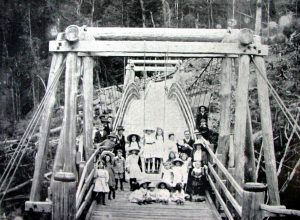
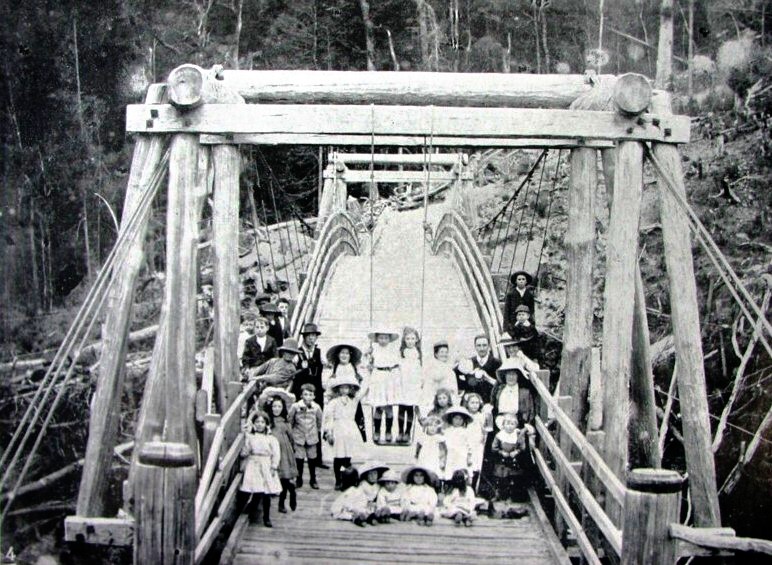
The McArthur family and friends on the Frankland River bridge, with Sylvia at back (left) in the wide-brimmed hat. William McArthur photo from the Weekly Courier, 18 April 1912, p.17.
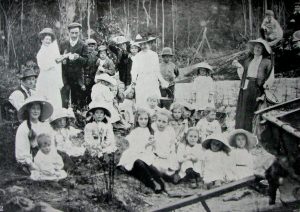
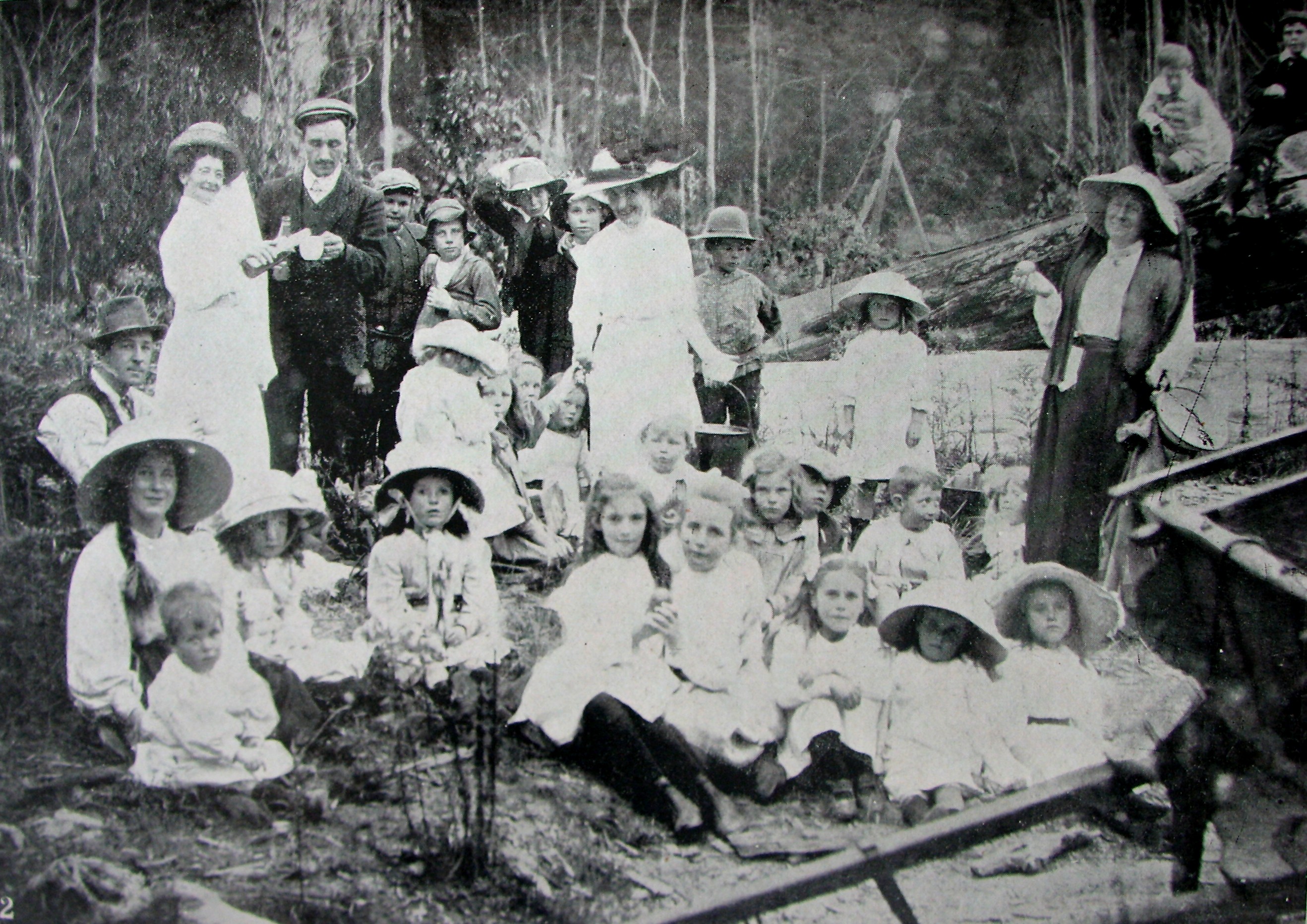
The same picnic party at the river. William McArthur photo from the Weekly Courier, 18 April 1912, p.17.
The McArthurs began to live their life in the social pages in January 1912, when Sylvia wrote her first letter to the Weekly Courier newspaper. It is through her words and her father’s photos that we get the story of everyday life in a remote settlement. Sylvia went from a very large school at Zeehan to a one-teacher operation of 23 students at Balfour. She stopped attending because there were no girls of her own age, and she felt as lonely at school as she was at home. Instead, she carried her father’s crib to the mine and looked after her younger siblings.[17] Her sisters became schoolteachers, and Sylvia’s own love of small children is very evident. For amusement she collected postcards and read copiously. The Christmas sports and picnic was the highlight of the social calendar. There was also a dance every few months to the tune of a piano accordion. Sylvia enjoyed the fern gullies and glades of the nearby Frankland River, a favourite picnic spot where walks were taken and the blackfishing was lively.[18]
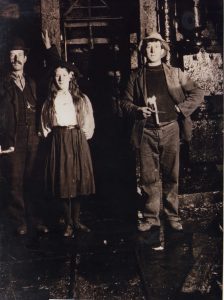
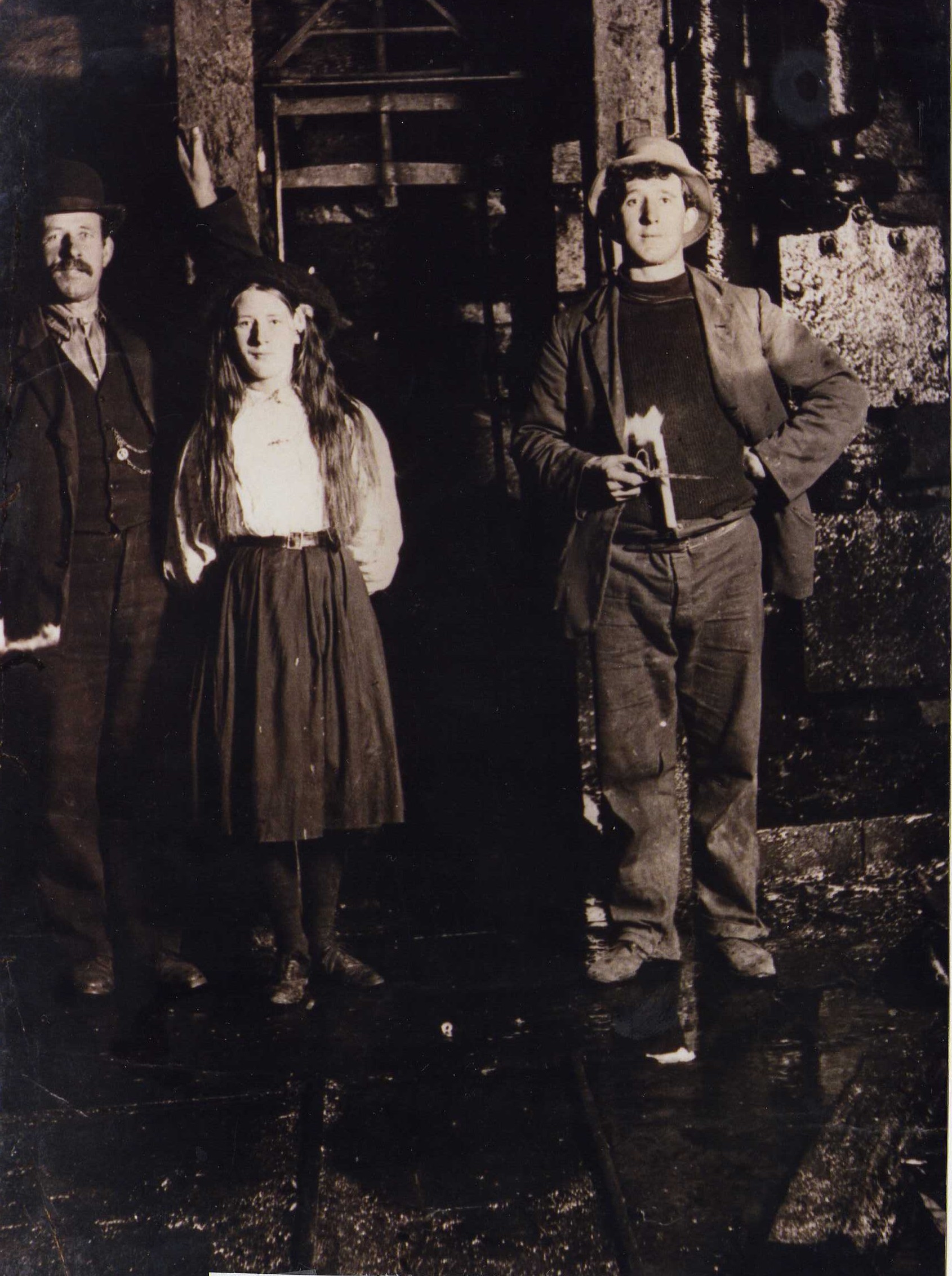
William and Sylvia McArthur pictured with an unknown man (right) underground in the Copper Reward. Photo courtesy of Edie McArthur.
One day she ventured underground at the Copper Reward. Her permanent interment underground was six months away when she looked to a future beyond the transitory mining town, one she would never know:
‘It was the first time I had been down a mine. I think it is a funny feeling one has whilst going down in a cage … Whilst I was down below a gentleman took a flashlight photograph of us. We all looked like ghosts, for our faces were so white. However, I would not like to leave Balfour without being able to say I was down a mine’.[19]
In her final letter to ‘Dame Durden’ of the Weekly Courier in October 1912, Sylvia described a concert given by the Balfour schoolchildren, illustrated, as usual, by her father’s pictures.[20] Her fatal illness may have been brewing even as the newspaper went to press.
What was William Murray’s condition? It must have been tempting for the Murrays to start living the good life that the speculation promised, and which could easily have landed them in debt. Perhaps the brothers had missed their big chance. It has been claimed that they refused an offer of £30,000 for the mine, a decision they may have come to regret.[21] William Murray shot himself in his home at Donald Street, Balfour, on 4 November 1912, reputedly as part of an unfulfilled double suicide pact with Tom.[22] Sylvia McArthur died in great pain next day ‘from a complication of complaints’ after a three-week illness.[23] She was buried overlooking the Frankland River that she loved. Her heartbroken father described the scene in the Weekly Courier:
‘For she’s sleeping on the hillside,
Where the morning sun will shine,
‘Mid a scene of ferns and dogwood,
Fringed with wild clematis vine,
With its tender fibres clinging,
Drawing close to the boughs above,
As our hearts are drawn to Sylvie,
By the tender cords of love.
And the fiercest storm in winter,
As it rages on the shore,
Will not disturb you, dearest Sylvie,
Where you sleep for evermore’.[24]
Ferns and dogwood still guard William Murray and Sylvia McArthur’s final resting-place. In fact the scrub has grown up so much that the cemetery’s river view has been lost. The ‘lonely spot near Balfour’, as William McArthur described it, is lonelier than ever.
[1] ‘Mount Balfour’, Circular Head Chronicle, 9 February 1910, p.3.
[2] See, for example, Heather Nimmo’s play ‘Murrays’ Reward: a play in two acts’.
[3] Thanks to Edie McArthur for help with McArthur family background. For Catherine Dolan, see birth registration no.1352/1877, Cygnet, to Thomas Dolan and Agnes Dolan, née Harrison.
[4] Marriage registration no.838/1895, Zeehan. Catherine gave her age as 18 but she was only 17; William was 28.
[5] Thanks to Edie McArthur for help with McArthur family background.
[6] She was born 16 October 1897, registration no.3194/1897, Zeehan.
[7] ‘Gaiety Theatre’, Zeehan and Dundas Herald, 1 November 1898, p.4.
[8] Editorial, Zeehan and Dundas Herald, 23 July 1904, p.2; memorial to Catherine McArthur, held by Edie McArthur.
[9] Marriage registration no.1389/1908, Zeehan.
[10] ‘Mining’, Mercury, 26 October, p.3; and 4 November 1911, p.2.
[11] ‘The far north-west’, North Western Advocate and the Emu Bay Times, 7 February 1911, p.2.
[12] Sylvia McArthur; in ‘Dame Durden’, ‘Young folks’, Weekly Courier, 11 January 1912, p.3.
[13] See ‘Balfour’, Circular Head Chronicle, 21 December 1910, p.2; and 18 January 1911, p.3.
[14] For the pig suspicion and the unsanitary drain, see ‘Balfour’, Circular Head Chronicle, 21 December 1910, p.2 and Circular Head Chronicle, 29 March 1911, p.2 respectively. For the pig slaughter, see the exchange of poems by JW Lord (‘Breheny’s pig’, Circular Head Chronicle, 21 June 1911, p.2 and 26 July 1911, p.4) and ‘Daybreak’ (Clement Lewis Gray), ‘RIP’, Circular Head Chronicle, 5 July 1911, p.3.
[15] ‘Social news’, Star (Sydney), 29 January 1910, p.16.
[16] ‘Mount Balfour’, Circular Head Chronicle, 9 February 1910, p.3; TB Moore diaries, 30 April 1912, ZM5641 (Tasmanian Museum and Art Gallery).
[17] Sylvia McArthur; in ‘Dame Durden’, ‘Young folks’, Weekly Courier, 13 June 1912, p.3.
[18] Sylvia McArthur; in ‘Dame Durden’, ‘Young Folks’, Weekly Courier, 1 February 1912, p.3; 13 June 1912, p.3; 18 July 1912 p.3; 3 October 1912, p.3; Mavis McArthur; in ‘Dame Durden’, ‘Young Folks’, Weekly Courier,18 July 1912, p.3.
[19] Sylvia McArthur; in ‘Dame Durden’, ‘Young folks’, Weekly Courier, 13 June 1912, p.3.
[20] Sylvia McArthur; in Dame Durden, ‘Young folks’, Weekly Courier, 3 October 1912, p.3.
[21] E Payne, ‘Balfour mine’, Examiner, 19 March 1951, p.2.
[22] The Circular Head Chronicle (‘Deaths at Balfour’, 6 November 1912, p.2) reported merely that Murray had ‘died suddenly’. The coroner found that Murray died of a self-inflicted ‘gunshot wound to the head … while of unsound mind’ (see SC195-1-82-13112, [TAHO]).
[23] She died 5 November 1912, registration no.652/1912, Montagu. See also ‘Deaths at Balfour’, Circular Head Chronicle, 6 November 1912, p.2. The official record places her death 10 days later. No inquest was conducted.
[24] Poem by William McArthur published in Dame Durden, ‘Young folks’, Weekly Courier, 21 November 1912, p.3.
by Nic Haygarth | 08/01/17 | Circular Head history, Tasmanian high country history
The story of Balfour is told by two graves in a highland cemetery in north-western Tasmania. For more than a century, lying side by side, William Murray and Sylvia McArthur have been fixed silently in their interlocking roles in what historian Geoffrey Blainey called the ‘Indian summer’ of Tasmania’s first mining boom. Why did they ever live in this remote place?
They were both casualties of frenzied speculation that Balfour would become a second Mount Lyell copper field. Part one of this story concerns William Wallace Fullarton Murray junior (1861–1912), manager of the Copper Reward (Murrays’ Reward) mine which generated this excitement. He received a fighting pedigree from both parents. William Murray’s paternal grandfather, a captain in the 91st regiment, was reputedly a hero of the Battle of Trafalgar. His father, William Wallace Fullarton Murray senior (1820–94), a Church of England minister, was brought to Tasmania from England to tutor the children of Governor Sir William Dennison, after which he served as chaplain of New Norfolk (St Matthew’s Church) for 39 years. William senior married Augusta Schaw, the sixth daughter of Major Schaw, a police magistrate formerly of the 21st Fusiliers.[1]
Such an impressive lineage demanded a private school education, which young William and his brother Thomas Charles Murray (1862–1938) received, but their upbringing, along with that of their six sisters, was relatively modest.[2] Although Tom was a mad-keen prospector, it was actually their sister Kate who led the Murray brothers to what became known as the Copper Reward mine near Mount Balfour, far from their home town of New Norfolk. Kate married William Wilbraham Ford, a Circular Head farmer, who grub-staked a prospector, Frederick Henry Smith.[3] Smith discovered copper on Tin Creek near Mount Balfour, which had been a sparsely-visited alluvial tin field for two decades. In 1901 Tom Murray helped him peg the discovery and applied for a reward claim under the Mining Act (1900). Tom and William Murray, Fred Smith and William Ford took a quarter share each in the mine, Ford apparently helping to finance and promote its development.[4] The remote claim was not surveyed until 1905, by which time Smith’s whereabouts were unknown. The lease was finally issued in 1907 to Tom Murray and in trust for others interested. Having abandoned their unprofitable gold leases at Woody Hill near Queenstown, the Murray brothers worked their reward claim continuously from February 1907.[5] To relieve financial pressure a fifth share in the mine (rumoured to be Robert Sticht, general manager of the Mount Lyell Company) was introduced.[6]
The Murrays built a farm—now known as Kaywood—with an extensive vegetable garden near the hazardous port of Whales Head (Temma). Six-horse wagons delivered ore from the mine to the brothers’ store shed at Temma, awaiting the fortnightly visits of the auxiliary ketch Gladys which bore it to market. Without even a jetty, loading and offloading at Temma involved a rowboat meeting a dray driven into the water.[7]
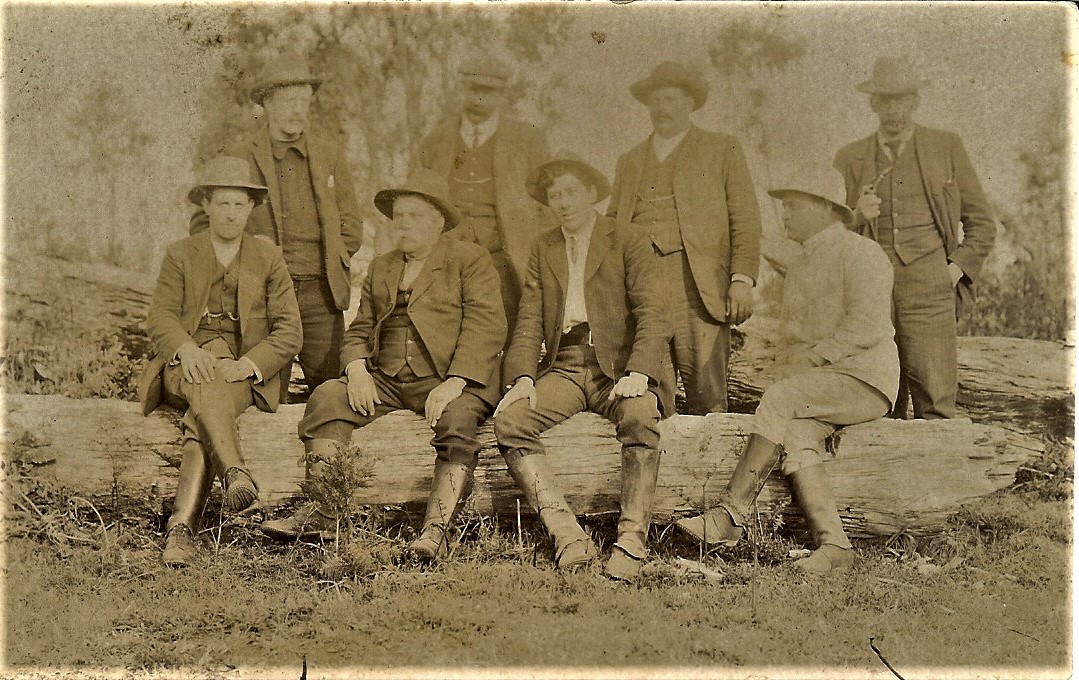
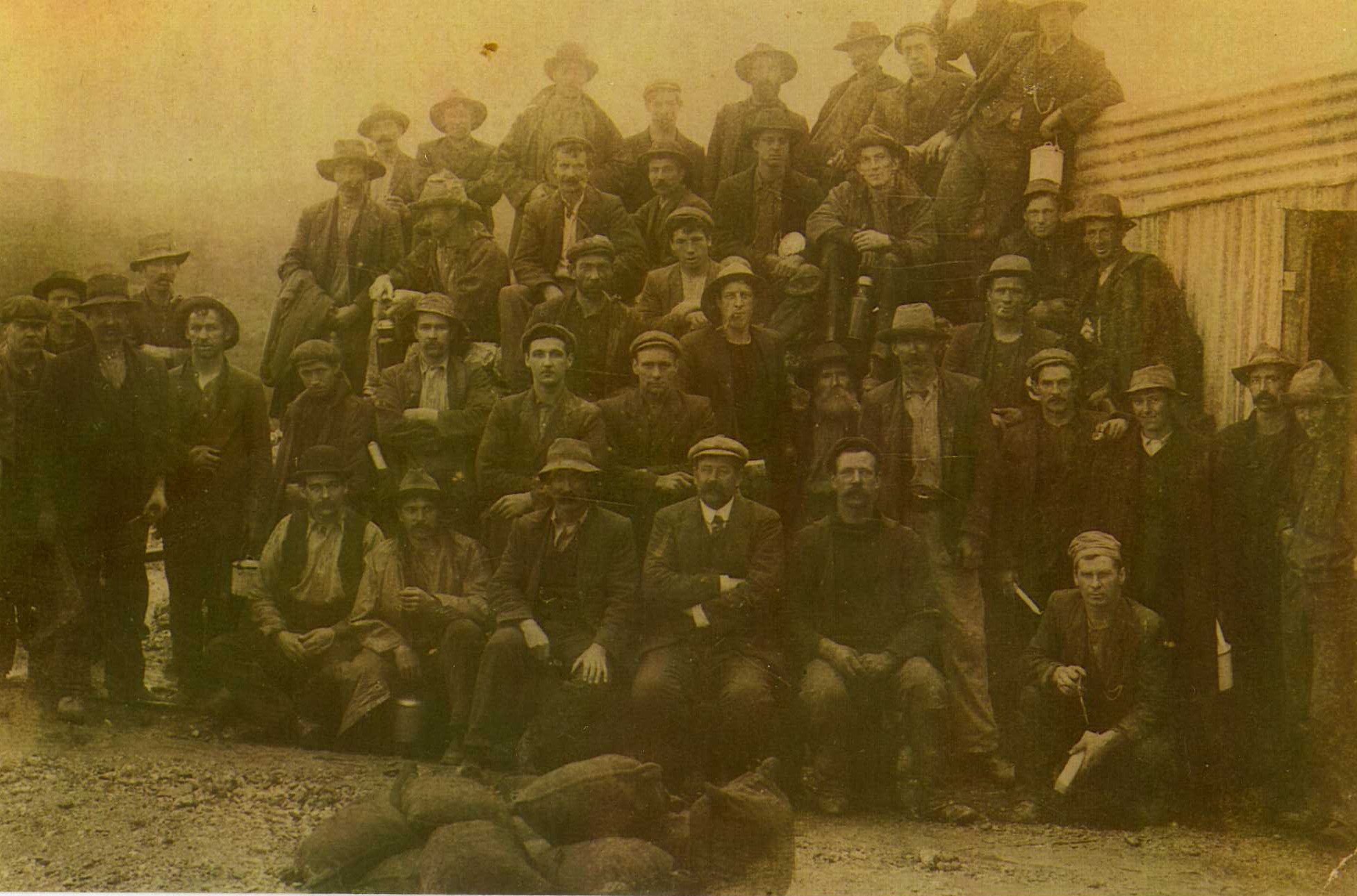
On 7 November 1909 TB Moore wrote in his diary: ‘Went into Balfour… Afternoon saw Harrisson & Insp Harrison, Langford, Speedy, young Dunne. The above with the two Murrays had our photos taken in a group. Fine & warm.’ Moore is at the extreme left in the back row. Beside him are William and Tom Murray. Courtesy of Michael Simco.
By the spring of 1909, investors were agog at the 1100 tons of ore, averaging about 30% copper, which the Murrays had reportedly dispatched. In addition, three or four times as much high grade ore was said to have been ‘at grass’ on the property. In October 1909 a report circulated that the brothers had sold the Copper Reward mine for £50,000 and an interest in a company with a big working capital—a claim the Murrays denied.[8] Meanwhile a township named after nearby Mount Balfour developed.
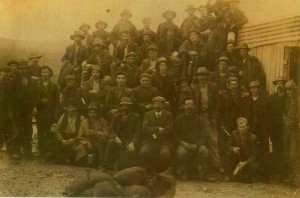
The workforce of the Copper Reward mine, with William Murray centre at front, and engine driver William McArthur seated to his left. Photo courtesy of Edie McArthur.
The entire mining field appears to have been invigorated by developments at the Copper Reward. Mount Lyell was stamped all over the speculation boom that followed. The Central Mount Balfour Company, with Mt Lyell Co directors Aloysius Kelly and Herman Schlapp in prominent roles, was floated in Melbourne with £25,000 subscribed capital. The adjoining Balfour Blocks Company had Mount Lyell supremo Bowes Kelly as chairman of directors. Meanwhile, veteran prospector and explorer Thomas Bather (TB) Moore dug away at the Norfolk Ranges at the behest of his boss, Robert Sticht.[9] In May 1910 the first sod was turned on the Stanley to Balfour Railway, a farcical grab at timber and hydro-electric power concessions by the Melbourne promoters of the Mount Balfour Copper Mines NL, now styling themselves the Mount Balfour Mining and Railway Company—mimicking the Mount Lyell Mining and Railway Company.[10]
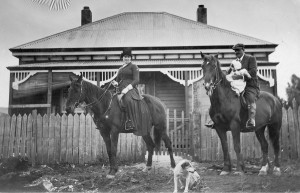
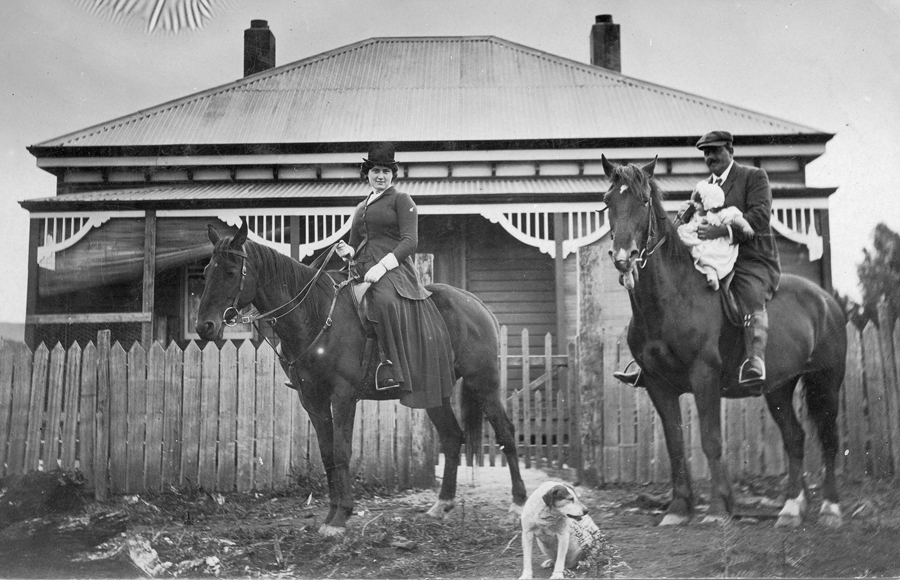
Hazel and William Murray in front of their ‘mansion’ at Balfour, 1911, with daughter Jean. Marital bliss or a façade for the photographer? Photo 1997:P:5591, QVMAG, Launceston.
It must have been tempting for the Murray brothers to start living the good life that the speculation promised, and which could easily have landed them in debt. Forty-eight-year-old William took an eighteen-year-old wife, Melbourne-born Hazel, née Myers (1891–1973).[11] Married in Sydney, the couple honeymooned first at Jenolan Caves, then in England while their Balfour home was built.[12] The Circular Head Chronicle noted that the house, with its concrete double chimneys, would provide ‘a magnificent contrast to our present canvas and paling humpies, to say nothing of those described by a recent visitors as being made of opened out sardine tins’.[13] TB Moore referred to the Murrays’ house as ‘the mansion’.[14] It is possible that Hazel Murray wasn’t quite so impressed with it when, in mid-1911, following on from their antipodean jaunt, William brought his young bride, baby and maid to Balfour via stage coach and the new horse-drawn tramway from Temma.[15] How happy the couple seems in the photo, with Hazel astride her horse, and William clutching their first daughter, Jean Wallace Murray.[16] Did Hazel adjust to frontier living, or did she ‘fly’ back to ‘civilisation’?
The fate of the Murray brothers is a staple of Tasmanian mining folklore, even being the subject of a play.[17] William Murray shot himself in his home at Donald Street, Balfour, in November 1912, reputedly as part of an unfulfilled double suicide pact with his brother Tom.[18] William was a quiet and private man: only he would know why he suicided. In her description of William and Hazel Murray’s wedding, the social writer for the Star newspaper referred to the brothers by their second names, Wallace and Charles: perhaps they had new social pretensions in Sydney. Had the Murrays missed their big chance to sell the mine, had dreams of marriage and riches crashed? It has been claimed that they refused an offer of £30,000 for a mine that ultimately proved a failure.[19] However, it had not failed at the time of William Murray’s death, and the copper price was starting to recover from the 1907 crash. It was sadly appropriate that William’s death was overshadowed by the tragedy of the North Mount Lyell fire, which killed 42 miners.[20]
William Murray bequeathed Hazel his life insurance policy to the value of £250—providing death by suicide was covered. She would not have been able to claim on an accident policy to the same value. She also received half the value of his mining interests, the other half being divided between his brother Tom Murray and others.[21] Perhaps debts absorbed all this and more. In 1913, 22-year-old mother-of-two Hazel was operating a boarding house at Battery Point, Hobart, but later she appears to have returned to her family.[22] Little is known about her life in Sydney. Her second daughter, Mary Fullarton Murray, married in 1937, but the other, Jean, had an unhappy love affair, suing her lover for £1000 in 1942 for breach of marriage contract.[23]
Tom Murray reputedly suffered a mental breakdown after his brother’s suicide, although he was apparently fit enough to walk from Hobart to Balfour to tend William’s grave.[24] Certainly he seems to have led a listless life, returning to Balfour in 1916 and 1920, then selling up his farm at Forest in 1924 with the intention of leaving the state.[25] Tom hunted osmiridium at Adamsfield two years later.[26] Described as having ‘no occupation’ and being ‘late of Roger River’, he died intestate at Latrobe in 1938, aged 75.[27] The Copper Reward mine remains untested at depth.
[1] ‘The Late Rev WWF Murray, MA’, Church News, October 1894, p.156; Whitfield Index (LINC Tasmania, Launceston)
[2] The Tasmanian Pioneers Index records that William Wallace Fullarton Murray senior and Louisa Augusta Schaw married at Richmond, Tasmania, in 1851 and produced five children at New Norfolk, Louisa Augusta Murray (born 1854), Mary Wallace Murray (born 1857), Eleanor Carter Murray (born 1859), then the two boys. William Wallace Fullarton Murray junior’s birth, recorded without given names, was 23 April 1861 (RGD33, 1664/1861). Thomas Charles Murray was born 5 October 1862 (RGD33, 1188/1862). However, the author of ‘The Late Rev WWF Murray, MA’, Church News, October 1894, p.156, records that he was survived by six girls, two of them married, and two unmarried sons.
[3] Valentia Kate (Kate Valencia) Murray (died 1948) married William Wilbraham Ford at Hobart in 1897, registration no.270/1897. For Ford as Smith’s grub-staker, see ‘A Balfour mining case: decision reserved’, Circular Head Chronicle, 10 August 1910, p.2.
[4] For WW Ford as promoter, see ‘Mt Balfour Copper Mines’, Circular Head Chronicle, 15 April 1908, p.2, in which Ford invites the newspaper’s reporter to the mining field as a guest of the Murray brothers.
[5] ‘A Balfour mining case: decision reserved’, Circular Head Chronicle, 10 August 1910, p.2. For William and Tom Murray’s gold leases, see Queenstown Assessment Roll for 1908, Tasmanian Government Gazette, 15 October 1907, p.1504. Tom Murray was then the owner/occupier of a cottage in Peters Street, Queenstown (p.1497). The Tasmanian Post Office Directory for 1907 (p.437) and 1908 (p.439) lists both Murrays as ‘mine owner, Queenstown’, whereas the 1909 edition (p.417) has them both as ‘mine owner, Mt Balfour’.
[6] ‘A Balfour mining case: decision reserved’, Circular Head Chronicle, 10 August 1910, p.2. In 1910 the Court of Mines adjudicated that Smith’s one-fifth share now belonged to Ernest Plummer and James Loftus Wells of Stanley (a one-tenth share each), to each of whom Smith had sold half his interest before he disappeared (‘Murray’s [sic] Reward Mine: Balfour mining action’, Circular Head Chronicle, 31 August 1910, p.2). A Murray brothers appeal to the Supreme Court in 1911 overturned this decision, denying Plummer and Wells any interest in the Murrays’ Copper Reward mine (‘A mining dispute: the Murray Reward claim: judgment for defendants’, Circular Head Chronicle, 3 May 1911, p.2).
[7] ‘Mount Balfour’, Circular Head Chronicle, 13 July 1910, p.3.
[8] ‘Mining’, Mercury, 26 October, p.3; and 4 November 1911, p.2.
[9] See TB Moore diaries for 1908 and 1909, ZM5640 (Tasmanian Museum and Art Gallery [hereafter TMAG]).
[10] ‘The Balfour Railway: turning the first sod’, Circular Head Chronicle, 10 May 1910, p.2.
[11] ‘Personal’, Circular Head Chronicle, 19 January 1910, p.2.
[12] ‘Social news’, Star (Sydney), 29 January 1910, p.16.
[13] ‘Mount Balfour’, Circular Head Chronicle, 9 February 1910, p.3.
[14] TB Moore diaries, 30 April 1912, ZM5641 (TMAG).
[15] ‘Balfour: general news’, Circular Head Chronicle, 30 August 1911, p.2.
[16] Did the maid hand the baby over to her father so that she could take the photo?
[17] The play is Heather Nimmo’s ‘Murrays’ Reward: a play in two acts’.
[18] The Circular Head Chronicle (‘Deaths at Balfour’, 6 November 1912, p.2) reported merely that Murray had ‘died suddenly’. The coroner found that Murray died of a self-inflicted ‘gunshot wound to the head … while of unsound mind’ (see SC195-1-82-13112, [TAHO]).
[19] E Payne, ‘Balfour mine’, Examiner, 19 March 1951, p.2.
[20] ‘Deaths at Balfour’, Mercury, 7 November 1912, p.4; death notice, Mercury, 20 November 1912, p.1.
[21] Will no.9043, AD960-1-34 (TAHO).
[22] The Hobart Assessment Roll for 1913 places her as a tenant in De Witt Street, Battery Point (Tasmanian Government Gazette, 8 December 1913, p.2426).
[23] ‘Out of town news’, Sydney Morning Herald, 9 March 1937, p.3; ‘Woman to receive £1000 damages’, Sydney Morning Herald, 8 September 1942, p.7.
[24] For Tom’s reputed mental breakdown see, for example, Kerry Pink and Annette Ebdon, Beyond the ramparts: a bicentennial history of Circular Head, Tasmania, Circular Head Bicentennial History Group, Smithton, 1988, p.249. For Tom’s return visits to tend William’s grave, see Joan Foss, Memories of the Marrawah Sand Track (held by Circular Head Heritage Centre, Smithton). Tom Murray reportedly asked to be relieved of the management of the Copper Reward in 1913 because of ill health (‘The Balfour field’, Circular Head Chronicle, 17 December 1913, p.2).
[25] ‘Mining’, Mercury, 13 June 1916, p.3; ‘Personal’, Circular Head Chronicle, 30 June 1920, p.3; advert, Advocate, 3 May 1924, p.8.
[26] ‘Forest’, Circular Head Chronicle, 14 July 1926, p.5.
[27] ‘Deaths’, Mercury, 16 August 1938, p.1. Probate was valued at only £168, see AD963-1-3-2352 (TAHO). He was buried at Cornelian Bay Cemetery, Hobart. An Examiner correspondent later claimed that Tom Murray ‘just sold me the machinery and left’, predicting that ‘we have not heard the last of Balfour yet’ (E Payne, ‘Balfour mine’, Examiner, 19 March 1951, p.2).
by Nic Haygarth | 29/12/16 | Circular Head history, Story of the thylacine, Tasmanian high country history
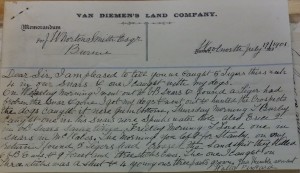
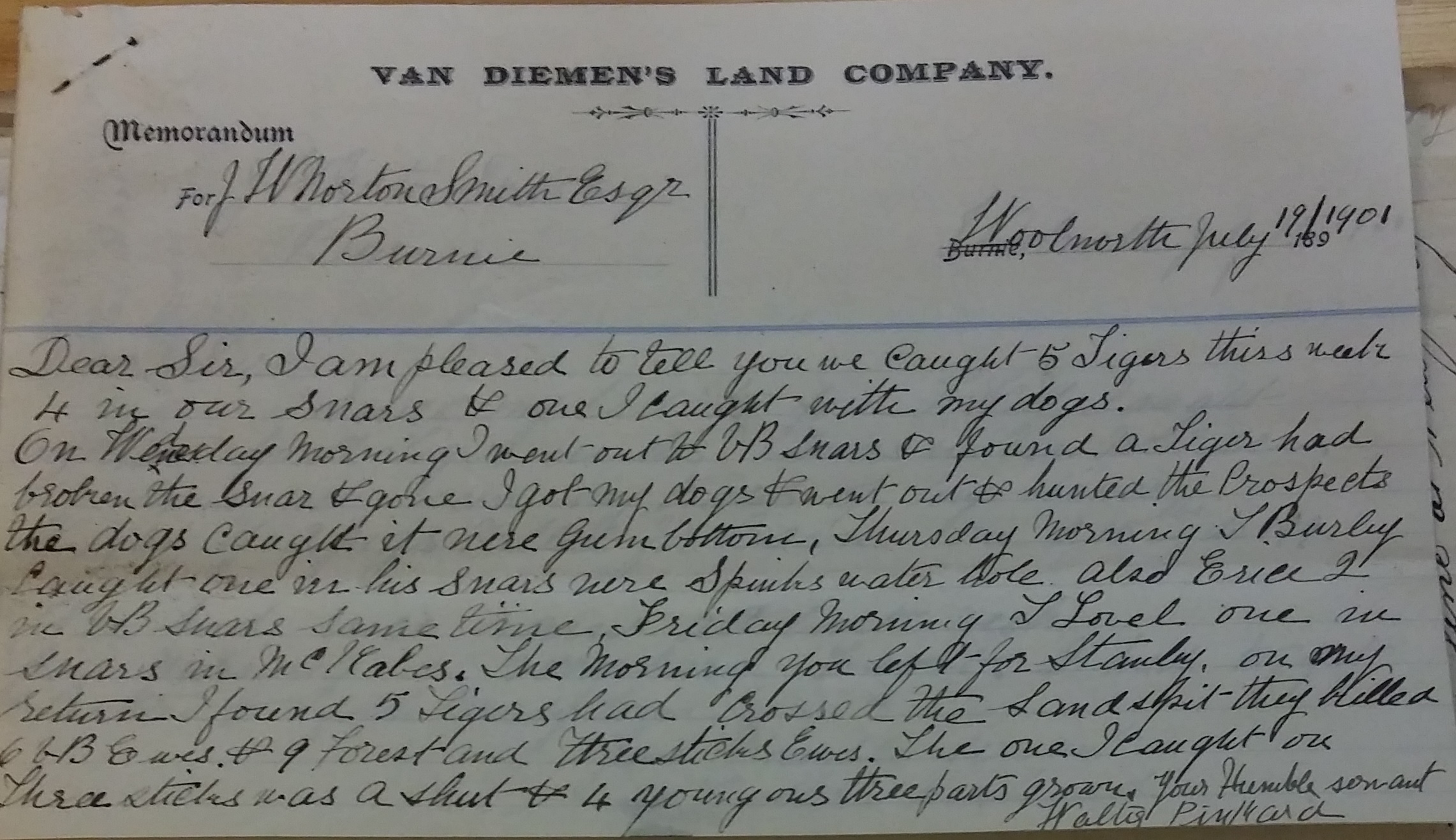
Tigers to the left, tigers to the right … VDL Co stockman Walter Pinkard reports from the thick of the Woolnorth tiger action 8 June 1901. From VDL22-1-32 (TAHO).
How do you stigmatise an animal? Try branding. The change from ‘hyena’ to ‘tiger’, as the common descriptor for the thylacine, was a major step in its reinvention as a sheep killer. Both ‘tiger’ and ‘hyena’ were used commonly to describe the thylacine during much of the nineteenth century, with ‘tiger’ only becoming the dominant term late in that century and into the twentieth century. For example, the records of the Van Diemen’s Land Company (VDL Co) show that the company’s local officers used ‘hyena’ almost universally to describe the thylacine during the company’s first period of farming its Woolnorth property, in the years 1827–51—whereas later they went exclusively with ‘tiger’.
The stripes on the thylacine’s back presumably prompted the original attributions of the names ‘tiger’ and ‘hyena’, by Robert Knopwood and CH Jeffreys respectively.[1] The Bengal tiger (Panthera tigris tigris) and the striped hyena (Hyaena hyaena) were mentioned regularly in nineteenth-century newspaper items about life in the British Raj, which some foreign-born Tasmanians had also visited. Tigers, leopards, cheetahs, wolves and, less often, hyenas, preyed on stock and sometimes people in India. Government rewards were offered there for killing tigers. While the fearsome tiger was the favourite ‘sport’ of Indian big game hunters, the hyena, unlike its some-time Tasmanian namesake, was not the primary carnivore in the Bengali ecology. It was sometimes reported to be ‘cowardly’, ‘skulking’ and lacking in the fight desired by the game hunter.[2]
Likewise, the thylacine was also often described as ‘cowardly’ in its alleged sheep predations.[3] By the 1870s and 1880s, however, when the profitability of the wool industry was declining, those employed in the industry seem to have used the term ‘tiger’ almost universally to describe the thylacine. Perhaps shepherds preferred ‘tiger’ because it glamorised their profession, introducing an element of danger and likening them to the big game hunters of India. The way in which some thylacine killers made trophies of their kills and were photographed with these suggests identification with big game hunting.[4] By the same token, dubbing the thylacine a ‘tiger’ provided a potential scapegoat for sheep losses, enabling the shepherd to shift the blame for his own poor performance on to what may henceforth be perceived as a dangerous predator. Wool-growers wanting to eliminate the thylacine would also be keen to cast it as a dangerous predator. John Lyne, the east coast wool-grower who led the campaign for a government thylacine bounty, referred to the animal as a ‘tiger’ but also as a ‘dingo’, thereby equating the thylacine with the well-known mainland Australian sheep predator.[5] In 1887 ‘Tiger Lyne’s campaign was mocked to the effect that
‘the jungles of India do not furnish anything like the terrors that our own east coast does in the matter of wild beasts of the most ferocious kind. According to ‘Tiger Lyne’, these dreadful animals [thylacines] may be seen in their hundreds stealthily sneaking along, seeking whom they may devour …’[6]
The VDL Co correspondence records show that the company’s local agent James Norton Smith also originally described the thylacine as a ‘hyena’. He appears to have adopted ‘tiger’ as a descriptor in 1872 after his Woolnorth overseer, Cole, used the term in a letter to him. James Wilson, Woolnorth overseer 1874–98, also used the term ‘tiger’ exclusively, and after 1876 Norton Smith followed suit. The term ‘hyena’ was not used in any correspondence written or compiled by VDL Co staff, in Woolnorth farm journal records or Woolnorth accounting records in the years 1877–99. While Norton Smith occasionally used the term ‘hyena’ in the years following Wilson’s retirement from Woolnorth, ‘tiger’ remained his preferred term and this continued to be used exclusively at Woolnorth.
Theophilus Jones: thylacine prosecutor
As Robert Paddle and others have suggested, pastoralists generally blamed the thylacine as well as the rabbit for their declining political power and wealth.[7] One of the greatest prosecutors of the thylacine at this time was Theophilus Jones. In 1877–78 and 1883–85 two young British journalists toured Tasmania writing serialised newspaper accounts of its districts. Since both were newcomers, with limited knowledge of the colony, they could be expected to repeat unquestioningly much of what they were told. The first of these writers, E Richall Richardson, travelled all the populated regions of Tasmania except the far north-west and Woolnorth. On the east coast, Richardson interviewed woolgrowers, including John Lyne, the MHA for Glamorgan who a decade later would petition to establish the thylacine bounty. Richardson’s only comment upon the thylacine as a sheep killer or any kind of nuisance in his 92-part series was not on the east coast or in the Midlands, but in reference to the twice-yearly visits of graziers to their Central Plateau stock runs:
‘If when the master comes up, and there is a deficit in the flock, the rule is ‘blame the tiger’. The native tiger is a kind of scape-goat amongst shepherds in Tasmania, as the dingo is with shepherds in Queensland; or as ‘the cat’ is with housemaids and careless servants all over the world. ‘It was the cat, ma’am, as broke the sugar-basin’; and ‘It was the tigers, sir, who ate the sheep’.[8]
Theophilus Jones, in his 99-part series written in the years 1883–85, told a different tale. By this time, only half a decade since Richardson wrote, the wool industry had declined markedly. The first ‘stock protection’ association, that is, a locally subscribed thylacine bounty scheme, was formed at Buckland on the east coast in August 1884 while Jones was touring the area.[9]
Jones’ circumstances were different to the earlier writer’s. Although travelling in poverty, Richardson was a single man with no commitments. Jones, on the other hand, was trying desperately to support a wife and large family. While travelling Tasmania as a newspaper correspondent, he doubled as an Australian Mutual Provident (AMP) assurance salesman. Much more than Richardson, Jones concentrated on populated areas where he might sell assurance and find well-to-do patrons. He not only visited Woolnorth but practically every large grazier in the colony, and he flattered men who were in a position to financially benefit him. Whether currying favour or being merely ignorant of the truth, it is not then surprising to find Jones spouting woolgrowers’ vituperative against the thylacine. Henry, John and William Lyne appear to have fed Jones a litany of almost six decades of warfare with Aborigines and the wildlife, as if these were age-old predators: ‘Blacks and tigers made the life of a young shepherd one of continued mental strain’.[10] For Jones the tiger was generally the biggest killer of sheep, followed by the devil and the ‘eaglehawk’. The thylacine had ‘massive’ jaws, ‘serrated’ teeth and a powerful body like that of a kangaroo dog.[11] It was ‘a great coward’, savaging lambs but refusing battle with man or dog.[12] Jones applauded the stock protection association, hoping that it would reduce eagles and tigers ‘to the last specimen’.[13] That is, drive them to extinction.
Jones had already visited Woolnorth. He found that, like his predecessors, tigerman Charlie Williams kept ‘trophies’ at Mount Cameron, his prize being a thylacine skin 2.3 metres long.[14]
Like Williams, the government was actually more interested in possums. It had cited increased hunting, in response to high skin prices, as a reason to introduce the Game Protection Amendment Act (1884), which protected all kinds of possum during the summer, allowing open season from April to July inclusive. During debate about the bill in the House of Assembly, James Dooley ‘likened the sympathy for the native animals to that which was excited in favour of the native race’, to which MHA for Sorell, James Gray, responded that ‘the only resemblance between the natives and the opossums were that they were both black. (Laughter.)’[15]
It was also Gray who in 1885 asserted the ‘necessity of something being done to stop the ravages of the native tiger in the pastoral districts of the colony …’.[16] John Lyne took up this stock protection measure: a £1 per head thylacine bounty operated from 1888 to 1909. About 2200 bounties were paid across Tasmania, helping to drive the animal towards extinction. Bounties were paid by the Colonial Treasurer upon thylacine carcasses being presented to local police magistrates or wardens.
Woolnorth was a remote settlement with challenges faced by few wool-growing properties. Distance from towns, doctors and schools was probably one reason that it was so difficult to find and keep a reliable man to work at Mount Cameron West in particular. Time and time again James Wilson’s farm journals record the Mount Cameron West shepherd’s monthly visits to the main farm at Woolnorth to get supplies and return with them to his own hut: ‘Tigerman came down’ and ‘Tiger went home’. ‘Tigerman’, which carries the implication of being a dedicated thylacine killer, may have been coined to glamorise the position in order to attract staff. It and the general use of the term ‘tiger’ at Woolnorth may also indicate that the overseer, his stockman and farm hands wanted to shift the blame for sheep losses on the property.
Table 3: Occurrences of various names for the thylacine in Tasmanian newspapers for the years 1816–1954 (in both text and advertising), taken from the Trove digital newspaper database 22 December 2016
| NAME |
1816–87 |
1888–1909 |
1910–54 |
TOTAL |
| Tasmanian tiger |
141 (84–57) |
96 (64–32) |
434 (420–14) |
671 (568–103) |
| Native tiger |
326 (199–127) |
197 (186–11) |
88 (88–0) |
611 (473–138) |
| Tasmanian native tiger |
5 (5–0) |
0 (0–0) |
7 (7–0) |
12 (12–0) |
| Thylacine/thylacinus |
43 (43–0) |
20 (20–0) |
93 (91–2) |
156 (154–2) |
| Hyena/native hyena/opossum hyena |
165 (107–58) |
46 (39–7) |
84 (77–7) |
295 (223–72) |
| Dog-faced opossum |
1 (1–0) |
0 (0–0) |
0 (0–0) |
1 (1–0) |
| Tasmanian wolf |
9 (3–6) |
11 (11–0) |
97 (97–0) |
117 (111–6) |
| Marsupial wolf |
4 (4–0) |
6 (6–0) |
74 (74–0) |
84 (84–0) |
| Tiger wolf |
7 (7–0) |
3 (3–0) |
3 (3–0) |
13 (13–0) |
| Native wolf/native wolf-dog |
5 (5–0) |
0 (0–0) |
5 (5–0) |
10 (10–0) |
| Zebra wolf |
5 (5–0) |
6 (6–0) |
2 (2–0) |
13 (13–0) |
| Tasmanian tiger wolf |
1 (1–0) |
0 (0–0) |
0 (0–0) |
1 (1–0)[17] |
In her book Paper tiger: how pictures shaped the thylacine, Carol Freeman stated that ‘Tasmanian wolf’ and ‘marsupial wolf’ were the principal names given to the thylacine in the zoological world until well into the twentieth century, described how in the period from the 1870s to the 1890s ‘wolf-like’ visual images of the species predominated in natural history literature, and speculated that illustrations of this kind, repeated in mass-produced Australian newspapers in 1884, 1885 and 1899, ‘influenced perceptions close to the habitat of the thylacine and encouraged government extermination policies’.[18]
The National Library of Australia’s Trove digital newspaper database allows us to test the idea that the depiction of the thylacine as a ‘wolf’ or as ‘wolf-like’ had any traction in Tasmania. Unlike the inter-colonial illustrated newspapers to which Freeman referred—Australian Graphic (1884), Illustrated Australian News (1885) and Town and Country Journal (1899)—the Trove search represented by Table 3 is restricted to 88 Tasmanian newspaper titles, 23 of which published during at least part of the period of the Tasmanian government thylacine bounty 1888–1909. More than any other type of publication, the Tasmanian newspapers are likely to contain the language of ordinary Tasmanians, expressed either by journalists, newspaper correspondents or by themselves in letters to the editor—and they were more likely than any other form of publication to be read by and contributed to by graziers, legislators and hunter-stockmen involved in killing thylacines. Some of these newspapers carried occasional lithographed or engraved images, but the search does not include the two best-known Tasmanian illustrated newspapers, the Weekly Courier (1901–35) and the Tasmanian Mail/Illustrated Tasmanian Mail (1877–1935), which (in December 2016) were yet to be digitised for the Trove database. Trove coverage of Tasmanian newspapers begins with the Hobart Town Gazette and Southern Reporter in 1816 and goes no later than 1954 except in a few cases.
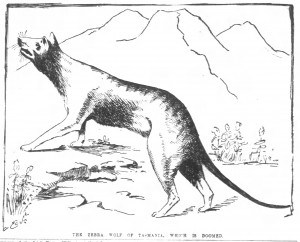
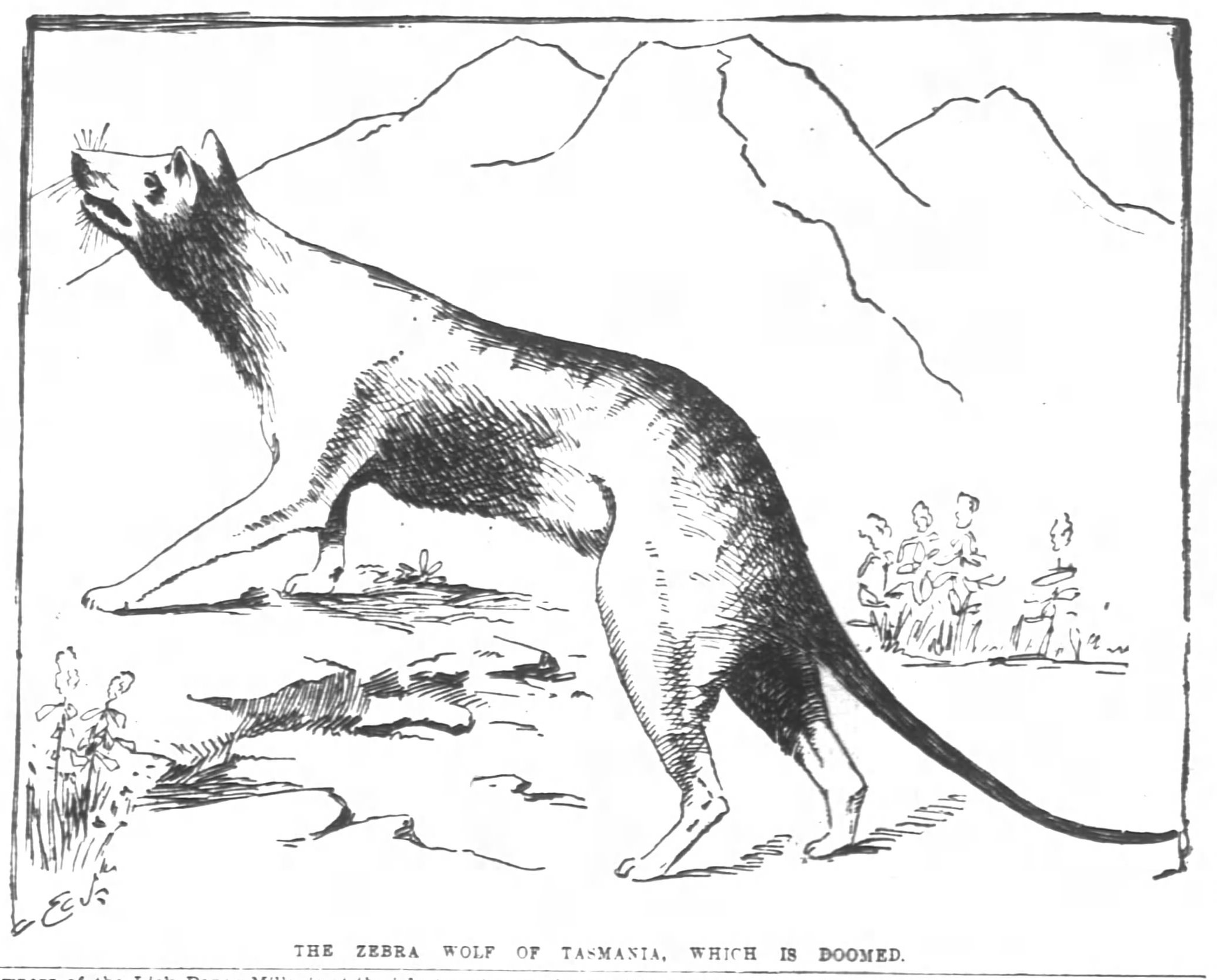
The Tasmanian ‘zebra wolf’, from the San Francisco Chronicle, 18 February 1896, p.6.
The Trove search suggests that in the period 1888–1909 the terms ‘native tiger’ (197 hits) and ‘Tasmanian tiger’ (96 hits) were much more widely used by the general public in Tasmania that any permutation of ‘wolf’ (26 hits altogether), and that ‘hyena’ (46 hits) was also more popular than ‘wolf’. While the 1884 issue of Australian Graphic which contained the illustration of the ‘Tasmanian zebra wolf’ is not included in the Trove search, it did pick up a description of that issue of the newspaper by the editor of the Mercury. Clearly he was not profoundly influenced by the engraving of the thylacine:
‘The illustrations are fairly good, excepting those which are apparently intended to be amusing; these amuse only by their extreme absurdity. There is a cut representing, what is termed, a Tasmanian zebra wolf. It is about as true to nature as the pictures exhibited outside a travelling menagerie’.[19]
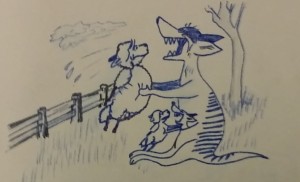
The ‘Tasmanian wolf’ as a sheep devourer in 1947, when the term ‘wolf’ had gained some popular usage: from Hotch Potch (the magazine of the Electrolytic Zinc Company of Australasia), October 1947, vol.4, p.2 (TAHO).
The names ‘Tasmanian wolf’ (97 hits) and ‘marsupial wolf’ (74 hits) only gained traction in Tasmanian newspapers in the period (1910–54) when the thylacine was clearly disappearing or virtually extinct, that is, when the scientific and zoological community entered the popular press in its desperate search for a remnant thylacine population. This is also the period in which the Latin scientific name for the animal, thylacine, thylacinus (93 hits) occurred much more frequently in the Tasmanian press. However, even in this period, ‘tiger’ (529 hits) remained easily the predominant descriptor for the thylacine. The fact that the thylacine received more attention in the press during the years when it could not be found than when it could speaks for itself, although of course many more newspapers were published in the first half of the twentieth century than in the nineteenth.
[1] Eric Guiler and Philippe Godard, Tasmanian tiger: a lesson to be learnt, Abrolhos Publishing, Perth, 1998, p.15.
[2] ‘Pigsticking in India’, Launceston Examiner, 29 March 1897, p.3; ‘Shikalee’, ‘Wild sport in India’, Launceston Examiner, 24 July 1897, p.2.
[3] See, for example’, ‘Royal Society of Tasmania’, Courier, 16 June 1858, p.2; or ‘Town talk and table chat’, Cornwall Chronicle, 27 March 1867, p.4.
[4] See, for example, [Theophilus Jones], ‘Through Tasmania: no.35’, Mercury, 26 April 1884, supplement, p.1.
[5] See, for example, ‘Parliament’, Launceston Examiner, 1 October 1886, p.3.
[6] Tasmanian Mail, 3 September 1887; cited by Robert Paddle, The last Tasmanian tiger: the history and extinction of the thylacine, Cambridge University Press, Cambridge, UK, 2000, p.161.
[7] See Robert Paddle, The last Tasmanian tiger.
[8] E Richall Richardson, ‘Tour through Tasmania: no.89: cattle branding’, Tasmanian Tribune, 14 March 1878, p.3.
[9] ‘Buckland’, Mercury, 15 August 1884, p.3.
[10] Theophilus Jones, ‘Through Tasmania: no.61’, Mercury, 8 November 1884, supplement, p.1.
[11] Theophilus Jones, ‘Through Tasmania: no.49’, Mercury, 26 July 1884, p.2.
[12] Theophilus Jones, ‘Through Tasmania: no.35’, Mercury, 26 April 1884, supplement, p.1.
[13] Theophilus Jones, ‘Through Tasmania: no.56’, Mercury, 20 September 1884, p.2.
[14] Theophilus Jones, ‘Through Tasmania: no.35’, Mercury, 26 April 1884, supplement, p.1.
[15] ‘House of Assembly’, Mercury, 24 October 1884, p.3.
[16] ‘Meeting at Buckland’, Mercury, 14 August 1884, p.2; ‘The native tiger’, Mercury, 25 September 1885, p.2.
[17] This list was compiled on 22 December 2016. The numbers in brackets indicate how many of the hits occurred in text and how many in advertising. While occurrences of a name in advertising are a relevant gauge of its public usage, it is recognised that numbers of hits are exaggerated by repeated publication of the same advertisement. Another issue noted in this search of Trove was the need to weed out references to ‘native and tiger cats’, which refer to the two species of quoll rather than to the thylacine. There are also cases of repetition in the sense that some textual references involve two or more names for the thylacine, such as ‘the Tasmanian tiger or marsupial wolf’. In such cases both names have been included in the table.
[18] Carol Freeman, Paper tiger: how pictures shaped the thylacine, Forty South Publishing, Hobart, 2014, pp.117and 140.
[19] Editorial, Mercury, 28 March 1884, p.2.
by Nic Haygarth | 28/12/16 | Circular Head history, Story of the thylacine, Tasmanian high country history
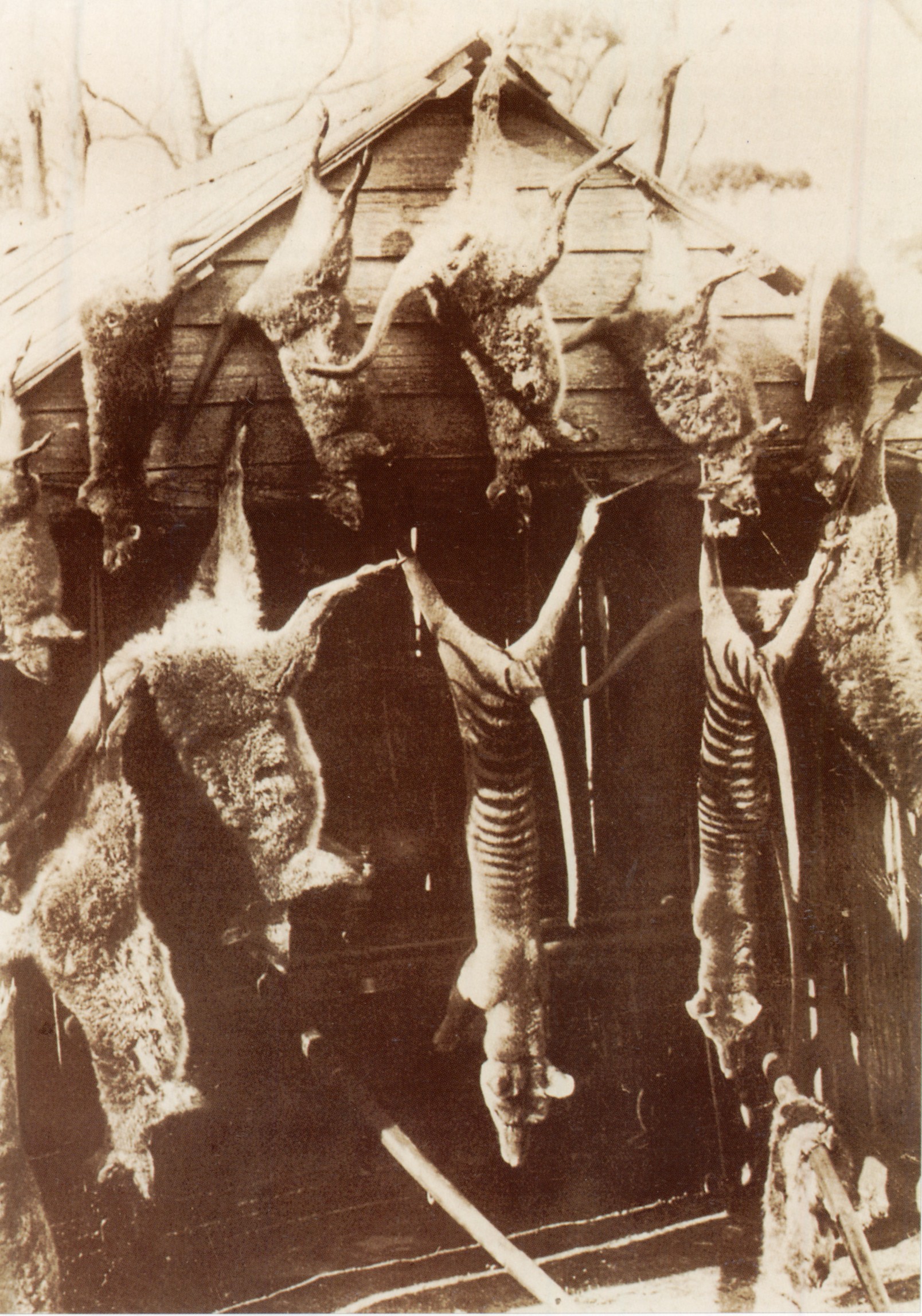
A photo of two thylacine (Thylacinus cynocephalus) carcasses suspended from a hut in Waratah, Tasmania, has intrigued students of the animal’s demise. Who killed these tigers? Eric Guiler speculated that they might have been taken by a Waratah hunter John Cooney who collected two government thylacine bounties in 1901.[1]
In fact the photographer, Arthur Ernest Warde, was himself a hunter and future Woolnorth ‘tigerman’, and the photo probably depicts his own kills. The man in question was a wheeler and dealer who spent three decades in Tasmania, turning his hand to any useful practical skill—including photography and exploiting the fur trade. The terms of Warde’s stint at the Van Diemen’s Land Company’s (VDL Co’s) Woolnorth property in the years 1903–05 confirm that, far from being specialist thylacine killers, the so-called Woolnorth tigermen were simply regular hunter-stockmen who also took responsibility for managing snares set for thylacines at Green Point near latter-day Marrawah. Given this collision of photographer and tiger snarer, it is tantalising to wonder what tiger-related photos Warde took while working at Woolnorth that may still remain undiscovered in a family scrapbook, or which may have long since mouldered away in someone’s back shed, lost for all time.

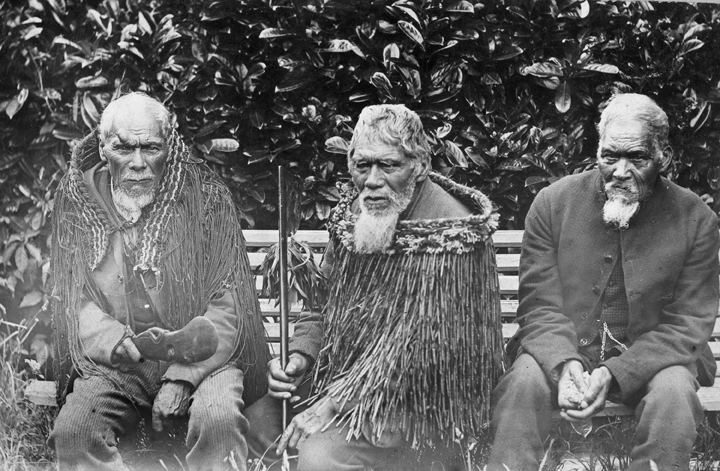
Ernest Warde photo of Maori chiefs, 1998:P:0383, QVMAG
Warde’s early life remains as mysterious as his tiger photo. In Wellington, New Zealand in 1890 he married renowned whistler and music teacher Catherine Elizabeth Walker, née Dooley, the daughter of Zeehan shopkeeper Joseph Benjamin Dooley and his wife Annie Dooley.[2] The Wardes, both of whom were known by their middle name, appear to have been in Bendigo in 1891 and by 1893 had relocated to Inveresk, Launceston, where the photographer, ‘late of New Zealand’, presented images of Maori chiefs to the Queen Victoria Museum.[3] The couple’s first child, Winifred Warde, was born at Launceston in 1893.[4]
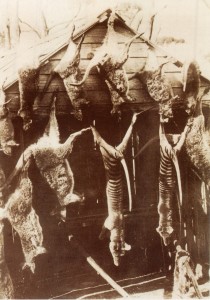
The Warde photo of the two thylacine carcasses, from Eric Guiler and Philippe Godard, Tasmanian tiger: a lesson to be learnt, p.129.
In 1896 the Wardes were in Devonport, in 1897 in Waratah, where second daughter Mabel was born.[5] Elizabeth taught music in both towns.[6] It was supposedly at Waratah that Warde took the intriguing photo, which shows two thylacine and eight wallaby carcasses hanging from the front of a building more closely resembling a woodshed than a hunting hut. The photo slightly pre-dates the era of the skinshed, the unique Tasmanian invention which revolutionised high country hunting by enabling hunters to dry large numbers of skins without leaving the high country. In fact, the photo does not show drying skins, but carcasses which are yet to be skinned. What is the purpose of the image? It is not the conventional trophy photo, which would pose the hunter with his trophy kill. Warde himself collected two thylacine bounties, ten months apart, in September 1900 and July 1901, while living at Waratah, where he probably learned to hunt.[7] Just as the bushman Thomas Bather Moore celebrated in verse the incident in which one of his dogs killed a ‘striped gentleman’, perhaps for Ernest Warde the novelty of killing a thylacine or two justified commemoration or memorialisation of the event with a photo. It is likely that he killed at least one of the thylacines in the photo, and afterwards submitted it for the government bounty.
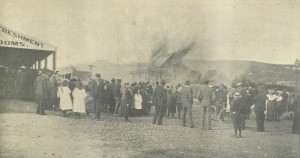
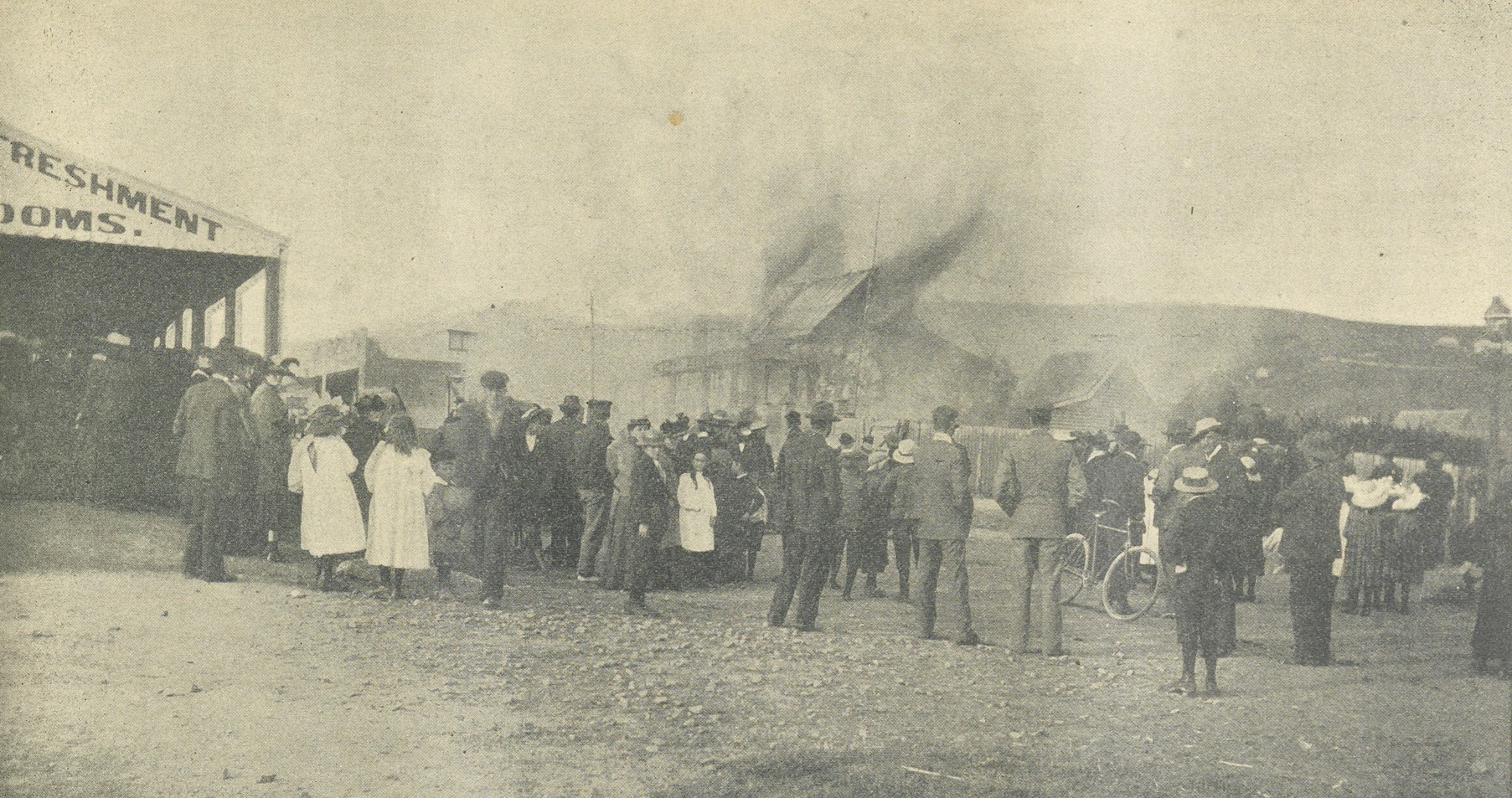
Warde’s Osborne Studio photo of the fire at ER Evans boot shop and house, Burnie.
From the Weekly Courier, 1 March 1902, p.17.
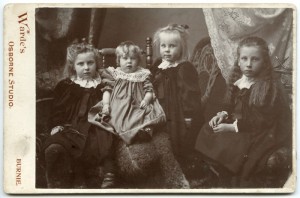
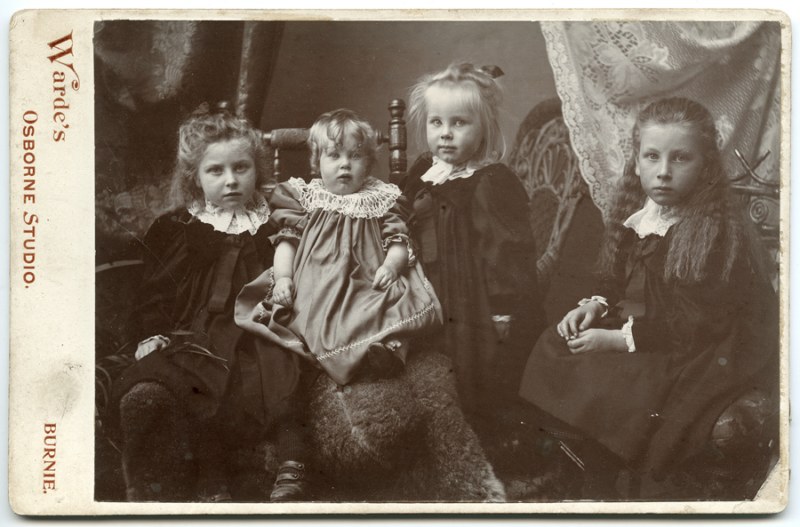
Warde’s Osborne Studio photo of EJ Wilson’s children, 1986:P:0045, QVMAG.
Warde was one of many to have practised photography in Waratah, and with the town’s population still growing, he would not be the last. However, in December 1901 a better photographic opportunity arose in a coastal centre, Burnie, when John Bishop Osborne decided to move on. Warde took over Osborne’s Burnie studio, while also operating a farm at Boat Harbour and advertising his and Elizabeth’s services as musicians.[8] In 1902, while Elizabeth was busy producing the couple’s third child, Francis Harold Warde, photos credited to Warde and to Warde’s Osborne Studio photos appeared in the Weekly Courier and Tasmanian Mail newspapers.[9]
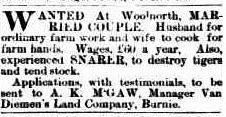
The tigerman job advertised, North Western Advocate and the Emu Bay Times, 22 May 1903, p.3.
Warde appears to have made the acquaintance of VDL Co agent AK McGaw while supplying photos to the company. The photography business must not have been lucrative, as in May 1903 he agreed to replace the gaoled George Wainwright as the Mount Cameron West tigerman.[10] Warde’s contract as ‘Snarer’ shows him to be a general stockman and farm hand engaged for the Mount Cameron West run, with the killing of ‘vermin’ (that is, all marsupials) his primary duty:
‘It is hereby agreed that the Snarer shall proceed to Mount Cameron Woolnorth … and shall devote his time to the destruction of Tasmanian Tigers, Devils and other vermin and in addition thereto shall tend stock depasturing on the Mount Cameron Studland Bay, and Swan Bay runs, also effect any necessary repairs to fences and shall immediately report any serious damage to fences or any mixing of stock to the Overseer & shall assist to muster stock on any of the above runs whenever required to do so & generally to protect the Company’s interests shall also prepare meals for stockmen when engaged on the Mount Cameron Run’.
The pay was £20 plus rations (meat, flour, potatoes, sugar, tea, salt, with a cow given him for milk) with the snarer providing his own horse.[11] A butter churn was later provided, and farm manager James Norton Smith added that ‘when he wants a change he can catch plenty of crayfish’.[12] No rent was paid for the Mount Cameron West Hut, and the former company reward of £1 per thylacine still applied. In addition, the VDL Co agreed to supply the snarer ‘with hemp and copper wire for the manufacture of tiger snares only (the Snarer supplying such materials as he may require for Kangaroo or Wallaby snares)’.[13] That is, the necker snares used to catch thylacines were stronger than those used to catch wallabies and pademelons. It was the same deal as for his predecessors: the company supplied a small wage and rations, encouraging the stockman-hunter to protect his flock by killing thylacines and keep the grass down by killing other marsupials. In July 1904 Warde advertised in the newspaper for an ‘opossum dog’, which he was willing to exchange for a ‘splendid kangaroo dog’. He knew that the best money was in brush possum furs.[14]
Warde was the last stockman-hunter based at Mount Cameron West. Nearing the close of 1904 he was also trying to ‘get a good line of snares down from the Welcome [?] forest into the back of the Studland bay knolls’, which would give him ‘a splendid tiger break …’[15] However, he had probably already landed the last of his twelve thylacines for the company. In February 1905 the Mount Cameron West Hut was burnt down, Warde’s family escaping the flames late at night in the breadwinner’s absence.[16] That the hut was not replaced for years confirms that the thylacine problem, real or perceived, had abated.[17]
After leaving Mount Cameron West, Ward ditched the ‘e’ from the end of his surname and complemented the Boat Harbour farm with a general store. The Wardes remained there until in 1923 they sold up their store to Hamilton Brothers of Myalla and relocated to New Zealand, where A Ernest Warde reattached his ‘e’ and reinvented himself firstly as an Otago real estate agent, working for his father-in-law, then as an Auckland used car salesman.[18] Elizabeth Warde disappeared from the picture and, appropriately, Ernest wound back his personal odometer to 49 years when in 1932 he took his new 33-year-old bride Mary Winifred Tremewan to see England and America.[19] The new marriage ended when the couple was living in Sydney in the mid-1940s.[20] Warde’s death certificate, in July 1954, described him as an ‘investor’. In truth, he was a trans-Tasman jack-of-all-trades who happened to be the last of the Woolnorth tigermen.[21]
[1] Eric Guiler and Philippe Godard, Tasmanian Tiger: a lesson to be learnt, Abrolhos Publishing, Perth, 1998, p.129. Cooney’s bounty payment was no.249, 19 June 1901 (2 adults, ’11 June’), LSD247/1/ 2 (Tasmanian Archive and Heritage Office [hereafter TAHO]).
[2] For her prowess as a whistler, see ‘Current topics’, Launceston Examiner, 15 January 1894, p.5; ‘Burston Relief Concert’, Daily Telegraph, 16 January 1894, p.3 and ‘Entertainment at the Don’, North West Post, 21 April 1894, p.4. Elizabeth Walker is the mother’s name given on the couple’s three children’s birth certificates. On the 1903 Electoral Roll her name is given as Catherine Elizabeth Warde.
[3] ‘Australian Juvenile Industrial Exhibition’, Ballarat Star, 26 May 1891, p.4; ‘The Museum’, Launceston Examiner, 23 December 1893, p.3.
[4] She was born 31 August 1893, birth registration no.606/1893, Launceston.
[5] In 1896 E Warde of West Devonport advertised to sell a camera, lens and portrait stand (advert, Mercury, 23 May 1896, p.4). In 1897 the Wardes featured in a Waratah dance (‘Plain and Fancy Dress Dance’, Launceston Examiner, 9 October 1897, p.9). Mabel Warde’s birth was registered as no. 2760/1898, Waratah.
[6] Advert, North Western Advocate and the Emu Bay Times, 30 January 1902, p.3.
[7]; Bounties no.293, 18 September 1900 (’11 September’); and no.305, 12 July 1901, LSD247/1/2 (TAHO).
[8] See advert, North Western Advocate and the Emu Bay Times, 6 December 1901, p.4; ‘Table Cape’, North Western Advocate and the Emu Bay Times, 19 November 1901, p.2. John Bishop Osborne, the former Hobart photographer, had been on the move every few years since setting up at Zeehan in 1890. Osborne moved to Penguin, and he would end his days in Longford, where he lived 1921–34. Ernest and Elizabeth Warde advertised that they were available to supply music to parties and balls, while Elizabeth also sought piano, organ and dance students (advert, North Western Advocate and the Emu Bay Times, 30 January 1902, p.3).
[9] Francis Harold Warde was born at Alexander Street, Burnie, on 17 December 1902 (registration no. 2061/1903). Catherine Elizabeth Warde and Ernest Warde were listed at Burnie on the 1903 Electoral Roll.
[10] The new operator of the Osborne Studio was Mr Touzeau of Melba Studio, Melbourne (advert, North Western Advocate and the Emu Bay Times, 27 June 1903, p.1). Warde held a furniture sale at his Alexander Street, Burnie, residence in June 1903 (‘Burnie’, North Western Advocate and the Emu Bay Times, 13 June 1903, p.3) and advertised for a ‘strong quiet buggy Horse and good double-seated Buggy (tray-seated preferred …’ (advert, North Western Advocate and the Emu Bay Times, 8 June 1903, p.3).
[11] For Warde’s proposed rations, see James Norton Smith to AK McGaw, 4 June 1903, VDL22/1/34 (TAHO).
[12] James Norton Smith to AK McGaw, 4 June 1903; Ernest Warde to AK McGaw, 7 October 1903, VDL22/1/34 (TAHO).
[13] Agreement between the VDL Co and Ernest Warde, 29 May 1903, VDL20/1/1 (TAHO).
[14] Advert, North West Advocate and the Emu Bay Times, 26 July 1904, p.3.
[15] E Warde to AK McGaw, 22 December 1904, VDL22/1/35 (TAHO).
[16] ‘Marrawah’, North West Advocate and the Emu Bay Times, 11 February 1905, p.2.
[17] Woolnorth farm journal, 3 February 1905, VDL277/1/32 (TAHO).
[18] ‘Boat Harbor’, Advocate, 31 January 1923, p.4; ‘Bankruptcy’, Auckland Star, 27 September 1929, p.9.
[19] Did Elizabeth Warde die or did the couple divorce? No record of her was found. According to their marriage certificate (registration no.8401/1929), Mary Winifred Tremewan was born in New Zealand in October 1898. For their ten-month English and American holiday, see ‘The social round’, Auckland Star, 6 January 1933, p.9 and UK Incoming Passenger Lists, 1878–1960. They sailed from Sydney to London on the Ormonde.
[20] Record no.1208/1944, Western Sydney Records Centre, Kingswood, NSW.
[21] Warde was not the last man to kill thylacines at Woolnorth, but the last in a long line of hunter-stockmen appointed specifically to Mount Cameron West to look after stock and manage the thylacine snares at Green Point.