by Nic Haygarth | 06/10/24 | Tasmanian high country history
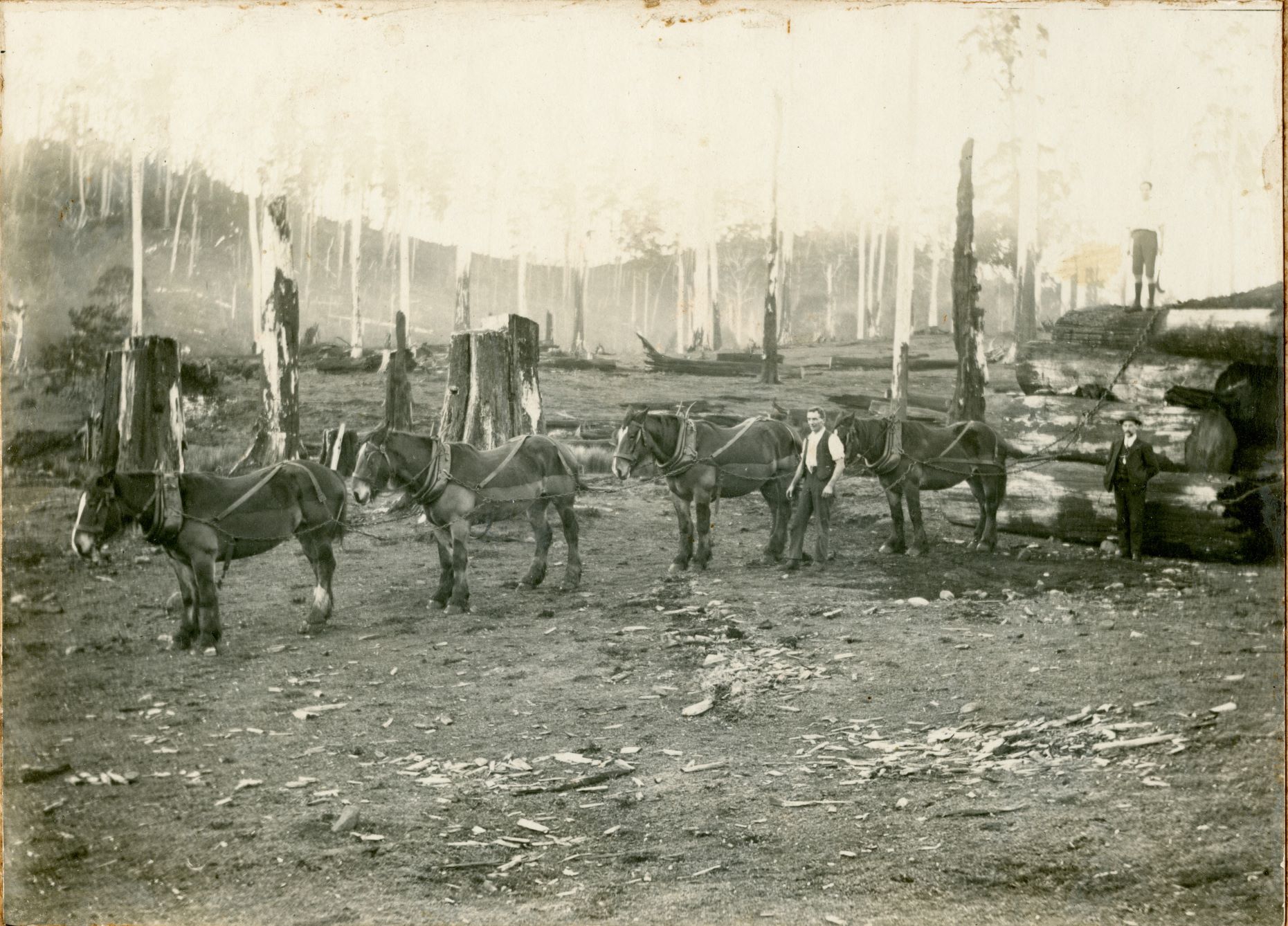
The collection of farms known as Narrawa in north-western Tasmania produced some tough old buggers. The small community west of Wilmot was home to the Carters, Vernhams, Williamses, Bramichs, Lehmans and others, bush farmers resigned to grubbing out, burning and stump jacking their way to cleared pasture. Crops like potatoes were planted in the ashes of the burnt trees as the beginning of farming operations.
Jack (aka Johnny) Carter, Bill ‘Yorky’ Smith and Jack ‘Boy’ Griffiths clearing land at Narrawa. Griffiths, standing precariously on the log stack, was later killed in a similar operation on the Williams farm. Courtesy of Peter Carter.
After the harvest came the hunt. This was a chance to earn enough money to keep self and family for the rest of the year. Each hunter had his own territory somewhere in the north-western highlands.
Harry ‘Poke’ Vernham/Vernon/Varnham (c1885–c1954)[1]
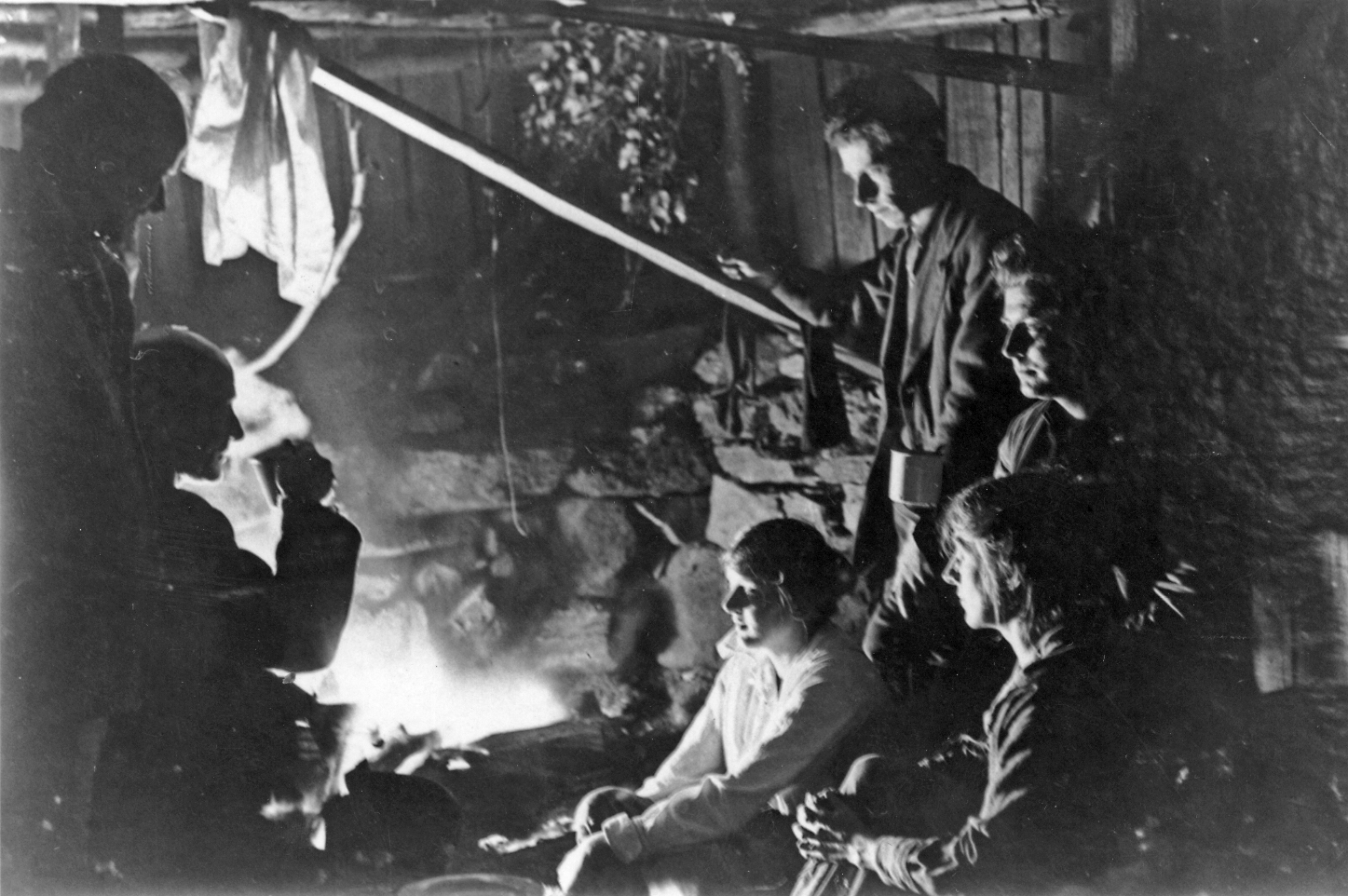
By the age of 20 Narrawa farmer Charles Henry Vernham already knew his way around Cradle Mountain, being conscripted in the search for hunter Bert Hanson who had gone missing near there in a winter fog.
[2] Harry excited more legends than probably any other bushman in his neck of the woods. He was a small man who, paradoxically, wore sandshoes (sneakers) in the bush. Harry was ‘square as a brick’ but so tough ‘you could drive nails into him and you wouldn’t hurt him’.
[3] Two stories bear out his toughness. In the snaring season of 1906 Harry cut his knee with an axe in the snow at Henrietta south of Wynyard. He covered the wound with salt and bandaged it with a green wallaby skin, telling his hunting partner ‘You’ll have to do all the snaring. I’ll peg out the skins and do all the cooking’.
[4] Eventually Harry presented himself to a doctor, who told him that he was just in time to prevent the onset of gangrene.
[5] Harry was then admitted to the Devon Cottage Hospital at Latrobe.
[6] Hearing of her son’s accident, Harry’s mother walked about 30 km from Wilmot to Latrobe to prevent a surgeon amputating his leg. She succeeded, but Harry was left with a stiff leg for the rest of his life.
[7]
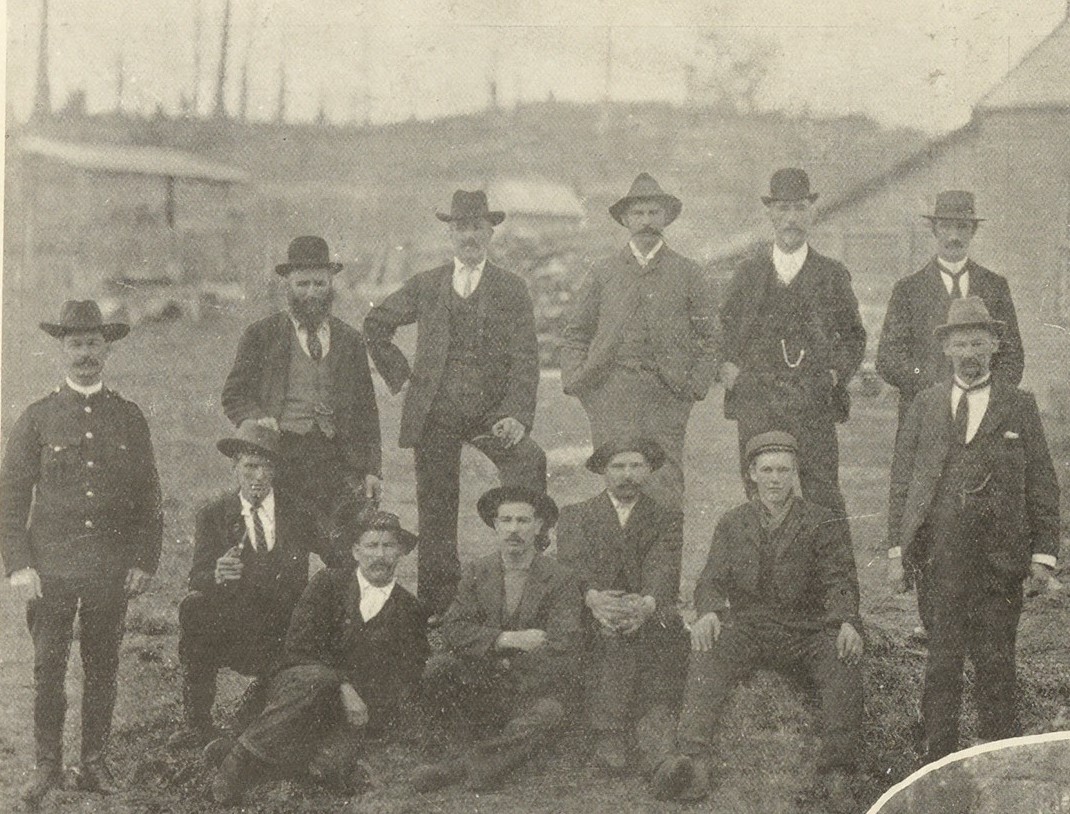
A young Harry Vernham sitting second from right in the second Bert Hanson search party, Weekly Courier, 30 September 1905, p.20.
On another occasion Harry’s nose was virtually detached from his face in a motorcycle accident.
[8] A doctor told him, ‘I’d better give you a whiff of something before I stitch it back on’. Harry is said to have replied, ‘I didn’t have a whiff when it come off so I don’t need one putting it back on’.
[9]
Hunting exploits
In 1914 Harry married Annie Eliza Carter, from the neighbouring family.
[10] They had a boy and three girls over the next four years, but Harry’s nickname Poke suggests that his sex life didn’t end there. At least the hunting seasons were celibate. Harry and his brother George Matthew ‘Native’ Vernham (1889–1966)
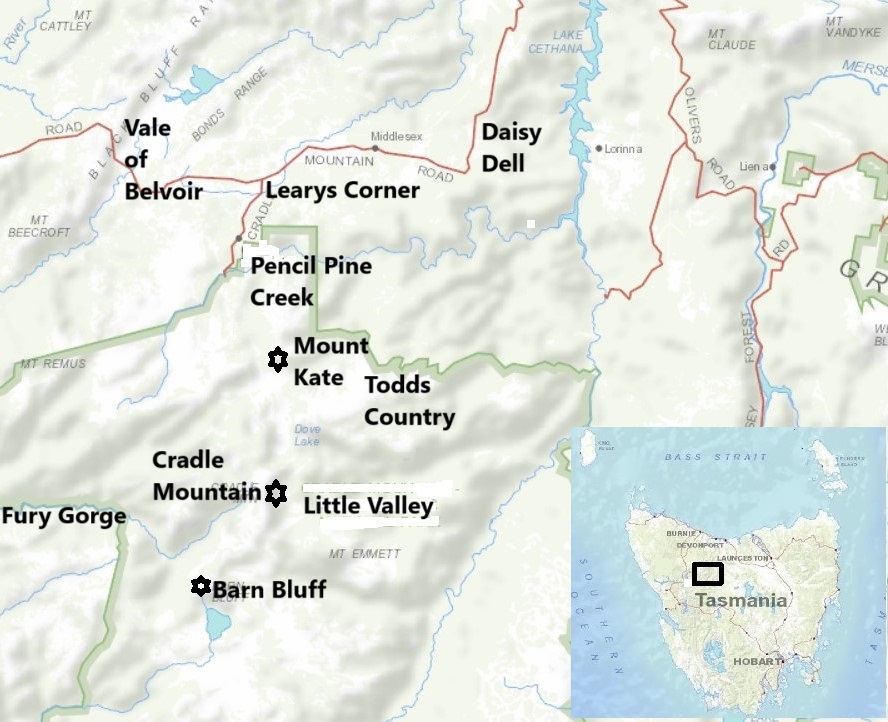
[11] had a hut on the south-eastern side of Mount Kate and a little log hut near the site of the present-day Cradle Mountain Lodge, the latter being pretty schmick as it was a lock-up affair.
[12] Other Harry Vernham hunting companions included Ernest ‘Son’ Bramich (1914) and Harry Leach (1933).
[13] Ted Murfet recalled camping with Harry in later years at Middlesex Station, the Twin Creeks Sawmill huts, the hut at Learys Corner, Daisy Dell and Robertson’s on the track into the Vale of Belvoir.
[14] They took a dozen balls of hemp for a season and used an old eggbeater to make up their treadle snares on a board about 1.2 m long. Usually they’d need 1000 snares for the season. In their worst season the pair shared £300 and in their best the take was £700—£350 each.
[15] By this time Harry had moved beyond the medicinal qualities of a green wallaby skin, developing new home remedies. He treated an ulcer on his leg with a plaster of onion wrapped up in a sock as a bandage and addressed a cold with swigs of Worcestershire sauce.
[16]
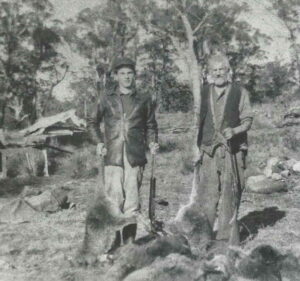
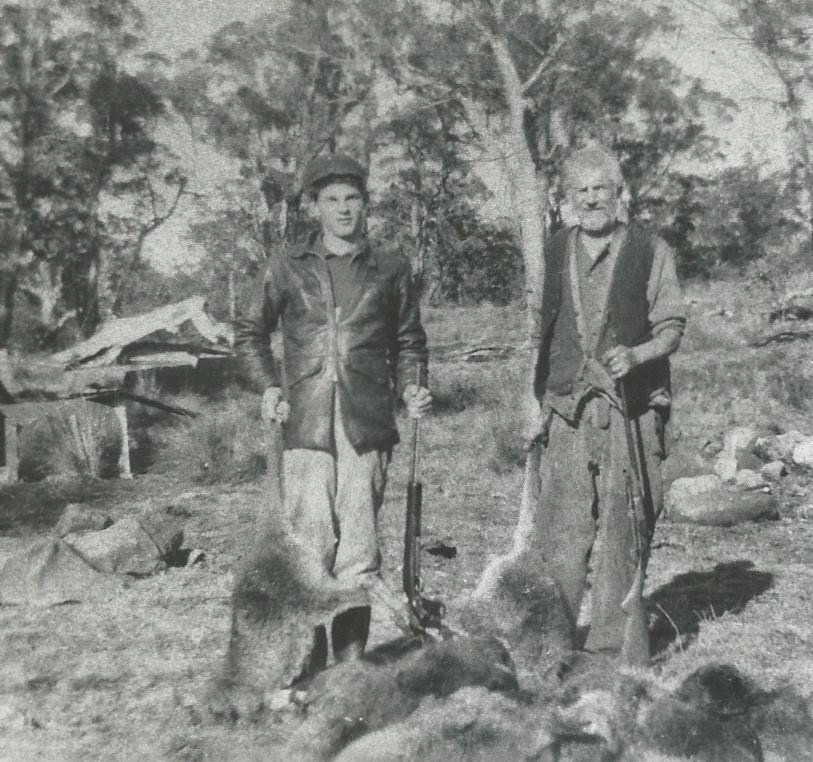
Harry Vernham (right) hunting much later in life. Courtesy of David Ball.
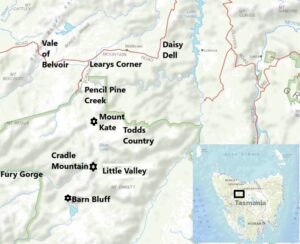
TOPOGRAPHIC BASEMAP FROM THELIST© STATE OF TASMANIA
The slow farm development ritual undertaken at Narrawa also applied to the Connell family when they took up the Dunlavin property at the top of Chinamans Hill, Lower Wilmot, in the 1890s. While his older brother Lionel Connell (1884–1960) became a miner, Gordon stayed on the farm.
[18] He married Alice Jacklin in 1911, and the couple had at least four children during the next decade.
[19] In 1915/16 Lionel Connell and Dick Nichols built a hunting hut in the Little Valley, south of Lake Rodway, and in 1917, when Lionel took a 3-month sabbatical from the Shepherd and Murphy Mine to go hunting, his younger brother Gordon joined him at Cradle.
[20] Known as Bull because of his huge shoulders and great physical strength, Gordon hunted with Lionel as far south as the plains between Barn Bluff and the Fury River. He also worked over the so-called Todds Country at the head of the Campbell River.
[21] Gordon had a big kangaroo dog called Slocum which would take him to his kills. One day Gordon put his feet up and smoked for 30 minutes before Slocum returned. ‘Where is he then?’, the master prompted, setting the dog off towards Lake Carruthers to a big kangaroo he’d killed. But Slocum wasn’t finished, refusing to budge. ‘Well where is he then?’. Off they went again beyond Lake Carruthers to another big kangaroo carcass.
[22]
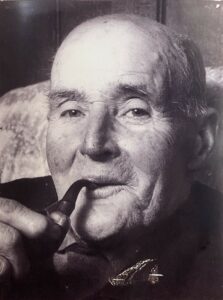
Gordon Connell, courtesy of Malcolm Dick.
Gordon hunted with Harry Vernham at Cradle in 1925 and 1926 and in other years around Middlesex and the Vale of Belvoir.
[23] They developed a regime of line camps or temporary shelters to get around their extensive snare lines, arriving at base camp only every three days. Gordon recalled icicles forming on Harry’s formidable body hair as he lugged his bag of skins about the snare lines. When Harry stripped off his shirt a huge cloud of steam arose from his singlet, an unusual form of enveloping fog. Wild bulls remaining from Field brothers’ Middlesex grazing operation were an occasional problem for hunters. The worst of these was a territorial bull called Bob because of the ‘bob’ in his tail. Another bull they put a bullet in roared back to life as they approached its apparent corpse. Gordon had a way of cutting a cartridge with a knife to concentrate its potency, but on this occasion it seems to have had the opposite effect.
[24]
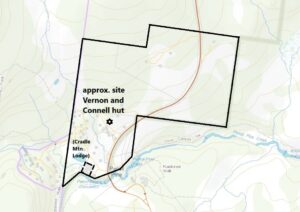
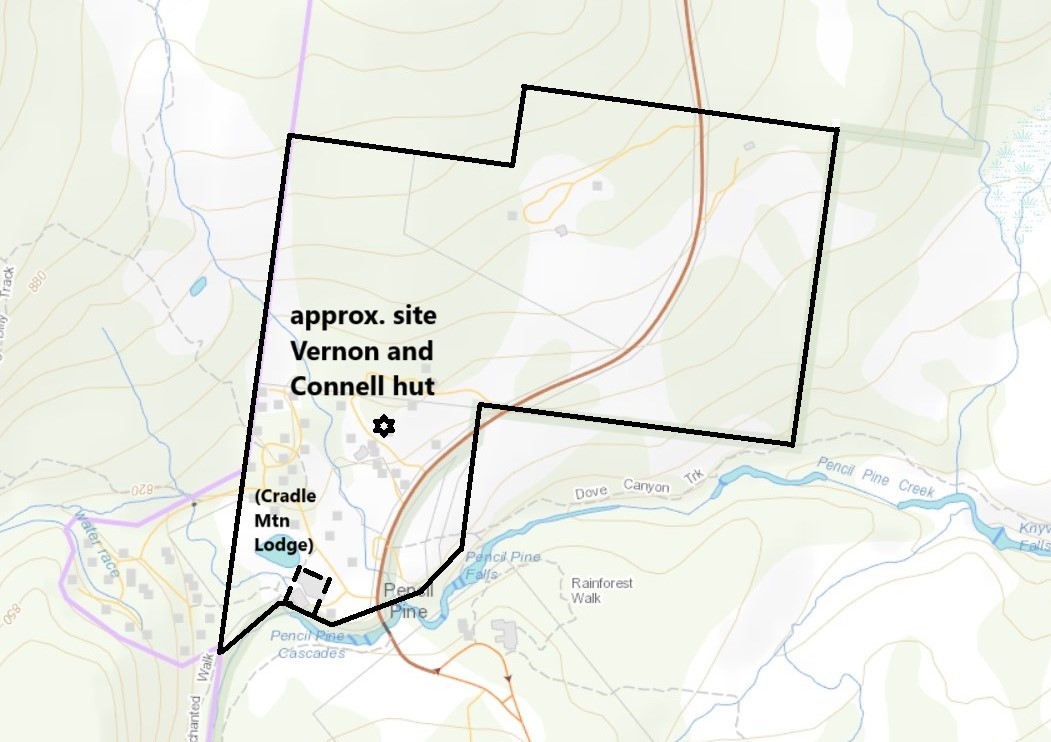
The Vernham and Connell 99-acre block at Pencil Pine Creek. TOPOGRAPHIC BASEMAP FROM THELIST© STATE OF TASMANIA
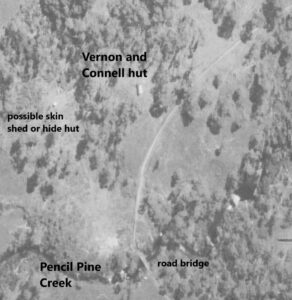
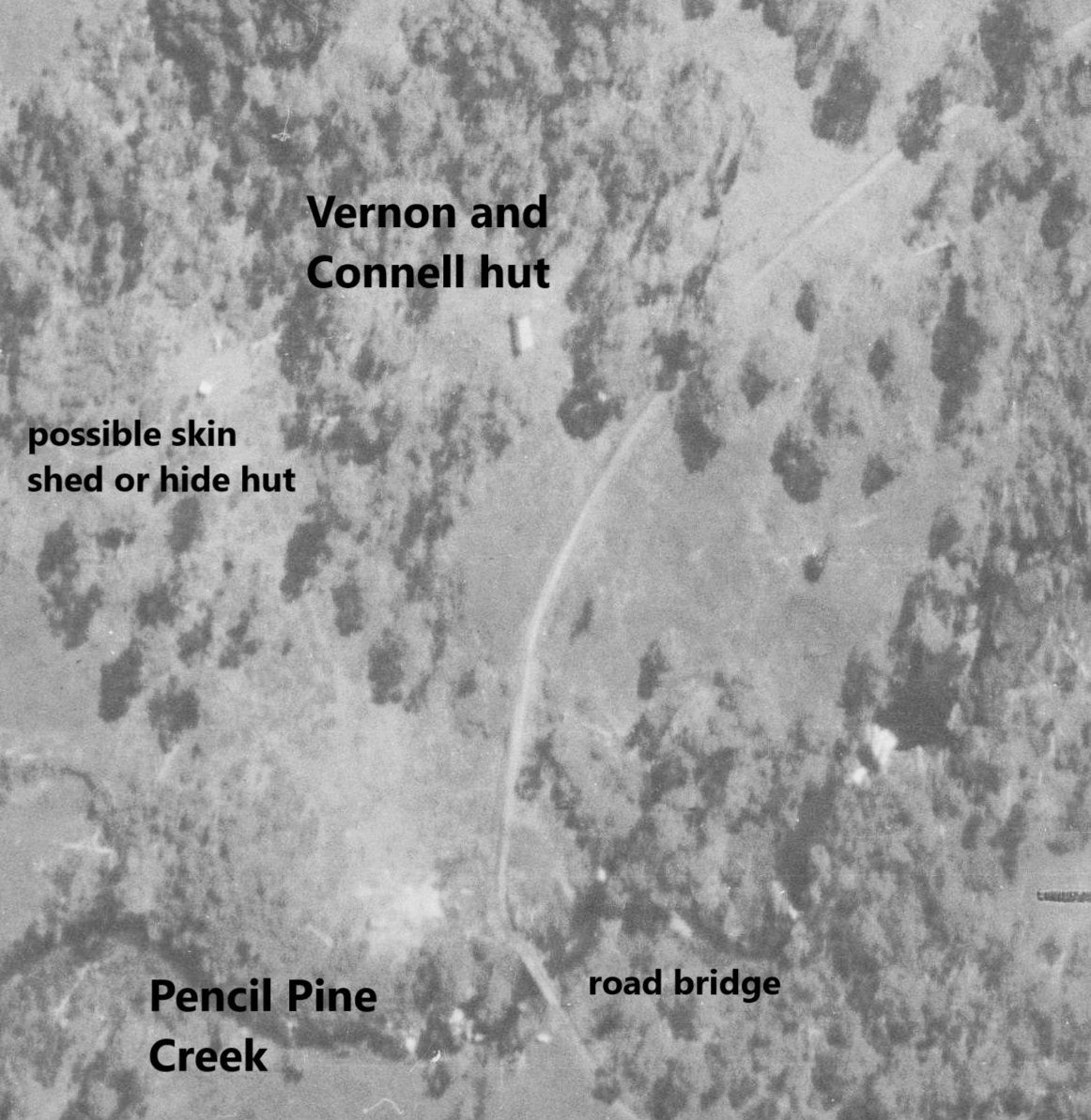
How the area looked in 1949, showing the position of the hunting hut. Crop from aerial photo 0196_483, 15 April 1949.
In the 1930s Poke and Bull selected and started to pay off a 99-acre-block at Pencil Pine Creek enclosing the log hut and the old FH Haines sawmill site—land now partly occupied by Cradle Mountain Lodge, the Cradle Mountain shop and rangers’ quarters. Presumably they were either safeguarding their hold on valuable hunting territory or foresaw future tourism development. The pair failed to pay it off, and Lionel and Margaret Connell took over the payments. Lionel’s family were still using the log hut in 1940. Like most hunting huts in the area it had a skin shed chimney, that is, a very large timber chimney in which skins were pegged to dry close to the fire.
[25]
The tiger stories
Peter Carter, Harry Vernham’s nephew, claimed that Harry caught thylacines (Tasmanian tigers) in ‘hell-necker’ or ‘hellfire necker’ snares positioned at each end of a hollow log that contained a live wallaby. The ‘hellfire’ appears to have been a heavy-duty neck snare—not terribly surprising, as plenty of tigers were strangled in neck snares. What is surprising is Peter’s claim that his uncle sold skun tigers, that is, tiger carcasses, for £5. Perhaps he meant that he sold tiger skins for £5.
[26] Harry Vernham’s name was never entered on the list of payees for the £1 per head government thylacine bounty, although it is possible he claimed bounties through an intermediary. Still, the question needs to be asked why he went to so much trouble to strangle a tiger in a neck snare, when he could just have easily snared it alive by the paw in a foot or treadle device which would have earned him much more money. The story would only make sense if Harry had learned the whereabouts of a tiger or family of tigers and set up the hollow log trap as above, making sure the wallaby was restrained so that it couldn’t spring the snares while making its escape. Prices paid for tigers, dead or alive, varied wildly, so it’s hard to put even an approximate year on Vernham’s tiger sales.
[27]
Gordon Connell is another name missing from the government tiger bounty register. He once caught a thylacine dead in the snare—presumably a necker snare which strangled it—but he encountered others in the wild. Bull was said to have found a thylacine lair in one of three rock shelters down in the Fury Gorge while hunting nearby. He shouldn’t have been surprised then when, hunting the button-grass plains above it out of season, he heard an animal yelp. A big kangaroo hopped up the slope, as if disturbed, convincing Gordon and his mate that the police were below them. Then a tiger came up the slope in pursuit of the kangaroo. At regular intervals it stopped and gave three sharp yelps before continuing the chase, as did a second tiger behind it.
[28]
What a pity neither Poke nor Bull put pen to paper! We know so little about hunters’ experiences with tigers, but at least these anecdotes give glimpses of what they passed down through family and the hunting community.
[1] Years of birth and death are from Ancestry.com.au, no birth certificate or will was found.
[2] ‘Lost in the snow: a second search party’,
North Western Advocate and the Emu Bay Times, 25 July 1905, p.3.
[3] Peter Carter, interviewed by David Bannear, 16 July 1990, in
What’s the land for?: people’s experiences of Tasmania’s Central Plateau region, Central Plateau Oral History Project, Hobart, 1991, vol.3, p.4.
[4] Warren Connell, interviewed 8 September 1997; David Ball, interviewed 25 April 2020.
[5] Warren Connell.
[6] ‘Latrobe’,
North Western Advocate and the Emu Bay Times, 29 August 1906, p.2.
[7] Len Fisher,
Wilmot: those were the days, pp.46–47
[8] ‘Ulverstone’,
Advocate, 26 March 1934, p.6.
[9] David Ball, 24 April 2020. Ted Murfet also told this story to Len Fisher in
Wilmot: those were the days, the author, Devonport, 1990, p.82.
[10] Married 15 October 1914, marriage record no.801/1914, registered at Wilmot (TA).
[11] Born to Blackwood Hill, West Tamar labourer William Varnam [sic] and Christina Bowers on 1 February 1889, birth record no.736/1889, registered at Beaconsfield, RGD33/1/68 (TA),
https://librariestas.ent.sirsidynix.net.au/client/en_AU/names/search/results?qu=george&qu=varnham, accessed 3 October 2023; died 7 February 1966, Will no.47656, AD960/1/105 (TA),
https://librariestas.ent.sirsidynix.net.au/client/en_AU/names/search/results?qu=george&qu=vernham, accessed 3 October 2023.
[12] Gustav Weindorfer diary, 12 July 1914 (Pencil Pine Creek), 23 July 1914 (east side Mount Kate), NS234/27/1/4 (TA); 10 July and 10 August 1925 (Pencil Pine Creek) (QVMAG). Es Connell, interviewed by Nic Haygarth on 23 September 1997, confirmed the location of this hut.
[13] Gustav Weindorfer, in his diary, 16 and 18 June 1914, NS234/27/1/4 (TA), recorded Harry Vernham and Bramich hunting Cradle Valley and Hounslow Heath with dogs. For Leach see ‘Taking game in close season alleged’,
Advocate, 12 September 1933, p.2.
[14] Ted Murfet, interviewed 15 October 1995.
[15] Ted Murfet, interviewed 15 October 1995.
[16] Ted Murfet, in Len Fisher,
Wilmot: those were the days, the author, Devonport, 1990, p.81.
[17] Born 29 April 1889 to Michael Connell and Frances Sayer, birth registration no.2639/1889, registered at Port Frederick, RGD33/1/68 (TA),
https://librariestas.ent.sirsidynix.net.au/client/en_AU/names/search/results?qu=gordon&qu=murray&qu=connell#, accessed 18 August 2024. The family was living at Torquay (East Devonport).
[18] Commonwealth Electoral Roll, Division of Wilmot, Subdivision of Kentish, 1914, p.10;
Wise’s Tasmanian Post Office Directory, 1919, p.277.
[19] Married 28 March 1911, file no.1384/1911, registered at Gunns Plains (TA).
[20] Gustav Weindorfer diary 29 December 1915 (Lionel Connell and Dick Nichols arrive at Cradle from Moina), NS234/27/1/5 (TA); 1–26 April 1917, NS234/27/1/7 (TA). Weindorfer possibly also referred to Gordon Connell in diary entries in May and June 1917, NS234/27/1/7 (TA).
[21] Todds Country was a name given by snarers to territory hunted by Bill Todd (1855–1926).
[22] Warren Connell.
[23] Gustav Weindorfer diary, 14 July 1925 and 23 March 1926 (QVMAG).
[24] Warren Connell.
[25] RE Smith diary, 29 June 1940, NS234/16/1/40 (TA).
[26] Peter Carter, p.10.
[27] For example,in James 1928 Harrison sold a tiger carcass to Colin MacKenzie in Melbourne for £12 (Harrison’s notebook). In 1930 Wilf Batty sold the carcass of the tiger he killed at Mawbanna for £5 (Wilf Batty; quoted in ‘The $55,000 search to find a Tasmanian tiger’,
Australian Women’s Weekly, 24 September 1980, p.41).
[28] Warren Connell.
by Nic Haygarth | 08/06/23 | Uncategorized
Mining in a scenic reserve? A fur farm as well? How about damming a protected lake to generate power? Bring it all on. During its first 25 years the Cradle Mountain–Lake St Clair National Park was a free-for all.
The national park might have been sparked by a sermon on Cradle Mount but its implementation was more like a meditation on patience. In the 1920s economy reigned over ecology in Tasmania. With the state considered an economic basket case, government had little appetite for funding national parks or for standing in the way of resource exploitation. The Scenery Preservation Board which nominally managed the park had only advisory powers and was, as Gerard Castles suggested, ‘handcuffed’ to this development ethos.[1] Voluntary park administrators attacked their task with a passion. However, their efforts were clouded by conflicts of ideology and pecuniary interest. The first two decades of park management were beset with challenges from the mining, fur and timber industries and the government mantra of hydro-industrialisation. Even the local experts employed to build, maintain and oversee park infrastructure and guide tourists were ‘exploiters’—fur hunters and mineral prospectors. The idea of a road from Cradle Mountain to Lake St Clair was entertained on the ‘bigger, better and more accessible’ social justice principle that has been used time and time again in Tasmania to justify development of natural assets. What a mess!
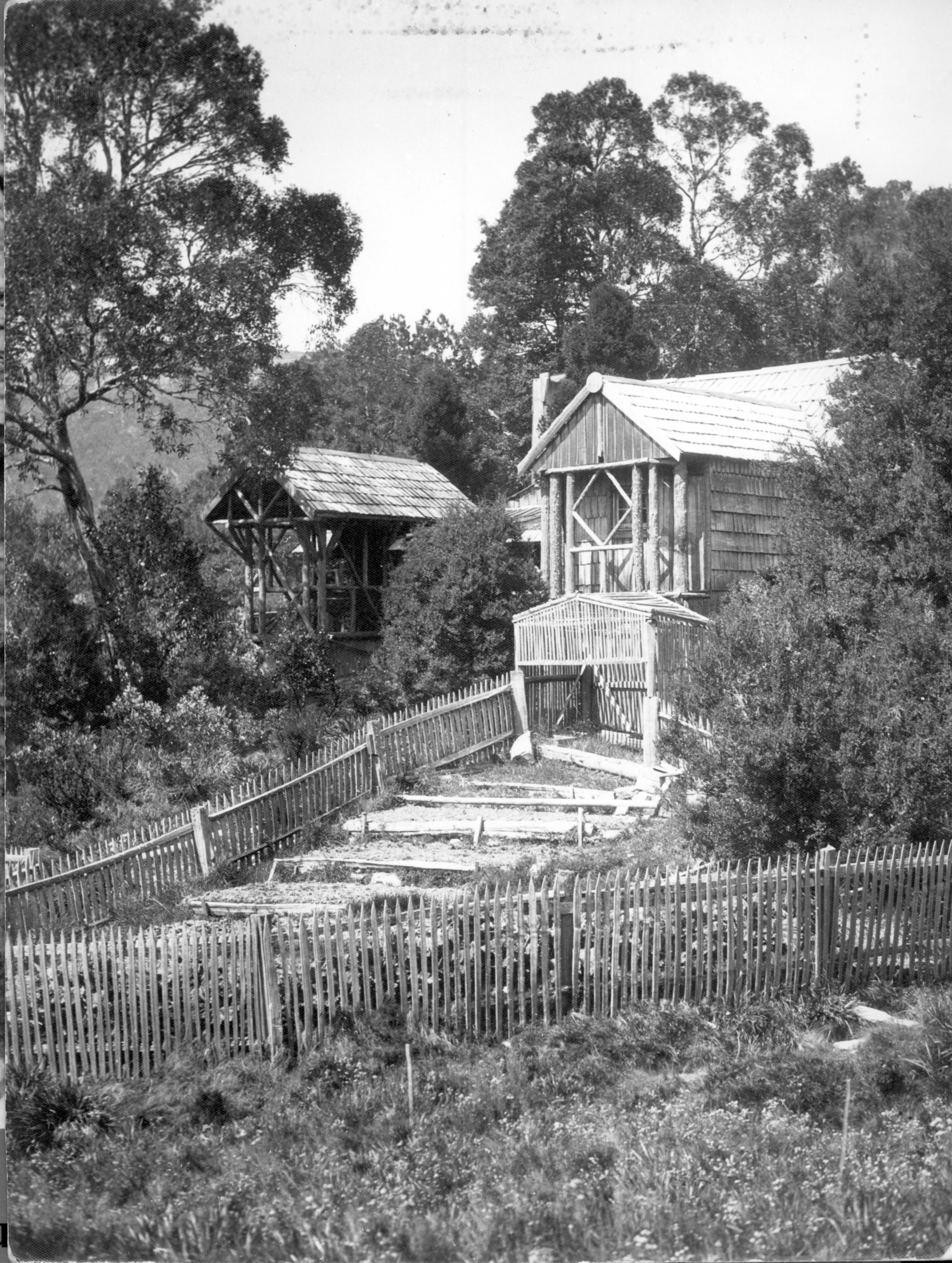
Waldheim in the Weindorfer era. Fred Smithies photo, courtesy of Margaret Carrington.
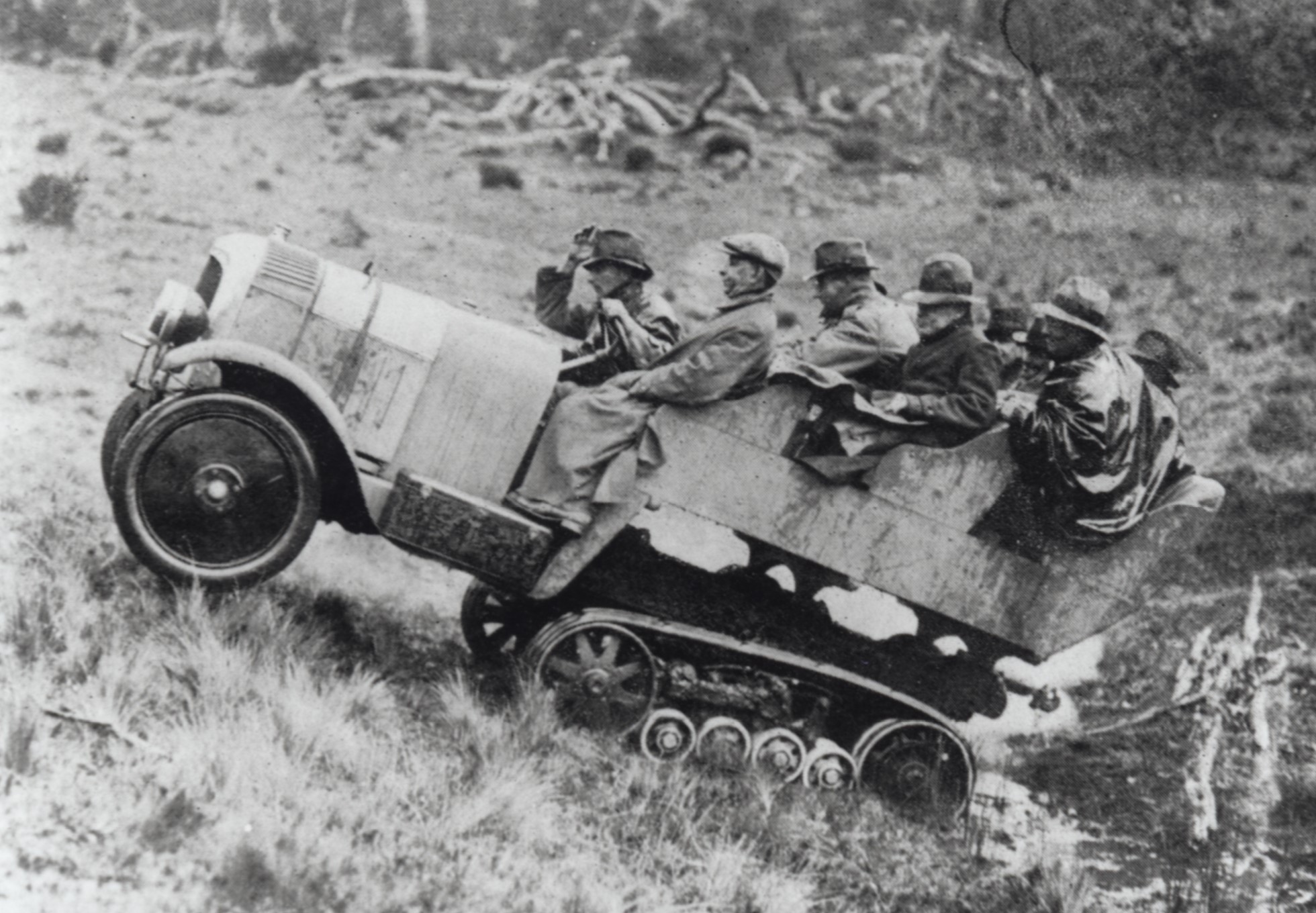
Getting to Cradle Mountain in 1924, the Citroen-Kegresse prototype, which Weindorfer called the ‘platypus motor’. Stephen Spurling III photo.
Origins of the park
The Cradle Mountain–Lake St Clair National Park had three starting points: Cradle Mountain, the Pelion/Du Cane region, and Lake St Clair. At Cradle Valley Gustav and Kate Weindorfer established a tourist resort called Waldhiem in 1912. The story of how they built it and almost no-one came has been told a thousand times. In the Pelion/Du Cane region hunter/prospector Paddy Hartnett had a network of huts, some of which doubled as staging posts for his guided tours as far south as Lake St Clair. Three industrial-size skin drying sheds which stood near Pelion Gap, at Kia Ora Creek and in the Du Cane Gap give some idea of the scale of hunting operations before and after World War One (1914–18). Hartnett’s Du Cane Hut remains today. Lake St Clair had been visited fairly regularly by Europeans for almost a century. It was effectively reserved in 1885 when a half-mile-wide zone around its shores was withdrawn from selection. The Pearce brothers built a government accommodation house, boat house and horse paddock at Cynthia Bay 1894–95 but the buildings were destroyed by fire in 1916.
Paddy Hartnett’s massive skin shed near Kia Ora Creek, 1913. Stephen Spurling III photo courtesy of Stephen Hiller.
When Gustav Weindorfer declared famously that ‘this should be a park for the people for all time’, he meant only the Cradle Mountain–Barn Bluff area in which he later operated. Other park proponents, including Director of the Tasmanian Government Tourist and Information Bureau ET Emmett, and bushwalker photographers Fred Smithies, Ray McClinton and HJ King, were familiar with a much greater area. They wanted to include the swathe of land from Dove Lake to Lake St Clair, making an area about six times the size of the Mount Field National Park.
The Scenery Preservation Act (1915), under which the Freycinet Scenic Reserve and National Park (Mount Field National Park) were gazetted in 1916, forbade the lighting of fires, cutting of timber, shooting of guns, removal or killing of birds and native or imported game and damage to scenic or historic features on reserved land. The Act therefore effectively forbade hunting but it did not expressly forbid mining, even though mining always included the lighting of fires and cutting of timber. Parts of the proposed national park area were already logged, grazed, hunted and mined, and to allay fears of these primary industries being locked out of a proclaimed reserve, in 1921 the Act was amended to allow exemptions from the provisions of the original Act.[2]
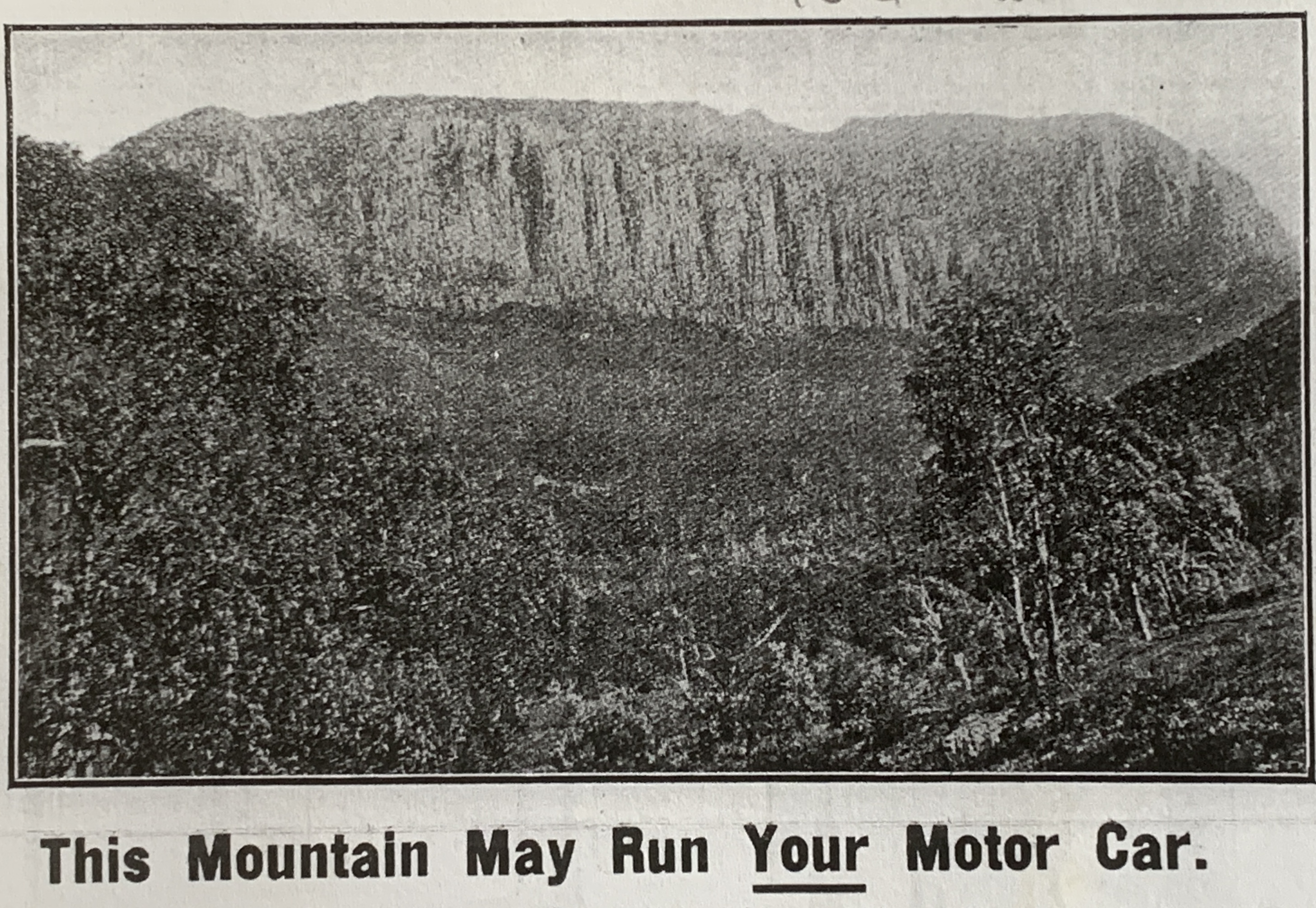
Stephen Spurling III photo, from file AB948/1/225, Tasmanian Archives.
The Pelion oil field
World War One (1914–18) had created anxiety about resource security in Australia and precipitated revolution and civil war in Russia. Outcomes for Tasmania included the search for shale oil reserves and a boom in the Tasmanian fur industry, with brush possum skins helping to make up for the loss of Russian fur reserves. While a lantern lecture campaign promoted the idea of a Cradle Mountain national park in 1921, about 80,000 acres of the land in question was under exploration lease in the search for shale oil (‘inspissated asphalite’). The Adelaide Oil Exploration Company used a Spurling photo to push the idea that Mount Pelion West was a motor oil bonanza. Its proponents assured would-be investors that its lease contained ‘the greatest potential amount of wealth hitherto controlled by any one concern in the British Empire, and, probably, in the whole world, outside the United States of America’. Faith might be able to move mountains, but the government geologist assured them it couldn’t put oil in these mountains. The only lasting impact of oil exploration was the Horse Track south from Waldheim, which was marked to enable pack horses to supply coal/oil operations at Lake Will.
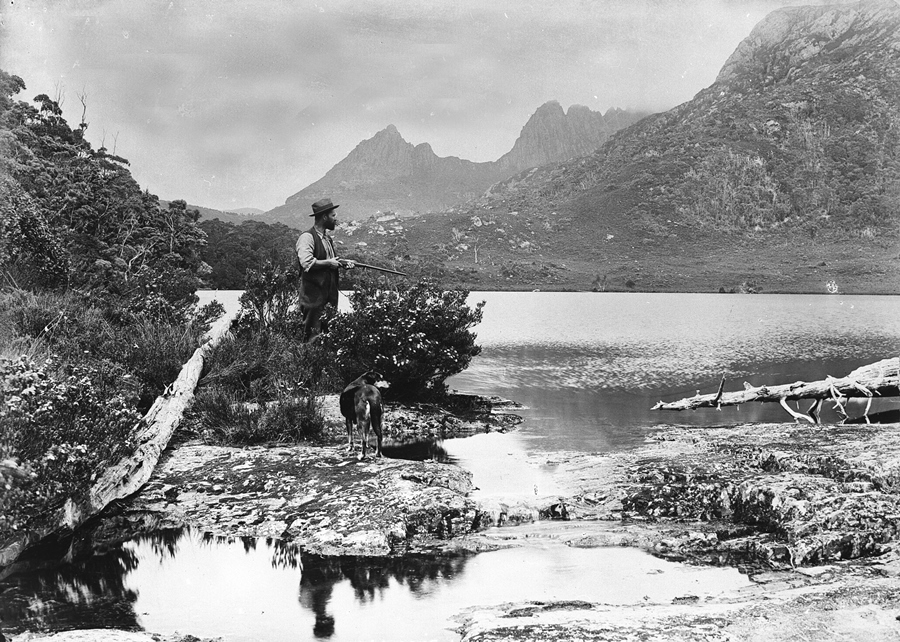
Gustav Weindorfer hunting at Lake Lilla with his dog Flock, 1922.
Stephen Spurling III photo courtesy of Stephen Hiller.
The Cradle Mountain fur farm
The Cradle Mountain and Lake St Clair Scenic Reserves were gazetted under the amended Act in 1922 but at first neither was a fauna sanctuary under the Animals and Birds Protection Act (1919). With the surge in hunting it was inevitable that fur farming on the Canadian model was proposed for Tasmania. The Fur Farming Encouragement Act (1924) reserved 30,000 acres at Cradle Mountain for a fur farm, but before local hunters could protest, in 1925 this area was dismissed as unsuitable by two of the scheme’s proponents, Melbourne skin buyers who, extraordinarily, believed that ‘furs grown at a high altitude have not the good texture of those grown on the low lying country’.[3] Nobody seems to have counselled Tasmanian hunters that high country furs were inferior. Working at Lake St Clair in the winter season of 1925, Bert Nichols reportedly made the small fortune of £500, his possum skins fetching 17 shillings 11 pence and his wallaby skins more than 12 shillings each at the Sheffield Skin Sale.[4] This was at a time when the average annual wage for a farm worker was about £110 to £125.[5]
Two subsidiary management boards
Two subsidiary bodies were appointed to advise the Scenery Preservation Board on matters relating to the two adjoining scenic reserves. One, the National Park Board, already helped manage the Mount Field National Park. Chaired by botanist Leonard Rodway, with Tasmanian Museum director Clive Lord as its secretary, it now added the Lake St Clair Scenic Reserve to its purview. The other body, which administered the Cradle Mountain Scenic Reserve, was created from nominated representatives of interested organisations and municipal councils plus several people who had campaigned for the reserve’s creation.[6] Ron Smith (Cradle Mountain Reserve Board secretary from 1930) and Fred Smithies became standard bearers for the 68,000-acre Cradle Mountain Reserve, but their simultaneous ownership of land at Cradle Valley inevitably led to a conflict-of-interest situation.
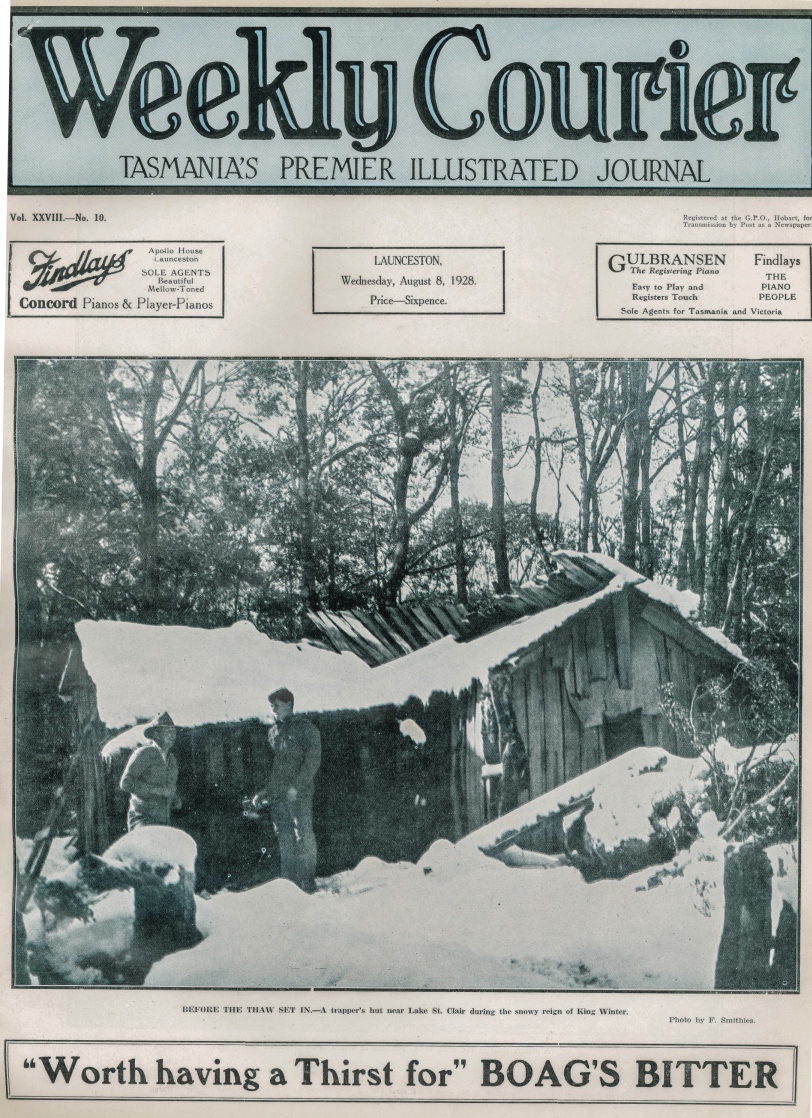
Fred Smithies’ photo of ‘a trapper’s hut near Lake St Clair’,
Weekly Courier, 8 August 1928. Courtesy of Libraries Tasmania.
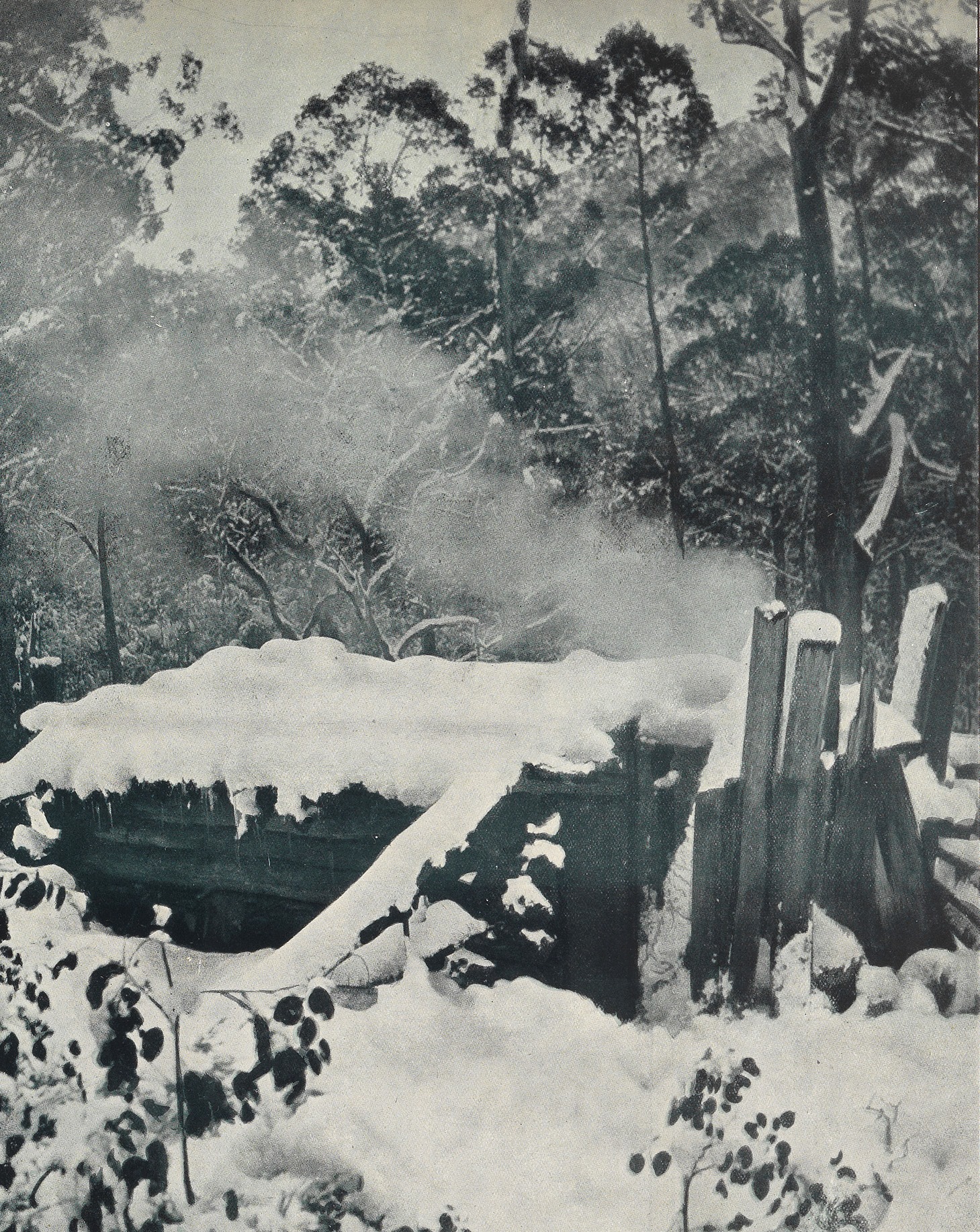
During 1927 the Cradle Mountain and Lake St Clair Scenic Reserves were gazetted as fauna sanctuaries.[7] Two months later the hunter/prospector Dick Nichols was nabbed for poaching at a hunting hut in the Cuvier Valley. His brother Bert was probably around somewhere too but escaped detection, and it became clear that they had a network of hunting huts around Lake St Clair and in the Cuvier Valley.[8] Fred Smithies, a member of the CMRB, was used to sleeping among the drying pelts in Bert Nichols’ Marion Creek Hut.[9] In the winter of 1928 he took a lovely photo of it under snow and this poacher’s hut in a fauna sanctuary made the front cover of the Weekly Courier newspaper![10] Nichols later duplicated the hut for the use of Overland Track walkers.
The Overland Track
The idea of threading a track through the two reserves to unite them seems to have started with Ron Smith, who in 1928 envisaged an ‘overland track’ connecting Cradle Mountain and Lake St Clair, including a motor boat service on the lake.[11] Sections of track that could be linked already existed, including that marked by Weindorfer from Waldheim to Lake Will (the basis of the Horse Track), the Mole Creek Track between Pelion Plain and Pine Forest Moor, and hunters’ tracks from Pelion Plain through to Lake St Clair and the Cuvier Valley. Paddy Hartnett offered to cut the Overland Track for £440, but Bert Nichols did it for only £15.[12] He connected up sections of track and cleared others south of Pelion Plain to form the Overland Track in 1931.[13] Mining, hunting and tourism huts like Old Pelion, Lake Windermere and DuCane were adopted as staging posts along the track.
In 1934 Fergy established this dining room and associated huts at Cynthia Bay, Lake St Clair. Norton Harvey photo.
Although the official Overland Track went through the Cuvier Valley, it soon became standard procedure to cross Lake St Clair instead on tourist operator Albert ‘Fergy’ Fergusson’s motorboat. During the Great Depression Miss Velocity was an integral part of Bert Nichols’ guided tours on the Overland Track. Fergy’s tourist camp of sixteen tent-huts with earthen floors and a communal rustic dining room rivalled Weindorfer’s set-up at Cradle Valley.[14] He employed a housekeeper and owned a ‘frightful old bus’ with sawn-off cane kitchen chairs for seats, with which he drove walkers out to the Lyell Highway at Derwent Bridge.[15]
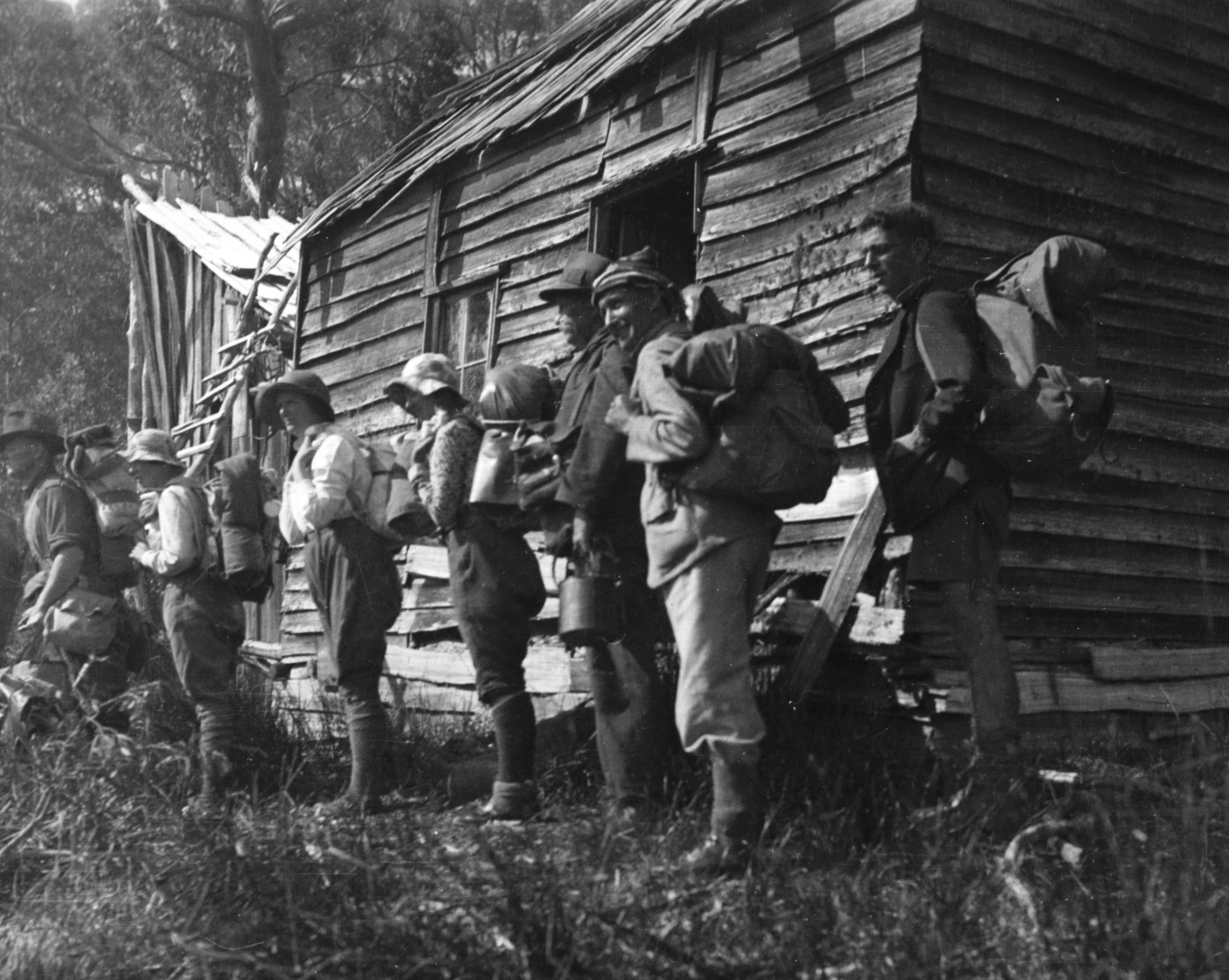
A 1929 Bert Nichols party at Windermere Hut. Marjorie Smith photo courtesy of the late Ian Smith.
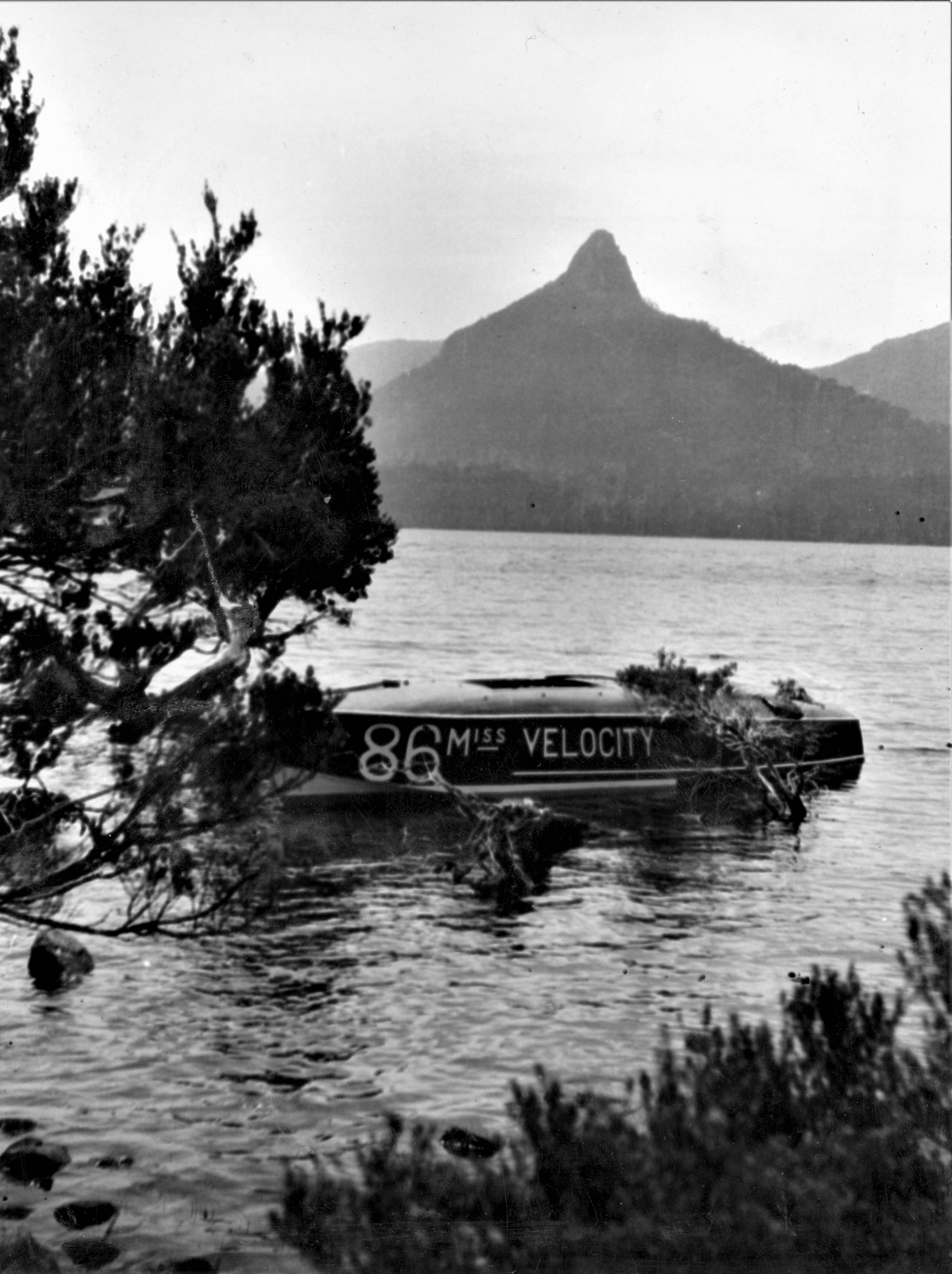
Fergy’s racing boat Miss Velocity at rest in front of Mount Ida, Lake St Clair, 1929. Marjorie Smith photo courtesy of Ian Smith.
The death and wake of Gustav Weindorfer
Gustav Weindorfer died of cardiac arrest in Cradle Valley in May 1932, apparently in the act of trying to start his Indian motorcycle.[16] His name was already inscribed on his wife Kate’s headstone at Don in anticipation of him joining her there but a group of his friends arranged his interment in front of Waldheim.[17] Ironically, despite his love of the place, for years Weindorfer had been trying to sell and leave Waldheim.[18] Now he was stuck there!
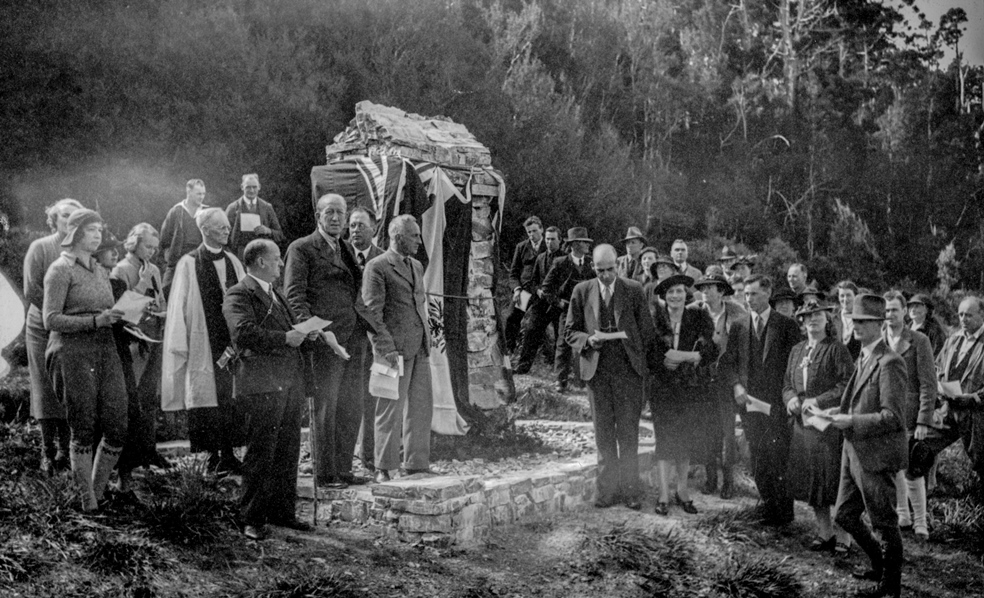
The ceremony to unveil the memorial to Gustav Weindorfer at Waldheim, 1938, with Ron Smith in the foreground at right. Fred Smithies photo courtesy of Margaret Carrington.
The Austrian secular tradition of remembering departed loved ones was adopted at Weindorfer’s grave after his sister Rosa Moritsch sent a bunch of flowers and four small candles from his native land. These were placed on his grave on New Year’s Day 1933. For several decades Weindorfer’s good friend Ron Smith organised the annual New Year’s Day ceremony. The annual commemoration of Weindorfer’s life has assumed possibly unparalleled longevity among Australian public figures.
The work of the Connells
First Bert Nichols and then Barrington farmers Lionel and Maggie Connell looked after Waldheim before a syndicate of Weindorfer’s Launceston friends (George Perrin, Charlie Monds, Karl Stackhouse and Fred Smithies) bought the chalet from his estate.[19] They asked the Connells to stay on as managers. Lionel Connell had been snaring around Cradle Mountain for two decades and knew the country well. The Connells, with six sons and daughters to help them, set about making Waldheim financially viable by extending the building and improving access to it.
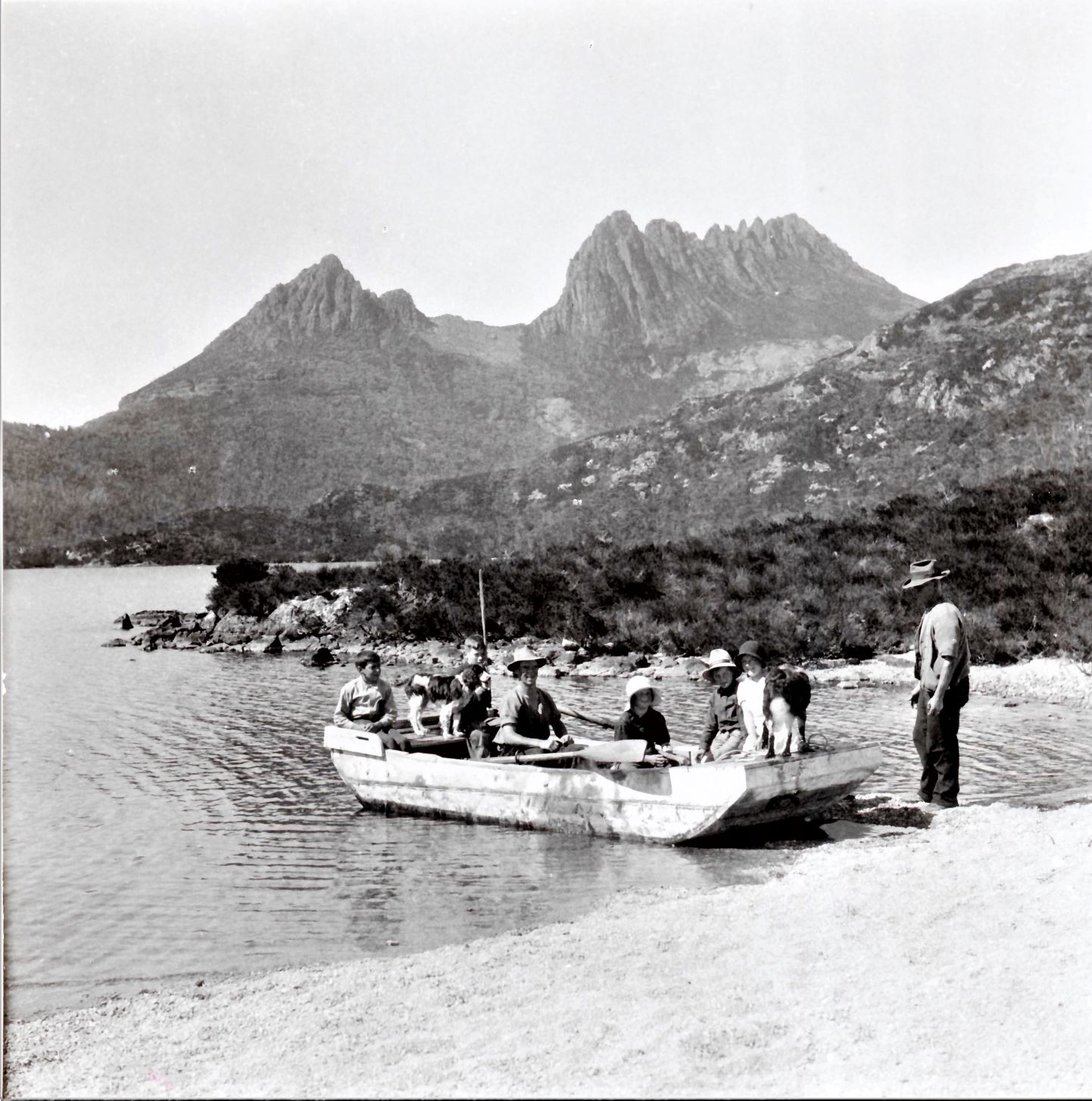
Lionel Connell loading up Weindorfer’s punt on Dove Lake, 1936. Ron Smith photo courtesy of Charles Smith.
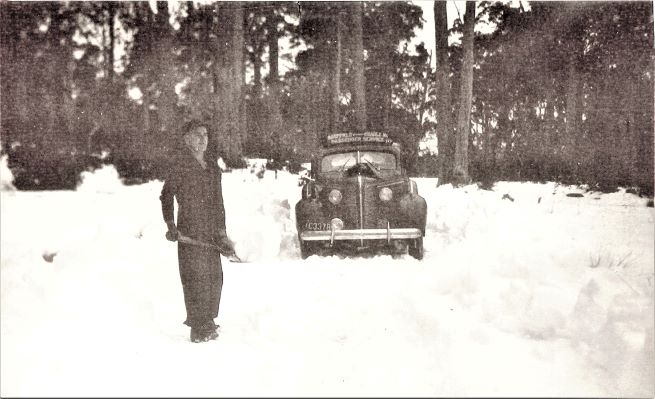
Os Connell digging out his family’s Sheffield–Cradle Mountain Passenger Service, 1943. Photo courtesy of Es Connell.
In the late 1930s the Connells had a tourism package for the Northern Reserve that far exceeded that of Gustav Weindorfer, ferrying visitors to and from Waldheim in their car, accommodating visitors, feeding them with produce from the farm at Barrington, guiding them around Cradle Mountain and even guiding them on pack-horse tours on the Overland Track.
Fergy’s other tub: early rangers
Ex-hunter and Overland Track guide Bert Nichols is said to have removed Overland Track markers when they were not needed in order to snare undetected in the fauna sanctuary. Nichols did other infrastructure work and was appointed ranger for two months in 1935. However, when the time came to appoint a permanent ranger the known poacher was not considered for the job.
A Lionel Connell hunting hut built with Dick Nichols still stood south of Lake Rodway as a reminder of the former’s past. Yet Connell was considered fit for a permanent posting as ranger.[20] The Connell family demonstrated great enterprise in their work at Cradle but conflict between Lionel’s roles of privately-employed tourism operator and government-employed ranger at the same location were soon obvious. To compound the issue, Connell managed Waldheim for Smithies and Karl Stackhouse. These men, as members of the CMRB, also effectively employed him as a ranger. CMRB Secretary Smith also had a family tie with the Connells.
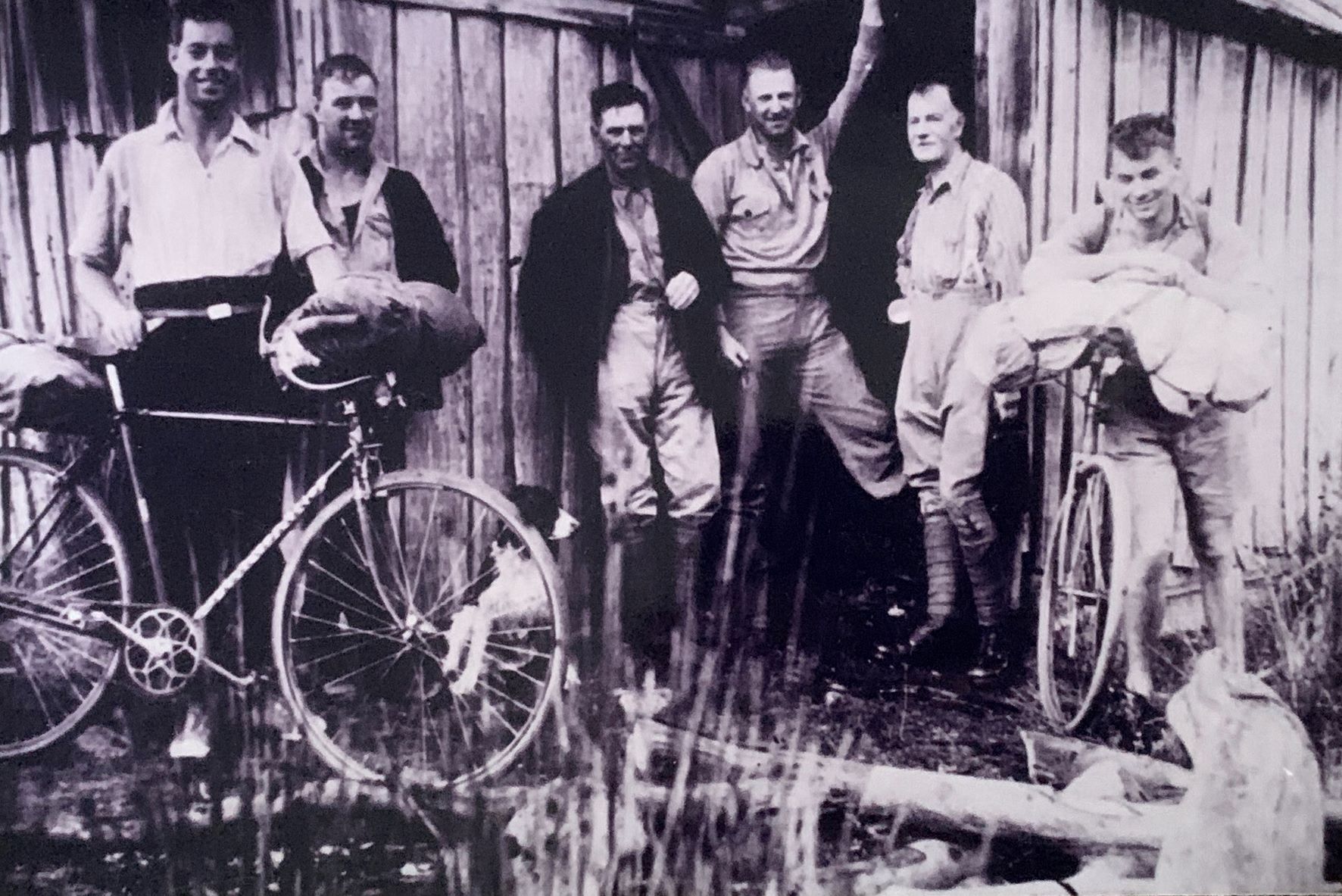
Cyclists arriving at Old Pelion Hut, 1936. With them (left to right) are (possibly) Os Connell, Lionel Connell, Mount Field ranger HE Belcher and Director of the Government Tourist Bureau, ET Emmett. Photo courtesy of Es Connell.
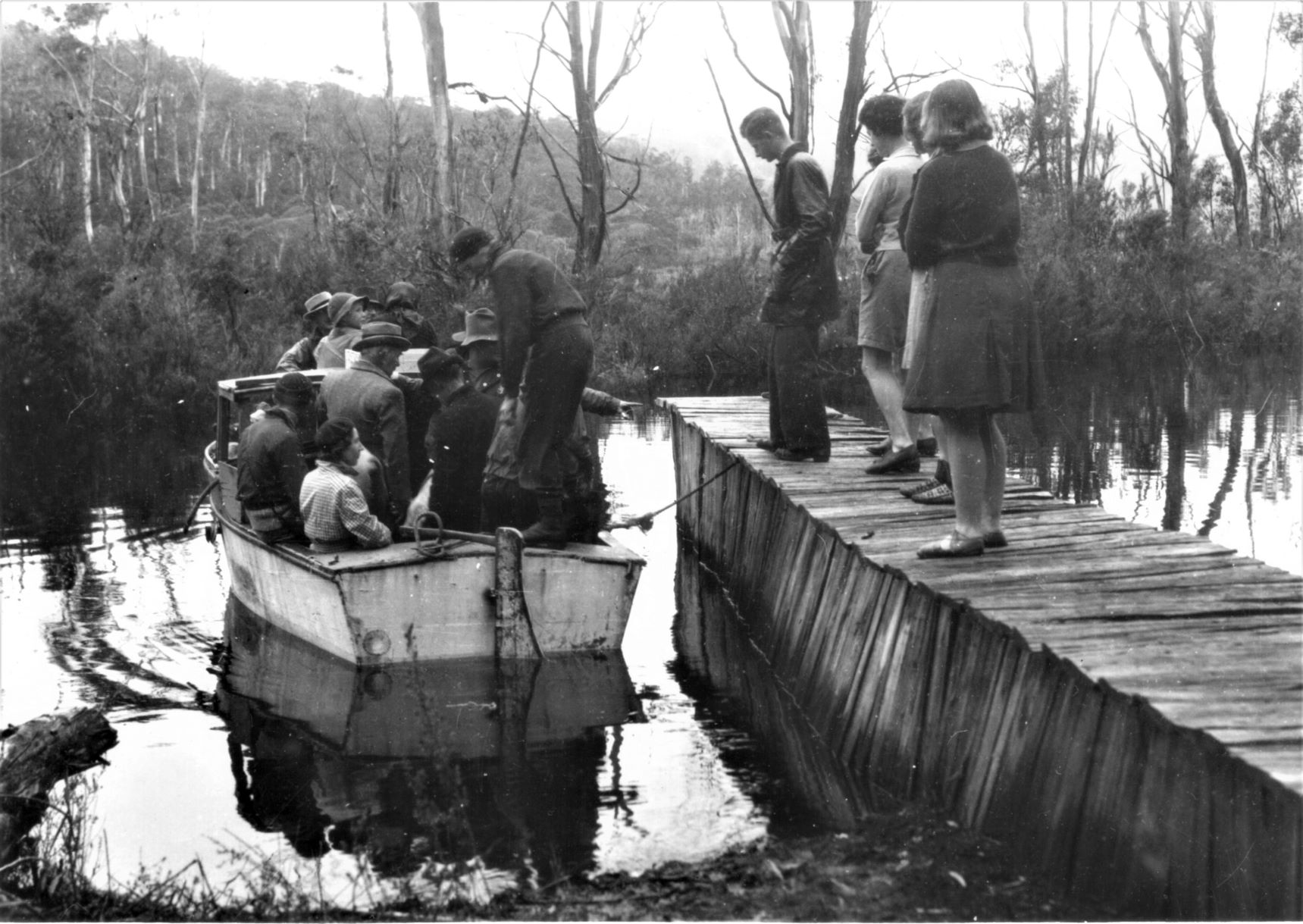
Fergy overloading Miss Velocity’s more mundane replacement at Narcissus Landing, 1940. Ron Smith photo courtesy of Charles Smith.
The other remarkable early ranger was Fergy who, like Lionel Connell, combined the job with that of tourism operator. His toughest journey was not on the lake but in an upside-down bath. While building the original Pine Valley Hut, the Lake St Clair ranger lugged an iron tub to it about 10 km from Narcissus Landing by balancing it upside down on his shoulders and head, his forehead reputedly having been reinforced to mend a war wound (his World War One record suggests only that he suffered from shell shock and deafness). Stripping off in the heat, his curses echoing inside the bath, he was stark naked when he ran into a party of bushwalkers.
Extension of eastern and western reserve boundaries 1935 and 1939
The extension of fauna sanctuary boundaries to natural features was done with the intention of negating claims by hunters that they weren’t sure where the boundaries were. Tommy McCoy seems to have known. His Lake Ayr Hut was cheekily perched within sight of the reserve boundary. Reactions to it showed the distinction between the old-style conservationists in the park administration and the new ones of the bushwalking community. Cradle Mountain Reserve Board Secretary Ron Smith, a former possum shooter, respectfully left payment of threepence for a candle he removed from McCoy’s camp.[21] Hobart hikers, on the other hand, became conservation activists, puncturing McCoy’s canned food with a geological pick when they found his hut in 1948.[22] McCoy, like fellow snarers Paddy Hartnett, Bert Nichols and Lionel Connell before him, embraced the opportunities offered by tourism, building and repairing Overland Track huts. He was proprietor of Waldheim Chalet when he died in 1952.
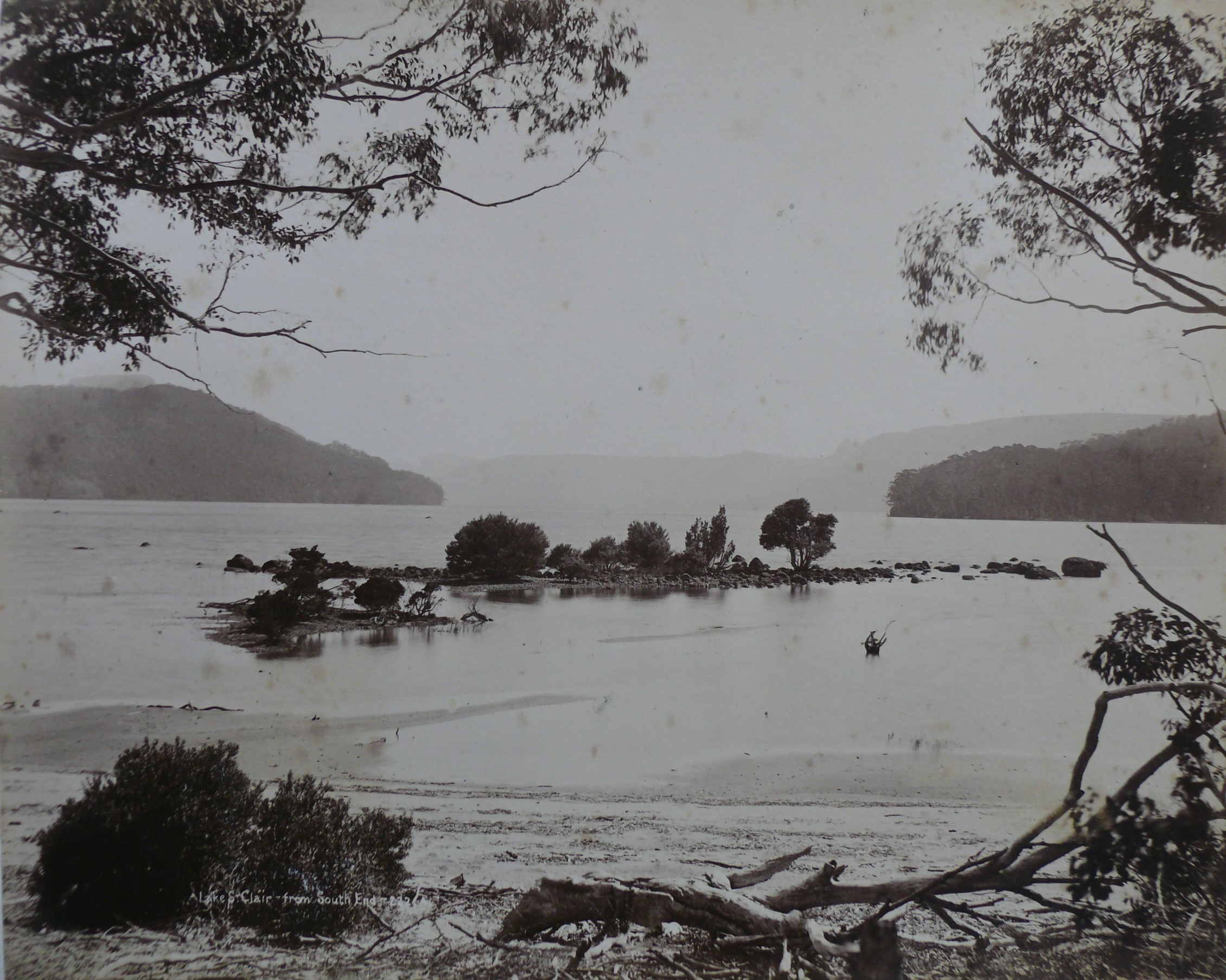
Some of JW Beattie’s islands, southern end of Lake St Clair. Beattie photo, courtesy of Alma McKay.
Damming Lake St Clair 1937
The Art Deco Pump-house Hotel which juts into southern Lake St Clair, as if walking the plank for its crimes, is a symbol of gradually changing values. In 1922, in a joint lecture about ‘preserving’ the tract of land south from Cradle Mountain, Ray McClinton and Fred Smithies deplored the ‘firestick of the destroyer’ and the ‘ravages of the trapper’ but spruiked the hydro-electric potential of the region’s lakes.[23] Fifteen years later the naivety of this position became apparent when the Hydro-Electric Department dammed the Derwent River as part of the Tarraleah Power Scheme. After assuring the National Park Board that Lake St Clair would be unaffected, it raised the lake’s water level by more than a metre, sinking the golden moraine sand (the Frankland Beaches) and the accompanying islands once painted by Piguenit and photographed by Beattie.[24] A fringe of dead trees around the lake’s edge now greeted visitors. When photographers Stephen Spurling III and Frank Hurley joined the National Park Board in attacking the Hydro, Minister for Lands and Works Major TH Davies sprang to the institution’s defence, describing the damage as ‘unavoidable’.[25] This was a taste of what was to come at Cataract Gorge, Lake Pedder, the Pieman River and the Lower Gordon River.
Excision of the Wolfram Mine
With rearmament taking place in Europe in 1938, the raised price of tungsten (wolfram), used for strengthening steel, prompted an application to reopen the (Mount Oakleigh) Wolfram Mine, which was then included in the Cradle Mountain Reserve. CMRB Secretary Ron Smith penned the board’s opposition to the proposal, stating that no payable lode was likely to be found and that a successful application would set a bad precedent in terms of mining the reserve.[26] The subsidiary board’s concerns were not heeded. In a forerunner to national park and/or Wilderness World Heritage Area excisions at Mount Field, the Hartz Mountains and Exit Cave, the mine was temporarily excised from the scenic reserve as the Mount Oakleigh Conservation Area.[27] No Tasmanian reserved land ever seemed inalienable after this.
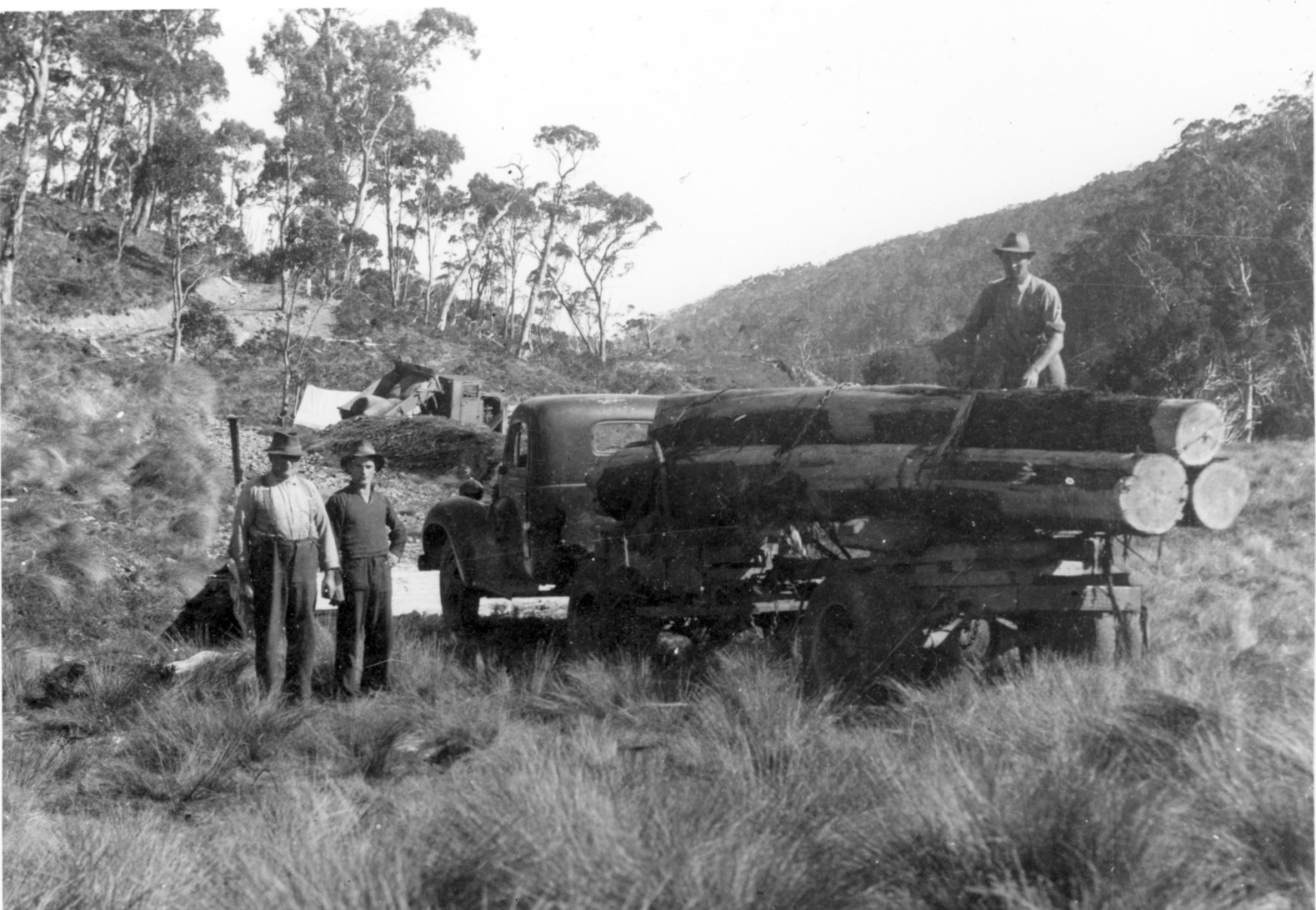
First load of logs from Mount Kate, 1943, with (left to right) George, Bernard and Leo Stubbs. Ron Smith photo, courtesy of Charles Smith.
The Mount Kate sawmill dispute and dissolution of the CMRB
The pitfalls of having vested interests on a government board again became apparent in December 1943 when Ron Smith took advantage of wartime stringency, rising timber prices and a finished access road to start harvesting King Billy pine on his property at Mount Kate. Over the next few years the definition of conflict of interest and the limits of official jurisdiction became increasingly blurred, as private land was resumed at Cradle Valley and the problematic CMRB was dissolved. Ironically, Smith and the Launceston syndicate had previously offered their land to the government but been refused. With Waldheim compulsorily acquired, Lionel Connell resigned as ranger. His sons Esrom and Wal were later reemployed in their own right as rangers at Cradle Mountain and Lake St Clair. The appointment of the Cradle Mountain National Park Board in 1947 was the first step in placing the national park—as it was now known for the first time—on a sound footing, 25 years after the scenic reserves were initially gazetted. But the battle of ecology and economy continued.
[1] Gerard Castles, ‘Handcuffed volunteers: a history of the Scenery Preservation Board in Tasmania 1915–1971’, BA (Hons) thesis, University of Tasmania, Hobart, 1986.
[2] This was the Scenery Preservation Act (1921). For an example of fears of loggers being locked out of the Cradle Mountain and Lake St Clair Scenic Reserves, see E Alexander, ‘Cradle Mountain park: claims of timber area’, Advocate, 22 August 1921, p.5.
[3] ‘Fur farming: Cradle Mountain unsuitable: area further south chosen’, Mercury, 17 August 1925, p.6.
[4] ‘Lure of the skins’, Advocate, 22 August 1925, p.12.
[5] Statistics of Tasmania, 1922–23, p.58.
[6] Proclamation, Tasmanian Government Gazette, 8 March 1927, p.753.
[7] Proclamation, Tasmanian Government Gazette, 31 May 1927, pp.1412–13.
[8] Gerald Propsting to the secretary for Public Works, 4 August 1927, AA580/1/1 (TA); ‘Game Protection Act: illegal possession of skins’, Mercury, 17 August 1927, p.5.
[9] Fred Smithies, transcript of an interview by Margaret Bryant, 15 June 1977, NS573/3/3 (TA).
[10] Weekly Courier, 8 August 1928, p.1.
[11] Ron Smith to National Park Board Secretary Clive Lord, 27 August 1928, NS234/19/1/20 (TA).
[12] Paddy Hartnett to ET Emmett, 26 November 1928, PWD24/1/3; Director of Public Works to LM Shoobridge, Chairman of the National Parks Board, 13 March 1931, NS234/17/1/17 (TA).
[13] Bert Nichols to Ron Smith, 26 April 1931, NS573/1/1/4 (TA).
[14] Kevin Anderson, ‘Tasmania revisited: being the diary of Kevin Anderson, in which he related the incidents of his travelling to and through Tasmania with his companion, William Foo, from 12th April 1939 to the 26th April 1939’, unpublished manuscript (QVMAG), p.27.
[15] Jessie Luckman interviewed by Nic Haygarth.
[16] Bernard Stubbs interviewed by Nic Haygarth, c1993; Esrom Connell, in writing to Percy Mulligan, 20 September 1963 (NS234/19/122, TA), claimed to possess a diary in which Weindorfer recorded the failure of the motorbike to start. The present whereabouts of the diary are unknown. For the coronial inquiry into Weindorfer’s death, see AE313/1/1 (TA). The coroner determined the cause of death to be heart failure.
[17] ‘Papers relating to Coronial Enquiry into death of Gustav Weindorfer’, AE313/1/1 (TA).
[18] On 17 April 1928 Weindorfer wrote in his dairy, ‘This is very likely my last trip on the mountain’ (QVMAG). If he had a buyer for Waldheim then, the deal must have fallen through.
[19] Public Trustee to Fred Smithies, 11 November 1932, NS573/1/1/7 (TA).
[20] Minutes of the Cradle Mountain Reserve Board meeting, 26 April 1935, AF363/1/1, p.185 (TA).
[21] Ron Smith diary, 1940, NS234/16/1/41 (TA).
[22] Jessie Luckman interviewed by Nic Haygarth.
[23] ‘Cradle Mountain’, Advocate, 31 July 1922, p.2.
[24] ‘Level of water raised’, Mercury, 12 October 1938, p.13.
[25] National Park Board: ‘Level of water raised’, Mercury, 12 October 1938, p.13; Davies: ‘Lake St Clair: high level “unavoidable”’, Advocate, 13 October 1938, p.6; Hurley: ‘Tasmanians asleep’, Mercury, 30 January 1939, p.8; Spurling: S Spurling, ‘Scenic vandalism’, Examiner, 5 October 1940, p.3.
[26] Ron Smith to Minister for Mines, 3 May 1938, NS234/19/1/4 (TA).
[27] For an overview of the Wolfram Mine dispute, see Gerard Castles, ‘Handcuffed volunteers: a history of the Scenery Preservation Board in Tasmania 1915–1971’, pp.51–52.
by Nic Haygarth | 21/03/19 | Story of the thylacine, Tasmanian high country history
They weren’t old lags, shifty safe-crackers or Hibernian highwaymen. They were Tasmanian highland snarers who flitted across the public record, leaving just their nicknames to tantalise the curious. ‘Five-fingered Tom’ was a little light fingered. ‘Black Harry’ was dark-skinned aberration in a white society. These traits help us to flesh out the legends of two early fur hunters who might otherwise have stayed as insubstantial as the Holy Ghost.
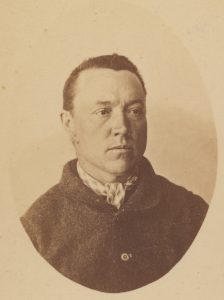
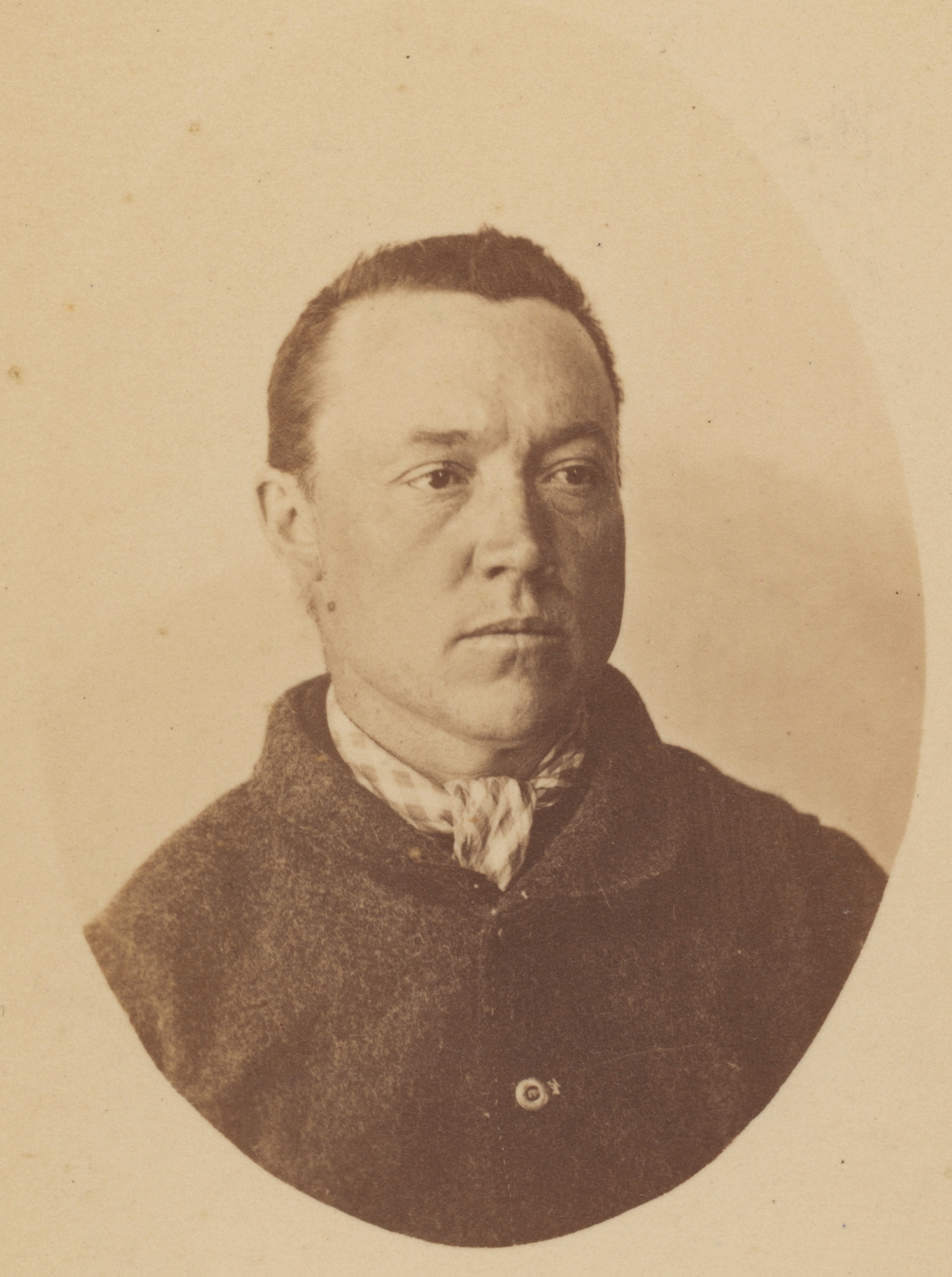
‘Five-fingered Tom’ Jeffries, photographed at the Hobart Penitentiary in 1873 by Thomas J Nevin. Courtesy of the National Library of Australia.
‘Five-fingered Tom’ was Thomas Jeffries. He was born as the second of three children to ex-convicts Thomas Jeffries and Ann Jeffries, née Willis, at Patersons Plains near Launceston in 1841.[1] His father was an illiterate labourer. Thomas Jeffries junior was born with an extra digit on his right hand (that is, five fingers and a thumb), hence ‘Five-fingered Tom’. This made him easily identifiable—good news for the cops! Jeffries regarded Evandale as his native place, but he was living and working on farms in the Sassafras area when in 1873 a warrant was issued for his arrest. The wanted man was described as about 35 years old, 5 feet 9 inches tall, with sandy hair, beard and moustache and a stout build, being ‘a good bushman [who] has spent much of his time hunting’.[2] First offender Jeffries was sentenced to eight years’ gaol for horse stealing. He spent four months making shoes in the Launceston Gaol, from which he vowed that he would abscond at the first opportunity—earning him a transfer to the Hobart Penitentiary.[3] What luck! Since Hobart prisoners were routinely photographed by Thomas J Nevin, we have the image of Jeffries attached to this article. He must have shucked off his bad attitude, since he served only five of his eight years.[4]
Like Jerry Aylett of Parkham, ‘Five-Finger Tom the Hunter’ moved into the high country by the 1880s, a time when Tasmanian brush possum had gained an export market.[5] Possum-skin rugs had been a useful earner for bushmen for decades but now the thicker highland furs had a reputation in the British Isles. In 1883 the ‘Tasmanian Opossum Tail Rug’ could be found alongside the ‘Grey Wolf Rug’, the ‘Silver Bear Rug’, the ‘Leopard, on Bear’ and the ‘Raccoon Tail Rug’ in the catalogue of Liverpool enterprise Frisby, Dyke and Co.[6] Lewis’s in Sheffield, Nottinghamshire, offered ‘real Tasmanian opossum capes’.[7] An 1887 ‘Rich winter fur’ auction in Dundee, Scotland, placed ‘Australian and Tasmanian Opossum’ alongside sealskin, sable, skunk, brown and polar bear, llama, leopard, puma, tiger and raccoon furs.[8]
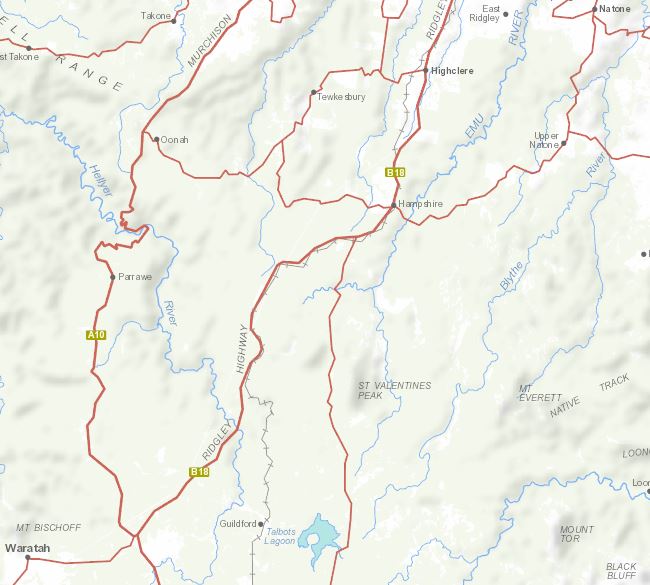
The Hampshire and Surrey Hills, Tasmania, map from the LIST database, courtesy of DPIPWE.
Waratah, a town born in the early 1870s at the Mount Bischoff tin mine, was a staging-post for both prospectors and hunters. We can follow Jeffries there in 1886 through the digitised pages of the Tasmania Police Gazette. He seems to have found it hard to stay out of trouble, allegedly committing an assault at Waratah before making for the hunting grounds of the Middlesex Plains.[9] Guildford Junction, a village created by the extension of the Emu Bay Railway to Zeehan in the late 1890s, was another hub for bushmen such as Van Diemen’s Land Company (VDL Co) timber splitters, hunters and prospectors. Jeffries and his mate Bill Todd were both based there in the period 1903–05, joining fellow hunters ‘Black Harry’ Williams, Tom Allen, the ‘Squire of Guildford’ Edward Brown and, from 1904, Luke Etchell.[10] They had a wide orbit. Todd, for example, was prospecting with George Sloane on the February Plains in 1901 when the latter discovered the body of lost Rosebery hotelier Thomas (TJ) Connolly.[11] Shopkeeper Allen packed stores into the Mayday gold mine under the Black Bluff Range in 1902.[12]
In the years 1888–1909 most of these men supplemented their income by claiming the £1 bounty on the head of the thylacine or Tasmanian tiger. Tom Allen appears to have received fifteen bounty payments—although, as a storekeeper and skins dealer, he may have submitted some applications on behalf of other hunters.[13]
Not so ‘Black Harry’ Williams, the so-called ‘colored king of the forest’, who probably claimed four tiger bounties.[14] He was a short, black-haired Afro-American bush farmer and hunter who arrived in Wynyard in 1887 aged about 24. After serving a month’s gaol for poaching neighbourhood ducks, Williams (‘A black man’!) started operating south of Wynyard (pre-1900), and later at Natone, Hampshire, Guildford and the Hatfield Plains (1900–08).[15] He caught two tigers at the Hampshire Hills in 1900, exhibiting a living one in Burnie. His intention was to sell it to Wirth’s Circus.[16] ‘Black Harry’ was reported to be submitting the other specimen, a very large dead one, for the thylacine bounty, although there is no record of this application.[17] Just enough details of his life survive with which to tell a story. In 1901 he was sued by Chinese storekeeper Jim Sing for failing to pay for a bag of carrots delivered to the Hampshire Hills; Williams counter-sued over Sing’s failure to pay for 100 wallaby skins delivered to Waratah by the hunter.[18] Three years later he was accused of breaking down a VDL Co stockyard at Romney Marsh near the Hatfield River in order to use the timber in a drying shed—making him an early adaptor of this technology (today Black Harry Road recalls his presence in this area). In 1905 Williams was described as the ‘champion trapper and bushman of the State’, the ideal man to lead a search for hunter Bert Hanson who went missing near Cradle Mountain.[19]
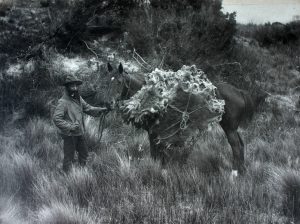
Wallaby hunter Henry Grave demonstrating his reliance on his horse as a pack animal, King Island, 1887. Photo by Archibald J Campbell, courtesy of Museums Victoria.
Jeffries may have been a contender for those honours. Knowledge of his hunting around Cradle Mountain with Todd—another man who flits across the public record—was passed down through generations of bushmen. Drawing on this oral record in 1936, Cradle Mountain Reserve Secretary Ronald Smith unwittingly fused the characters into Tom Todd, aka ‘Five-fingered Tom’. It was on the edge of the high plain they hunted, known as Todds Country, that Hanson died in a blizzard.[20] Correcting Smith’s article, another writer recalled that ‘Tom Jeffrey’ and his Arab pony Dolly were known for many years between Middlesex and Waratah, his mount being ‘the most faithful and gamest bit of horseflesh that ever packed a load over the Black Bluff’.[21] The winter haunts of the highland snarer were very cold, very wet and poorly charted, his comforts simple and meagre, his rewards contingent upon government regulation and global demand. Often he was unseen for months at a time. No newspaper trumpeted his story. Perhaps an extra digit and a different pigment were all that kept Jeffries and Williams from historical anonymity—but I hope there is a lot more to their stories that hasn’t yet been teased out.
[1] Thomas Jeffries senior, transported on the Georgiana, was granted permission to marry Ann Willis, transported on the New Grove, on 3 October 1838, p.88, CON52/1/1; Thomas Jeffries junior was born to Thomas and Ann Jeffries on 1 November 1841, birth record no.1848/1842, registered at Launceston, RGD32/1/3 (TAHO). He had elder and younger sisters: Mary Ann Jeffries, born 24 October 1839, birth record no.1021/1840, registered at Launceston, RGD32/1/3, address was given as Watery Plains; Maria Jeffries, born 11 June 1844, no.271/1844, registered at Launceston, RGD33/1/23 (TAHO).
[2] ‘Warrants issued, and now in this office’, Reports of Crime, 23 May 1873, vol.12, no.723, p.86.
[3] Prison record for Thomas Jeffries, image 25, p.11, CON94/1/2 (TAHO).
[4] ‘Prisoners discharged from Her Majesty’s gaols …’, Reports of Crime, 27 September 1878, vol.17, no.1001, p.157.
[5] See, for example, ‘Commercial’, Launceston Examiner, 24 November 1886, p.2; 19 April 1890, p.2. While William Turner failed to attract a reasonable price for Tasmanian brush possum from English buyers in 1871 (William Turner to the Colonial Treasurer, 27 September and 17 December 1872, TRE1/1/462 [TAHO]), in 1883 HE Button of Launceston began to ship furs to London: ‘Open fur season’, Mercury, 30 July 1926, p.3. For William ‘Jerry’ Aylett, see Nic Haygarth, ‘William Aylett: career bushman’, in Simon Cubit and Nic Haygarth, Mountain men: stories from the Tasmanian high country, Forty South Publishing, Hobart, 2015, pp.28–55.
[6] Frisby, Dyke and Co advert, Liverpool Mercury, 12 November 1883, p.3.
[7] ‘Lewis’s great sale of mantels and furs’, Sheffield Daily Telegraph, 5 February 1886, p.1.
[8] ‘Sales by auction’, Dundee Courier and Argus, 19 November 1887, p.1.
[9] ‘Waratah’, Tasmania Police Gazette, 19 November 1886, vol.25, no.1426, p.187.
[10] Wise’s Tasmanian Post Office directory, 1903, p.56; 1904, p.412; 1905, p.61.
[11] ‘”Lost and perished in the snow”: another Cradle Mountain tragedy’, Advocate, 27 March 1936, p.11.
[12] Thomas Allen to James Norton Smith, Van Diemen’s Land Company, 28 January 1902, VDL22/1/33 (TAHO).
[13] Bounty no.374, 12 January 1899 (3 adults, ‘3 December’); no.401, 15 November 1900 (3 adults, ’15 June’); no.482, 21 January 1901 (3 adults, ’17 December’); no.22, 4 February 1901 (3 adults, ‘4 January’); no.985, 25 July 1902 (‘July’); no.1057, 27 August 1902 (’15 August’); no.1091, 17 September 1902 (‘4 September 1902’); no.462, 6 August 1903, (1 juvenile, ’24 July’), LSD247/1/ 2 (TAHO). See ‘Burnie’, North Western Advocate and the Emu Bay Times, 15 December 1900, p.2.
[14] ‘Veritas’, ‘The lost youth Bert Hanson’, North Western Advocate and the Emu Bay Times, 11 August 1905, p.2. The bounties were all under the name ‘H Williams’: no.344, 17 November 1899 (’10 October’); no.1078, 11 September 1902 (’31 July 1902’); no.1280, 2 December 1902; no.76, 20 February 1903 (’14 February 1903’), LSD247/1/2 (TAHO).
[15] Williams’ activities at Wynyard in 1887 and 1889 were recorded in the diaries of George Easton, held by Libby Mercer (Hobart). For his conviction on a larceny charge, see ‘Wynyard’, Colonist, 12 October 1889, p.2; and ‘Prisoners discharged …’, Tasmania Police Gazette, 8 November 1889, vol.28, no.1581, p.180. Wise’s Tasmanian Post Office directory listed H Williams as a hunter living at Wynyard in 1900 (p.223), 1901 (p.239) and 1902 (p.255). Yet he caught two tigers at the Hampshire Hills (Hampshire) in 1900. In June 1903 he advertised for sale a 50-acre farm on Moores Plain Road south of Wynyard (‘For sale’, North Western Advocate and the Emu Bay Times, 1 June 1903, p.3), and in the period 1903–08 he had a mortgage on a 98-acre block at Natone near Hampshire, which would have been a handy base for his hunting activities (Assessment rolls, Hobart Gazette, 8 December 1903, p.2080; 5 December 1905, p.1847; Tasmanian Government Gazette, 12 November 1907, p.1951; and 30 June 1908, p.739). Wise’s Tasmanian Post Office directory placed him at Guildford Junction in 1905 (p.61) and 1906 (p.61). ‘Veritas’ placed him at the Hatfield Plains south-east of Waratah in 1905 (‘Veritas’, ‘The lost youth Bert Hanson’).
[16] ‘Burnie’, North Western Advocate and the Emu Bay Times, 21 November 1900, p.2.
[17] ‘Inland wires’, Examiner, 14 December 1900, p.7.
[18] ‘Burnie’, North Western Advocate and the Emu Bay Times, 18 October 1901, p.2.
[19] ‘Veritas’, ‘The lost youth Bert Hanson’.
[20] Ronald Smith, ‘Scene of hunter’s tragic death’, Mercury, 21 March 1936, p.9.
[21] ‘BEG’, ‘Cradle Mountain memories’, Advocate, 24 March 1936, p.6.
by Nic Haygarth | 08/12/18 | Story of the thylacine, Tasmanian high country history
Arthur ‘Cutter’ Murray reckoned that thylacines (Tasmanian tigers) followed him when he walked from Magnet to Waratah in the state’s far north-west—out of curiosity, rather than malicious intent. If he swung around suddenly he could catch a glimpse of one.[1] However, Cutter did better than that. In 1925 he caught a tiger alive and took it for a train ride to Hobart.
Tigers are just one element of the twentieth-century tale of Cutter and his elder brother Basil Murray. Yet for all their exploits these great high country bushmen started in poverty and rarely glimpsed anything better. Cutter married and produced a family, but his weakness all his working life was gambling: what he made on the possums (and tiger) he lost on the horses. Basil made enough money to keep the taxman guessing but was content to live out his days in a caravan behind Waratah’s Bischoff Hotel.[2]
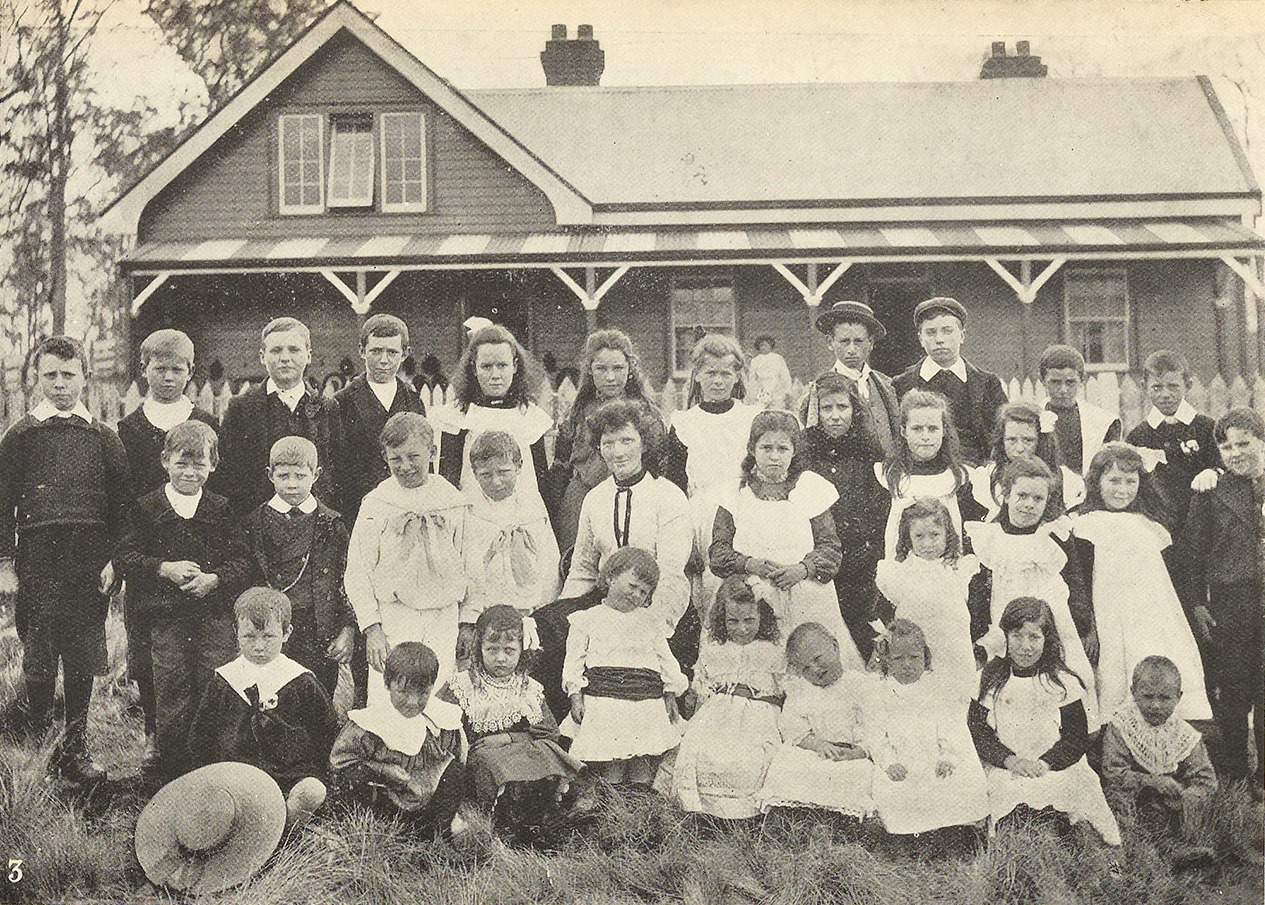
Their ancestry was Irish Roman Catholic. Basil Francis Murray (1893–1971) was born to Emu Bay Railway ganger Edward James (Ted) Murray and Martha Anne Sutton. He was the couple’s ninth child. Arthur Royden Murray (1898–1987?) was the twelfth.[3] Three more kids followed. The family lived at the fettlers’ cottages at the Fourteen Mile south of Ridgley while Ted Murray was a ganger, but in 1907 he became a bush farmer at Guildford, renting land from the Van Diemen’s Land Company (VDL Co).[4] Guildford, the junction of the main Emu Bay Railway line to Zeehan and the branch line to Waratah, had a station, licensed bar and state school, but was also a centre for railway workers, VDL Co timber cutters and hunters. Edward Brown, the so-called ‘Squire of Guildford’, dominated local activity.
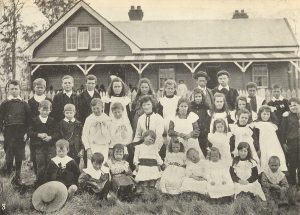
Guildford Junction State School, with teacher May Wells at centre. From the Weekly Courier, 10 November 1906, p.24.
Squaring sleepers, splitting timber, hunting, fencing, scrubbing out bush, driving bullocks, herding stock, milking cows and setting snares were essential skills for a young man in this locality. Like others, the Murrays snared adjoining VDL Co land, paying the company a royalty. Several Murray boys escaped Guildford by serving in World War One, but Cutter recalled that his father would not let him enlist.[5] Basil also stayed home.[6] Perhaps it was enough for Ted and Martha Murray that they lost one son, Albert Murray, killed in action in France in 1916.[7]
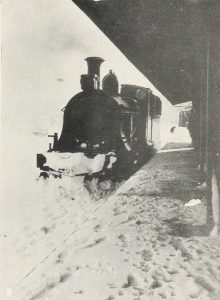
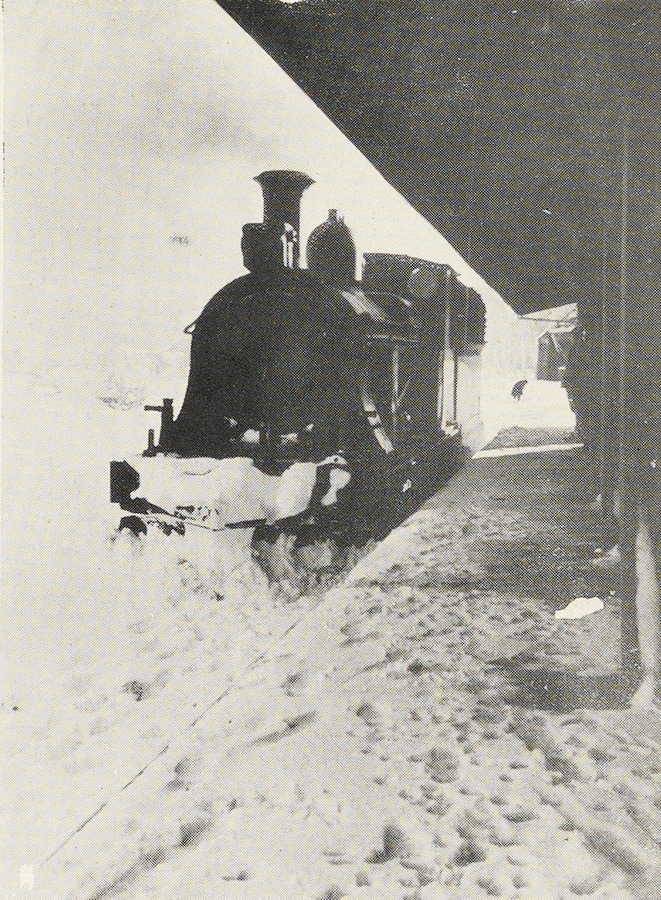
Guildford Railway Station during the ‘great snow’, 1921. Winter photo, Weekly Courier, 18 August 1921, p.17.
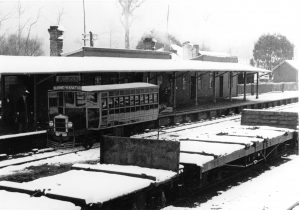
Guildford Station under snow again, 24 September 1930. RE Smith photo, courtesy of the late Charles Smith.
Twenty-three-year-old Arthur Murray appears to have married Alice Randall in Waratah during the ‘great snow’ of August 1921. He would already have been a proficient bushman. Cutter learned to use the treadle snare with a springer, although he would also employ a pole snare for brush possum and would shoot ringtails. He shot at night using acetylene light to illuminate the nocturnal ringtails, but he found it easier to go after them by day by poking their nests in the tea-tree scrub. ‘It was like shooting fish in a barrel’, Cutter’s son Barry Murray recalled. ‘It was only shooting as high as the ceiling … A little spar and you just shook it … and they’d come out, generally two, a male and a female …’[8] Hunters aimed for the nose so as to keep the valuable fur untainted.
In the bush Cutter lived so roughly that no one would work with him. Some tried, but none of them lasted. His huts and skin sheds on the Surrey Hills were little more than a few slabs of bark. Friday was bath day, which meant a walk in Williams Creek (east of the old Waratah Cemetery), regardless of weather conditions. Cutter’s son Val once snared Knole Plain with him, but couldn’t keep up. Snares had to be inspected every day, the game removed, and the snares reset. Cutter and Val took snaring runs on opposite sides of the plain, but Val found that even if he ran the whole way and didn’t reset any snares, Cutter would be sitting waiting for him, having long completed his side.
Cutter’s most substantial skin shed was near home base, on the hill above the primary school at Waratah. Here he would smoke the skins before an open fire. He pegged them out both on the wall and on planks about eighteen inches wide, each plank long enough to accommodate three wallaby skins. When the sun shone, he took the laden planks outside; otherwise he sat inside the skin shed with his skins, chain smoking cigarettes in empathy. A skin shed had no chimney, the idea being that the smoke would brown the skins as it escaped through the cracks between the planks of the walls. The air was so black with smoke that Cutter was virtually invisible from the doorway.[9] Yet no carcinogens prevented him reaching his eighties.
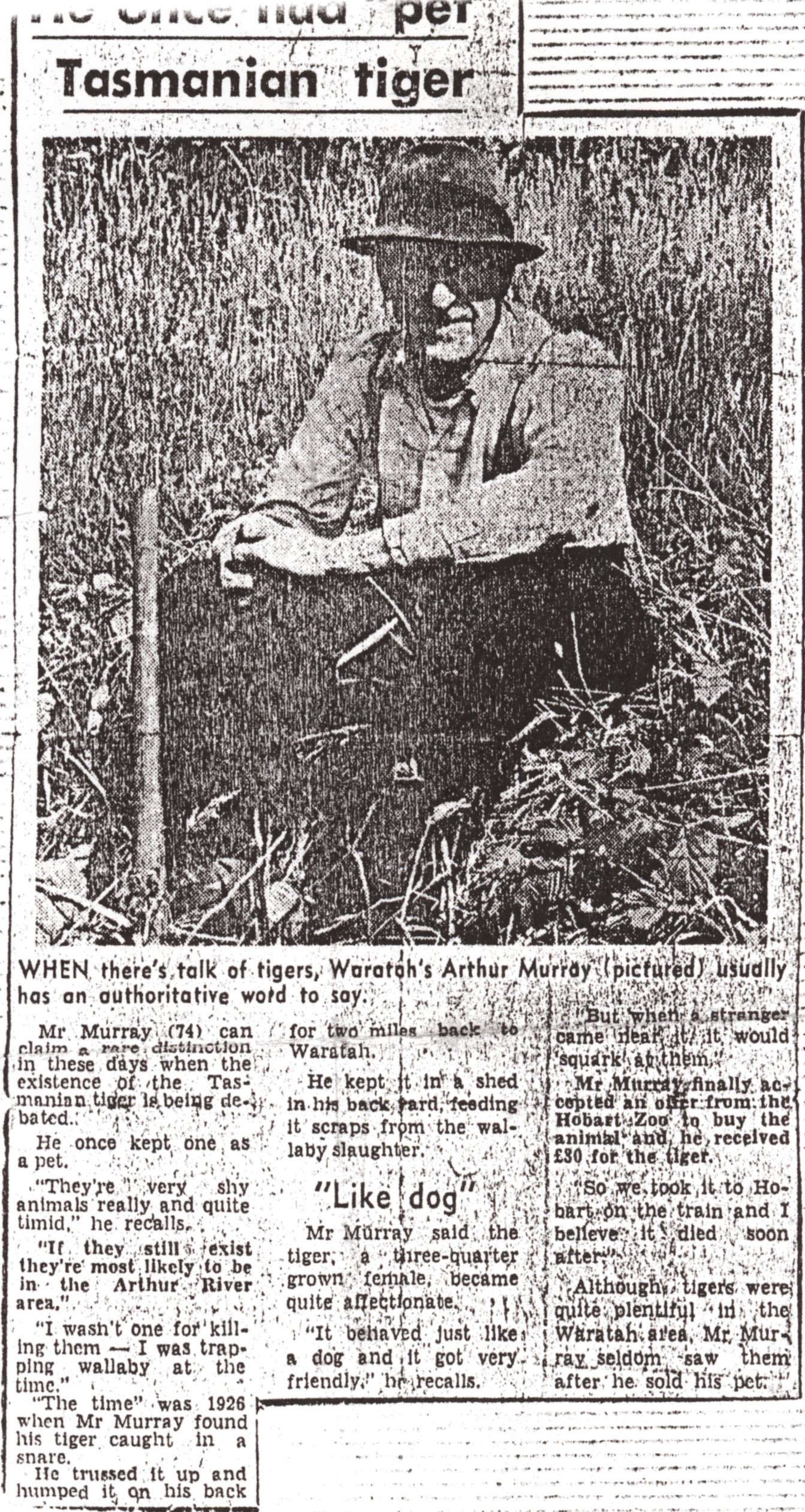
Joe Fagan claimed that Basil Murray was such a good snarer that he once snared Bass Strait.[10] Basil preferred the simple necker snare to the treadle, and caught a tiger in such a device on Murrays Plain, a little plain above the 40 Mile mark on the railway named after Ted Murray.[11] Cutter caught a couple of three-quarters-grown tigers. One was taken dead in a treadle snare with a springer on Goderich Plain when Cutter was hunting with Joe Fagan.[12] Joe kept the skin for years as a rug, but when it grew moth-eaten he tossed it on the fire—oblivious to its rarity or future value.[13] Cutter caught the other thylacine alive in a treadle near Parrawe.[14] He trussed her up and humped her home, where ‘a terrific number of people’ came for a look.[15] ‘They’re very shy animals really, and quite timid’, he recalled of the captive female. ‘It behaved just like a dog and it got very friendly. But when a stranger came near it would squark at them.’[16] At first he couldn’t get her to eat. The breakthrough came when he skinned a freshly caught wallaby, rolled the carcase up in the skin with the fur on the inside, and fed it to the tiger while it was still warm.[17] In June 1925 ‘Murray bros, Waratah’ advertised a ‘Tasmanian Tiger (female)’ in the ‘For sale’ columns of the Examiner and Mercury newspapers.[18] Hobart’s Beaumaris Zoo offered £30 for it, prompting Cutter to deliver her by train. It was his only visit to Hobart. Four cruisers of the American fleet were in town, and Cutter recalled that ‘it was so crowded you could hardly move. I didn’t like it much’.[19]
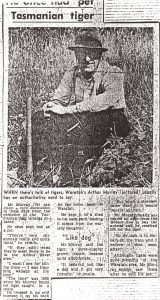
Cutter tells his story, Mercury, 13 February 1973, p.12.
The other big event in Hobart at the time was the Adamsfield osmiridium rush, which ensnared Basil Murray. In the last quarter of 1925 he pocketed £126 from osmiridium, the equivalent of a year’s wage for a farmhand.[20] Later he spent six months mining a tin show alone at the Interview River. Having set the exact date he wanted to be picked up by boat at the Pieman River heads, Basil hauled out a ton of tin ore on his back, bit by bit.[21] On another occasion he worked a little gold show on the Heazlewood River, curling the bark of gum saplings to make a flume in order to bring water to the site.[22]
It was pulpwood cutting that gave Arthur Murray his nickname. When Associated Pulp and Paper Mills (APPM) started manufacturing paper at Burnie in 1938, it turned to Jack and Bern Fidler of Burnie company Forest Supplies Pty Ltd for pulpwood.[23] Over the next two decades Joe Fagan supplied about one-third of the pulpwood quota as a sub-contractor to the Fidlers. At a time when Mount Bischoff was a marginal provider for a few families, and osmiridium mining had fizzled out, Fagan became a significant employer, with about 65 men splitting barking and carting cordwood to the railway at Guildford for transport to Burnie.[24]
A good splitter would split about 3 cords of wood (a cord equals 128 cubic feet of timber) per day. Cutter held the record for the best daily effort, 8½ cords. Unlike most splitters, he never used an axe, but wedged off and split the billet into three pieces. Yet Cutter’s pulpwood stacking exasperated Joe Fagan. Unlike other men, Cutter did not stack his pulpwood as he went. Pulpwood cutters were paid according to the size of their stacks, and the large gaps in Cutter’s hasty, last-minute efforts ensured that he got paid for a bit more fresh air than he was entitled to. Kicking one such stack, Joe growled:
‘I don’t mind the rabbits goin’ through, Arthur, but I bloody well hate those bloody greyhounds behind them goin’ through the holes’.[25]
World War Two was a lucrative time for snarers. £15,000-worth of skins were auctioned at the Guildford Railway Station in 1943, while more than 32,000 skins were offered there in the following year. Record prices were paid at what was probably the last annual Guildford sale in 1946.[26] Taking advantage of high demand, the VDL Co dispensed with the royalty payment system and made the letting of runs its sole hunting revenue. One party of three hunters was reported to have presented about three tons of prime skins as its seasonal haul.[27]
Both Murrays cashed in. Cutter made £600 one season.[28] Working with Eric Saddington at the Racecourse, Surrey Hills, Basil took 3000 wallabies in 1943. Unfortunately their wallaby snares also landed 42 out-of-season brush possums (21 grey and 21 black)—which landed the pair in court on unlawful possession charges. Both men were fined.[29] Basil had a reputation for being a ‘poacher’, and one story of his cunning, apocryphal or not, rivals those told about fellow poacher Bert Nichols.[30]
According to Ted Crisp, Basil was sitting at the bar at the Guildford Junction Railway Station when two Fauna Board rangers came in on the train and announced they were looking for Basil Murray, whom they believed had a stash of out-of-season skins. Then they set off for his hut, rejoining the train to go further down the line:
‘Old Baz headed down by foot and took after them, he was a pretty good mover in the bush and the trains weren’t real fast … and by the time he got down there, they’d found his skins, decided there were too many to carry out so they’d hide them and pick them up at a later date, and of course old Baz was sitting there watching them, they had to catch the train back a couple of hours later, they left and old Baz picked up the skins and moved them to another place …’
By the time the Fauna Board rangers got back to Guildford, Basil was still in the bar, propped up against the counter.[31] However, the taxman did better than the Fauna Board rangers. Basil seems to have been a chronic tax avoider. He and Eric Saddington were camped at Bulgobac, squaring sleepers and snaring, when they were busted for not filing tax returns for the years 1941–42–43.[32]
Basil kept on in the same vein, landing a £25 fine for not lodging a 1943–44 return and then a whopping £60 for the 1947–48–49 period.[33] Things finally got too hot for Basil, who adjourned to the Victorian goldfields for a time.[34]
In 1951 Basil was the cook for the party re-establishing the track between Corinna and Zeehan. One of the track-makers, Basil’s nephew Barry Murray remembered him as ‘a good old cook, as clean as Cutter was rough. They were just opposites. He had a big Huon pine table. He used to scrub it with sandsoap every day, and he would have worn it away if he’d stopped there for two or three years’.[35] Basil became well known as APPM’s gatekeeper at the Hampshire Hills.
In 1963 Cutter Murray was one of Joe Fagan’s men recruited by Harry Fraser of Aberfoyle in a party which investigated the old Cleveland tin and tungsten mine and recut the Yellowband Plain track to Mount Lindsay. At the party’s Mount Lindsay camp Cutter used snares to reduce the numbers of marauding devils that were tearing through the canvas tents, biting the tops off sauce bottles and biting open tins of beef and jam.[36]
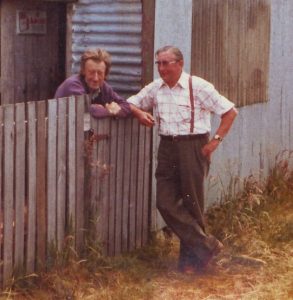
Cutter Murray (left) and friend at Waratah. Note the Ascot cigarettes advertisement on the wall behind him. Photo courtesy of Young Joe Fagan.
Cutter snared until virtually the day he died in the 1980s, making him—along with Basil Steers—one of the last of the snarers. He possumed on North’s block and took wallabies on the Don Hill, under Mount Bischoff, wheeling the skins home draped over a bicycle. A great snaring dog, a labrador that he had trained to corner but not kill escaped game, made his life easier.[37] Nothing is known to remain of his hunting regime, not a hut or a skin shed. Barely a photo remains of the hardy bushman. His tiger tale flitted across the country via newspaper in 1984, then was forgotten.
Unfortunately Cutter Murray’s travelling tiger has an equally obscure legacy, apparently dying soon after it was received at the Beaumaris Zoo.[38]
[1] Barry Murray, interviewed by Nic Haygarth, 21 November 2008.
[2] Barry Murray, interviewed by Nic Haygarth, 23 July 2011.
[3] Registration no.484, born 16 May 1898, RGD33/1/85 (TAHO). Basil Murray’s years of birth and dirt are recorded on his headstone in the Wivenhoe General Cemetery, Burnie.
[4] ‘Ridgley’, North West Post, 8 October 1907, p.2.
[5] Cutter Murray; quoted by Mary McNamara, ‘Have Tasmanian tiger, will travel … but only once’, Australian, 1984, publication details unknown.
[6] Basil and John Murray were refused an exemption (‘Waratah Exemption Court’, North Western Advocate and the Emu Bay Times, 11 November 1916, p.2; ‘Burnie: in freedom’s cause’, North Western Advocate and the Emu Bay Times, 13 January 1916, p.2), but there is no record of Basil serving.
[7] ‘Tasmanian casualties’, North Western Advocate and the Emu Bay Times, 22 September 1916, p.3.
[8] Barry Murray, interviewed by Nic Haygarth, 23 July 2011.
[9] Barry Murray, interviewed by Nic Haygarth, 23 July 2011.
[10] Joe Fagan to Bob Brown and Ern Malley, 1972 (QVMAG).
[11] Barry Murray, interviewed by Nic Haygarth, 23 July 2011.
[12] Cutter Murray and Joe Fagan to Bob Brown and Ern Malley, 1972 (QVMAG).
[13] Harry Reginald Paine, Taking you back down the track … is about Waratah in the early days, the author, Somerset, 1994, pp.62–66.
[14] Cutter Murray and Joe Fagan to Bob Brown and Ern Malley, 1972 (QVMAG).
[15] Cutter Murray; quoted by Mary McNamara, ‘Have Tasmanian tiger, will travel … but only once’, Australian, 1984, publication details unknown.
[16] Cutter Murray; quoted in ‘He once had pet Tasmanian tiger’, Mercury, 13 February 1973.
[17] AAC (Bert) Mason, No two the same: an autobiographical social and mining history 1914–1992 on the life and times of a mining engineer, Australasian Institute of Mining and Metallurgy, Hawthorn, Vic, 1994, p.571.
[18] See, for example, ‘For sale’, Examiner, 17 Jun 1925, p.8.
[19] Cutter Murray; quoted by Mary McNamara, ‘Have Tasmanian tiger, will travel … but only once’.
[20] Register of osmiridium buyers’ return of purchases, MIN150/1/1 (TAHO).
[21] Barry Murray, interviewed by Nic Haygarth, 21 November 2008.
[22] Barry Murray, interviewed by Nic Haygarth, 23 July 2011.
[23] Steve Scott, quoted by Tess Lawrence, A whitebait and a bloody scone: an anecdotal history of APPM, Jezebel Press, Melbourne, 1986, p.25.
[24] Kerry Pink, ‘His heart belongs to Waratah … Joe Fagan’, Advocate, 10 August 1985, p.6.
[25] Barry Murray, interviewed by Nic Haygarth, 21 November 2008.
[26] ‘£15,000 skin sale at Guildford’, Examiner, 14 October 1943, p.4; ‘Over 32,000 skins offered at sale’, Advocate, 13 September 1944, p.5; ‘Record prices at Guildford skin sale’, Advocate, 30 July 1946, p.6.
[27] ‘£15,000 skin sale at Guildford’, Examiner, 14 October 1943, p.4.
[28] Barry Murray, interviewed by Nic Haygarth, 23 July 2011.
[29] ‘Trappers fined’, Advocate, 22 October 1943, p.4.
[30] For Nichols’ poaching, see Simon Cubit and Nic Haygarth, Mountain men: stories from the Tasmanian high country, Forty South Publishing, Hobart, 2015, pp.116–19.
[31] Ted Crisp; quoted by Tess Lawrence, A whitebait and a bloody scone: an anecdotal history of APPM, p.26.
[32] ‘Men fined’, Mercury, 5 May 1944, p.6.
[33] ‘Fines imposed for income tax offences’, Mercury, 5 September 1946, p.10; ‘Fined for tax breaches’, Examiner, 6 July 1950, p.3.
[34] Barry Murray, interviewed by Nic Haygarth, 23 July 2011.
[35] Barry Murray, interviewed by Nic Haygarth, 23 July 2011.
[36] AAC (Bert) Mason, No two the same, pp.570–71, 577, 579.
[37] Barry Murray, interviewed by Nic Haygarth, 23 July 2011.
[38] Email from Dr Stephen Sleightholme 26 December 2018; Cutter Murray stated his belief that it died soon after arrival in Hobart in ‘He once had pet Tasmanian tiger’. I thank Stephen Sleightholme and Gareth Linnard for their contributions to this story.
by Nic Haygarth | 11/01/17 | Story of the thylacine, Tasmanian high country history
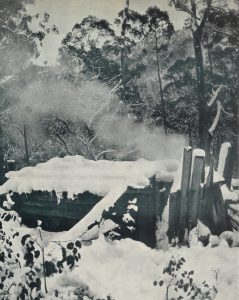
A hunter’s log cabin in the Cuvier Valley (Fred Smithies photo, from the Weekly Courier, 3 July 1929, p.27). From 1927 the Cuvier Valley was part of a game sanctuary. This was not the first time that Smithies, a member of the Cradle Mountain Reserve Board, had photographed an illegal hunting hut in the Lake St Clair Reserve.
In 1906 a newspaper contributor calling himself ‘The Rover’ wrote an account of four months’ hunting in a mountain valley near Lake St Clair. The party of four was from Queenstown. They started for the lake through heavy rain in April, each member bearing a pack weighing 23 kg up the Linda Track, precursor of the Lyell Highway—while a mule carried the rest, a mere 141 kg! First stop was the ‘cockatoo hut’, which at the time was a well-known shelter at the Franklin River.[1] Next day, high on Mount Arrowsmith, the grave of John Largan, who had frozen to death there in 1900, served to warn them of the dangers of the highlands.[2] Arriving at Lake St Clair on the second evening after their long tramp, they spent two days exploring the surrounds before settling on a ‘beautiful valley’ 11 km from the lake. Over four days the party built a log hut with a bark roof as their base.
Then, instead of laying down their snare lines, they ‘waited with feverish impatience for the first fall of snow’. Unleash the hounds! ‘The Rover’ knew what many hunters knew: that in heavy snow wallabies were easy prey for dogs:
‘As we had been at the business before, no time was lost in getting to work, two of us going out and two remaining in camp every alternate day … The same remark applies to the dogs, for they soon knock up if the work is not divided between them. The best plan is to take four dogs at a time, for if the kangaroos [Bennett’s wallabies] are plentiful the dogs will kill faster than a man can skin them, it being a common occurrence to have four or five killed within as many minutes. The fastest kangaroo falls a victim to the slowest dog when pursued through three feet of snow’.
The two men back at camp were kept busy pegging out skins, fetching wood for the fire and cooking supper. No mention was made of a skin shed—but the existence of one is implied by the volume of skins obtained and the duration of the expedition. Mouldy or frozen skins were worthless. They needed to be cleaned and kept dry. The skin shed, a unique Tasmanian invention, was developed at about the beginning of the twentieth century. Its inception was one of the reasons for an escalation in the Tasmanian fur industry, enabling longer stints and greater, more valuable hauls in the highlands where possum furs in particular grew thicker.
After one month the mule was revisited at the Clarence River, and divested of its load—which presumably it had not borne in the interim. The snow was then two feet deep, and in June it got deeper, with metre-long icicles draping the eaves of the hut. Now the ‘rough-coated mongrel’ dog showed his superiority to the purebred, with wallabies being slaughtered in all directions.
One day the hunters found the tracks of a ‘hyena, or Tasmanian tiger’. The dogs took up the scent
‘and in a few minutes discovered the enemy. Their angry growls brought us on the scene, when it was plainly to be seen that the tiger intended to fight to the bitter end. With a cry of encouragement to the dogs we urged them on, and immediately they were engaged in mortal combat with their fierce opponent. The struggle was a long one, but at last the combined strength of the four dogs began to tell, and the battle was over. We found on examination that the tiger was one of the largest of its class, measuring 5 ft 6 in [1.69 m] from the end of his nose to the tip of his tail’.
‘The Rover’ claimed a haul of 91 dozen (1092) wallaby skins—and a weight loss of from 15 to 22 kg per man.[3] The mule, not the men, would have borne the skins back to Queenstown. Providing they were in good condition, they would have fetched something in the region of £80–£140 on the fur market, or an average of about £20–£35 per man.[4] While this would have been a very useful income supplement, better money was to be had in an open season on brush possum.
How credible is this anonymous tale? Let’s start with the hunting season. No year is given, but the events described, if they are real, must have taken place in the period 1901–05. Which season is it likely to be? Throughout the period 1901–05 the season for wallaby was four months, 1 April to 31 July, with closed season for possums in 1903 and 1904 and a one-month season (July) in 1901, 1902 and 1905.[5] So wallabies would have been the focus for many hunters during these seasons, and almost without exception in 1903 and 1904. As for the very heavy snow falls, there was plenty of snow at Cradle Mountain in July 1905 when hunter Bert Hanson disappeared in a blizzard. Hanson and his mate Tom Jones were also using dogs to hunt down wallabies.[6]
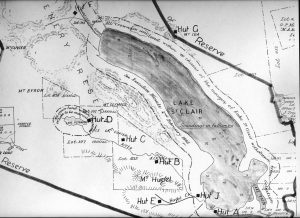
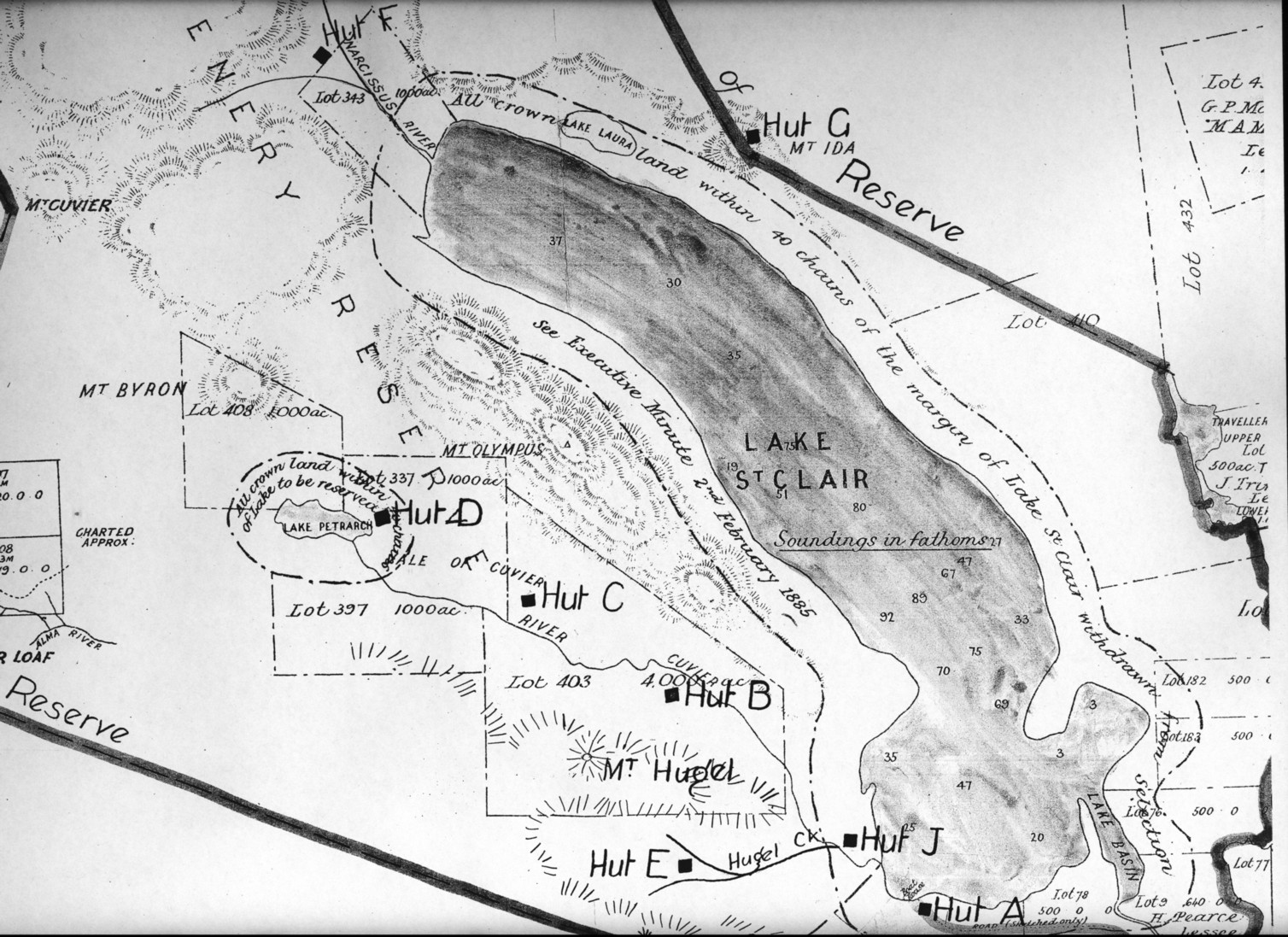
A map showing Cuvier Valley hunting huts visited during a police raid on the Lake St Clair Game Sanctuary in 1927. From AA580/1/1 (Tasmanian Archive and Heritage Office).
What was the ‘beautiful valley about 10 miles long by two in width, and bounded on each side by high ranges extending as far as the eye could reach, rising almost perpendicularly from the valley below’? Allowing for a little poetic licence, it could be the Cuvier Valley west of Mount Olympus, where hunters like Bert and Dick Nichols operated two decades later.[7]
What about the thylacine: was the carcass submitted for a government thylacine bounty? Plenty of applications were made for the bounty in the spring of the years 1901–05, but without knowing the origin of each application it is very difficult to track down ‘The Rover’ or his mates from Queenstown.[8] Given the value of the wallaby skins they obtained, carting a single thylacine carcass back to Queenstown in order to submit it for a £1 bounty may not have been a priority for them anyway.
In short, the story is plausible. I hope there are further missives from ‘The Rover’, giving more insight into the task of feeding the world’s craving for furs.
[1] See, for example, JW Beattie, ‘Out west with salmon fry’, Mercury, 18 February 1903, p.6; ‘Alluvial gold’, Mercury, 25 August 1935, p.8.
[2] See ‘Mount Arrowsmith tragedy’, Mount Lyell Standard and Strahan Gazette, 3 September 1900, p.2.
[3] ‘The Rover’, ‘A Tasmanian winter camp’, Weekly Courier, 26 May 1906, p.37.
[4] In August 1901 ‘kangaroo’ skins free from shot were fetching £0-1-6 to £0-1-8 each (‘Commercial’, Mercury, 17 August 1901, p.2); in August 1905 ‘kangaroo’ fetched from £0-1-11 to £0-2-6 (‘Commercial’, Examiner, 12 August 1905, p.4). My calculations assume that all the skins obtained were Bennett’s wallabies, when it is likely that some were pademelons. ‘The Rover’ does not specify.
[5] Editorial, Daily Telegraph, 30 July 1901, p.2; ‘To correspondents’, Zeehan and Dundas Herald, 31 July 1902, p.2; ‘Current topics’, Examiner, 31 March 1903, p.4; ‘Warning to possum poachers’, Examiner, 19 June 1903, p.6; ‘To correspondents’, Examiner, 13 April 1904, p.4; ‘Kangaroos and opossums’, Daily Telegraph, 3 May 1905, p.2.
[6] ‘The Tramp’ (Dan Griffin), ‘The mountain mystery’, Daily Telegraph, 5 August 1905, p.6.
[7] See Gerald Propsting to the Secretary for Public Works, 4 August 1927, file AA580/1/1(Tasmanian Archive and Heritage Office [afterwards TAHO]); ‘Lake St Clair Reserve: allegations of poaching’, Mercury, 26 May 1927, p.10.
[8] Government thylacine bounty payments in the years 1888—1909 are recorded in LSD247/1/2 and LSD247/1/3 (TAHO).